By
Nathan Auyeung
—
What Is a Call for Papers? How to Read and Respond to a CFP

Nathan Auyeung
Senior Accountant at EY
Graduated with a Bachelor's in Accounting, completed a Postgraduate Diploma of Accounting
You found the right conference. Then you opened the call and hit a wall of tracks, page limits, anonymity rules and five separate deadlines, none of which was the one you thought mattered.
A call for papers is a contract before it is an invitation. This guide walks the whole timeline, from the day you find the call to the day the paper lands in the proceedings.
<CTA title="Turn the call into a draft" description="Jenni helps you go from a call for papers to a structured draft, with your sources attached to every claim." buttonLabel="Try Jenni Free" link="https://app.jenni.ai/register" />
First, what a call for papers actually is
A call for papers, usually shortened to CFP, is the public announcement in which a conference states what work it wants, in what form, by when, and under what rules. It decides whether your submission is eligible before anyone reads a word of your research.
Calls come from conferences, journals running special issues, edited volumes and workshops. The conference version is the strictest, because a meeting has a fixed date and no room to slip.
Week 1: read the call like a contract
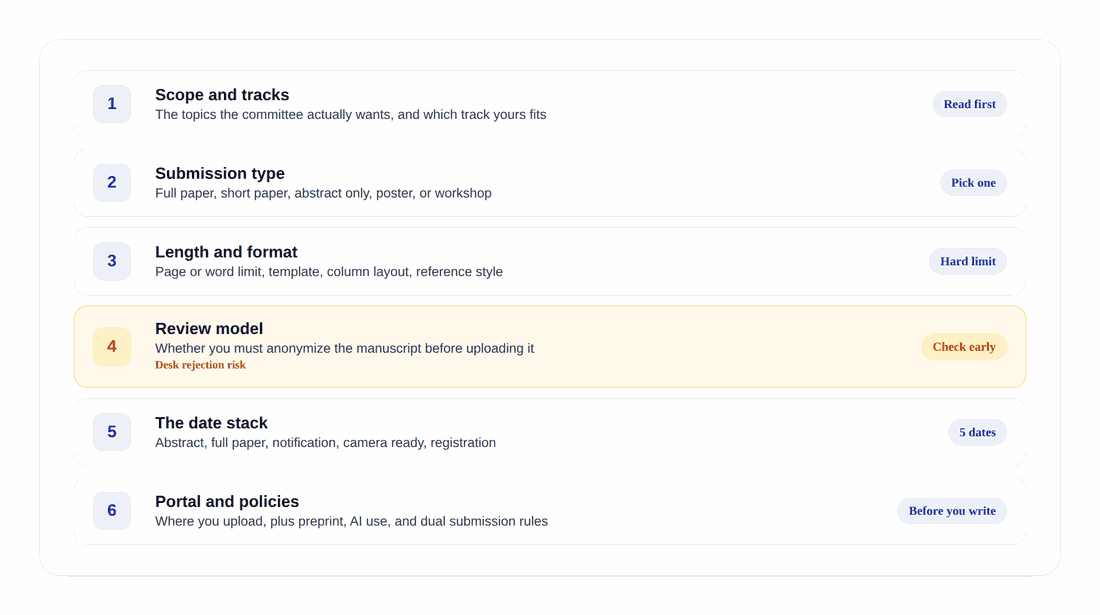
Six blocks, and most people skim straight past two of them.
The two blocks that decide eligibility
Length and review model. Everything else is negotiable in the sense that a good paper survives getting it slightly wrong. These two are not. CHI 2027 desk rejects submissions above 12,000 words unless the length is strongly justified, and desk rejects anonymization failures outright.
The block people skim
Policies. Preprints, dual submission, and increasingly AI use. ICLR 2027 now requires an AI use statement and notes it does not count toward the page limit. That is a new requirement, it is mandatory, and it is buried three quarters of the way down the author guidelines.
The rest, in one line each
Scope and tracks. Submitting to the wrong track is a real cause of rejection.
Submission type. Full paper, short paper, abstract only, poster or workshop, each with its own limit.
Template. Named, versioned, and downloaded from the venue rather than a course page.
Portal. Which system, and whether the abstract deadline gates the paper upload.
<ProTip title="📋 Before you write:" description="Copy the length limit, the template name and the review model into the top of your draft document. Three lines of admin at the start saves a rewrite at the end." />
Week 1, still: work out which deadline binds you
Usually the abstract deadline, because at many venues it gates everything after it. You register a title and summary first, and only then can you upload the paper.
Date | What it means | What happens if you miss it |
Abstract deadline | Register title, authors and summary in the portal | At many venues you cannot submit the paper at all |
Full paper deadline | Upload the manuscript and supplementary files | Submission closes, no exceptions at large venues |
Notification | Accept, reject or revise decision released | Nothing to miss, but plan the rebuttal window |
Camera ready | Final formatted version for the proceedings | Paper can be pulled from the proceedings |
Registration | At least one author pays and commits to present | Accepted work is commonly withdrawn from publication |
The gap between the two submission dates is usually about a week. ICLR 2027 set its abstract deadline at 18 September 2026 and its paper deadline at 25 September. Have the abstract genuinely finished at the first date, because it is what reviewers bid on when choosing which papers to take.

<ProTip title="🗓️ Deadline math:" description="Anywhere on Earth time is not your local midnight. It is the last midnight on the planet, which buys you extra hours in most of the world. Never rely on those hours, because portals queue under load." />
Weeks 2 to 6: write to the rules you wrote down
Two rules change what you actually type, rather than just what you expect.
If the venue is anonymized
Your manuscript must carry no identifying detail. CHI 2027 requires authors to cite their own work in the third person and states that violations, including through supplementary material or links to code repositories, will be desk rejected. ICLR is equally direct: any paper where author identity is revealed is desk rejected.
If you want to preprint
The rules have loosened. ACL Rolling Review removed its anonymity period in February 2024 and places no limitation on posting non anonymous preprints during review. CHI does not discourage it either. Check your venue rather than assuming either way.
How the two interact
Badly, in small fields. A preprint under your name plus an anonymized submission means a reviewer who searches one distinctive phrase finds you. Permitted is not the same as effective. Our guide to the two anonymized review models covers how much anonymity actually survives.
<ProTip title="🔐 Anonymity:" description="Clear the author field in your document properties and rename the file before you upload. Metadata is the most common way an anonymized submission gets unmasked, and it is invisible on the page." />
The week before: what the portal will ask for
More than the paper, and the extras are what people scramble for at the deadline.
Most venues run on OpenReview, EasyChair, Microsoft CMT or PCS. Expect to supply the title and full author list with affiliations and ordering, an abstract pasted as plain text, topic keywords from the venue taxonomy, conflict of interest declarations naming recent collaborators, the anonymized PDF within a file size cap, optional supplementary material, and a statement about AI use.
Two practical notes. Author order and affiliations are often locked after the abstract deadline. And the abstract you paste is what reviewers see when bidding, so it should be the finished version. Our guide to writing an abstract for a conference covers what that version needs, and if you are starting from nothing, drafting it against your own library beats staring at the empty field.
<ProTip title="📮 Portal tip:" description="Create the submission record on the day the portal opens, even with a placeholder file. It reserves your slot, surfaces every required field early, and turns the deadline into an upload rather than an ordeal." />
After you submit: review, rebuttal, camera ready
Reviewers bid, chairs assign, and reports come back over several weeks. Many computing venues then run an author response period with a short window and a strict character limit. It is for correcting factual errors in the reviews, not for adding results.
Camera ready is a harder deadline than it looks. Copyright forms, a compliant PDF, any over length page fees. Miss it and an accepted paper can still fall out of the conference proceedings. If the reports come back mixed, our guide on responding to peer review comments covers the reply, and a review pass before you submit catches the claims a committee will question.
The calls that are not worth the timeline
Some of what you find is advertising. Compare a suspect call against a real one and the gaps show immediately: a legitimate CFP names its program chairs, states its review model, says where proceedings will be indexed, and publishes deadlines months out.
Six signals, in rough order of how much they should worry you:
You were invited by email, flatteringly, out of nowhere. Real conferences advertise. They rarely court individual strangers.
Acceptance is promised fast. A guaranteed decision in 48 hours is not review.
No named committee. If you cannot find who the chairs are and where they work, there is no committee.
The scope is enormous. One meeting covering engineering, medicine, education and management is selling registrations.
The fee is above the fold and the review process is not.
Indexing claims you cannot check. Vague promises of Scopus coverage with no publisher named.
The test that settles most cases
Open last year proceedings. If you cannot find them, or the papers in them are unrelated to the stated scope, walk away. It takes ninety seconds and it is more reliable than any checklist.
<ProTip title="🚩 Red flag:" description="Search the conference name plus the word predatory, then search two authors from last year proceedings. If neither search returns anything recognizable in your field, treat the invitation as advertising." />
Questions that come up once the call is open
Is a call for papers the same as a call for abstracts?
No. A call for abstracts asks only for a summary, usually a few hundred words, and is common in medicine and the life sciences. A call for papers asks for the full manuscript. Some venues run both, in sequence.
Can I submit the same work to two conferences?
Almost never at the same time. Dual submission rules ban a manuscript being under review at two venues simultaneously, and breaking them is an ethics matter rather than a formatting one. Sequential submission after a rejection is normal.
Do deadlines get extended?
Sometimes, at some venues, never predictably. Extensions are announced at the discretion of the chairs, often a day or two before the original date. Plan as though there will be none.
Turn the Call Into a Submission
Read a call the way you would read a contract, because that is what it is. Scope, type, length, review model, dates, portal. Five minutes with a highlighter at the start removes almost every way a good paper gets rejected for a reason that has nothing to do with the research.
<CTA title="Go from the call to a first draft" description="Set your venue and citation style once, then let Jenni draft alongside the sources already in your library." buttonLabel="Draft My Response" link="https://jenni.ai/conference-abstract-writer" />
Once the draft exists, format is the next filter. Our guides to conference paper format and poster presentations cover what the committee sees after the call has done its filtering.