






Score your conference abstract before a reviewer does

Five AI reviews read your abstract the way a programme committee would. Every claim checked against its source.

HC

HC

HC

Loved by over 6 million academics

Score your conference abstract before a reviewer does

Five AI reviews read your abstract the way a programme committee would. Every claim checked against its source.

HC

HC

HC

Loved by over 6 million academics

Score your conference abstract before a reviewer does

Five AI reviews read your abstract the way a programme committee would. Every claim checked against its source.

HC

HC

HC

Loved by over 6 million academics

Retrieval-Augmented Tutoring: Effects on Undergra...ShareAI Chat
TextCiteAutocomplete
Prompts

Retrieval-Augmented Tutoring: Effects on Undergraduate Learning Outcomes

Submitted to LAK '26 · Track 3, Learning Analytics in Practice

Abstract

Evidence that LLM tutors improve measurable learning outcomes remains thin (Kasneci et al., 2023). Across a semester-long trial of 412 undergraduates, students assigned to a retrieval-augmented tutor gained 0.31 SD on end-of-term assessment (Zhang & Okonkwo, 2024).

Effects were strongest among students entering with below-median prior attainment, a pattern consistent with earlier work on adaptive scaffolding (Vygotsky, 1978)(Doo et al., 2020).

Gains did not transfer to a delayed retention test administered six weeks later, which we discuss as a limitation of session-bounded tutoring.

Keywords: intelligent tutoring, retrieval-augmented generation, learning analytics, higher education

1. Introduction

Large language model tutors have moved from demonstration to deployment across higher education, often ahead of the evidence base. Institutions now face procurement decisions with little comparative data on attainment, and most published trials run for a single session rather than a full term.

This study reports a semester-long randomised trial across four undergraduate cohorts, comparing a retrieval-augmented tutor grounded in course materials against an unmodified baseline model.

Weakly supported

Vygotsky (1978) is a theoretical account of the zone of proximal development and reports no attainment outcomes. Doo et al. (2020) is a meta-analysis of scaffolding effects in higher education and supports the claim as written.

Referenced source
ArticleOpen access

A Meta-Analysis of Scaffolding Effects in Online Learning in Higher Education

Doo, Bonk & Heo

International Review of Research in Open and Distributed Learning · 2020

The significance of scaffolding in education has received considerable attention. Many studies have examined the effects of scaffolding with diverse… See more

Open quoteReject
Accept
Review
Claim confidence

Checks your writing, finds missing or weak citations, and adds references to help you avoid academic plagiarism

Run review
Peer Review

Simulate an expert academic peer review of your document.

Run review
Source Quality

Check your citations for retractions, preprints, and other quality issues.

Run review
Tone of Voice

Match your document's tone to a preset style or a paper from your library.

Run review
Proofread

Identify grammar, punctuation, word choice, and other writing issues in your document.

Run review
Thinking for 0 seconds1/3 sections
Searched academic databases
adaptive scaffolding attainment gap undergraduates 2015..2025
zone of proximal development empirical attainment studies
For best results, stay on this tab while review runs
Thought for 22 seconds
Results

One citation was flagged as weakly supported. A foundational theory reference was standing in for empirical evidence, and a meta-analysis on scaffolding outcomes was suggested in its place.

Review Changes
Detailed breakdown
All suggestions1
Misrepresented
Contradicted
Unsupported
Weakly supported1
Overstated
Unverifiable
All suggestions resolved!

You've successfully resolved all Claim confidence suggestions in your document

Last ran just now
Re-scan
Try next
Peer Review

Simulate an expert academic peer review of your document.

Run review
Not now

Trusted by researchers at universities and labs worldwide

Trusted by researchers at universities and labs worldwide

Trusted by researchers at universities and labs worldwide

Claim Confidence

A programme committee reads your abstract looking for the claim your sources do not support. Claim Confidence finds it first, and shows you the passage that settles it.

Claim confidence

The claim confidence analysis addressed issues of redundant, weak, or missing citations, alongside instances of contradiction in citation arguments.

Misrepresented

Contradicted

3

Unsupported

4

Weakly Supported

2

Overstated

Unverifiable

Six verdicts, not a score

Every claim checked against the full text of the source it cites, with a category and a reason you can judge for yourself.

Try it free

Reads the full source

Not the abstract, not the metadata. Jenni opens the paper you cited and checks what it actually says.

Clear categorisation

Every flag comes back with a category and an explanation, so you know whether to hedge the claim or drop it.

Avoid desk rejection

Unsupported and overstated claims are among the most common reasons abstracts get rejected. Catch them before you submit.

For me Jenni is like a research assistant who is always there. No waiting for feedback anymore, but direct support at any point in the writing process. This takes away a big burden on my supervisors, who are therefore super happy with Jenni as well!

Michelle, PhD Transport Planning

Proofread

Every conference rubric scores clarity separately from science. Proofread catches the dense sentence a reviewer would flag as hard to follow.

Compression makes prose worse

Cutting an abstract to a word limit is where the writing gets dense. Proofread finds the places where tightening cost you clarity.

Try it free

Proofread

Whilst generally sound. The text contains some areas for improvement to comply with academic best practices.

Word Choice

6 pending changes
AllThe majority of participants reported improved outcomes.

Formality

6 pending changes
Yang (2024) found a negative correlationwhich was interesting..

Grammar

8 pending changes
These results indicate that early intervention appears to be effective.

Transitions

4 pending changes
Also,In addition, Jones (2022) found similar results.

Overgeneralized

6 pending changes
AllThe majority of participants reported improved outcomes.

The results provesuggest that X has an effect on Y.

Results in seconds

Your abstract is scanned and actionable results appear straight away.

Built for academia

Categories capture the conventions of scholarly prose, not generic grammar-checker noise.

Accept on your terms

Take individual suggestions, whole categories, or all of them. The voice stays yours.

As a non-native English speaker I spend a lot of time ensuring my writing matches scientific standards. Proofread removes that stress completely.

Matheus, HCI Postdoc

Source Quality

Committees notice a reference list built on preprints. Source Quality checks every citation for the signals a reviewer would flag, then helps you fix each one.

Source Quality

8 Preprints, 1 Supporting Document and 2 Rarely Cited found.

Bibliography notes

2006

2026

Mixed source ages. Median year 2021; 3 of 10 dated works over a decade old.

Retracted

Preprint

8

Supporting Document

1

Rarely Cited

2

Unverified Journal

Unverifiable

Swap a preprint for the published version

One action replaces a preprint with its peer-reviewed version, finds a replacement, or keeps it if the choice was deliberate.

Try it free

Catch retractions

A retracted source in your reference list is the fastest way to lose a reviewer's trust.

See your venue spread

Publication-age distribution and the venues you lean on. Avoid a reference list that looks narrow or dated to a programme committee.

Flag unverifiable sources

If a citation cannot be located or its venue cannot be verified, you find out before a reviewer does.

Jenni's built specifically for academic writing. It treats sources, citations, and evidence as the main point, not as an afterthought.

Dr. Sabine Hossenfelder

built for conference submissions

built for conference submissions

Defensible before you submit

A programme committee reads your abstract looking for the weak claim, the thin reference list, and the sentence that does not parse. Jenni finds all three first.

Every claim traced to its source

Claim Confidence reads the full text of every source you cite and flags what a reviewer would question: unsupported, overstated, contradicted or misrepresented.

Your bibliography audited

Source Quality flags retracted work, preprints that have since been published, rarely cited sources and unverified journals, then helps you swap them.

Clear academic English

Proofread and Tone of Voice catch the dense sentence a committee would flag as hard to follow. Especially useful if English is not your first language.

See each review in action

Short walkthroughs of Claim Confidence, Source Quality and Peer Review.

Claim Confidence: strengthen your arguments
Source Quality: scan for weak and invalid citations
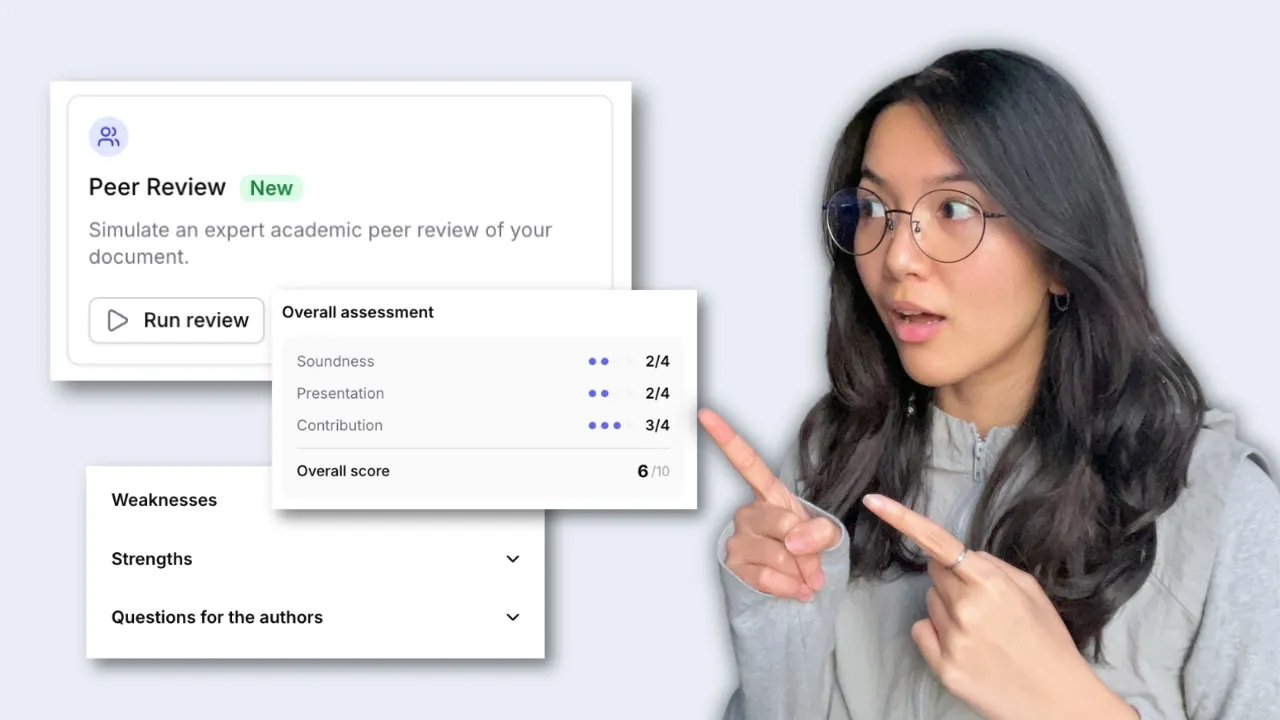
Peer Review: how AI peer review works

Frequently asked questions

Frequently asked questions

What does a Jenni review actually check?

Will Jenni rewrite my abstract for me?

Can Jenni tell me if my abstract will be accepted?

Does Jenni check my abstract against the conference's submission rules?

Can Jenni check whether my citations are real?

Can I review an abstract I wrote in Word or Google Docs?

Will the committee know I used AI?

Does Jenni store or share my unpublished abstract?

Is it free to review an abstract?

Can Jenni review my conference abstract before I submit it?

What does a Jenni review actually check?

Will Jenni rewrite my abstract for me?

Can Jenni tell me if my abstract will be accepted?

Does Jenni check my abstract against the conference's submission rules?

Can Jenni check whether my citations are real?

Can I review an abstract I wrote in Word or Google Docs?

Will the committee know I used AI?

Does Jenni store or share my unpublished abstract?

Is it free to review an abstract?

Can Jenni review my conference abstract before I submit it?

What does a Jenni review actually check?

Will Jenni rewrite my abstract for me?

Can Jenni tell me if my abstract will be accepted?

Does Jenni check my abstract against the conference's submission rules?

Can Jenni check whether my citations are real?

Can I review an abstract I wrote in Word or Google Docs?

Will the committee know I used AI?

Does Jenni store or share my unpublished abstract?

Is it free to review an abstract?

Can Jenni review my conference abstract before I submit it?

Improve the quality of your research, today

Submit your next abstract knowing what a reviewer will see

Start for free

No credit card required

Cancel anytime

Over 6m

Academics worldwide

5.2 hours saved

On average per paper

Over 15m

Papers written on Jenni

Improve the quality of your research, today

Submit your next abstract knowing what a reviewer will see

Start for free

No credit card required

Cancel anytime

Over 6m

Academics worldwide

5.2 hours saved

On average per paper

Over 15m

Papers written on Jenni

Improve the quality of your research, today

Submit your next abstract knowing what a reviewer will see

Start for free

No credit card required

Cancel anytime

Over 6m

Academics worldwide

5.2 hours saved

On average per paper

Over 15m

Papers written on Jenni