By
Nathan Auyeung
—
Conference Paper Format: Structure, Sections, and Template

Nathan Auyeung
Senior Accountant at EY
Graduated with a Bachelor's in Accounting, completed a Postgraduate Diploma of Accounting

Almost every conference paper that dies before review dies the same five ways. None of them is about the science, and all five are fixable in an afternoon.
This guide works through each failure in turn, with the real page limits and anonymization rules from five named venues, then builds the paper so none of them can happen.
<CTA title="Start with the structure already in place" description="Set your venue style once and let Jenni draft into a clean IMRaD skeleton with citations formatted from the first line." buttonLabel="Try Jenni Free" link="https://app.jenni.ai/register" />
Conference paper or journal article, and why the difference bites
A conference paper is a full manuscript submitted to a specific meeting, reviewed against a fixed deadline, and published in that meeting's proceedings. Everything below follows from that fixed deadline.
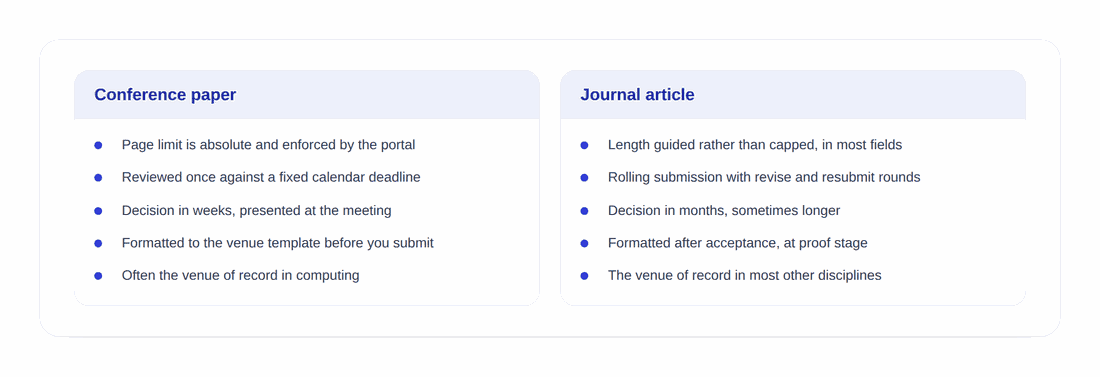
Length is capped and enforced by the upload portal. There is one review round, not a revise and resubmit cycle. You format to the template before submission rather than at proof stage. And in computing, the top conferences are the venue of record rather than a stepping stone.
Failure 1. The paper that was one page over
Portals measure the PDF, not your word processor, and at large venues the rejection is automatic.
Venue | Limit | What is excluded |
ICLR 2027 | 9 pages main text, 10 at camera ready | References and appendices, both unlimited |
NeurIPS 2026 | 9 content pages, plus one at camera ready | References, appendices, checklist |
ACL Rolling Review | 8 pages long, 4 short | References and the limitations section |
EMNLP 2026 | 8 long, 4 short, plus one at camera ready | References |
ICASSP 2027 | 4 pages, plus an optional fifth | Fifth page may hold references only |
CHI 2027 | 5,000 to 8,000 words encouraged | References, captions, appendices |
ICLR 2027 states that references do not count and that you may use as many appendix pages as you wish, though reviewers are not required to read them. CHI 2027 works in words and desk rejects above 12,000 when the length is not justified.
<ProTip title="📐 Page count:" description="Check whether references count before you start cutting. On a nine page limit with unlimited references, moving a table into an appendix can buy you half a page of argument at no cost." />
Failure 2. The name left in the metadata
The most common and the least forgivable, because it takes thirty seconds to prevent.

CHI 2027 desk rejects papers that violate the anonymization policy, including through supplementary material or external links to datasets and code repositories, and states that using references marked "anonymous" is itself grounds for rejection. CHI also requires you to cite your own work in the third person.
Where it actually hides
Six places to check
Document properties. The PDF filename. A GitHub or lab page link in a footnote. An acknowledgments line you meant to delete. A figure exported from software that stamps the account name. A data availability statement naming your institution.
The thirty second check
Open your own submission PDF and search it for your surname, your institution and your lab name. Then open the document properties and clear the author field. Then rename the file to something neutral. That is the whole procedure, and it catches almost every case.
Does a preprint break anonymity?
It undercuts it, though the rules on whether you may preprint have loosened. ACL Rolling Review removed its anonymity period in February 2024, and CHI does not discourage non archival publication before or during review. Permitted is not the same as effective: a reviewer who searches one distinctive phrase from your methods will find the preprint with your name on it.
<ProTip title="🗂️ Version control:" description="Keep the submission PDF and the identified version as two separate files with obviously different names. Uploading the wrong one is a desk rejection that no appeal recovers." />
Do references count toward the page limit?
At the major machine learning and computational linguistics venues, no. ICLR, NeurIPS and ACL all exclude them, and ACL also excludes the limitations section it requires. Elsewhere, often yes.
It changes how much argument you can afford, so it is worth checking before you write rather than while you cut. The same question applies to appendices: ICLR allows unlimited ones, ICASSP allows a single extra page that may hold references only.
Failure 3. The template from last year
Style files change between cycles, and an old one produces a paper that looks almost right and fails the compliance check.
Download fresh, from the venue, for the year you are submitting. For IEEE conferences use the IEEE Author Center templates rather than a copy on a course page. For ACM venues the acmart template covers the sigconf layout. Machine learning venues distribute their own style pack alongside the call.
The layout follows from the template, so you do not set it yourself. Two columns, citation format, heading levels and figure captioning are all built in. Changed margins, shrunk fonts and adjusted line spacing to fit are detectable, and they are checked.
<ProTip title="🧩 Template:" description="Download the template fresh even if you have last year copy on disk. Ten seconds of downloading beats discovering in March that the class file changed in November." />
Failure 4. The PDF that would not pass the checker
Fonts must be embedded. Some venues run more than a format check: ICASSP 2027 puts every submission through a plagiarism and self plagiarism check with iThenticate before review, and assigns at least three reviewers per paper.
Generate the final PDF from the template rather than exporting from a preview tool, then open it on a machine that does not have your fonts installed. If it renders, it will pass.
Failure 5. The conference paper reused too thinly
Extending into a journal is normal and expected. Doing it without enough new material is not.
IEEE Transactions on Learning Technologies describes the general IEEE rule requiring at least 30% of new content for a journal paper that expands a published conference paper, and notes expanded papers typically add around 50%.
The percentage matters less than the principle. Adding proofs and extra experiments to the same contribution is an extension. Broadening what the work claims is a new paper. Disclose the earlier publication with its DOI in a first page footnote either way, because journals run overlap checks and finding out that way is much worse than telling them.
<ProTip title="🔁 Reuse rule:" description="Keep a note of which figures and sections came from the conference version while you write. Reconstructing that months later under a journal deadline is far harder than logging it as you go." />
Building the paper so none of these can happen

Most of the five failures come from doing the formatting last. Doing the skeleton first removes four of them.
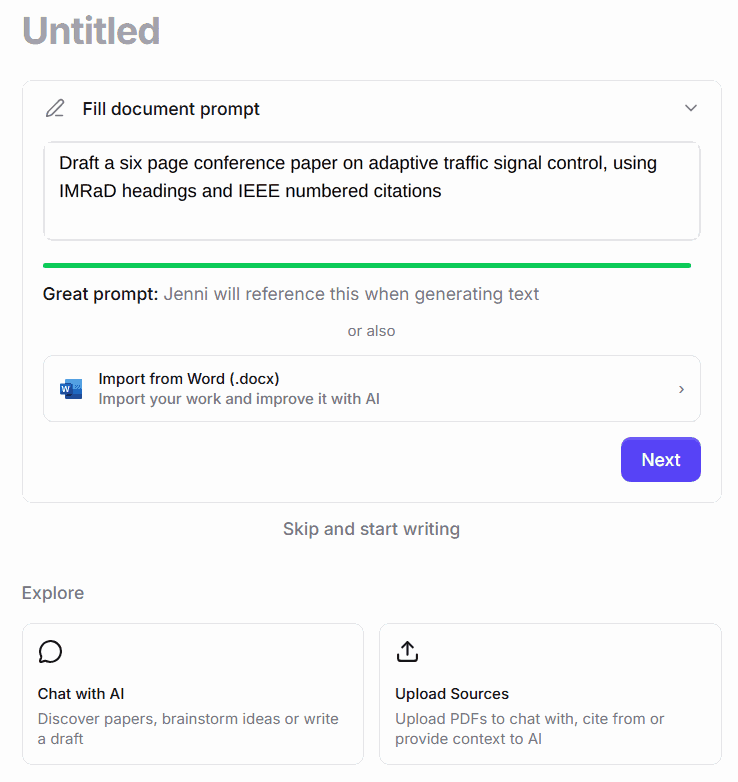
Name the paper and the venue in the prompt. Say which structure and citation format you need, so the draft starts in the right shape.
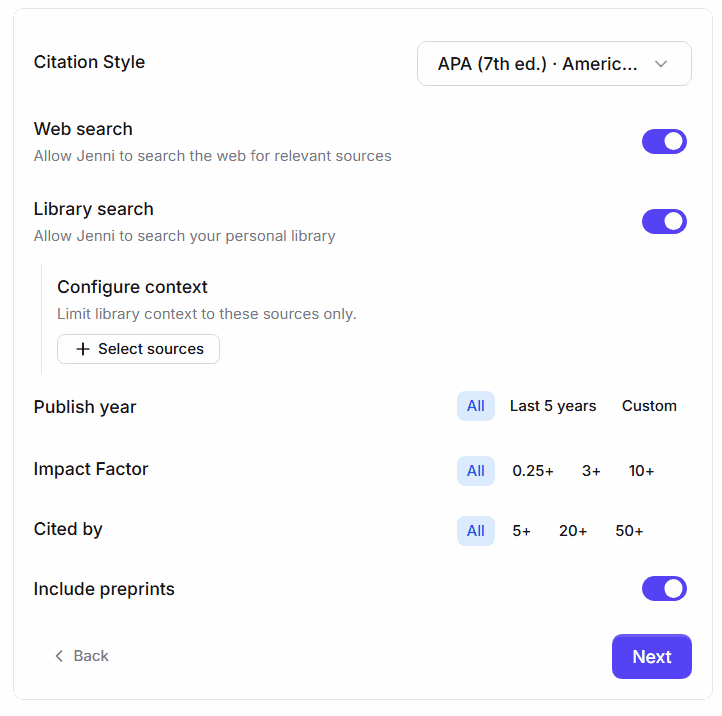
Set the citation style to match the venue. IEEE numbered citations, ACM reference format, or whatever the call specifies.
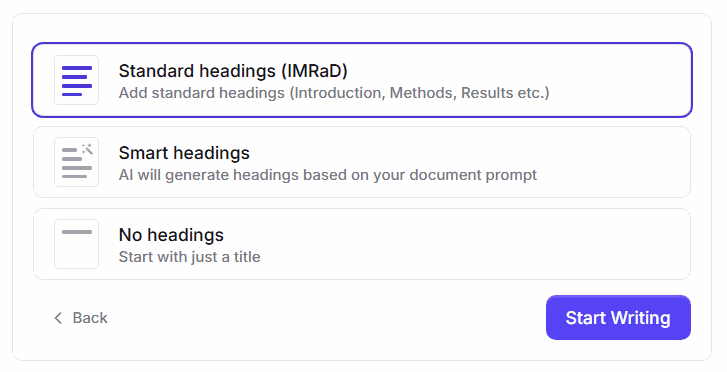
Generate standard IMRaD headings. Every required section exists before you write a sentence into any of them, including the limitations section ACL now requires.
Then fill methods and results first, since those constrain everything else, and write the introduction against what you actually found. Export to Word or LaTeX and drop the text into the venue template for final layout. Before you submit, a review pass over the draft catches the claims a committee will push back on.
If you have two hours left
Do these three, in this order, and skip everything else.
Search the PDF for your name, institution and lab. Then clear the document properties and rename the file.
Check the page count against the limit, and check whether references count. Move a table to the appendix if you are over.
Open the PDF fresh and confirm the fonts render. If the template is the current one and the fonts embed, you will pass the checker.
Everything else, including the prose, can be imperfect. These three cannot.
Get the Format Right Before the Science Is Judged
Formatting is the cheapest filter a conference has, which is exactly why it is applied first. Page limit, template, anonymity, compliant PDF. None of them requires you to be clever, and all four have to pass before a reviewer forms an opinion about your contribution.
<CTA title="Draft straight into the right structure" description="Pick the venue style once and let Jenni handle the skeleton and the citations while you write the science." buttonLabel="Structure My Paper" link="https://jenni.ai/conference-abstract-writer" />
The call sets all of these rules, so it is worth rereading before you submit. Our guides to reading a call for papers, writing the abstract and the two anonymized review models cover the parts that decide what your PDF has to look like.