By
Justin Wong
—
How to Write an Abstract for a Conference (With Examples)

Justin Wong
Head of Growth
Graduated with a Bachelor's in Global Business & Digital Arts, Minor in Entrepreneurship

Your abstract is the smallest thing you will submit and the only thing most reviewers read before voting. At a competitive venue it is one of several thousand chasing a fixed number of rooms.
Six steps, in order, with the real limits from nine named conferences built into step one. Work through them and you will have a finished abstract that fits the count.
<CTA title="Draft the abstract with your sources attached" description="Jenni drafts alongside the papers already in your library, so every claim traces back to something real." buttonLabel="Try Jenni Free" link="https://app.jenni.ai/register" />
What you are actually competing against
Not other abstracts on quality. Other abstracts on legibility, in a batch of forty, read on a screen by someone who agreed to review in a lighter month than this one turned out to be.

The abstract is judged alone, with no paper attached. For the reviewers doing the first pass, it is your submission.
Step 1. How long should a conference abstract be?
There is no general answer. Nine real limits, from current submission guidelines:
Venue | Limit | Structure |
CHI 2027 | 150 words or fewer | No required headings |
IEEE | Up to 250 words, one paragraph | Self contained, no references |
APA Convention posters | 250 to 300 words | No title or names inside the abstract |
American Academy of Neurology | 300 words, body only | Five headings required |
American Thoracic Society | 400 words | Headings recommended |
American Heart Association | 2,500 characters | Headings recommended |
ASCO | 2,600 characters excluding spaces | Count includes title and table |
AACR | 3,100 characters including spaces | No figures or tables |
American Society of Hematology | 4,500 characters including spaces | Structured or unstructured |
CHI 2027 allows 150 words. ASH allows 4,500 characters, roughly four times the writing. And character counts are not interchangeable: ASCO excludes spaces but includes your title, while AACR includes spaces and bans tables.
<ProTip title="📏 Count it properly:" description="Paste your draft into the submission portal early, even unfinished. Portal counters apply the venue rule about spaces, titles and tables, and they are the only count that decides." />
Step 2. Check whether headings are required or merely suggested
Read the verb. This is where a good abstract fails on a technicality.
Required
The American Academy of Neurology states that it requires all authors to organize the abstract body under five headings: OBJECTIVE, BACKGROUND, DESIGN/METHODS, RESULTS and CONCLUSIONS. Case reports are the only exception.
Recommended
The American Heart Association says it recommends identifiable sections and lists them. The American Thoracic Society recommends rationale, methods, results and conclusions. ASH leaves it entirely to you.
Where headings are named, use those exact words in that exact order, in capitals if the guidelines show capitals. Reviewers scan for them, and a renamed heading reads as a submission that did not read the rules.
Step 3. Write the finding sentence, and write it first
Not the background. The finding. Everything else gets built around it rather than toward it.
The difference is easiest to see side by side:
Opening on the field | Opening on the finding |
"Student retention is a growing concern in higher education, and many institutions have explored interventions." | "Weekly low stakes quizzing raised course completion by 6.6 percentage points across 14 sections of an introductory course." |
Could open any abstract in the field | Could only open yours |
<ProTip title="📊 Lead with:" description="If your first sentence would still be true had your study failed, it is background. It belongs later, or nowhere." />
Step 4. Add the design, the sample and the significance
Three more sentences, in this order, because that is the order a reviewer needs them.
Design and sample
Design. What kind of study, in one clause. Randomized, retrospective, qualitative, simulation.
Sample and setting. How many, of what, where, over what period.
Precision. The interval around your effect, not just the effect.
The significance sentence
This is the line most abstracts skip and most committees weight, because a chair is choosing sessions rather than papers. It answers one question: what does the room get?
"Attendees will leave with the quiz schedule, the analysis code, and the two implementation problems that cost us a full section."
Compare that with "implications for teaching practice will be discussed," which promises the same thing and commits to nothing.
What if your results are not ready?
Report what you have and name what is still running. Committees accept work in progress, because most abstracts are submitted months before the meeting. What they do not accept is an abstract with no findings where findings were expected.
"Analysis of clinic level staffing predictors is under way and will be presented" is fine. "Results will be discussed" is not, because it tells a reviewer nothing about whether there is anything to discuss.
Step 5. Cut to the number
In this order. The first three usually get you there.
Trim background before you trim results. Background is the only part nobody came for.
Delete every sentence that would fit in any abstract in your field.
Turn method descriptions into noun phrases. "We conducted a trial in which participants were assigned" becomes "In a trial, participants were assigned."
Keep the numbers, cut the adjectives.
Read the first and last sentences together. If they say the same thing, delete one.
<ProTip title="✂️ Cut this first:" description="Growing concern, considerable attention and increasingly important are filler a committee has read four hundred times this week. They are always the cheapest words to lose." />
Step 6. Check it against the paper before you paste it

Every number in the abstract should appear, unchanged, in the full text. That sounds obvious and it is measurably not what happens: a review in BMC Medical Research Methodology found a median inconsistency rate of 39% between abstracts and full texts.
The wording matters as much as the figures. In a randomized trial in the Journal of Clinical Oncology, 300 clinicians read a cancer trial abstract either with spin or with the spin removed, and readers of the spun version rated the treatment as more beneficial by 0.71 points on a 10 point scale. Same data.
What a finished one looks like
The study below is invented for this guide as a formatting model. The numbers are illustrative and should not be cited.
218 words, AAN heading structure
Objective To test whether weekly low stakes quizzing improves course completion in large introductory lectures. Background Retrieval practice improves retention in laboratory settings, but evidence from full semester courses at scale is limited. Design/Methods Cluster randomized trial across 14 sections of an introductory biology course at one public university, spring to fall 2025. Sections were assigned to weekly online quizzing or to the existing syllabus. The primary outcome was course completion. Results Of 2,180 enrolled students, 1,094 were in quizzing sections. Completion was 88.2% in quizzing sections and 81.6% in control sections, a difference of 6.6 percentage points (95% CI 3.4 to 9.8). Final examination scores differed by 2.1 points on a 100 point scale (95% CI 0.4 to 3.8). Self reported study time did not differ. Conclusions Weekly quizzing improved completion without increasing reported study time. The effect on examination performance was small and should not be the main justification for adopting it. Attendees will leave with the quiz schedule, the analysis code, and the two implementation problems that cost us a full section.
Three things make it work. The result carries an interval rather than a direction. The conclusion refuses to oversell the exam finding. And the last sentence tells the committee what the room gets.

How to draft it with Jenni
Set the brief in the prompt. Name the topic, the length and the sections the call asks for.
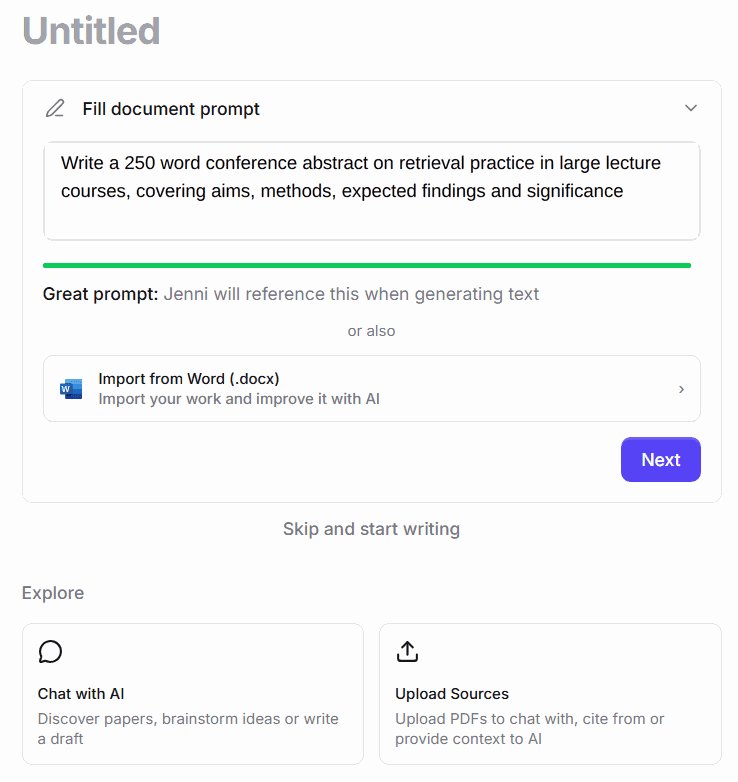
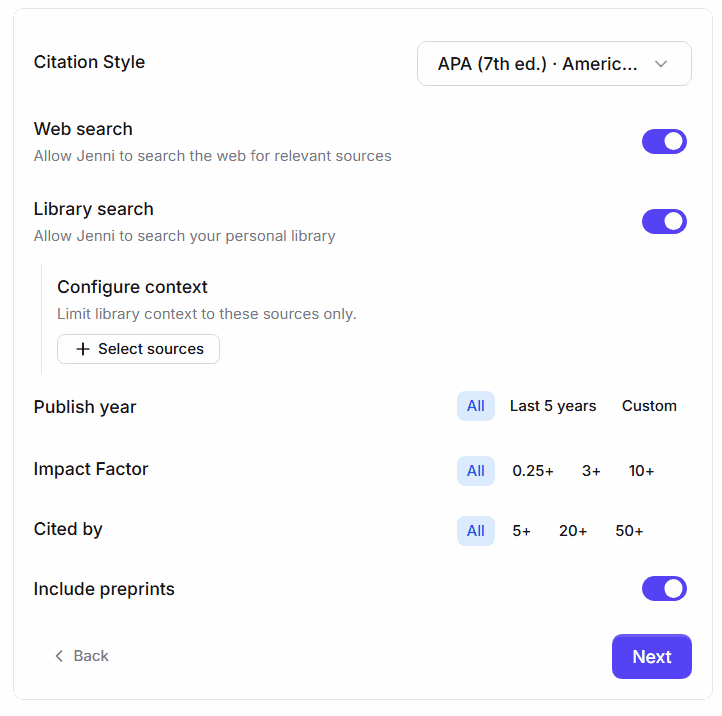
Point it at your own sources. Turn on library search so the draft draws from papers you have already read, and pick the venue's citation style.
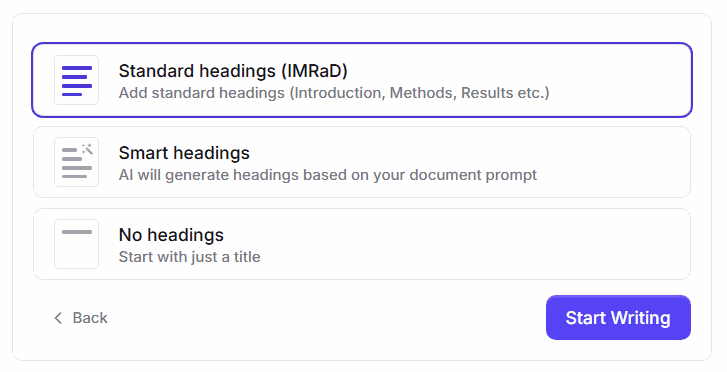
Choose the structure. Standard IMRaD headings, or headings generated from your prompt if the call uses its own names.
Then draft the finding sentence first, tighten with the editing commands until you are under the count, and run a Claim Confidence review to catch sentences stating more than your data supports. If the abstract already exists, running it through the review pass is the faster route.
Before you hit submit
Six checks, none longer than a minute.
The count is inside the limit in the portal, not in your editor.
The headings match the call word for word, if it names any.
A number with an interval appears in the results sentence.
The last sentence says what attendees gain.
Every figure matches the paper.
No citations, unless the venue explicitly allows them.
<ProTip title="🔤 Headings:" description="Paste the required headings into your draft as empty labels before you write anything. Filling gaps is faster than restructuring prose, and you cannot forget one." />
Give the Committee a Reason to Say Yes
A conference abstract has one job: convince a tired reviewer, on their fortieth submission of the evening, that a room full of people would be better off hearing this. That takes a finding, a number, and a sentence about what attendees leave with. Everything else competes for space with those three.
<CTA title="Write it against your own sources" description="Draft, tighten and check your abstract in Jenni, with the papers you have already read sitting alongside the document." buttonLabel="Write My Abstract" link="https://jenni.ai/conference-abstract-writer" />
The rest of the submission is waiting. Our guides to reading a call for papers, conference paper format, poster presentations and abstract word counts by type cover what comes next.