By
Nathan Auyeung
—
Single Blind vs Double Blind Review: How Each Works

Nathan Auyeung
Senior Accountant at EY
Graduated with a Bachelor's in Accounting, completed a Postgraduate Diploma of Accounting
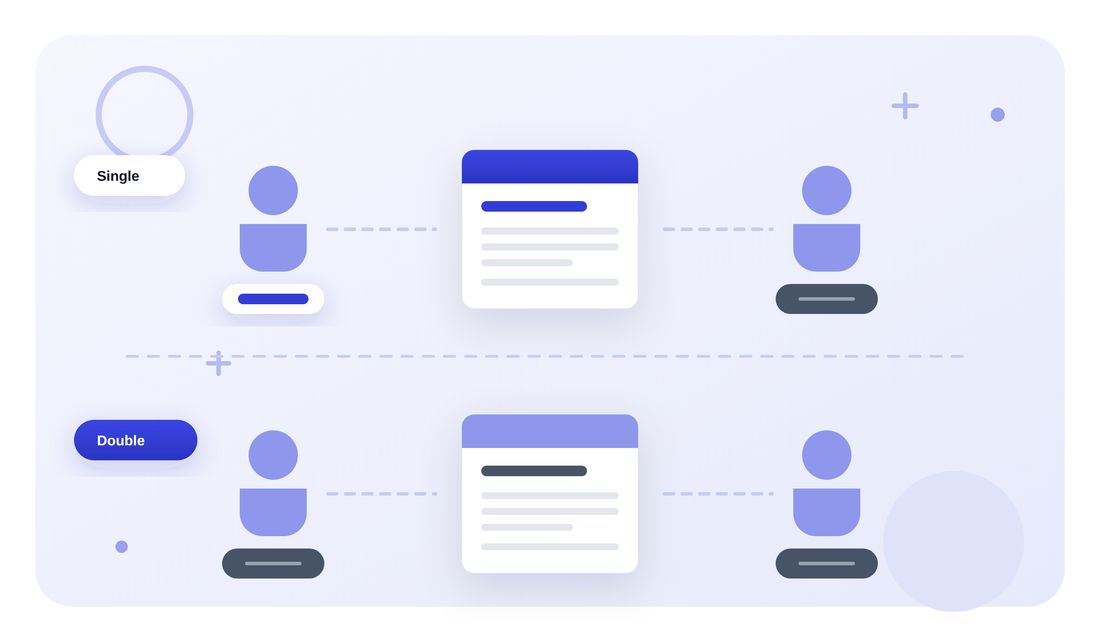
Submit to ICASSP and the reviewers will know your name, your institution and who funded the work. Submit to ICLR and they will know none of it, and revealing yourself by accident gets the paper desk rejected.
This guide builds toward one thing: four questions that tell you which model to pick when a venue lets you choose. Everything before them is the evidence those questions rest on.
<CTA title="Read your paper the way a reviewer will" description="Run a Peer Review pass before you submit and find the objections while you can still answer them." buttonLabel="Try Jenni Free" link="https://app.jenni.ai/register" />
The difference in one line
In single blind review the reviewers know who you are and you do not know who they are. In double blind review neither side knows the other. Reviewers stay anonymous to the author in both. The variable is whether the author is anonymous to the reviewers.
Which venues use which
Venue or publisher | Model | What it means for you |
ICLR 2027 | Double blind | Desk rejection if identity is revealed anywhere, including the supplement |
NeurIPS 2026 | Double blind | All submissions anonymized, violations desk rejected |
CHI 2027 | Anonymized | Self citations in third person, no references marked anonymous |
ICASSP 2027 | Single anonymous | No anonymization needed, at least three reviewers per paper |
IEEE (most publications) | Single anonymous | The default across the majority of IEEE venues |
ACM (most journals) | Single anonymous | Stated for most ACM journals and transactions |
Elsevier | Single anonymized | Described as the traditional method and most common by far |
Taylor & Francis | Varies by field | Single in science and medicine, double common in humanities |
Nature Portfolio | Single by default | Double available on request, and you do the anonymizing |
ICASSP 2027 states that papers undergo single anonymous review. ICLR 2027 takes the opposite position and desk rejects any paper where author identity appears in the main text or supplement.
Why the vocabulary changed under you
The current terms are single anonymized, double anonymized and triple anonymized, from a peer review taxonomy working group convened by the STM Association in 2020, documented in Science Editor. A Royal Society of Chemistry editorial states the reasoning: the group decided "blind" in this context is easy to misinterpret and is ableist in origin. Sage dated its change to 24 September 2021.
<ProTip title="🔤 Terminology:" description="Search the venue site for anonymized as well as blind. Many publishers renamed the models but left older pages in place, so searching one term can make you think a policy does not exist." />
What the evidence actually shows
Three studies matter, and they do not all point the same way.
The controlled experiment
At the 2017 Web Search and Data Mining conference, every submission was scored by two single blind and two double blind reviewers at the same time. The published analysis in PNAS concluded that single blind reviewing confers a significant advantage to papers with famous authors and authors from high prestige institutions. The authors' own account gives odds multipliers of 1.63 for famous authors, 1.58 for top universities and 2.10 for top companies. Google's write up adds that single blind reviewers bid for about 22% fewer papers and bid preferentially for top institutions.
The one that complicates it
Rebecca Blank's randomized experiment at the American Economic Review found acceptance rates lower and referees more critical when the reviewer did not know the author, no significant difference between female and male authors, and authors at top ranked and low ranked institutions largely unaffected. Those who lost out were at near top ranked universities and nonacademic institutions.
The one that was refuted
Budden and colleagues reported in 2008 that female first authorship rose after Behavioral Ecology adopted double blind review. A critique in the same journal argued the increase tracked a general rise across biology journals, and a 2025 systematic review in Scientometrics treats the critique as having refuted it. It is still widely cited as settled. It is not.
How often anonymization fails anyway
The same 2025 systematic review found four studies measuring blinding failure, ranging from 21% to 65% with a mean of 44.4%. The reason is rarely a sloppy title page: reviewers recognize the dataset, the study site, the instrument or the argument. In a small subfield the topic is the byline.
That does not make the model pointless, since the WSDM experiment measured a real effect despite imperfect anonymization. It means the model reduces prestige signals rather than removing them.
<ProTip title="🕵️ Anonymity:" description="Search a distinctive phrase from your own methods section before you submit. If a preprint, a conference abstract or a lab page comes back on the first page, your anonymity is thinner than the title page suggests." />
Anonymizing a manuscript
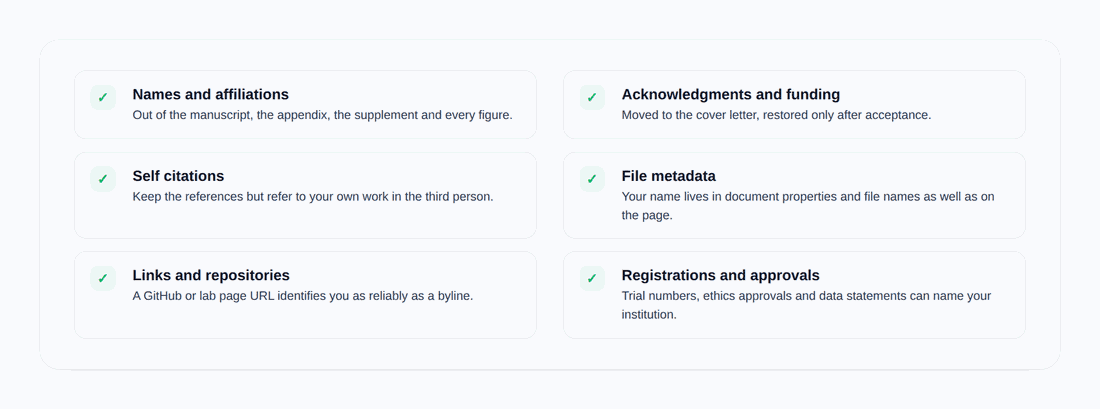
The five obvious ones
Names and affiliations, out of the manuscript, appendix, supplement and every figure. IEEE Robotics and Automation Society asks for lab names and logos removed from figures and videos too.
Acknowledgments and funding, moved to the cover letter. Cambridge University Press asks for ethical approvals and registration details to go as well.
Self citations, kept but written in the third person. Elsevier suggests "[Anonymous, 2007]"; Nature Portfolio asks you to change "as we have shown before" to "as has been shown before".
Links and repositories. A GitHub URL identifies you as reliably as a byline.
Registrations and approvals, which frequently name the institution.
The one everyone forgets
File metadata. Your name sits in document properties and often in the filename. Sage states plainly that file metadata and comments must be anonymized. IEEE RAS states that violations can result in the paper being desk rejected.
<ProTip title="🧾 File check:" description="Open the document properties, clear the author field, then rename the file to something neutral. Two minutes removes the single most common way an anonymized submission gets unmasked." />
The decision: four questions
Most authors never make this choice. Across 128,454 manuscripts submitted to 25 Nature branded journals over two years, uptake for double blind was 12%, with corresponding authors from less prestigious institutions more likely to opt in. Work through these in order.
Would your affiliation help or hurt the first impression? At a mid ranked or nonacademic institution, the controlled evidence says anonymity helps. If your group is the recognized authority on the method, it may not.
Is your work identifiable anyway? A distinctive dataset, a named cohort or a circulating preprint means anonymity is nominal. Weigh the effort accordingly.
Does the paper depend on an established program of work? If reviewers need to know it continues a published line, anonymizing removes context that helps you.
Can you actually anonymize it well? A half anonymized submission is worse than an honest single blind one, because at some venues it is a desk rejection rather than a disadvantage.
The one that overrides the others
Question four. If the answer is no, stop. Every advantage measured in the WSDM experiment assumes the anonymization held.
<ProTip title="🎲 Odds:" description="If you work at a mid ranked institution, the WSDM and AER results point the same way. Double anonymized review is more likely to help you than hurt you, and the effect is larger than most authors assume." />
The other two models
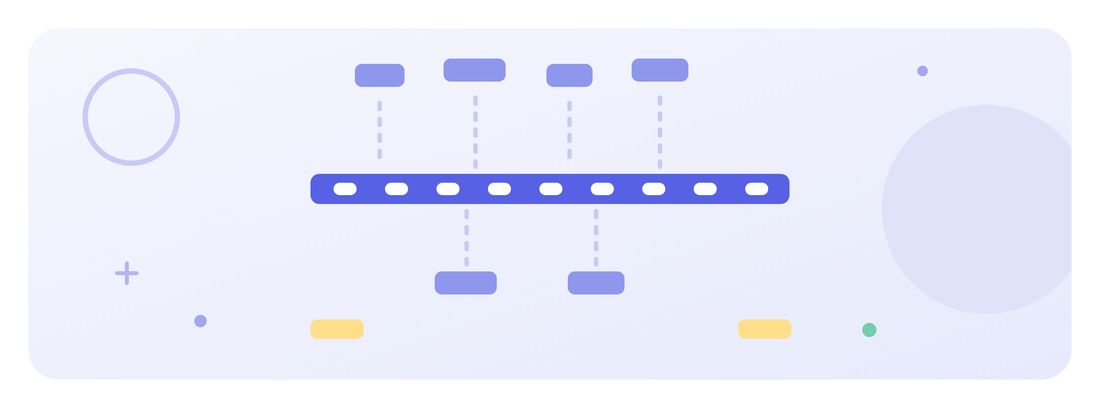
Triple anonymized adds the editor, so neither identity reaches the decision maker. Elsevier and Sage both offer it.
Open and transparent review go the other way. eLife publishes a public review from each reviewer. BMJ Open publishes previous manuscript versions with comments and replies. F1000Research reviews after publication and gives each report a DOI. PeerJ makes all reviews of published articles public. Our guide to the types of peer review maps them all.
Questions that come up at submission
Does preprinting break double anonymized review?
It undercuts it, though whether you may preprint is a separate question and increasingly the answer is yes. ACL Rolling Review removed its anonymity period in February 2024, and CHI does not discourage non archival publication before or during review.
Which model is fairer?
The controlled evidence favors double anonymized for reducing prestige effects, and the failure rate data shows it is imperfect. Single anonymized keeps context that helps reviewers spot conflicts. Most publishers now offer both because neither dominates on every dimension.
What is the difference between open and transparent review?
Open means participants know each other's identities. Transparent means the reports and decision letters are published alongside the article, whether or not reviewers are named.
Know Which Room You Are Submitting Into
Before you upload anything, find the venue's peer review policy and read one sentence: which model it uses. That answers whether you need an hour of anonymization work, whether your affiliation is part of the judgment, and how much to read into a decision that comes back fast.
<CTA title="Catch the objections first" description="Use the Peer Review and Source Quality checks to pressure test your draft before an editor sends it out." buttonLabel="Check It Before Review" link="https://jenni.ai/cfp-review" />
Reviewers flag overstatement more often than anything else, so our guide to the discussion section of a research paper is worth reading before you submit. Our guides to responding to peer review comments, reading a call for papers and writing the abstract cover the rest, and drafting against your own library makes the self citation problem easier to manage.