By
Justin Wong
—
Discussion Section of a Research Paper: Structure and Examples

Justin Wong
Head of Growth
Graduated with a Bachelor's in Global Business & Digital Arts, Minor in Entrepreneurship
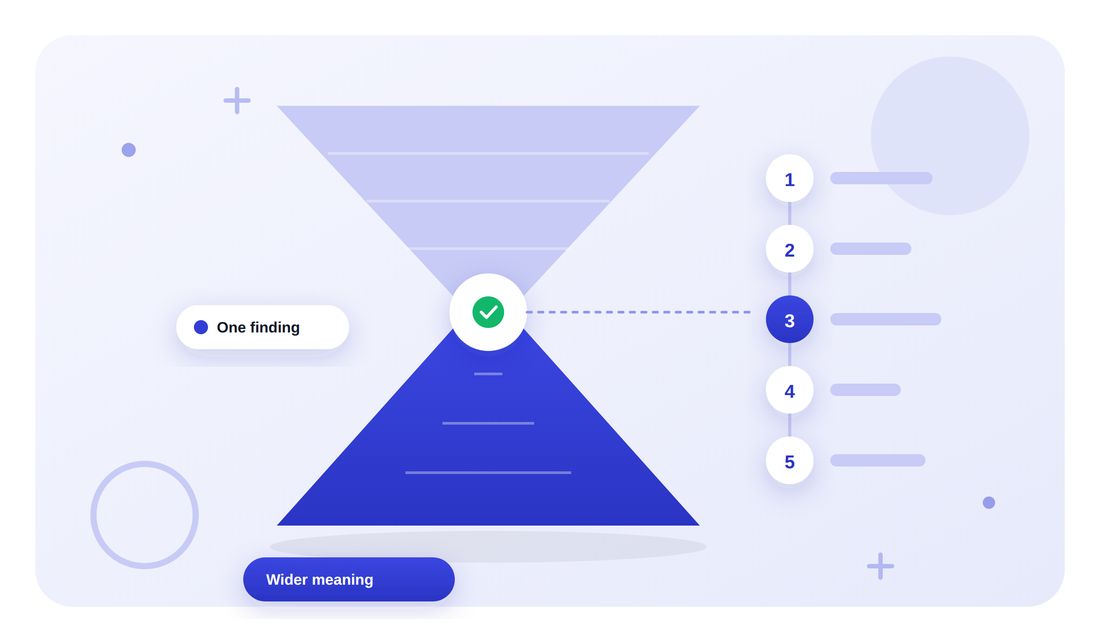
The results section is the easy part. The numbers are the numbers. The discussion is where you say what they mean, and that is where papers come back.
Rather than a list of rules, this guide takes one discussion apart paragraph by paragraph. The study is invented for this guide as a model.
<CTA title="Say exactly what your data supports" description="Jenni checks how strongly each claim is backed by the sources behind it, so your discussion stays inside what you actually found." buttonLabel="Try Jenni Free" link="https://app.jenni.ai/register" />
What is the discussion section of a research paper?
Interpreting your results: what they mean, how they fit existing work, what limits them, what should happen next. The only section where you are allowed to argue, and the only one where you may not introduce anything new.

A discussion, dissected
Paragraph 1: the principal findings
A single pharmacist review at the bedside within 24 hours of discharge reduced 30 day readmission by 8.1 percentage points in patients aged 70 or older taking five or more medicines. The effect on emergency department attendance was smaller and did not reach significance. Medication discrepancies at 14 days fell by roughly half, which is the most plausible route from the intervention to the readmission result.
Three sentences, three jobs:
Sentence | Doing what |
First | Answers the research question in the terms it was asked |
Second | Volunteers the outcome that did not work, before a reviewer finds it |
Third | Proposes a mechanism, flagged as plausible rather than proven |
The ICMJE Recommendations ask you to begin by briefly summarizing the main findings and exploring possible mechanisms. That is this paragraph, and nothing else belongs in it.
Paragraph 2: against the other studies
Two earlier trials of pharmacist review at discharge reported no effect on readmission. Both delivered the review by telephone in the week after discharge rather than at the bedside before it, and both recruited patients taking three or more medicines rather than five. Timing is the more likely explanation, since discrepancies introduced at the point of transfer are hardest to correct once a patient is home.
The move that makes it work is naming a specific difference and committing to which one explains the divergence. Compare the version most drafts contain, which is "these differences may be due to variation in study populations and settings." That sentence acknowledges the conflict without resolving anything, and reviewers read it as a dodge.
Paragraph 3: the limitation
Randomization was at patient level within two hospitals, so the same pharmacists delivered both the intervention and usual care and could not be blinded. This may have raised the quality of usual care in the control arm, which would bias the estimate toward the null rather than away from it. A cluster design across more sites would remove that contamination, at the cost of a larger sample.
Set that beside the version that appears in most papers:
Generic version | The one above |
"The sample size was relatively small and the study was conducted at a single institution, so results may not be generalizable." | Names the specific mechanism: unblinded delivery by the same staff |
Says nothing about direction | States which way it biases the estimate, and toward the null |
Offers no remedy | Proposes the design that fixes it, and its cost |
A four part framework in Perspectives on Medical Education describes exactly this: describe the limitation, explain its implication, provide alternative approaches, and describe steps taken to mitigate it.
The structure those three paragraphs sit inside
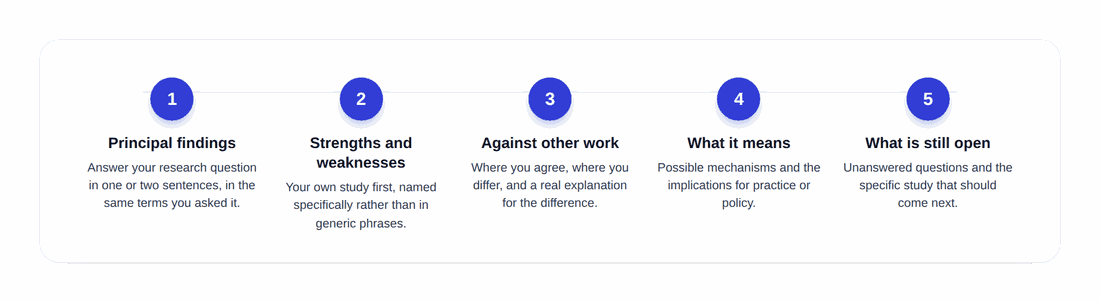
The BMJ asks for five elements in order, and notes you need not signpost them with subheadings: principal findings, strengths and weaknesses of the study, strengths and weaknesses against other studies, meaning, and unanswered questions. It also caps the whole section at no more than a page and a half.
Note where limitations sit. Second, not last. Putting them early signals confidence; burying them in the final paragraph reads like an admission.
<ProTip title="🔬 Interpretation:" description="Write your first discussion sentence before anything else, and make it a direct answer to your research question. If you cannot write that sentence, the problem is in the results, not the discussion." />
Where sentences actually belong
If you want to write | It belongs in |
A number the reader has not seen yet | Results |
Why the study was needed at all | Introduction |
Why your result differs from an earlier study | Discussion |
How you measured the outcome | Methods |
What a practitioner should do differently now | Discussion |
The direction a confounder would push your estimate | Discussion |
Spin, and finding it in your own draft

Spin is reporting that makes a result look more favorable than the data supports, and it has been counted. A study in JAMA examined 72 published reports of trials with nonsignificant primary outcomes and found spin in the main text discussion of 43.1% of reports and in the conclusions of 50.0%.
It changes what readers believe. In a randomized trial in the Journal of Clinical Oncology, 300 clinicians read a cancer trial abstract with or without spin, and those reading the spun version rated the treatment as more beneficial by 0.71 points on a 10 point scale.
The CONSORT 2025 statement now names it directly, listing interpretation as item 29 and instructing authors to avoid overinterpretation, with the word spin in brackets.
Three tells worth searching for
A conclusion about a secondary outcome when the primary one was null. The word "improved" where the table shows an interval crossing zero. And any use of "trended toward" or "showed a tendency", which describe a result that did not happen.
<ProTip title="🗣️ Wording:" description="Whenever you write a limitation, add the phrase which would bias the estimate toward or away from the null. If you cannot finish that sentence, you have not thought the limitation through." />
How honest most limitations sections are
Not very. A survey of 300 biomedical publications found that 27% mentioned no limitations at all, while the 73% that did acknowledged a median of three. Only 5% mentioned a limitation in the abstract.
Six categories are worth checking yours against: sample and recruitment, measurement, design, confounding, generalizability, and analysis choices. CONSORT 2025 item 30 requires limitations addressing bias, imprecision, generalizability and multiplicity of analyses.
<ProTip title="📉 On limitations:" description="Pick the two or three that would actually change how a reader uses your result. Eight generic caveats read as a lack of judgment about which ones matter." />
Drafting one with Jenni
Set the section up in the prompt. Name the study and the order you want, so the structure is right before the sentences are.
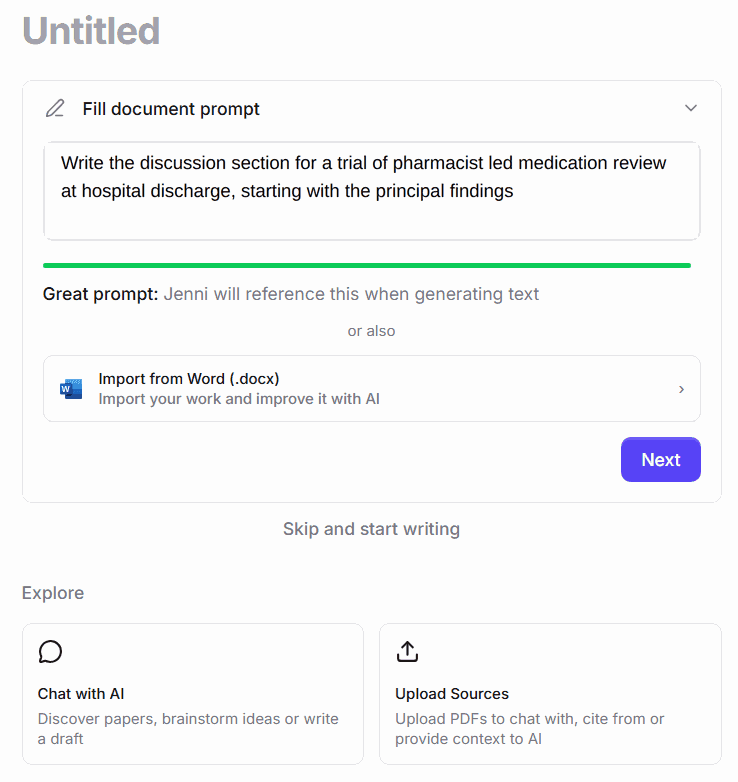
Set your citation style. The comparison paragraph carries most of your references.
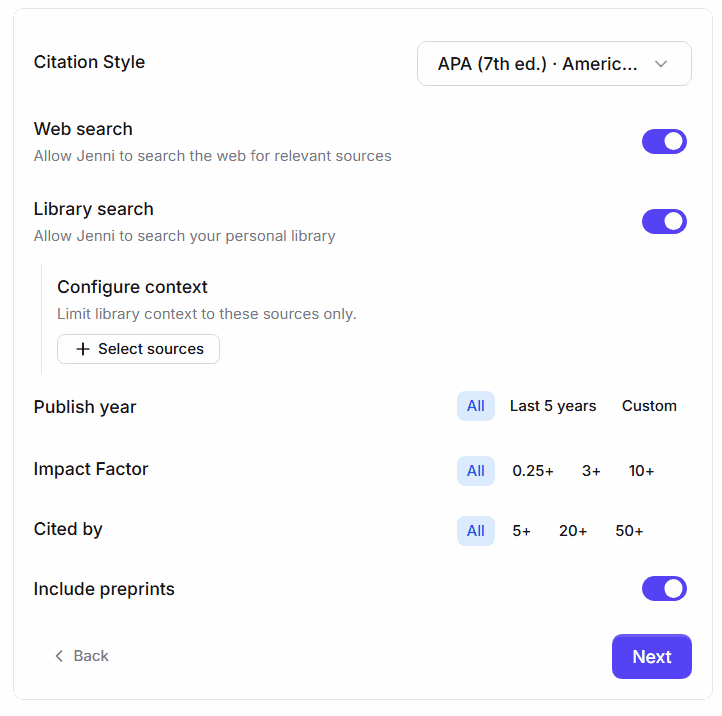
Generate the structure. Headings first, so the five elements exist before you write into any of them.
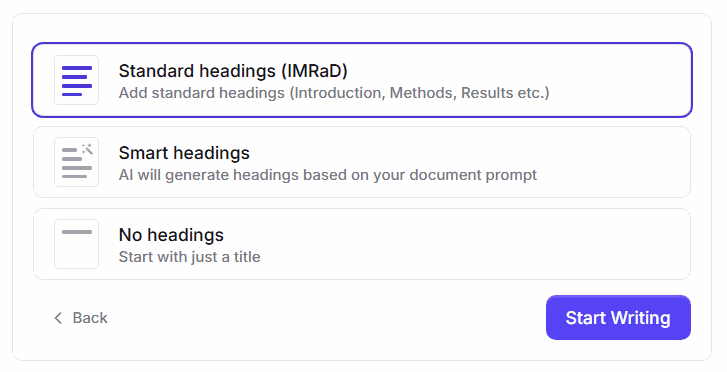
Then draft one element at a time. Findings, then comparison, then limitations. Separate passes stop the summary drifting into interpretation. Run Claim Confidence to flag sentences stating more than the evidence supports, then Peer Review to read it the way a reviewer would. Both sit in the review pass.
The self check
Read only the first sentence of each paragraph in order. Does that sequence tell the whole story?
Does the first sentence answer your research question in the same terms it was asked?
Is any number in this section appearing for the first time? Move it to results.
Print the abstract conclusion beside the discussion conclusion. If the abstract sounds more certain, that is where your spin is.
Does each limitation name a direction of bias?
<ProTip title="🪞 Self-check:" description="Hand the discussion to someone who has read only your results table. If they are surprised by any claim in it, the claim has outrun the data." />
Say What It Means, and No More
A strong discussion answers the question you asked, explains honestly why your answer differs from anyone else's, and names the reasons a careful reader should hold the finding loosely. Everything else is decoration, and reviewers can tell.
<CTA title="Check your claims before a reviewer does" description="Run five review passes over the draft and find the overreach while you can still fix it." buttonLabel="Review My Draft" link="https://jenni.ai/cfp-review" />
For the section before it, see our guide to the results section of a research paper. If you are still drafting, writing against your own library keeps the comparison paragraph honest, and the conference abstract guide covers summarizing it all afterward.