By
Justin Wong
—
What Are Conference Proceedings? A Simple Guide

Justin Wong
Head of Growth
Graduated with a Bachelor's in Global Business & Digital Arts, Minor in Entrepreneurship
You found the perfect source and the citation says "in Proceedings of". Is that a real publication? Is it peer reviewed? Does it count?
A lookup guide rather than an essay. Short answers first, then the tables you actually came for.
<CTA title="Keep every source traceable" description="Jenni imports by DOI and keeps the citation attached to the claim it supports, so proceedings papers land in your reference list correctly." buttonLabel="Try Jenni Free" link="https://app.jenni.ai/register" />
The short answer
Conference proceedings are the published collection of papers presented at a conference, issued as a volume with an ISBN or ISSN and, at major publishers, a DOI for every paper. At established venues they are peer reviewed. In computing they count as full publications; in most other fields they sit below journal articles.
What is inside a volume
Full papers, short papers, and often poster or workshop abstracts, sometimes with keynote summaries. The talk happens once. The proceedings are what remains and what other people cite.
Whether they are peer reviewed
At established venues, yes, and often more competitively than journals in the same field. Papers are reviewed before acceptance against a fixed deadline, usually by three reviewers.
Rigor varies enormously though, from top computing conferences with acceptance rates under 25% to meetings that accept nearly everything, and the volume itself does not tell you which you are holding. Our guides to identifying a peer reviewed article and the anonymized review models cover how to check.
Where they get indexed
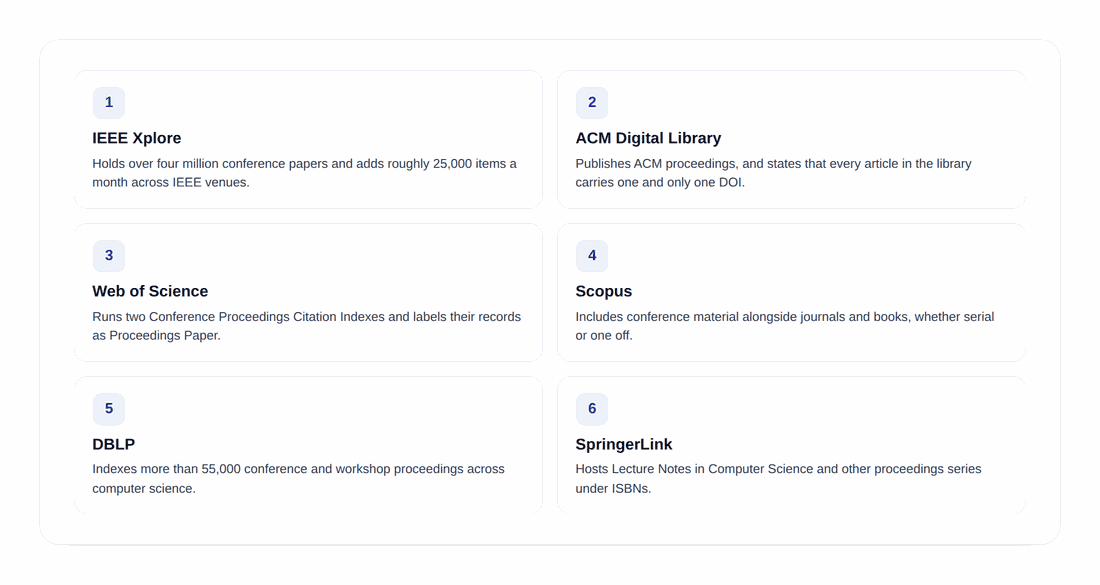
Database | What it holds |
IEEE Xplore | Over four million conference papers, roughly 25,000 new items a month |
ACM Digital Library | ACM proceedings. Policy states every article shall have one and only one DOI |
Web of Science | Two Conference Proceedings Citation Indexes, records labeled "Proceedings Paper" |
Scopus | Conference material alongside journals and books |
DBLP | More than 55,000 conference and workshop proceedings in computer science |
SpringerLink | Lecture Notes in Computer Science and other proceedings series |
One correction worth making
Not every proceedings paper gets a DOI. Major publishers assign them as policy. Smaller regional and self published proceedings often do not, which is exactly when a paper becomes hard to find again.
<ProTip title="🔎 Check indexing:" description="Before you submit, search last year proceedings from the same conference in the database you care about. If the previous volume is not there, yours will not be either." />
How to cite one
You cite the individual paper, not the volume, and the pattern is the same across styles: author, year, paper title, then the proceedings as the container.
APA 7
IEEE
[1] A. A. Author, "Weekly quizzing and course completion in large lectures," in Proc. Conf. Learning at Scale, Boston, MA, USA, 2026, pp. 114–123.
MLA 9
Two details people get wrong: include the page range when the volume has one, because that is what distinguishes a published proceedings paper from a talk; and if you attended something that was never published, that is a presentation, not a proceedings paper. APA publishes worked examples for each variant.
<ProTip title="🔗 Cite it right:" description="Import proceedings papers by DOI rather than typing them out. Conference names are long, abbreviated inconsistently across styles, and the single most common source of a broken reference." />
Whether they count as publications

In computing, yes, and often as the primary venue. In most other disciplines they sit below journal articles, closer to a documented presentation. For a CV, list them under a heading that names them accurately rather than folding them in with journal articles, and let the reader weigh them by the venue.
<ProTip title="📌 On your CV:" description="Give proceedings papers their own section and include the acceptance rate where the conference publishes it. A 23% acceptance rate says more to a hiring committee than the venue name alone." />
Turning one into a journal article
Usually possible with substantial new material and full disclosure. IEEE Transactions on Learning Technologies describes the general IEEE rule requiring at least 30% of new content, noting expanded papers typically add around 50%. Disclose the conference version in a first page footnote with its DOI, because journals run overlap checks.
Questions that come up when you are citing one
Is "Proceedings of" always a conference?
Not always. Some journals carry it for historical reasons, such as Proceedings of the National Academy of Sciences, which is a journal. Check whether the source names a meeting, a date and a location.
Are proceedings the same as a conference paper?
The proceedings are the volume; the conference paper is your contribution inside it. You cite the paper and name the proceedings as its container.
How long until they appear?
It varies. IEEE tells authors to expect their paper in Xplore roughly six weeks after the conference ends, and warns that once published it is part of the scientific record and cannot be changed.
<ProTip title="⏳ After the meeting:" description="Set a reminder for eight weeks after the conference to check that your paper actually appeared. Proceedings occasionally stall at the publisher, and nobody will tell you." />
From Presented to Permanently Findable
Proceedings turn a twenty minute talk into something citable a decade later. That only works if the volume is indexed somewhere real, the paper carries a DOI, and your own reference to it is complete enough for a reader to follow.
<CTA title="Check the paper before it becomes permanent" description="Run five review passes over your draft and see what a program committee would flag, while you can still change it." buttonLabel="Check Before Submitting" link="https://jenni.ai/cfp-review" />
Getting into the proceedings starts earlier, with the call and the abstract. Our guides to reading a call for papers, writing a conference abstract and conference paper format cover the steps between, and drafting against your own library is where most people start.