By
Nathan Auyeung
—
Research Paper Keywords: How to Choose Them and Why They Matter

Nathan Auyeung
Senior Accountant at EY
Graduated with a Bachelor's in Accounting, completed a Postgraduate Diploma of Accounting

The keyword box is the last field on the submission form and it usually gets ninety seconds of thought. Most of the advice about it is also wrong, which does not help.
Five claims worth correcting first, because three of them will change how you fill the field.
<CTA title="Keep the whole paper findable and traceable" description="Jenni gives you a searchable library of everything you have read, so your field vocabulary stays in front of you while you write." buttonLabel="Try Jenni Free" link="https://app.jenni.ai/register" />
Five things people believe about keywords
The claim: Good keywords will get you more citations.
What is true: The evidence contradicts itself. A 2013 study in the Journal of Informetrics found the number of keywords insignificant or of no practical significance. A 2016 study in the same journal found a positive correlation. Neither establishes cause. Optimize for findability, not citations.
The claim: Google Scholar reads your keyword field.
What is true: It does not. Scholar publishes every metadata tag it supports, from citation_title to citation_pdf_url. There is no keywords tag anywhere on that list.
The claim: Your keywords become the MeSH terms.
What is true: MeSH terms are assigned by the National Library of Medicine, and since April 2022 all journals indexed for MEDLINE are indexed automatically. Yours sit in a separate field alongside.
The claim: PubMed ignores author keywords entirely.
What is true: Also false, and this is the correction that matters most. Author supplied keywords have been captured in the Other Term field since January 2013, displayed below the abstract and searchable on their own.
The claim: More keywords means more reach.
What is true: Publishers cap you at three to six, and the cap is the point. The field is a coverage tool, so a term that repeats your title spends a slot on reach you already had.

What the field actually is
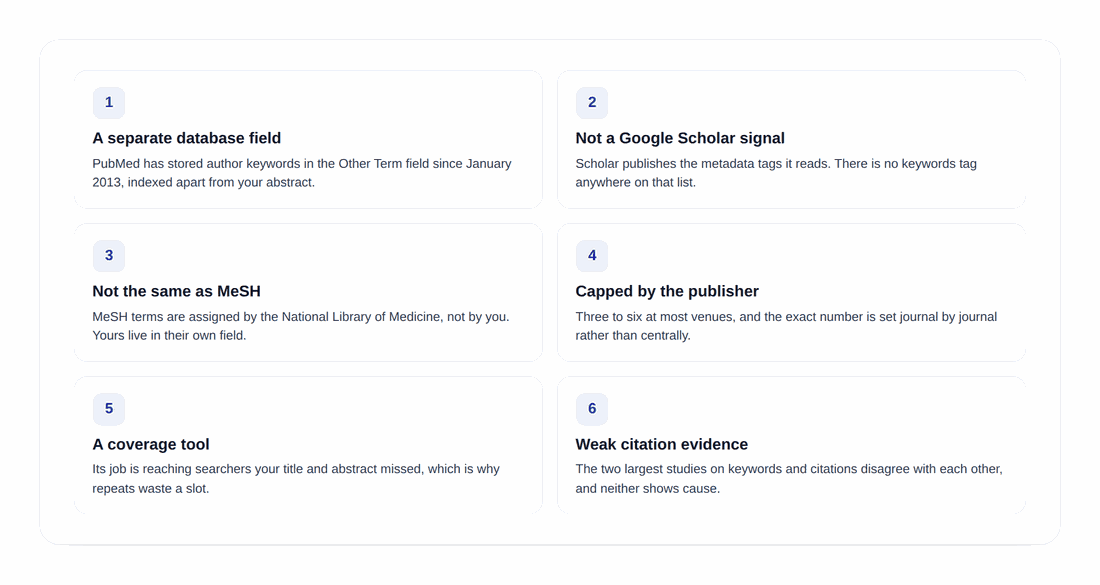
A dedicated database field, indexed separately from your title and abstract, capped by the publisher, matched against searches inside Scopus, Web of Science, PubMed and the publisher's own site. That is the whole mechanism, and everything useful follows from it.
How many keywords should a research paper have?
Publisher or standard | How many | Notable rule |
Elsevier (standard guide) | Maximum of 6 | Avoid general and plural terms, be sparing with abbreviations |
Springer, Reading and Writing | 4 to 6 | Stated to be used for indexing |
IEEE | 3 to 5 | Drawn from the IEEE Thesaurus |
Cambridge University Press | 3 to 5 | Avoid broad disciplinary terms |
Sage (typical) | 4 to 5 | Varies by journal, 3 up to 7 |
APA 7 style | 3 to 5 | Indented line below the abstract, italic label |
Taylor & Francis | No fixed count | 1 to 2 keywords in the first 65 characters of the title |
Elsevier asks for a maximum of six with American spelling. Taylor and Francis sets no count but gives the sharpest title advice in publishing: one or two keywords inside the first 65 characters, so they survive search result truncation.
<ProTip title="🚧 Limit check:" description="Sage asks for three keywords on one journal and seven on another. Never carry a count from a previous submission. Open the specific journal page before you fill the field." />
Choosing them, in five moves
Write down what a stranger would type. Someone who needs your paper but has never heard of it.
Delete anything already in your title or abstract. University of Washington Libraries says the same: choose words that complement title words rather than repeat them.
Add the population, the setting and the method. The facets titles leave out, and exactly how other researchers narrow a search.
Check each against your field vocabulary. MeSH in biomedicine, the IEEE Thesaurus in engineering.
Search your own keywords and read the results. If the first page is not full of neighbors, the term points at the wrong shelf.
One formatting habit: a peer reviewed guide in Insights recommends a keyword should always be in the singular, and suggests three to seven per article describing temporal context, location, subjects or methodology.
<ProTip title="🧪 Test it:" description="Paste a candidate into your usual database and count the results. Tens of thousands means the term is too broad to help anyone find you. Under a hundred usually means nobody searches it." />
The same paper, twice
Title: Wildfire smoke exposure and emergency department visits for asthma in children. It already covers wildfire smoke, emergency department, asthma and children.
The list most people submit
Weak list: asthma, children, wildfire, air pollution, health
Four of five repeat the title. The fifth is too broad to narrow any search. Net new coverage: close to zero.
The list that adds coverage
Strong list: fine particulate matter, case crossover design, environmental epidemiology, pediatric emergency care, air quality index
Each adds a facet the title missed: the exposure measure, the study design, the field, the care setting, the data source. A reader searching for case crossover studies of air quality now finds this paper.
Why almost everyone writes the first one
Because the title is right there and the box is the last thing between you and submitting. A 2024 survey of ecology and evolutionary biology journals found that 91.9% of studies duplicated at least one keyword in the title or abstract. It is the default behavior, not an occasional slip.
Setting the paper up with Jenni
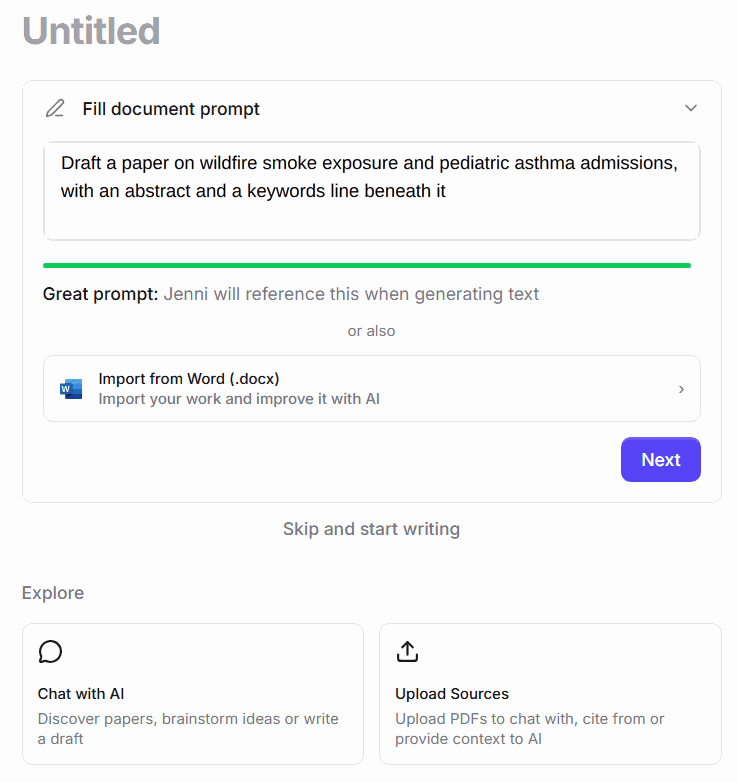
Describe the paper in the prompt. Name the topic and say you want an abstract with a keywords line beneath it.
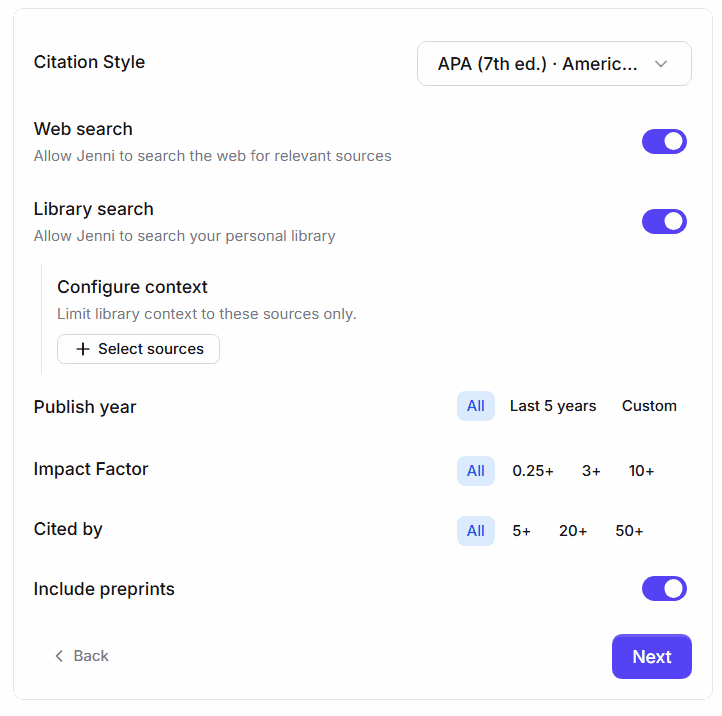
Set the citation style. The style decides how the keywords line is formatted, and APA has the strictest rules.
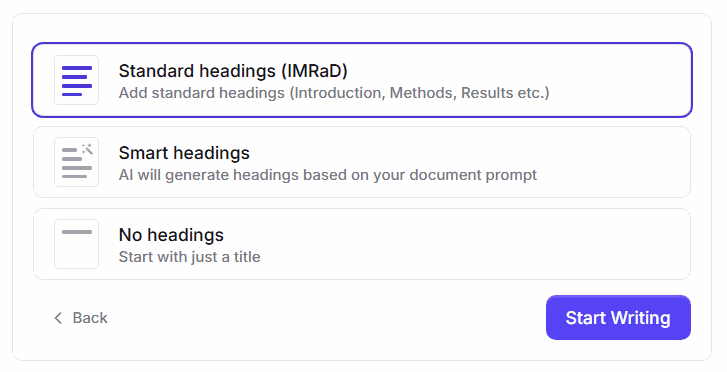
Generate the headings. The structure exists before you write, so you can see which facets the paper actually covers.
Then draft, and pick keywords last. You cannot choose coverage terms until you know what the paper says. Search your library for each candidate: if the papers that come back are the ones you cite, the term is right.
<ProTip title="🗺️ Coverage map:" description="Write your title, then your abstract, then list every search term each already covers. Whatever is left over is your keyword list, and it will be better than anything you brainstorm cold." />
What to do instead of guessing
Three habits that replace the ninety seconds.
Read your title and keywords side by side and cross out overlaps. If you cross out more than one, you have room for a facet you have not covered.
Use the singular. Controlled vocabularies are built that way.
Paste your abstract into MeSH on Demand if you are in biomedicine. It shows which standard terms your writing already signals, and which it missed.
<ProTip title="📖 Vocabulary:" description="Terms like comparison, analysis and evaluation describe what you did to the topic, not the topic. They are the most commonly wasted slots in the field." />
Five Slots, Used Well
Treat the field as a coverage map. Your title reaches some searchers, your abstract reaches more, and the keywords are for the ones neither caught. Five specific terms adding new facets will do more than eight restating what a reader could already see.
<CTA title="Start the paper with the vocabulary in front of you" description="Draft against a searchable library of your own sources, so the terms your field actually uses stay visible while you write." buttonLabel="Start My Draft" link="https://jenni.ai/conference-abstract-writer" />
For the summary those terms describe, see our guides to writing a conference abstract, nine worked abstract examples and APA abstract format, and a review pass before submission.