By
Nathan Auyeung
—
APA Abstract Format: Word Count, Keywords, and Example

Nathan Auyeung
Senior Accountant at EY
Graduated with a Bachelor's in Accounting, completed a Postgraduate Diploma of Accounting
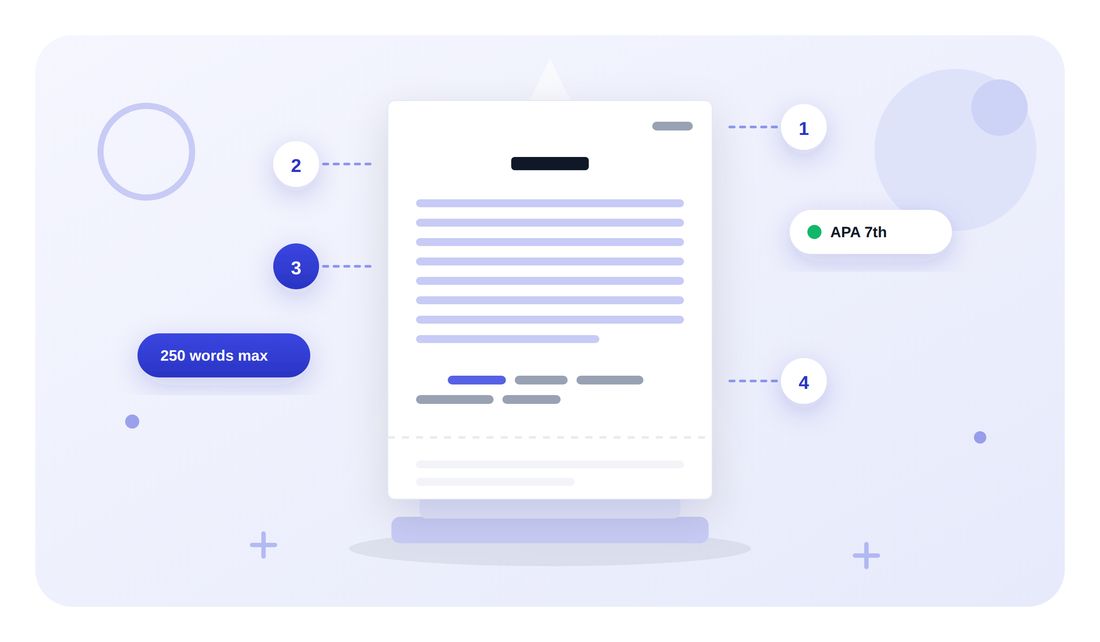
Most of what people believe about APA abstracts is half right, and the half that is wrong is the half graders check first.
Five claims worth correcting, then the actual format in five steps, a worked example, and a reference card you can keep beside the paper.
<CTA title="Format your APA paper without the guesswork" description="Jenni drafts in APA 7 with citations formatted as you write, so the abstract page and the reference list stay consistent." buttonLabel="Try Jenni Free" link="https://app.jenni.ai/register" />
Five things people get wrong
The claim: Every APA paper needs an abstract.
What is true: APA 7 introduced a separate student paper format, and student papers generally do not include one unless the instructor asks. Professional papers submitted for publication do.
The claim: The abstract paragraph is indented like every other paragraph.
What is true: It is the one paragraph in an APA paper that sits flush left. This is the error graders catch first, and word processors that auto indent will introduce it for you.
The claim: 250 words is the target to aim for.
What is true: It is a ceiling, not a goal. Purdue OWL states the abstract should typically be no more than 250 words. Most land between 150 and 250, and a tight 180 beats a padded 250.
The claim: The keywords line is decoration.
What is true: It is a formatted field with more rules per word than anything else in APA: indent, italic label, lowercase terms, comma separated, no closing period.
The claim: APA requires structured headings like a medical abstract.
What is true: It does not. The default is continuous prose in one paragraph. Some journals published by APA ask for structure, so check the journal rather than assuming.

What the format actually is
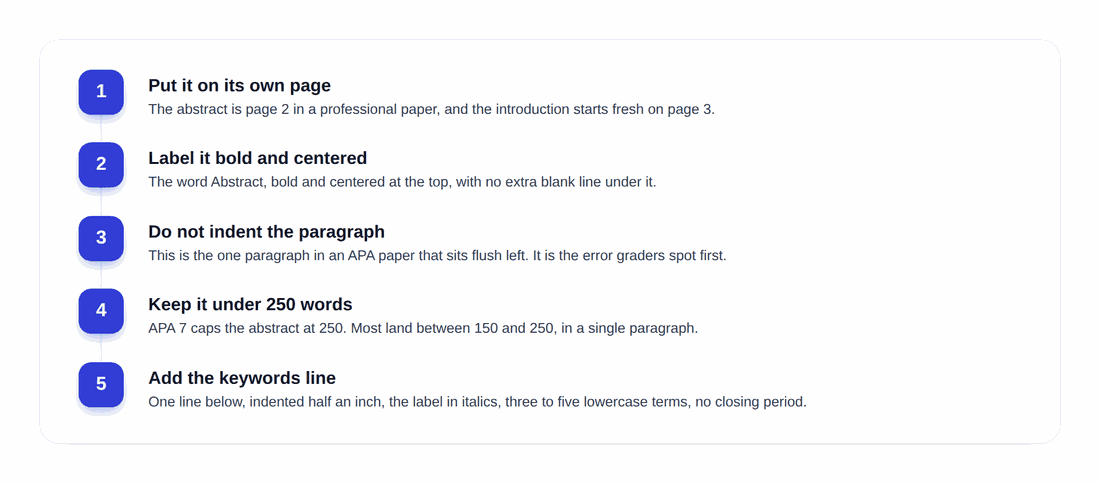
Its own page. Page 2 in a professional paper, with the introduction starting fresh on page 3.
Bold and centered label. The word Abstract, bold and centered, no extra blank line beneath.
No indent on the paragraph. Flush left, double spaced like the rest of the paper.
Under 250 words. One paragraph.
Keywords line beneath. Indented half an inch, italic label, three to five lowercase terms, no closing period.
<ProTip title="🖊️ Indent rule:" description="If your word processor auto indents new paragraphs, the abstract will be indented before you notice. Set the first line indent to zero for that paragraph rather than deleting a tab." />
The keywords line, in detail
It carries the most rules and gets the least attention.
Position and formatting
One line below the abstract paragraph, same page.
Indented half an inch. The abstract above is not indented, but this line is.
Keywords: in italics, not bold, followed by a space.
Terms lowercase except proper nouns, not italicized, not bold.
Comma separated, with no period after the last one.
If they run to a second line, that line is not indented.
How many, and which
Three to five, per Western Oregon University and other APA 7 guides. The formatting details above match The Chicago School library guide and the Antioch University handout, which cites page 38 of the APA 7 manual.
The selection rule nobody mentions
Pick terms that are not already in your title. Databases index the title and abstract separately from the keyword field, so a repeat spends a slot on coverage you already have. Our guide to choosing research paper keywords covers the reasoning.
<ProTip title="🏷️ Keywords line:" description="Write the keywords last, after the abstract is final. You cannot pick coverage terms until you know which words the summary already uses." />
Do student papers need an APA abstract?
Usually not. APA 7 introduced a separate student paper format, and student papers generally do not include one unless the instructor asks for it. Professional papers submitted for publication do. Check the assignment brief, and if it is silent and the paper is short, ask.
A finished example
The study is invented for this guide and the numbers are illustrative.
Abstract
Short sleep is common among undergraduates, but the size of its effect on working memory under normal course conditions is unclear. This study tested whether habitual sleep duration predicted working memory performance across a single semester. One hundred eighty six undergraduates wore actigraphy watches for 14 consecutive nights and completed an operation span task at the start and end of the recording period. Mean nightly sleep duration was 6.4 hours (SD = 1.1). Sleep duration predicted operation span scores after controlling for prior grade point average and caffeine intake, β = .27, p < .001, R² change = .07. The association was nonlinear: performance improved with sleep up to approximately 7.5 hours and did not improve beyond it. Students in the shortest quartile scored 0.61 standard deviations below those in the longest quartile. Self reported sleep overestimated actigraphy by 41 minutes on average, which suggests survey based studies may understate the effect. The findings support brief sleep education sessions in first year courses.
Keywords: working memory, sleep duration, actigraphy, undergraduate students
Three conventions inside the statistics: exact p values unless below .001, no leading zero on values that cannot exceed 1, and no closing period on the keywords.
Writing one with Jenni
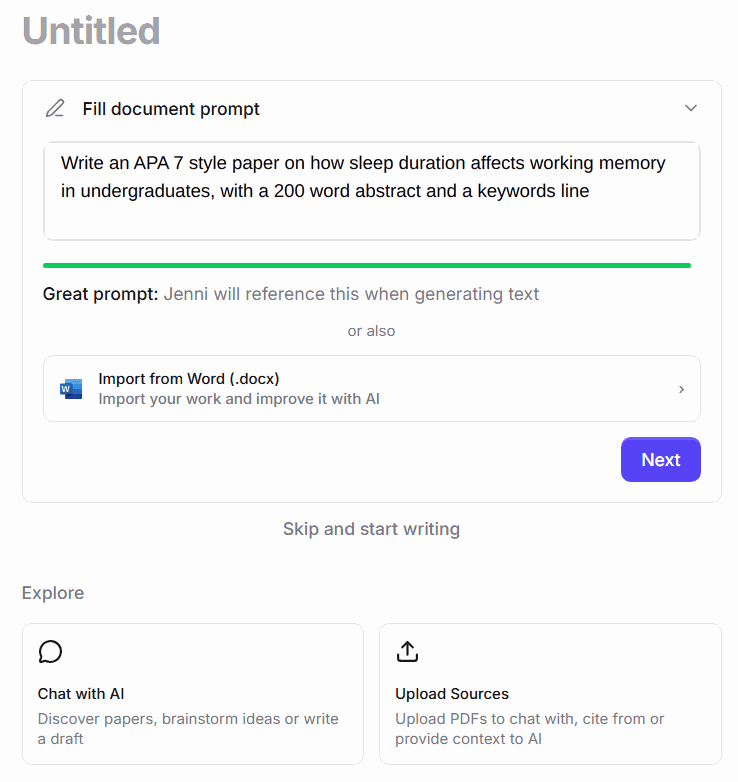
Describe the paper in the prompt. Name the topic, the style and the abstract length, so the draft starts in the right format.
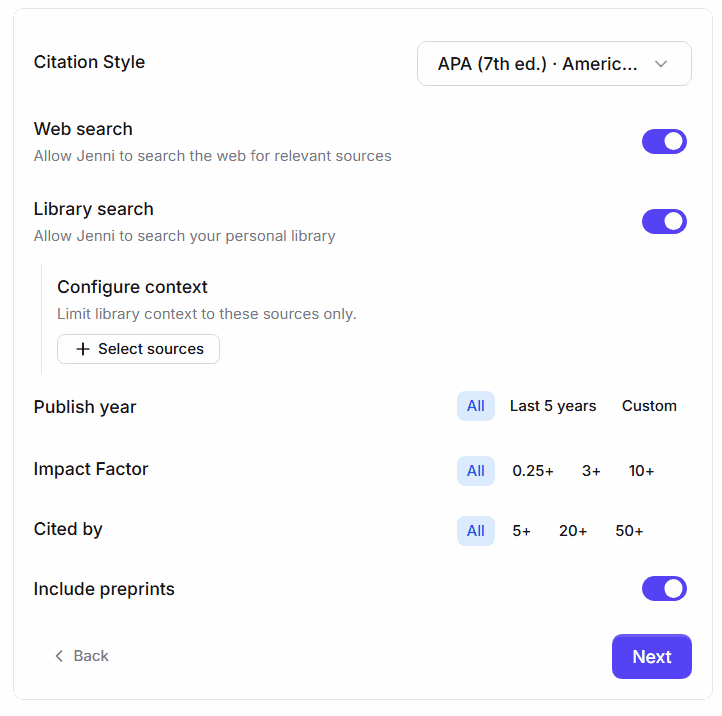
Set the citation style to APA 7th. Every in text citation and the reference list follows from here.
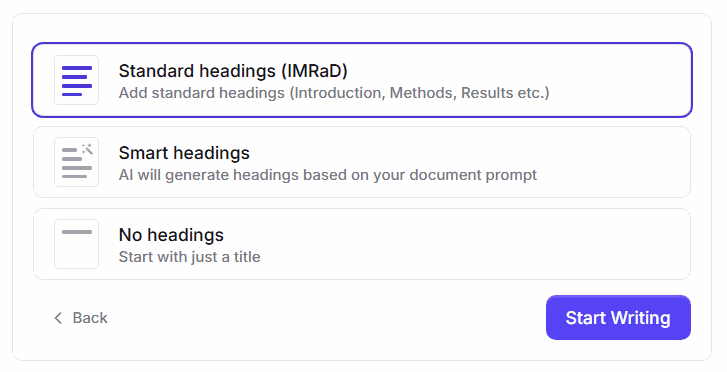
Generate the headings. The section structure exists before you write into it.
Then write the body first and the abstract last, tighten with the editing commands, and run a Claim Confidence review to confirm each sentence is supported by the paper underneath. If the draft already exists, a review pass is the faster route.

The reference card
Element | Rule |
Page | Page 2, its own page, introduction starts page 3 |
Label | Abstract, bold, centered, no extra spacing |
Paragraph | One paragraph, flush left, double spaced |
Length | No more than 250 words, typically 150 to 250 |
Structure | Continuous prose, headings not required |
Keywords label | Keywords: italic, not bold, indented 0.5 in |
Keywords terms | Three to five, lowercase, comma separated, no final period |
Student papers | Usually no abstract unless requested |
<ProTip title="⏱️ Write it last:" description="Draft the abstract after the discussion is finished. Abstracts written first describe the study you intended rather than the one you ran." />
<ProTip title="🎓 Student papers:" description="Check the assignment brief before writing one. Adding an unrequested abstract is a smaller problem than omitting a required one, but neither is free." />
Getting the Abstract Page Right the First Time
APA's rules look fussy until you notice they serve one goal: making the summary readable on its own, in a database entry, with no context around it. Bold label, no indent, one paragraph, under 250 words, three to five lowercase keywords with no closing period.
<CTA title="Draft in APA 7 from the first sentence" description="Set the style once and let Jenni keep citations, references and formatting consistent while you focus on the writing." buttonLabel="Format My Abstract" link="https://jenni.ai/conference-abstract-writer" />
Once the formatting is settled, spend the remaining time on the sentences. Our guides on abstract word counts by type, nine worked examples and conference abstracts cover what goes inside.