By
Nathan Auyeung
—
Abstract Examples: 9 Real Samples and What Makes Each Work

Nathan Auyeung
Senior Accountant at EY
Graduated with a Bachelor's in Accounting, completed a Postgraduate Diploma of Accounting

You know the parts. Purpose, method, result, conclusion. Then the submission box opens with a word counter ticking underneath it and none of that helps.
Nine specimens below, grouped by family, each one dissected differently because each one fails differently. Every example is written for this guide. The studies are invented and the numbers should not be cited.
<CTA title="Draft the abstract with your sources attached" description="Jenni drafts from the papers already in your library, so the summary stays tied to what you actually found." buttonLabel="Try Jenni Free" link="https://app.jenni.ai/register" />
Pick your specimen
Type | Length | Reports results? | Where you meet it |
Structured research abstract | 250 to 300 words, up to 400 for a trial | Yes, with numbers | Medical and health journals |
Unstructured research abstract | 150 to 250 words, one paragraph | Yes | APA style journals |
Systematic review abstract | 250 to 300 words, usually structured | Yes, plus registration | Evidence synthesis journals |
Descriptive abstract | 100 words or fewer | No | Humanities and coursework |
Thesis abstract | 150 words at UNC Chapel Hill | Yes | Master's theses |
Summary paragraph, Nature style | 200 words, references allowed | Yes | Nature research journals |
Conference abstract | 150 to 400 words, or a character cap | Yes, even if preliminary | Submission portals |
Dissertation abstract | 350 words at UNC Chapel Hill | Yes | Doctoral dissertations |
Case report abstract | 150 to 250 words | Yes, as the case course | Clinical case journals |
Two of those come from the source. The UNC Graduate School caps a thesis abstract at 150 words and a dissertation at 350. Nature asks for a fully referenced summary paragraph of no more than 200 words.
Research abstracts: the three you will meet most
1. Structured, for a clinical trial
Objectives To test whether a pharmacist review at discharge reduces 30 day readmission among older adults. Design Parallel group randomized controlled trial, 1:1 allocation. Setting Two urban teaching hospitals, March 2023 to June 2024. Participants 812 patients aged 70 or older discharged on five or more regular medicines. Main outcome measures All cause readmission within 30 days. Results Readmission occurred in 91 of 406 (22.4%) intervention patients and 124 of 406 (30.5%) controls, a risk difference of 8.1 percentage points (95% CI 2.1 to 14.1, p = .008). Emergency attendance did not differ. Conclusions A brief pharmacist review reduced 30 day readmission. The effect on emergency attendance was not significant and needs a larger trial.
Every sentence has one job. Here they are, mapped:
Sentence | What it is carrying |
Objectives | The question, in the terms the conclusion will answer |
Design and Setting | How much weight a reader should give the result |
Participants | Who the finding applies to, and who it does not |
Results, first clause | Absolute numbers, so the percentages mean something |
Results, second clause | Effect size and interval |
Conclusions, second sentence | The refusal to claim the secondary outcome |
2. Unstructured, APA style
Students who draft with generative AI report writing faster, but little is known about how the practice affects citation accuracy. This study examined citation error rates in undergraduate literature reviews written with and without an AI drafting assistant. Two hundred forty second year psychology students were randomly assigned to draft a 1,500 word review with or without assistant access, and every reference was verified against the original source. Drafts written with the assistant contained more references (M = 14.2, SD = 3.1) than drafts written without it (M = 10.7, SD = 2.8), t(238) = 9.11, p < .001, d = 1.18. The proportion of references whose cited claim did not appear in the source was higher in the assistant condition (11.4%) than in the control condition (4.2%). Students who reported opening every source showed no difference between conditions. Drafting speed and citation accuracy appear to trade off unless verification is made an explicit step.
Keywords: citation accuracy, generative AI, source verification, undergraduate research
The APA conventions doing quiet work in there:
Exact p values, except below .001 where it becomes an inequality.
No leading zero on values that cannot exceed 1, so p < .001 and d = 1.18 but not 0.42.
Means and standard deviations in parentheses, not a separate sentence.
The keywords line on its own, carrying terms absent from the title.
3. Systematic review
Background Peer tutoring is widely used to support first year undergraduates, but effect estimates vary and few reviews separate paid from volunteer programs. Methods We searched five databases from inception to March 2026 for controlled studies of peer tutoring, with course grade as an outcome. Two reviewers screened independently. Risk of bias was assessed with ROBINS-I. Results Thirty one studies covering 28,406 students met inclusion criteria. Peer tutoring was associated with a small improvement in course grade (standardized mean difference 0.21, 95% CI 0.13 to 0.29), with substantial heterogeneity (I² = 62%). The effect was larger where tutors were paid (SMD 0.34) than in volunteer programs (SMD 0.11). Twenty four of 31 studies were at serious risk of bias. Conclusions Peer tutoring shows a small positive association with first year grades, but the evidence base is weak and the paid versus volunteer difference is hypothesis generating.
One line does most of the work here, and it is the one about risk of bias sitting in the abstract rather than buried in the results. Without it a reader quotes the 0.34 figure as settled. With it, they cannot.
Short forms: when you have 150 words or fewer
4. Descriptive, 72 words
This article traces the shifting use of the word "objectivity" in Anglo American journalism manuals published between 1890 and 1950. It surveys thirty one manuals held in three archival collections, sets out the three competing definitions that circulate across them, and considers how each was tied to a particular model of newsroom labor. The closing section outlines what the shift implies for current debates about impartiality in reporting.
Every verb is a verb of coverage. Traces, surveys, sets out, considers. Nothing is claimed, because the UNC Writing Center describes this type as making no judgments and providing no results.
5. Thesis, exactly 150 words
Community land trusts are described as a tool for permanent housing affordability, yet few studies track resale prices after the first owner leaves. This thesis examines resale outcomes in four community land trusts in the American Midwest between 2005 and 2023. Using deed records for 612 homes and interviews with 14 trust administrators, it compares realized resale prices against the affordability formula written into each ground lease. Three of the four trusts held prices within their stated band across the full period. The fourth drifted upward after a 2014 formula revision that indexed prices to area median income. Interviews suggest the drift was unintended and went unnoticed for six years, because no trust reviewed its formula against outcomes. The study argues that affordability formulas need scheduled review, and offers a resale audit that small trusts can run without specialist staff.
What the 150 word ceiling forces
One job per sentence. The method sentence carries both data sources and the sample size. The finding is split into the pattern and the exception, because the exception is where the interest is. There is no room for a chapter tour, which is exactly why thesis abstracts that attempt one read as empty.
6. Nature style summary paragraph
Soil microbial communities regulate a large share of terrestrial carbon flux, and their composition shifts with temperature. How quickly those shifts translate into changed carbon release has been hard to observe outside the laboratory, because most field warming experiments run for a single season. Here we show that in a six year warming experiment across twelve temperate grassland plots, respiration rose sharply in the first two years, then returned to control levels by year four despite continued warming. Sequencing indicates the return coincides with a turnover in dominant fungal taxa rather than a decline in biomass. These results suggest community reassembly can buffer soil carbon loss on a multi year timescale, a mechanism absent from most Earth system models.
Nature asks for four parts in one paragraph, and the hinge is the phrase "Here we show". A reader can find it in half a second, which means they can find your contribution in half a second. The field context gets two sentences, not five.
Specialist formats
7. Conference submission
Introduction Rural clinics report longer waits for pediatric mental health referrals than urban clinics, but the gap has not been measured at state level. Methods We linked referral records from 46 clinics (18 rural, 28 urban) between January 2024 and December 2025 and calculated median days to first appointment. Results Across 11,204 referrals the median wait was 63 days in rural clinics and 29 in urban clinics (difference 34 days, 95% CI 28 to 40). Clinic level staffing predictors are in analysis and will be presented. Conclusion The gap is large and appears to be growing. Attendees will leave with a replicable method for measuring referral delay from routine records.
Compare the last line with the version most drafts use:
What most write | What this one writes |
"Implications for policy and practice will be discussed." | "Attendees will leave with a replicable method for measuring referral delay from routine records." |
Commits to nothing a chair can evaluate | Tells a chair exactly what the session is worth |
Our full guide to writing an abstract for a conference covers the limits venue by venue.
8. Doctoral dissertation, 238 words
Machine translation has reshaped how multilingual newsrooms produce copy, but its effect on reporting is largely unstudied. This dissertation asks how translation tools change source selection in newsrooms publishing in more than one language.
The study combines a content analysis of 4,180 articles published by six European outlets between 2019 and 2024 with newsroom observation at three of them and 27 interviews. Source language, source type and time from filing to publication were coded for every article.
Three findings emerge. First, the share of articles citing at least one source outside the publication language rose from 18% to 41%, with the sharpest increase in the year after each newsroom adopted a translation tool. Second, the gain concentrated in official sources such as ministries and regulators, while citations to local reporting in other languages did not rise. Third, editors described a verification gap: reporters reported lower confidence judging outlets they could not read unaided, and resolved it by defaulting to institutional sources.
The dissertation argues that translation tools widen the language range of sourcing while narrowing its type. Because the sample covers only European outlets with existing multilingual desks, the pattern may not extend to newsrooms adopting translation without that infrastructure.
Three things the extra 200 words buy, none of them background:
Numbered findings, so a reader can hold three at once.
A second finding that qualifies the first rather than repeating it.
A limitation specific enough to be useful, naming the population the pattern may not reach.
9. Clinical case report
Background Drug induced liver injury from herbal supplements is under recognized in adolescents. Case presentation A previously healthy 16 year old presented with two weeks of jaundice, nausea and dark urine after starting a commercial turmeric extract at four times the labeled dose. Alanine aminotransferase was 1,148 U/L on admission and total bilirubin 8.4 mg/dL, with negative viral, autoimmune and metabolic workup and no acetaminophen exposure. The supplement was stopped and no specific treatment given. Enzymes normalized over eleven weeks. Conclusion High dose turmeric extract can cause clinically significant hepatocellular injury in adolescents. A supplement history taken in doses rather than product names would have shortened the workup.
The failure this format invites
A conclusion that restates the case instead of changing behavior. "This case highlights the importance of considering herbal supplements" is a restatement. "A supplement history taken in doses rather than product names would have shortened the workup" is a change. Only one of those is publishable.

What the nine have in common
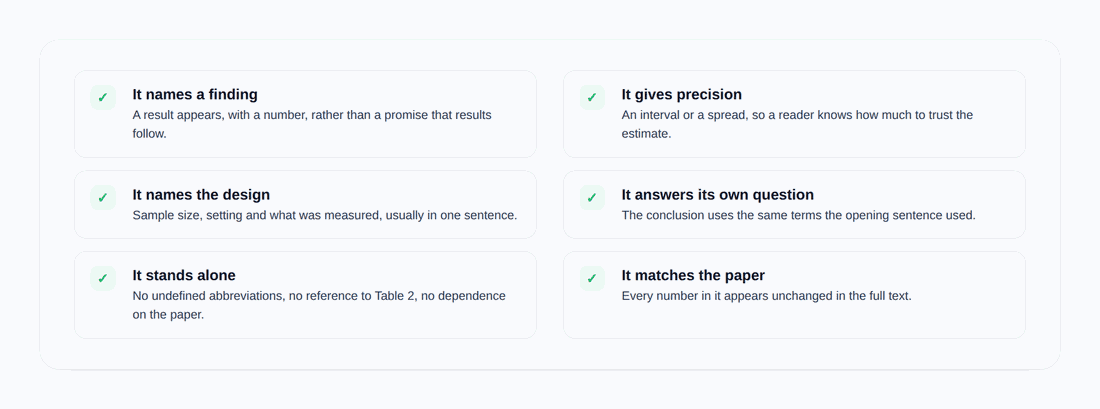
Six habits hold across every format above. A finding appears, with a number rather than a promise. Precision is given, so a reader knows how much to trust the estimate. The design is named. The conclusion answers the question the opening asked, in the same terms. It stands alone, with no undefined abbreviations and no reference to Table 2. And every number in it appears unchanged in the full text.
How often that last one fails
Far more often than anyone assumes. A 2017 review in BMC Medical Research Methodology found a median inconsistency rate of 39% between abstracts and full texts, with an interquartile range of 14% to 54%.
Wording matters as much as figures. In a randomized trial in the Journal of Clinical Oncology, 300 clinicians read a cancer trial abstract with or without spin, and readers of the spun version rated the treatment as more beneficial by 0.71 points on a 10 point scale. Same data, different sentences.
<ProTip title="⚖️ Accuracy check:" description="Read your abstract beside your results section and compare every figure. Ten minutes of checking puts you ahead of a surprising share of published work." />

Turning a specimen into your own
Pull one sentence from each section. Question from the introduction, design from methods, primary result from results, main claim from the discussion. You now have a rough abstract that is already accurate.
Put the numbers back. Effect size, sample size, interval. Most first drafts describe a result without stating it.
Cut background to one sentence. Whatever survives has to earn its place against a results sentence.
Check against the target guide. Word limit, headings, citations, keywords line.
Read it against the paper. Every number unchanged.
Can I copy the structure of a published abstract?
Yes, and you should. Structure is a genre convention, not intellectual property. Copying sentences is plagiarism. Copying the order of moves is how the format is learned.
<ProTip title="📖 Read five:" description="Before drafting, open five recent abstracts from your exact target venue and read them back to back. Twenty minutes teaches the house rhythm better than any guide, including this one." />
<ProTip title="🧭 Pick your type:" description="Match your row in the table above before you write a sentence. A descriptive abstract and a structured research abstract are different documents, and submitting one where the other was expected reads as a study that has not been done." />
<ProTip title="🔬 Study the moves:" description="Read each specimen twice. Once for content, once counting sentences per move. The ratio is the thing worth copying, and it is invisible on a single read." />
From Specimen to Submission
These nine are not templates to fill in. They are nine demonstrations of one discipline: name the question, name the method, give the number, say what it means, and let nothing in the summary contradict the paper underneath. Pick the one that matches your format, read it twice, then close it and write your own.
<CTA title="Write the abstract your paper deserves" description="Jenni drafts alongside your sources and checks how strongly each claim is supported, so the summary matches the study." buttonLabel="Draft My Abstract" link="https://jenni.ai/conference-abstract-writer" />
Once drafted, check it before anyone else does. A review pass catches the overstatement a reviewer would flag. For the mechanics, see our guides on how long an abstract should be, APA abstract format and what belongs in an abstract versus an introduction.