By
Justin Wong
—
Abstract vs Introduction: What Goes in Each (With Examples)

Justin Wong
Head of Growth
Graduated with a Bachelor's in Global Business & Digital Arts, Minor in Entrepreneurship

Both sit at the front of the paper. Both mention the problem, the aim and roughly what you did. So people write one, adjust the wording, and call the other finished.
They have opposite jobs. This guide ends with a decision table you can hold a sentence against, but first the one line that settles most cases.
<CTA title="Write both without repeating yourself" description="Jenni helps you draft the introduction and the abstract as separate pieces of work, with your sources attached where they belong." buttonLabel="Try Jenni Free" link="https://app.jenni.ai/register" />
What is the difference between an abstract and an introduction?
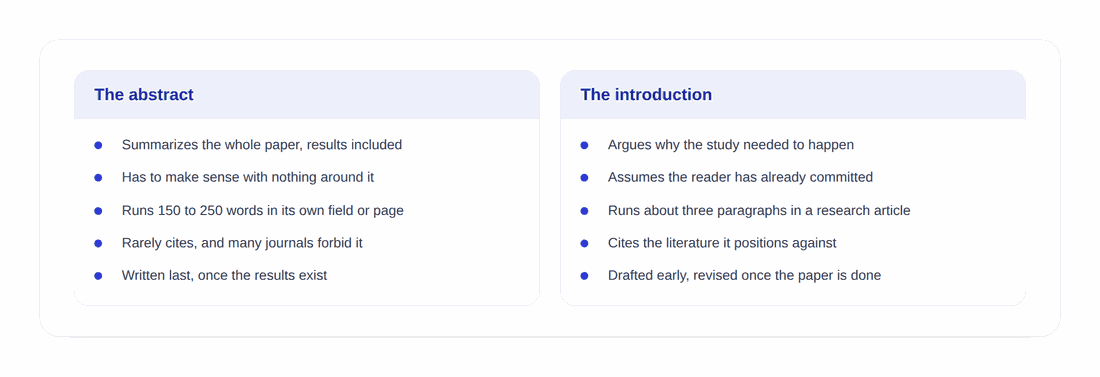
An abstract summarizes the whole paper, including the results. An introduction argues why the paper needed to be written, and stops before the results.
The Walden University Writing Center puts it the same way: an abstract is a summary of your paper, and it does not provide context or attempt to interest a reader in your paper the way an introduction does.
Why the introduction is forbidden from reporting results
This is not a style preference, it is written down. The ICMJE Recommendations instruct authors to cite only directly pertinent references in the introduction, and not to include data or conclusions from the work being reported.
So the abstract must state your findings, because it is the only part many readers will see. The introduction must withhold them, because its job is to make the reader want the answer.

How long each one runs
The abstract has a hard number. Most venues set 150 to 250 words, some 300, and conference caps run tighter.
Introductions are measured differently. A 2020 study in PLOS ONE analyzed paragraph structure across The BMJ, JAMA, The Lancet, NEJM and PLOS Medicine and concluded that where no journal specific guidance exists, authors should use three paragraphs for the introduction, against ten for methods, nine for results and eight for discussion. The BMJ asks for no more than three paragraphs directly.
<ProTip title="🧮 Length check:" description="Count the paragraphs in your introduction before you count the words. Past five, at least one is doing work that belongs in the literature review or the discussion." />
What the introduction does that an abstract cannot
It makes an argument. The standard description is John Swales' Create A Research Space model, usually shortened to CARS.
Establish a territory. Show the topic matters and summarize what is known.
Establish a niche. Point to the gap, the contradiction, or the unanswered question.
Occupy the niche. State your purpose, announce the study, preview the structure where relevant.
The Manchester Academic Phrasebank describes the same sequence. An abstract has no room for that argument. It states the aim and moves on.
The same study, written both ways
The study below is invented for this guide as a formatting model.
The abstract, 158 words
Districts adopting a four day school week often cite staff retention, but the effect on student attendance is rarely tracked past the first year. This study examined daily attendance in 34 rural districts that moved to a four day week between 2018 and 2023, matched to 34 comparable districts that did not. Attendance records for 96,400 students were analyzed with a difference in differences design. Average daily attendance rose by 1.4 percentage points in the first year after adoption (95% CI 0.9 to 1.9), then declined toward the pre adoption level by year three. The early gain was concentrated in middle school grades and among students with prior chronic absence. Teacher vacancy rates fell in adopting districts and stayed lower across the full period. The results suggest that the attendance benefit is real but temporary while the staffing benefit persists, and that districts evaluating the policy on first year data will overstate its effect.
The introduction, 190 words in three paragraphs
More than 850 school districts in the United States now operate on a four day week, and the number has risen every year since 2015. Districts adopting the schedule usually give two reasons: transport and utility savings, and difficulty filling teaching posts in rural labor markets. Early evaluations reported improved attendance and stable achievement, and those findings have been cited widely in board level decisions.
Yet almost all of that evidence covers a single year after adoption. Attendance can rise simply because the calendar has changed, and novelty effects in school scheduling are well documented. Studies that follow districts for three or more years are rare, and the few that exist do not separate the attendance effect from the staffing effect that motivated adoption.
This study addresses that gap. Using daily attendance records from 34 adopting districts and 34 matched comparison districts, we ask whether the attendance gain observed in the first year persists, and whether it is distributed evenly across grade levels and student groups. We also track teacher vacancy rates over the same period so the two effects can be assessed separately.
The introduction never says what was found. The abstract never explains why anyone should care beyond one opening clause.

The decision table
Hold any sentence against this and it resolves.
Element | In the abstract | In the introduction |
Background | One sentence at most | Two or three paragraphs, cited |
Research gap | Implied by the purpose sentence | Stated explicitly and defended |
Aim or question | Yes, one sentence | Yes, usually the final paragraph |
Method | One or two sentences | Brief or absent |
Results | Yes, with numbers | No |
Conclusion | Yes, one sentence | No |
Citations | Rare, banned by many journals | Required |
Length | 150 to 250 words | About three paragraphs |
<ProTip title="🪞 Leak test:" description="Read your introduction and ask whether a stranger could tell what you found. If they can, results have leaked into a section that should not have them." />
Which to write first, and which to write twice
Introduction, early
Writing it forces you to define the gap, which is the single most useful thing a first draft can do for you. It will be wrong by the end, and that is fine.
Abstract, last
The University of Wisconsin Madison Writing Center advises waiting until the full paper is drafted so you know what you are summarizing. Abstracts written first describe the study you intended.
Introduction again, at the end
The third pass is the one people skip, and it is where the two sections come into alignment. Check three things:
Does the gap you claimed still match the finding you produced?
Has any result crept into the final paragraph?
Does the aim sentence use the same terms your abstract uses?
If you are starting the abstract from a finished paper, drafting it against your own sources keeps the summary tied to what the paper actually says.
<ProTip title="🗂️ Order of work:" description="Introduction first, abstract last, introduction again. The third pass is where you align the gap you claimed with the finding you actually produced." />
Whether they can share sentences
Better not to. Copying from the introduction into the abstract imports background into a space that needed a result. Copying the other way drops your finding into a section built to lead toward it.
ICMJE notes that abstracts are the only substantive portion of the article indexed in many electronic databases and the only portion many readers read, which means duplicated background is duplicated in the one place with the least room for it.
<ProTip title="📚 Citations:" description="If your abstract has a citation in it, check the target guide before you keep it. Many journals ban references in abstracts outright, and the ones that allow them usually want author and year only." />
Two Openings, Two Jobs
The abstract answers "what did they find." The introduction answers "why did anyone do this." Hold those apart and the sections write themselves differently with no effort. If a sentence answers neither cleanly, it probably belongs in the discussion.
<CTA title="Draft the front of your paper with sources attached" description="Outline, draft and cite in one place, so the introduction argues its case and the abstract reports what you actually found." buttonLabel="Start My Abstract" link="https://jenni.ai/conference-abstract-writer" />
For each section separately, see our guides to the introduction of a research paper and writing a conference abstract, or the nine worked abstract examples. When the draft is done, a review pass catches claims that drifted between the two.