{{HeadCode}} Reducing AI Hallucinations in Writing: Practical Methods That Work

通过

贾斯汀·王

Reducing AI Hallucinations in Writing: Practical Methods That Work

贾斯汀·王

增长负责人

获得全球商业与数字艺术学士学位,辅修创业

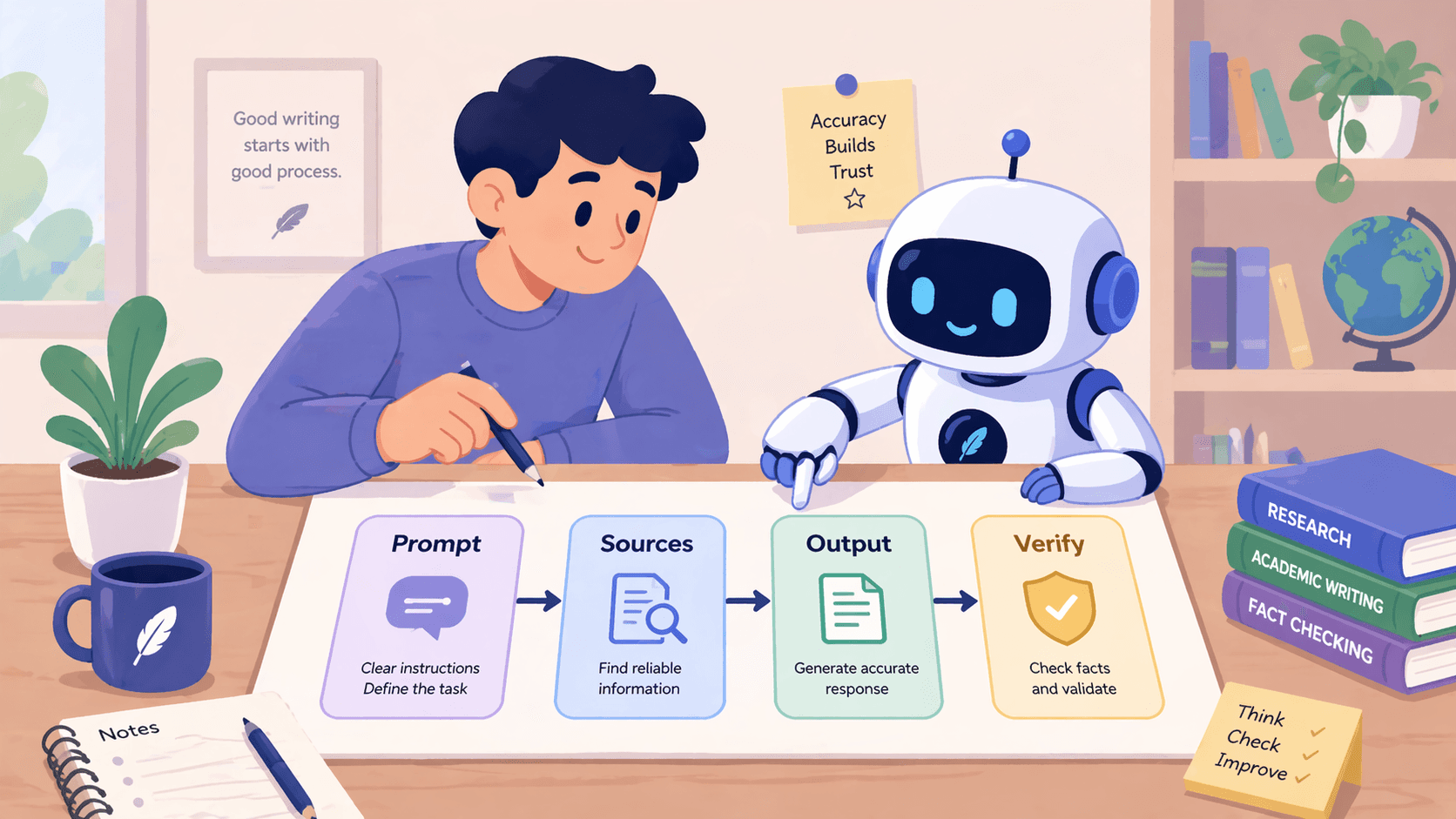
AI models sometimes make things up. This is called a hallucination. To stop this, you need three things: clear instructions, facts to check against, and a system to double-check the answers.

As these tools are used more, wrong answers are a bigger problem. This guide shows you specific, working steps to reduce those errors right now. Ready to build a more reliable workflow? Let's get started.

<CTA title="Write With Fewer AI Errors" description="Generate accurate structured outputs with guided prompts and built in verification steps" buttonLabel="Try Jenni Free" link="https://app.jenni.ai/register" />

Why AI Hallucinations Happen in Writing

At its core, an AI writing tool is a sophisticated pattern-matching engine. It's trained on mountains of text to predict the next word in a sequence. For a deeper look at the mechanics (and where they fail), see our explanation of how AI writing assistants work for academic writing.

This process creates remarkably fluent language, but it doesn't guarantee truth. To use these tools effectively, it is vital to understand the difference between ai hallucinations vs misinformation.

When you ask it a question, it doesn't retrieve a verified fact from a database. Instead, it generates a response based on statistical probability.

The problems start when the prompt is ambiguous or the topic requires specific, up-to-date knowledge the model simply doesn't have.

Three interconnected issues drive most hallucinations:

  • The Ambiguity Problem. A broad or poorly defined prompt gives the AI too much room to invent. Without clear boundaries, it will fill the gaps with whatever word patterns seem most coherent, leading to confident but incorrect statements.

  • The Knowledge Gap. An AI model's knowledge is frozen at its last training update. It has no innate ability to know current events, recent data, or private information. When a query touches on these areas, the model often fabricates an answer that fits the older patterns it knows.

  • The Overconfidence Error. These models are designed to be helpful and sound certain. In specialized areas like law, medicine, or technical specs, they might overapply a general pattern they learned, creating a detailed but fundamentally flawed explanation.

Understanding this is the first step toward control. Since the AI can't distinguish fact from fiction on its own, the responsibility falls on the user to guide it with precision and verify its outputs.

Prompt Engineering for Accuracy and Control

A precise prompt is your first and most powerful defense against made-up information. By removing ambiguity and setting strict rules, you force the AI to work inside a box you define, which dramatically cuts down on its ability to invent details. If you want more structured frameworks and examples, our prompt engineering guide for academic AI writing expands on these techniques.

Think of it this way: a vague prompt like "explain quantum computing" is an open invitation for the model to fill in gaps with whatever sounds good. A strong prompt gives it a job description, a deadline, and a specific format to follow.

For example, compare these two approaches:

  • Weak Prompt: Explain climate change.

  • Strong Prompt: Using only data from the IPCC's Sixth Assessment Report, list three primary human-driven causes of climate change. Format the answer as a bulleted list with one-sentence explanations. Do not speculate.

The second version works because it does three things: it specifies the source (IPCC report), defines the output (bulleted list), and sets a clear boundary ("do not speculate").

Key techniques for reliable prompts:

  • Assign a role: Start with "Act as a financial auditor" or "You are a historian summarizing events."

  • Constrain the sources: Tell it which databases, time periods, or publications to use.

  • Dictate the format: Ask for a table, a list with citations, or a step-by-step explanation.

  • State explicit limits: Use direct commands like "Do not include opinions" or "Only use information provided in the context above."

<ProTip title="💡 Pro Tip:" description="Use structured prompts that define sources scope and output format for higher factual accuracy" />

Key techniques for reliable prompts include assigning a specific role and dictating the format. Another useful method is utilizing chain of thought prompting, which encourages the model to break down its reasoning step-by-step.

This makes the process slower, but the logic is clearer and less prone to jumps to a wrong conclusion. Adjusting the temperature setting (typically to a lower value like 0.2) also helps for factual tasks.

This reduces the randomness in the AI's word choices, making its responses more consistent and predictable. However, a perfect prompt is just the first filter. It sets the stage, but you still need to check the results.

Retrieval-Augmented Generation (RAG): Grounding AI in Data

Retrieval-Augmented Generation (RAG) tackles the core problem: an AI's internal knowledge is limited and possibly outdated.

The solution is straightforward, don't let the model guess. Instead, give it verified documents to use as a reference before it writes a single word.

Think of RAG as making the AI do its homework. When you ask a question, the system first searches a connected database, like your company's internal reports, a legal database, or recent academic papers.

It pulls relevant passages from these real sources and feeds them to the AI with the instruction: "Answer the question using only this information."

This changes the process from open-ended invention to constrained reporting. The model's job shifts from "generate a likely answer" to "synthesize an answer from these provided facts."

A basic comparison shows the difference in approach and result:

Method

Where It Gets Its Info

Factual Accuracy

Hallucination Risk

Standard AI

Its static training data

Moderate

High

RAG System

Your provided external sources

High

Lower

Graph-RAG

A mapped network of connected facts

Very High

Lowest

Advanced implementations like Graph-RAG use knowledge graphs to map entity relationships, which research shows can outperform standard RAG in maintaining logical consistency.

For practical use, you don't need a complex system to start. The simplest form of RAG is copying and pasting the text of a source document directly into your prompt, then asking the AI to summarize or answer questions based solely on that text.

More advanced tools can connect the AI to live databases or your own document library automatically. This method moves the goal from hoping the AI is correct to knowing where its information came from, making verification possible.

Why Human Verification Matters for AI Safety

AI systems can make things up. Human verification is the process of checking what an AI produces against trusted, real-world sources before anyone sees it. This step is crucial, because even the best AI can get things wrong.

Studies in Nature Machine Intelligence emphasize that human-in-the-loop verification is the most effective safeguard, significantly reducing the propagation of AI-generated errors. Fact-checking isn't optional; it's essential.

To keep track of the legitimate sources you find during this stage, using a what is citation manager is highly recommended. This ensures that every claim is backed by a real, traceable document rather than a "hallucinated" reference.

This isn't about skimming an article. It's a structured, methodical process.

How the verification workflow works

A solid verification process follows specific steps:

  • Cross-reference claims. Every significant statement should be checked against at least two reliable sources.

  • Go to the source for data. Don't trust an AI's summary of a statistic. Find and read the original report or publication.

  • Check the citations. Make sure any cited sources actually exist and that the AI has represented them accurately.

  • Flag what you can't confirm. Any claim that seems uncertain or can't be quickly verified gets set aside for deeper, manual investigation.

This approach mirrors the research workflows used in academia and journalism to ensure accuracy.

A practical method: confidence tagging

One effective technique is to tag each piece of information with a confidence level as you verify it. For instance:

  • High confidence: Verified by multiple authoritative sources.

  • Medium confidence: Seems accurate based on one good source, but could use a second check.

  • Low confidence: Unverified, questionable, or from a dubious source. Requires full manual validation.

This tagging system builds transparency. It shows exactly which parts of a document are rock-solid and which might need a second look, which builds trust in the final product.

The bottom line is simple: human oversight is the real safety net. Without it, AI systems, no matter how well-designed, will eventually make a serious error in a complex or unusual situation.

<ProTip title="🔍 Pro Tip:" description="Always verify statistics directly from primary sources instead of relying on AI summaries" />

Reality Filters and Constraint Systems

AI often tries to fill in gaps, even when it shouldn't. Reality filters are a technical approach to stop this. They force the AI to acknowledge uncertainty and avoid making claims it can't back up.

In high-stakes environments, these filters prevent the spread of fake news and misinformation, ensuring that data-driven content remains objective.

If you cannot verify the information, the system should be instructed to respond with "insufficient data" instead of guessing.

The idea started circulating in developer forums and on platforms like X. The core principle is straightforward: program the AI to explicitly state when it lacks information, instead of guessing.

A basic example: The constraint prompt

You can instruct an AI with a simple rule:

If you cannot verify the information, respond with "insufficient data" instead of guessing.

This single instruction, when consistently applied, cuts down on fabricated content. The AI isn't allowed to invent an answer.

Applying hard constraints

More advanced systems use specific, hard-coded rules:

  • No statistics can be presented without a cited source.

  • No named entities (people, companies, places) can be mentioned without verification.

  • No speculative conclusions are permitted.

These rules act as guardrails. They physically limit the model's ability to generate plausible-sounding but false or misleading outputs.

In practical terms, this method makes AI-generated content in technical fields or research much more trustworthy. It trades the illusion of completeness for verifiable accuracy.

<ProTip title="⚠️ Reminder:" description="Force AI to admit uncertainty instead of filling gaps with invented information" />

Memory Systems vs Surface Fixes

Stopping AI from making things up isn't just about clever prompts. To really fix the problem long-term, you need to look at the system's memory.

When you evaluate how to choose ai writing tool, look for platforms that maintain context over long documents.

Surface-level prompt engineering misses deeper structural failures, such as errors that build up over several steps of reasoning.

Researchers have identified a 'cascade effect,' where a significant portion of hallucinations in complex tasks stems from the model losing track of previous reasoning steps.

This isn't a theoretical flaw; it's a real issue people encounter when they use AI for complicated work.

Think of it this way: a good prompt is like putting a bandage on a cut. A memory system is like fixing the underlying cause of the bleeding.

What a good memory system actually does

When an AI can remember, it solves core problems:

  • It keeps track of the conversation and task from start to finish.

  • It stops repeating itself or contradicting something it said five minutes ago.

  • Its responses stay consistent with what it has already produced.

What quick fixes can't solve

Surface-level prompt engineering misses the deeper, structural failures:

  • Errors that build up over several steps of reasoning.

  • The complete loss of context in a long, detailed workflow.

  • Getting a different, conflicting answer if you ask the same question in a new session.

For writing, especially for research, reports, or any long-form content, this is critical. To make AI reliable, the system must be designed to remember and track context over time. Without that foundation, you're just applying bandages.

AI Content Auditing and Error Detection

Systematic auditing identifies hallucinations by analyzing outputs for inconsistencies, To catch an AI's mistakes, you need a system. Auditing is that system, a method for scanning AI-generated text to spot inconsistencies, logical leaps, and claims that have no backup.

It turns AI writing from a gamble into a controlled, repeatable process.

What to look for in an audit

A proper audit runs a few key checks:

  • Verify every number and statistic. Assume they are wrong until proven right.

  • Detect internal contradictions. Does the text argue against itself?

  • Flag vague or unsupported claims. Sentences that sound confident but are hollow.

  • Check citation accuracy. Do the sources exist, and do they actually say what the text claims?

A practical validation checklist

Using a simple table as a guide makes this systematic.

Check Type

What to Look For

Action to Take

Facts

Incorrect or outdated information

Cross-check with primary sources

Citations

Missing, broken, or misrepresented references

Replace with real sources or remove the claim

Logic

Inconsistent reasoning or unsupported conclusions

Rewrite the entire section for clarity

Clarity

Ambiguous or overly broad claims

Add specific details or qualifying context

This structured approach is what separates amateur use from professional, low-risk AI content creation. It's the quality control step that catches errors before they cause problems.

<ProTip title="🧠 Pro Tip:" description="Use a checklist to audit AI outputs before publishing to catch hidden inaccuracies" />

Building a Reliable AI Writing Workflow

To get reliable results from AI, you need a process. A good workflow combines generation, checking, and editing into a single, repeatable system. It's a pipeline, not a one-time command.

The core three-step cycle

  • Generate. Start with structured, constrained prompts that tell the AI what not to do.

  • Audit. Run the output through verification checks. Hunt for inconsistencies and unsupported claims.

  • Refine. Rewrite the sections that are unclear, shaky, or just don't sound right.

This create-check-fix loop is the foundation of professional AI error correction. It's how teams use these tools without introducing mistakes.

How it works on the ground

In practice, a single piece of content might move through these stages:

  • Drafting with engineered prompts to set boundaries.

  • Validating every key claim against external, trusted sources.

  • Finalizing the tone and clarity only after the facts are confirmed.

This method does more than just catch lies. It steadily improves the actual meaning and accuracy of AI-assisted writing, cutting down on false statements from the start.

Stop Guesswork Before It Shows Up in Your Writing

You’ve probably seen it happen, the output sounds confident but something feels off and you can’t fully trust it. That doubt slows you down. It’s a real problem.

<CTA title="Write Accurate AI Content Faster" description="Use structured prompts verification and guided workflows to reduce hallucinations in your writing" buttonLabel="Try Jenni Free" link="https://app.jenni.ai/register" />

The way forward is building a simple system where prompts are clear and every claim gets checked, with tools like Jenni helping you stay consistent without losing control. It won’t replace your judgment, but it makes it easier to catch mistakes early and keep your writing accurate.

目录

今天就开启你的非凡写作之旅

从今天起,用 Jenni 写下你的 第一篇论文,开启全新篇章

免费开始

无需信用卡

随时取消

500万+

遍布全球的学者

5.2小时

每篇论文平均节省

超过1500万篇

在鉴研上完成的论文

今天就开启你的非凡写作之旅

从今天起,用 Jenni 写下你的 第一篇论文,开启全新篇章

免费开始

无需信用卡

随时取消

500万+

遍布全球的学者

5.2小时

每篇论文平均节省

超过1500万篇

在鉴研上完成的论文

今天就开启你的非凡写作之旅

从今天起,用 Jenni 写下你的 第一篇论文,开启全新篇章

免费开始

无需信用卡

随时取消

500万+

遍布全球的学者

5.2小时

每篇论文平均节省

超过1500万篇

在鉴研上完成的论文