By
Nathan Auyeung
—
AI Hallucination vs Misinformation: Key Differences Explained

Nathan Auyeung
Senior Accountant at EY
Graduated with a Bachelor's in Accounting, completed a Postgraduate Diploma of Accounting
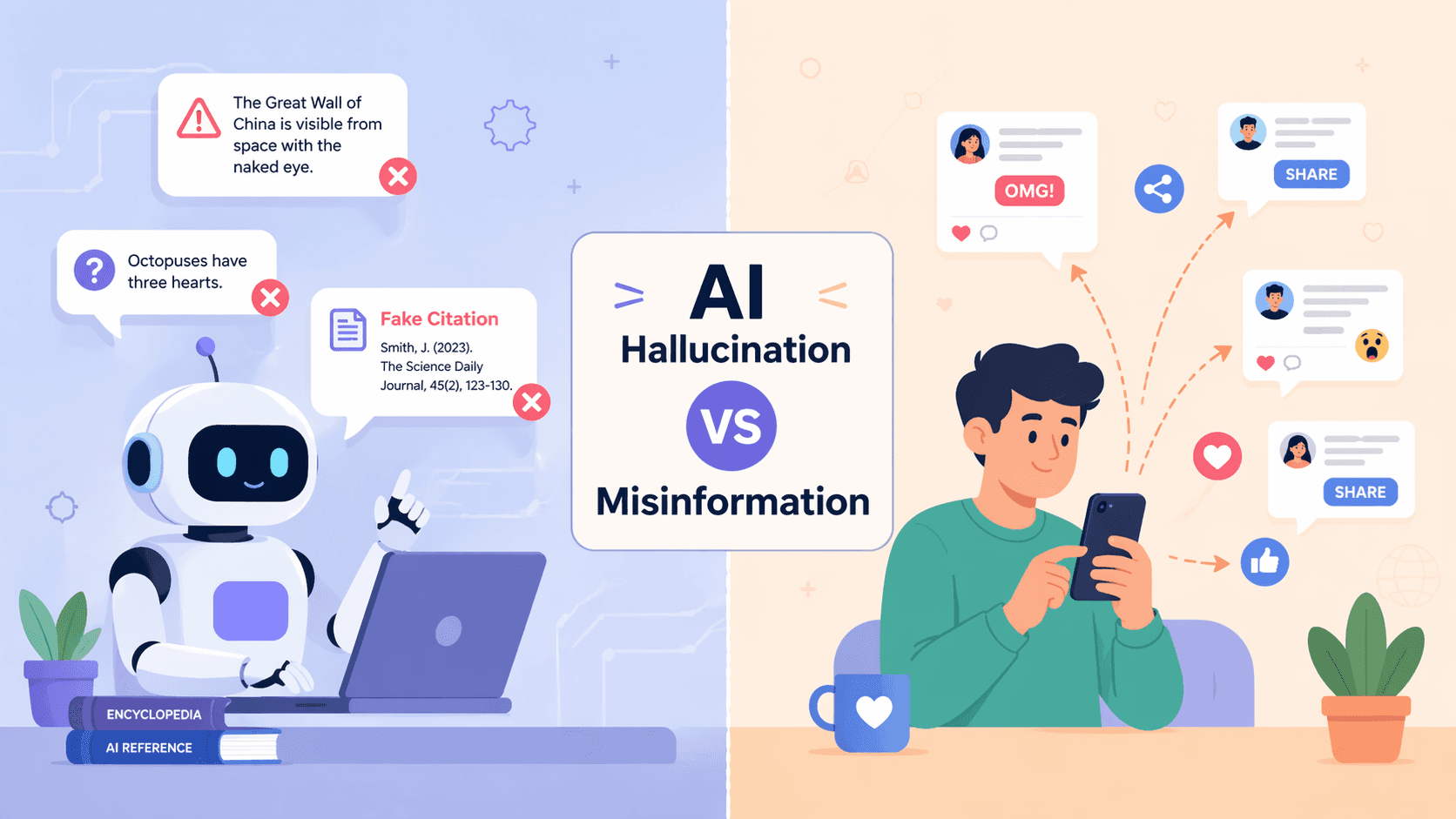
When an AI makes a mistake, it's usually called a hallucination. When a person spreads a lie, that's misinformation. They both give you wrong facts, but they come from completely different places.
Knowing which one you're dealing with is pretty important, especially if you're using AI tools to help with work or research.
The way each problem starts, and how it grows, isn't the same. This matters for figuring out what went wrong and how to fix it, or at least how to avoid it next time.
<CTA title="Improve AI Output Accuracy" description="Create structured prompts and verify AI outputs with clarity and control." buttonLabel="Try Jenni Free" link="https://app.jenni.ai/register" />
What Is AI Hallucination vs Misinformation?
It's easy to mix up these two ideas. They both end with you getting wrong information, but the paths they take to get there are totally separate.
What is an AI hallucination?
Think of it as a system glitch. An AI hallucinates when it confidently spits out something false. This happens because of flaws in its training or simple errors in its prediction process. These models work by guessing the next most probable word in a sequence.
They aren't searching for truth; they're assembling text that sounds right. Because of this, it is crucial to learn how to reduce ai hallucinations in writing by setting strict boundaries.
Stanford's Human-Centered AI Institute noted in a 2023 report that these fabrications become more common when an AI is asked about topics it doesn't fully understand.
What is misinformation?
This one starts with us. Misinformation is false or misleading information shared by people. The key here is intent, it's usually shared by someone who believes it, or at least doesn't mean to cause harm.
Understanding the spread of true and false news online shows that misinformation often spreads through social networks where trust outweighs critical checking.
It spreads through honest mistakes, bias, or just not having the full story. Sharing an old article about a health treatment, thinking it's current, is a typical example.
Groups like the WHO use this term specifically for inaccurate information that isn't deliberately malicious.
Why does everyone get them confused?
The result is the same: you're left with a false fact. But the mechanics aren't. A hallucination is a machine error. Misinformation is human behavior.
The blurring happens when an AI's hallucinated output gets picked up by a person and shared online. Suddenly, a technical fault becomes a social problem.
<ProTip title="💡 Pro Tip:" description="Treat AI outputs as drafts, not facts, until verified with reliable sources." />
Key Differences Between AI Hallucination and Misinformation
The main differences are in where they start, and how they move.
A direct comparison
Aspect | AI Hallucination | Misinformation |
Origin | A flaw in the AI's programming or data. | A mistake or belief held by a person. |
Intent | There is none. It's an accident. | Usually none, or at least not a malicious one. |
Mechanism | The AI guesses what words should come next. | People share, discuss, or believe something false. |
Example | An AI inventing a historical event. | Someone posting outdated financial advice online. |
Spotting It | Tough, because the AI presents it with total confidence. | Depends on the topic. Sometimes it's obvious, sometimes not. |
How they actually function
An AI hallucination is a bit like a very smart, very broken autocomplete. The system has a gap in its knowledge, and instead of admitting it, it makes up something plausible to fill the space.
Misinformation travels through people. It gets pushed along by feelings, fear, excitement, the desire to confirm what we already think, and by simply being repeated enough that it starts to sound true.
Here's a simple analogy: if an AI hallucination is a calculator giving you 2 + 2 = 5 because of a bug, then misinformation is your friend telling you the answer is 5 because they learned it wrong.
When they combine
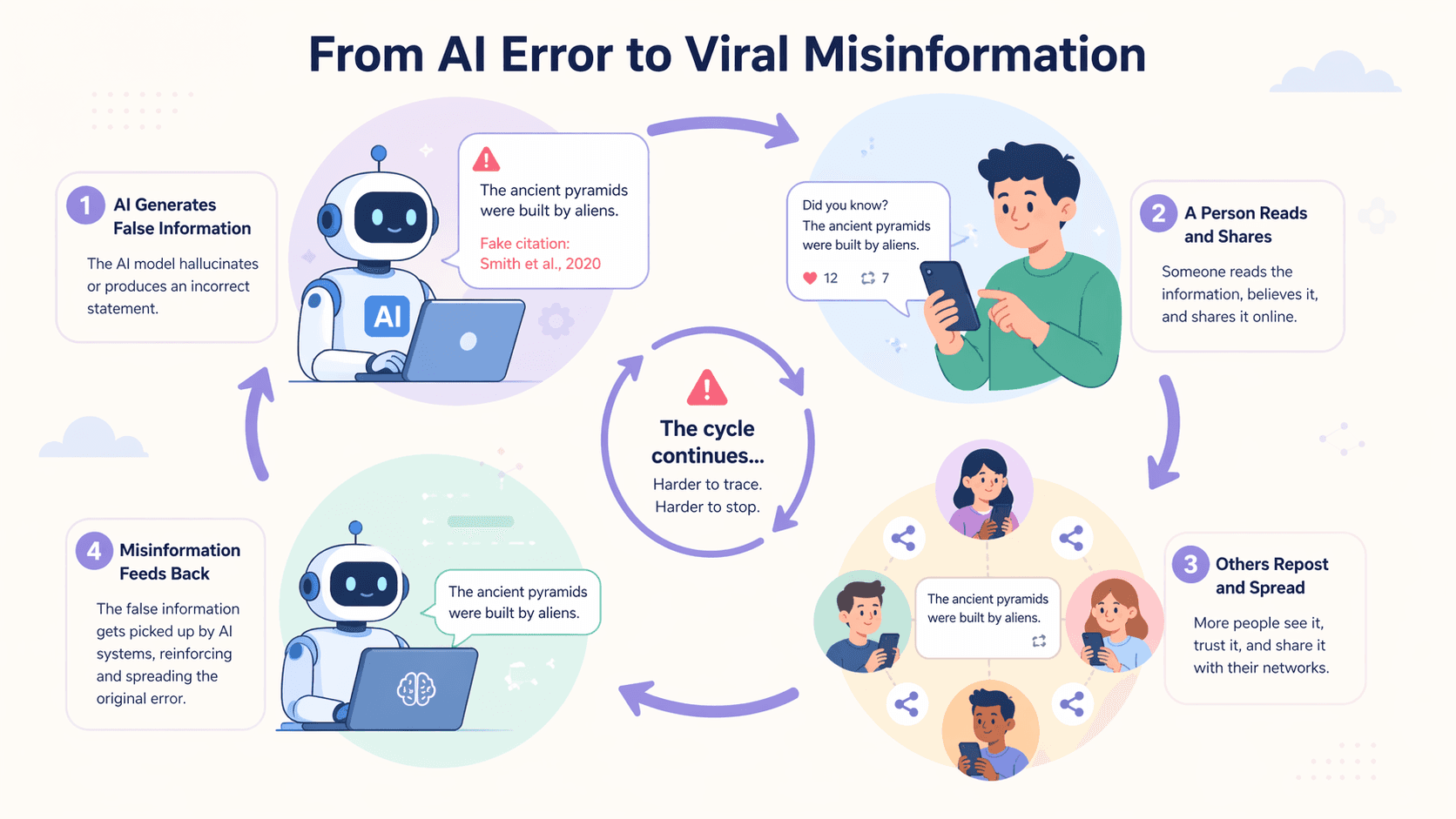
This is where things get messy. An AI might hallucinate a false statistic, which a human then shares. This creates a cycle where the original falsehood becomes harder to trace.
Research into the internal consistency of large language models is helpful here, as it explores how these models can generate deceptive content that looks perfectly authentic to the average reader.
Other people see it, trust it, and maybe even feed it back into another AI system. This loop makes the original falsehood harder to trace and more difficult to root out.
<ProTip title="📌 Note:" description="AI hallucinations can become misinformation once humans share them without verification." />
What Causes AI Hallucinations?
The main reason is that AI language models aren't built to tell the truth. They're built to write sentences that sound good. This leads to a few specific technical problems.
They work by guessing, not knowing
These models operate on probability. They predict the next word based on patterns in their training data, not by checking a fact. If a likely-sounding sequence of words happens to be false, the AI will still generate it.
It's optimizing for coherent language, not accurate information. When you ask it about something obscure or very new, its guesses become less reliable.
A piece from MIT Technology Review pointed out that niche questions are a common trigger for these fabrications.
Their training material has holes
The data these AIs learn from is massive, but flawed. It can be incomplete, old, or full of contradictory statements. If the model wasn't trained on enough information about a particular event or concept, it has a knowledge gap.
To complete your request, it will improvise, stitching together patterns from related topics to create a plausible but invented answer.
They sometimes misunderstand what you're asking
This is called semantic drift. The AI might latch onto one word in your prompt and run with it, missing your actual question.
This leads to answers that are based on a wrong assumption, are completely off-topic, or draw fabricated links between unrelated ideas.
When selecting software for research, knowing how to choose ai writing tool that prioritizes factual grounding over creative "guessing" is vital for maintaining integrity.
When are hallucinations most likely?
You'll see them more often under certain conditions:
When your question is vague or has multiple meanings.
When the topic is so new or specialized that the AI's data is scarce.
When you ask for something very broad, like "everything about X."
When you specifically request hard numbers, sources, or citations, the AI will often invent them to satisfy your prompt.
<ProTip title="💡 Pro Tip:" description="Ask specific and narrow questions to reduce hallucination risk in AI responses." />
How Misinformation Spreads in the AI Era
The way false information moves today is different. AI tools don't start the fire, but they can pour gasoline on it.
People are the engine
Misinformation spreads because we believe it. We trust friends, we like stories that fit our views, and we share things that make us angry or hopeful. Social media platforms take these natural human behaviors and crank up the speed.
The World Economic Forum has listed this combined threat, human bias plus digital scale, as a major global risk.
How AI fuels the problem
AI systems can take a single piece of false information and multiply it. They do this in a few ways:
They can produce thousands of articles, posts, or comments based on a flawed idea.
They write with a confident, expert-like tone that makes the content seem reliable.
If their training data already contained misinformation, they might repeat it and reinforce it.
This leads to a new risk regarding mathematical discoveries from language models, where even high-level automated systems can propagate systemic errors if not properly verified by domain experts.
The new life cycle of a lie
Here's a common pattern now:
An AI model, perhaps through a hallucination, generates a false statement.
A person reads it, assumes it's true because it looks professional, and posts it online.
Others see it, trust the person who shared it, and repost it themselves.
The idea gains traction and starts to feel like common knowledge.
This loop doesn't just spread the original false fact. It also damages trust in the AI systems themselves, because their outputs are directly feeding the confusion. It makes checking sources manually more critical than ever.
Risks and Real-World Impact
Knowing the difference between an AI glitch and a human lie isn't just academic. It matters in places where mistakes have serious consequences.
In research and science
Hallucinations can lead to fabricated data or fake sources. To avoid this, every researcher should use a citation manager to ensure every reference cited actually exists in the real world.
Using an AI to help write a paper can backfire badly. If the tool hallucinates, it might invent a study, fabricate data, or cite a source that doesn't exist.
A researcher who includes this false information could face a rejected submission, or worse, a published paper that later needs to be retracted.
Their reputation takes a direct hit. If you're working in academia, it's also worth knowing how to disclose AI use in academic writing clearly so your methods stay transparent.
There are already documented instances where AI-generated fake references have slipped into drafts sent for peer review.
In law and medicine
The stakes are even higher here. A lawyer using an AI that hallucinates a precedent or a statute could build a case on a foundation that isn't real.
In healthcare, a doctor or nurse relying on an AI for diagnostic support might get a confident, but completely wrong, suggestion.
These scenarios aren't hypothetical; they're the reason experts stress that every single AI output in these fields must be checked by a human against verified sources.
The crumbling of trust
When people repeatedly find errors in AI-generated content, they stop trusting it. This isn't just about one bot.
A broader concern in academic and professional circles is that the flood of AI-assisted work containing hidden inaccuracies could slowly undermine public confidence in published findings, legal documents, and medical advice altogether.
The tool meant to aid progress might instead make us doubt everything.
<ProTip title="⚠️ Reminder:" description="High stakes fields require human verification for every AI generated claim." />
How to Detect AI Hallucinations and Misinformation
Here are some hands-on ways to check what an AI tells you.
A quick way to check Before you trust an AI's answer, run through these points:
Are there any sources or citations? Check them.
Can you confirm the facts using a reliable website or database you already trust?
Does the writing sound too sure of itself, like it's stating opinions as absolute facts?
Have you looked at a couple of other places to see if they say the same thing?
What AI "hallucination" looks like When an AI invents information, you might notice:
References that don't exist, like a fake study or a made-up news article.
Details that change or don't add up if you read carefully.
Explanations that sound very smooth and professional, but are actually vague or empty when you think about them.
For instance, it might cite a paper by a real researcher, but that specific paper was never published.
What misinformation looks like Content designed to mislead often has these traits:
Language that tries to make you feel strong emotions (anger, fear, excitement) to persuade you.
A complete lack of links to trustworthy, verifiable sources.
The same claim popping up repeatedly, but only on blogs or social media accounts known for low-quality info.
Comparing how to spot each problem
What you're looking for | AI Hallucination | Misinformation |
Fact-checking | You have to do it. | You have to do it. |
Checking the sources | This is the most important step. | This is the most important step. |
Analyzing the tone | Not very helpful. The tone can sound perfectly normal. | More useful. The tone is often a big clue. |
Cross-referencing | Works very well. | Works very well. |
In short, you need to verify both. But catching an AI hallucination means paying extra attention to weird technical details and inconsistencies in the information itself.
How to Prevent and Reduce AI Hallucinations
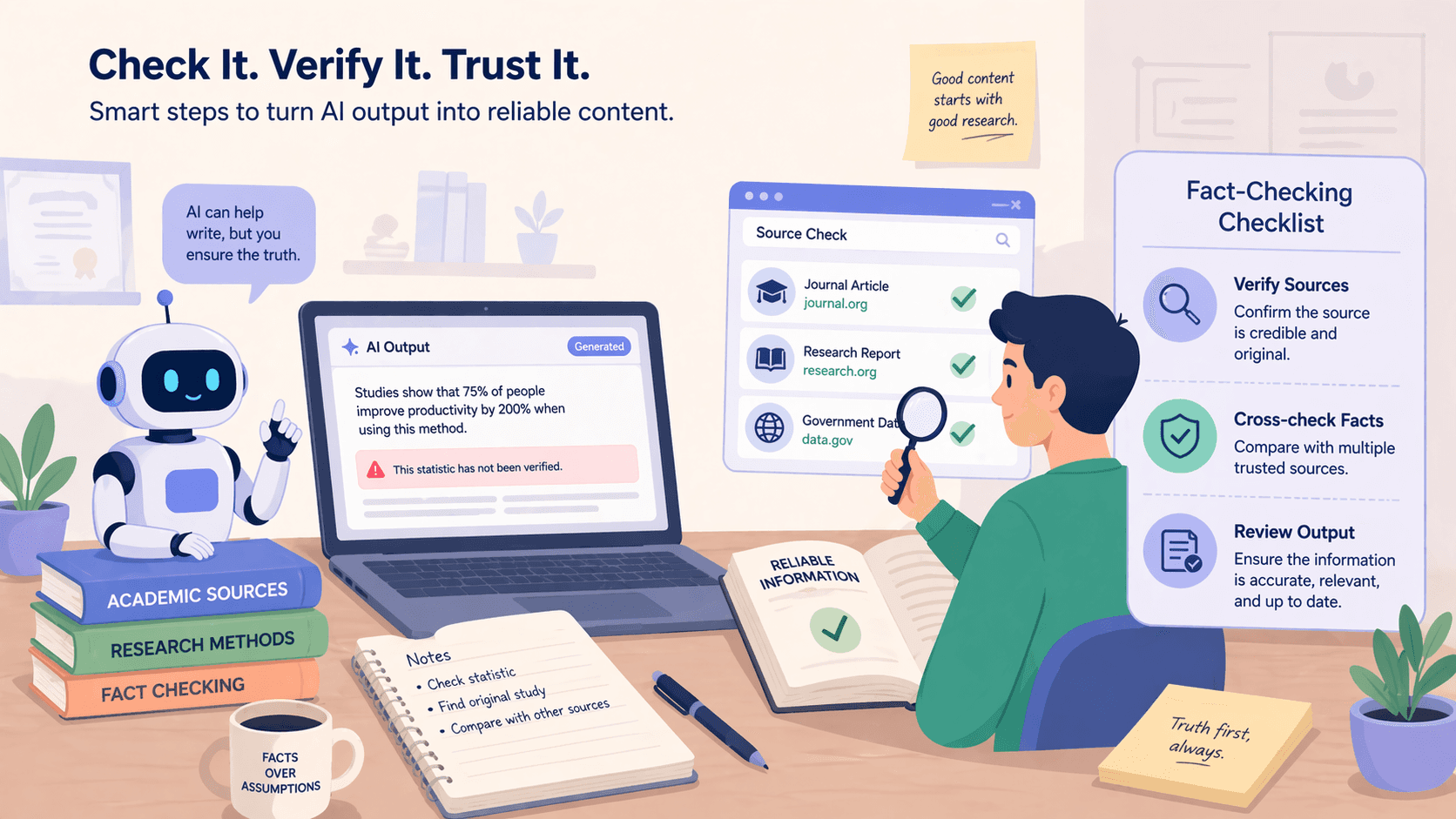
You can take specific steps to make AI answers more reliable. For a more detailed set of tactics, see practical methods that work for reducing AI hallucinations in writing.
Write better prompts The way you ask a question matters. Clear, specific instructions give the AI less room to invent things.
Don't ask: "Explain climate change."
Instead, try: "Summarize the main conclusions from three peer-reviewed studies on climate change published after 2020."
Use systems with external data access Some AI tools are connected to live databases or knowledge sources. This method, often called Retrieval-Augmented Generation (RAG), helps by tethering the AI's response to actual documents and facts. It's a common feature in newer systems designed for accuracy.
Keep a human in charge The single best check is a person. Don't just copy and paste an AI's answer. Build a process where a human reviews the work.
A solid workflow looks like this:
Let the AI create a first draft.
Check every claim in that draft against trusted sources.
Edit and finalize the text yourself.
A few practical rules
Always have a reliable source (like a known journal or official dataset) ready to check facts against.
Be extra careful with very specialized or obscure information. AI is more likely to be wrong here.
Write down where you got your information as you research, so you can trace it back.
Read the final output with a critical eye. If something feels off, it probably is.
<ProTip title="💡 Pro Tip:" description="Combine AI assistance with manual verification to balance speed and accuracy." />
Know the Difference Before It Costs You
It’s easy to mix things up when false information shows up and everything looks convincing at first glance. You start second guessing what’s real. That confusion adds risk.
<CTA title="Write Accurate AI Assisted Content" description="Structure reliable content and reduce errors with guided AI writing support." buttonLabel="Try Jenni Free" link="https://app.jenni.ai/register" />
The smart move is knowing where the error comes from and checking it with a clear process, with tools like Jenni helping you stay organized while you review your work. It won’t replace careful thinking, but it gives you a steady way to keep your content accurate and trustworthy.