By
Nathan Auyeung
—
When AI Disclosure Is Required: Clear Rules That Apply

Nathan Auyeung
Senior Accountant at EY
Graduated with a Bachelor's in Accounting, completed a Postgraduate Diploma of Accounting
You often need to disclose when AI has a real impact on someone’s choice, their trust, or their rights. The rules for this, however, are a global patchwork and they change by industry, platform, and location.
This guide clarifies when AI disclosure is mandatory, when it’s just a good idea, and when you can skip it. You’ll get practical frameworks to use in your own work, from business to content creation. Keep reading to build a clear, actionable policy for your team.
<CTA title="Document AI Use Clearly" description="Structure AI usage statements and disclosures with clarity and confidence." buttonLabel="Try Jenni Free" link="https://app.jenni.ai/register" />
What AI Disclosure Means and Why It Matters
AI disclosure means telling people when artificial intelligence played a key role, whether that's in creating something, making a choice, or handling an interaction. This is about being clear, not about getting in trouble.
The EU AI Act: first regulation on artificial intelligence, for instance, sets transparency rules specifically for AI that shapes what the public sees or believes, like deepfakes or automated judgments. The basic goal is to avoid confusion.
The real question isn't whether AI was used, but what effect it had. Using an AI tool to draft an internal memo is low impact.
Using it to help write a public blog post carries more weight. Using it to make a decision about someone or to represent your brand directly has the highest impact, and the strongest need for a disclosure.
This push for transparency is growing for a few clear reasons: new laws are rolling out, big platforms like YouTube are setting their own rules, and people simply expect to know when they're dealing with a machine.
The OECD found that more than 60% of official AI governance rules, influenced by the OECD AI Principles, now require some form of transparency.
<ProTip title="💡 Pro Tip:" description="Think impact first. The more your AI affects people, the stronger your duty to disclose." />
When AI Disclosure Is Legally Required
When a law says you have to disclose your use of AI, you have to do it. It's not a suggestion. The EU's new AI Act sets strict rules.
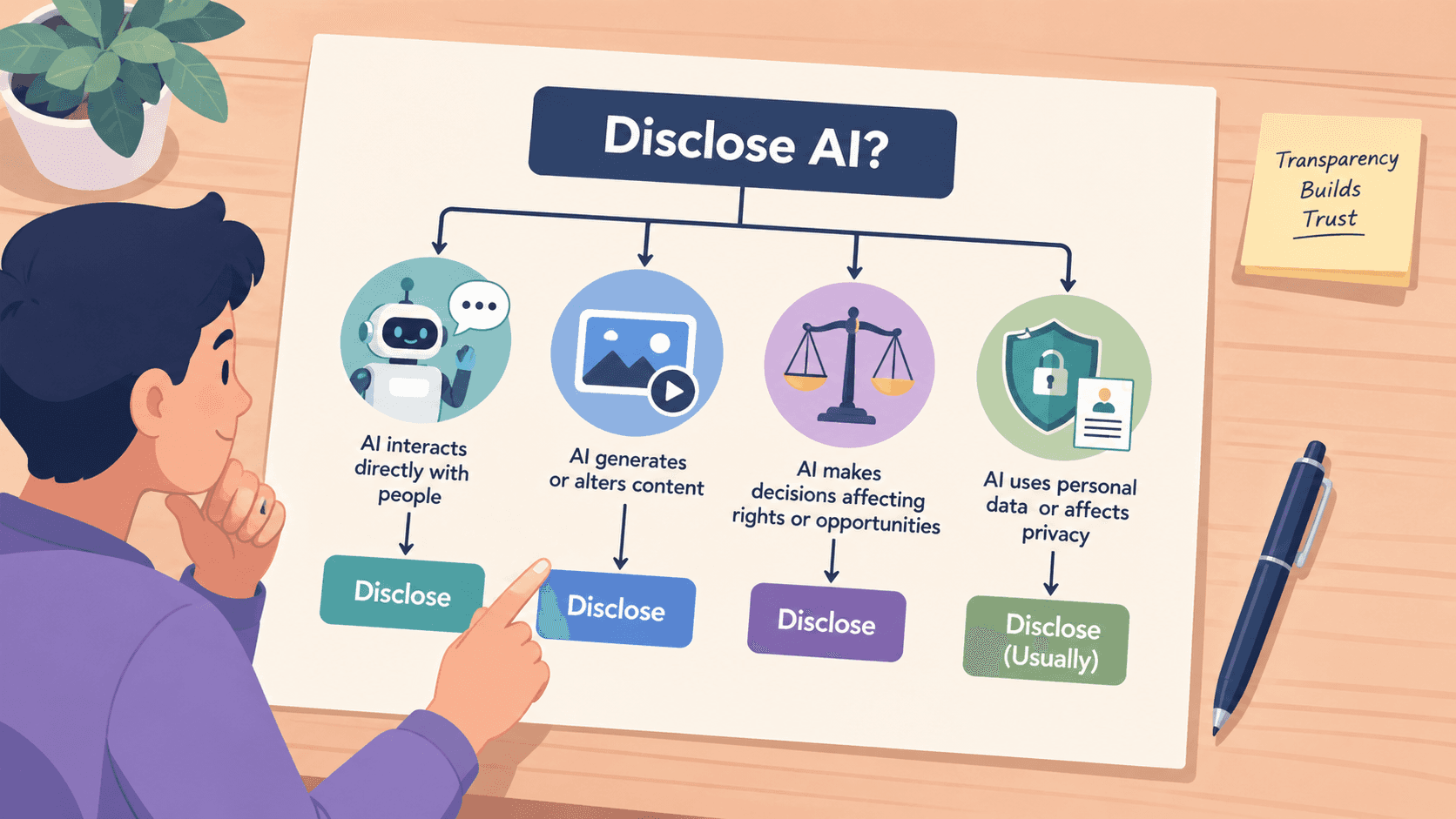
You must tell people when content is AI-generated but looks real, when an AI is directly talking to them, or when an automated system makes a decision that affects them.
The GDPR adds another layer, giving individuals the right to know about and challenge these automated decisions.
The goal, as the European Parliament states, is to safeguard fundamental rights, particularly with high-risk systems.
To better understand how to manage risk, many organizations look toward the NIST AI Risk Management Framework.
In the United States, state-level laws are filling the gap. California, New Jersey, and Utah all have laws requiring bots to identify themselves in commercial conversations, so people know they aren't talking to a human.
The rules are also tightening in advertising and media. If an ad uses a synthetic face or voice.
If any AI-created content could realistically fool a consumer, regulators now expect a clear disclosure. Getting this wrong can lead to fines under standard consumer protection laws.
When AI Interacts Directly With People
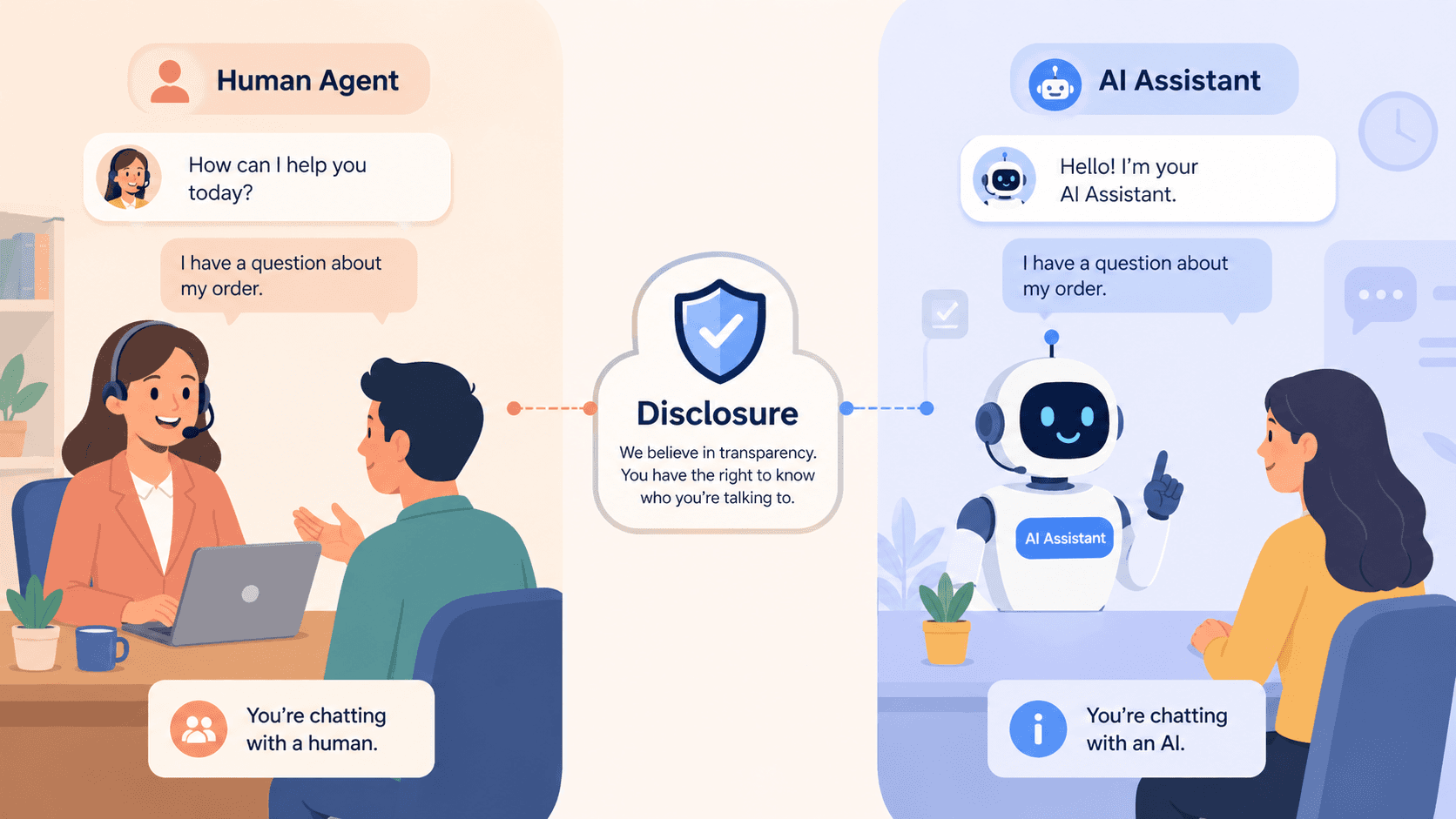
If an AI system is talking directly to a person, that's a major signal for disclosure. People have a right to know who, or what, they're dealing with.
Take customer service. A banking chatbot that discusses loan options, or a retail bot handling returns, should identify itself upfront.
This stops any false impression a human is on the other end, and it actually helps build trust over time.
Before deploying these systems, companies must evaluate how to choose AI writing tools that support transparency and brand safety.
The stakes get much higher in fields like healthcare, law, or finance. If an AI tool is involved in suggesting a diagnosis, reviewing a legal document, or giving financial advice, disclosure is crucial.
Even without a specific law, professional ethics and user expectations demand transparency when the outcome impacts someone's health, liberty, or money.
Then there are automated decision systems that gatekeep opportunities. Algorithms used in hiring, determining credit scores, or setting insurance premiums directly shape a person's access and fairness.
Disclosing the role of AI in these processes isn't just about clarity; it's a fundamental issue of rights.
<ProTip title="⚠️ Reminder:" description="If AI influences a decision about a person, disclosure is often expected or required." />
When AI Generates or Alters Content
Content creation is the area where AI disclosure gets the murkiest, and the rules are evolving fast.
Social media platforms are now drawing hard lines. YouTube mandates a disclosure for realistic, synthetic content. X automatically applies “Made with AI” labels.
The common thread is a need for clarity when AI-made content could be mistaken for reality.
In journalism and academic publishing, the expectation is shifting. If AI played a substantial role in drafting an article, analyzing data, or generating insights, you're expected to say so.
Major academic bodies, like COPE, now advocate for AI usage statements to uphold research integrity.
For students and researchers, the principle is similar to plagiarism. If you used an AI to write parts of a paper or develop an argument, you must learn how to disclose AI use in academic writing to avoid serious consequences.
This transparency is just as important as knowing what is a citation manager when organizing your sources; both ensure the integrity of your final work.
<ProTip title="📘 Note:" description="In academic work, always disclose AI use in methods or acknowledgments sections." />
When AI Uses Personal Data or Affects Privacy
When AI systems work with personal data, the rules for disclosure tighten significantly, driven by privacy laws.
Under regulations like the GDPR, you have a clear obligation to inform users. If an AI is profiling their behavior, creating personalized recommendations, or automatically filtering content for them, they need to know.
The disclosure must be specific: what data is being used, how the AI makes its decisions, and what rights the user has to question or opt out.
This applies even when the AI itself is invisible. The targeted ads you see, the "suggested for you" playlists, the subtle tracking of your online habits, these are all powered by AI.
The requirement to disclose isn't about the tool being seen, but about its real effect on a person's choices and privacy. If the AI shapes their experience or uses their data, transparency is required.
When Disclosure Is Not Always Required
You don't always have to announce your use of AI. The need for disclosure depends entirely on the context and the potential impact.
Internal or low-impact use
If you're using AI privately, for tasks that never reach an outside audience, disclosure is typically unnecessary.
This covers using a chatbot to brainstorm ideas, drafting internal meeting notes, or employing a code-completion tool in your own development environment. The key is that no external party is affected or misled.
Human-reviewed outputs
When a human being thoroughly reviews, edits, and takes full responsibility for an AI-generated output, a formal disclosure may not be legally required.
However, it's still a wise practice for academic papers, public reports, or work in sensitive fields like medicine or law, where credibility is paramount.
The gray area: partial assistance
Most everyday use lives in a middle ground. Think of using an AI tool to edit for tone, rewrite a tricky paragraph, or improve the clarity of a draft.
In these cases, whether you disclose comes down to a few factors: how much of the final work is the AI's contribution, what your specific audience or industry expects, and the formal policies of your organization or publisher. There's rarely a single right answer.
<ProTip title="💡 Insight:" description="If removing disclosure would mislead your audience, you should disclose." />
Practical Checklist: When to Disclose AI Use
Use this simple framework to make a quick decision.
Scenario | Disclosure required? | Why |
An AI chatbot talks to users | Yes | Prevents people from thinking they're dealing with a human. |
AI creates realistic images, video, or audio | Yes | Stops synthetic media from misleading the audience. |
AI makes a decision that affects someone (e.g., hiring, credit) | Yes | A matter of fairness and protecting individual rights. |
AI processes personal data for profiling or personalization | Usually | Often required by privacy laws like GDPR. |
AI helps draft internal memos or brainstorm ideas | No | The impact is contained and doesn't affect the public. |
AI is used to edit grammar or rephrase a few sentences | It depends | Hinges on your industry's norms and the final human oversight. |
This table breaks down complicated guidelines into straightforward, actionable choices.
Common Misconceptions About AI Disclosure
Several persistent myths confuse the practical application of AI disclosure rules.
"You must disclose every single use of AI."
This isn't true. The trigger for disclosure is the impact of the use, not the mere fact that AI was involved. Announcing every minor application, like using a grammar checker, creates noise and dilutes the importance of disclosures for high-impact situations.
"A disclosure shields you from legal or ethical liability."
It doesn't. While being transparent is a critical first step, it doesn't absolve you of responsibility for the accuracy of the content, the fairness of a decision, or the final outcome. You remain accountable for what the AI produces or recommends.
"Adding an ‘AI-generated’ label fulfills all obligations."
A label is just the start, especially in serious contexts. For decisions affecting someone's rights, health, or finances, you often need to provide a meaningful explanation of how the system worked, maintain documentation of the process, and ensure there is a clear path for human review and appeal.
A Simple Framework for AI Disclosure Decisions
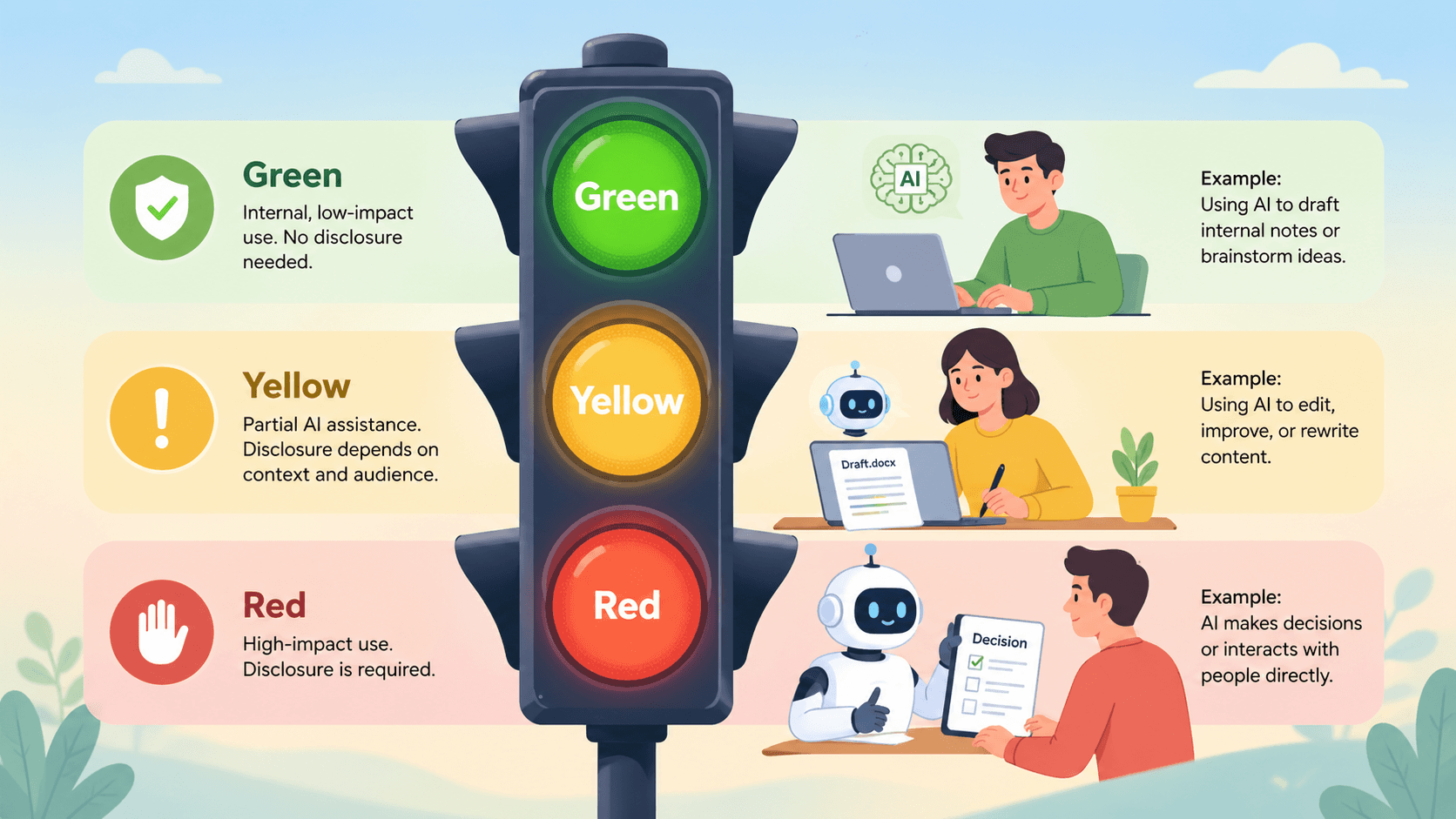
Think of the need for disclosure like a traffic light system. It turns a complex judgment call into a clearer, faster process.
Green Light: No disclosure needed
This is for internal, low-impact use where the AI's work stays behind the scenes. Examples include using AI to brainstorm ideas, draft private notes, or complete routine code.
Since no external audience is affected or could be misled, you can proceed without a disclosure.
Yellow Light: Consider disclosure
This is the caution zone for partial AI assistance. It covers tasks where AI significantly edits, rewrites, or improves content that will be seen by others.
Whether you disclose depends on the degree of AI contribution, your audience's expectations, and any specific rules from your publisher, client, or institution. It's a judgment call.
Red Light: Disclosure required
This is for high-impact situations where AI has a direct effect on people. It's mandatory when an AI interacts with users, generates realistic synthetic media, makes automated decisions (in hiring, finance, etc.), or processes personal data in a meaningful way.
Here, transparency isn't optional, it's a necessity for trust, fairness, and often for legal compliance.
Using this framework cuts through the ambiguity and helps teams make consistent, defensible choices without overthinking every single use case.
When AI Disclosure Becomes Non-Negotiable
You can feel the tension when AI is shaping outcomes behind the scenes, especially when decisions affect trust or rights. It creates doubt fast. People start questioning what’s real, what’s assisted, and what’s being hidden. That uncertainty matters. It can damage credibility before you even notice.
<CTA title="Write Clear AI Disclosure Statements" description="Create accurate and transparent AI disclosures for research, content, and business use." buttonLabel="Try Jenni Free" link="https://app.jenni.ai/register" />
Using Jenni gives you a simple way to stay clear and upfront without overthinking every line. It helps you document AI use in a way people understand, so you don’t risk confusion or pushback. It’s not extra work. It’s protection.