By
Justin Wong
—
How to Disclose AI Use in Academic Writing Clearly

Justin Wong
Head of Growth
Graduated with a Bachelor's in Global Business & Digital Arts, Minor in Entrepreneurship
Using AI tools to help write an essay or research paper is pretty common now. But you can't just quietly paste from AI and call it a day.
Major journals and universities have made it a rule: you have to be upfront about what AI you used and how. This isn't about getting you in trouble.
It's about making sure you're still the one in charge of your own work. You're confirming that you checked everything, you stand by the ideas, and the final content is your responsibility.
Think of it as giving credit, the same way you would cite a book—including citing large language models in academic writing when they meaningfully shape your draft. This guide lays out the simple, non-negotiable rules for doing it right.
<CTA title="Write Transparent AI Disclosures" description="Create clear AI usage statements for essays and research without confusion or risk." buttonLabel="Try Jenni Free" link="https://app.jenni.ai/register" />
Why AI Disclosure Matters in Academic Writing
It's simple: honesty builds trust. When you're clear about using a tool like ChatGPT, you show your professor, your reviewers, and your readers that you have nothing to hide.
Almost every major publisher, Elsevier, Wiley, and groups like the International Committee of Medical Journal Editors, now demands this.
They all agree on one key point: an AI can't be listed as an author. A growing body of research on publishing policies reinforces that transparency is becoming a universal requirement across journals, as outlined in recent findings on ai use in academic writing.
The logic is straightforward. Using an AI to help draft or edit doesn't transfer responsibility. The Committee on Publication Ethics is clear: the author is always ultimately accountable for the work.
If the AI makes an error or a false claim, it's on you. That's the core principle here. The AI is a tool, like a powerful spell-checker, not a partner.
What happens if you don't mention it? The consequences are real and they're severe. Journals will reject your paper. If a hidden use is discovered later, the published work can be retracted.
It can trigger a formal investigation for academic misconduct. In the long run, it erodes your credibility with colleagues who now wonder what else you might not be disclosing.
The consensus from recent academic debates is consistent: getting caught hiding AI use does far more harm than just being open about it from the start.
For specific, detailed guidelines on research integrity, you can consult resources from the World Health Organization or the U.S. Office of Research Integrity.
<ProTip title="💡 Pro Tip:" description="Treat AI like a research assistant you must acknowledge in every major contribution." />
When You Should Disclose AI Use
You need to disclose AI use any time it plays a meaningful role in creating your work. The important word there is "meaningful." It's not about every single keystroke, but about substantial help.
Clear cases where disclosure is required
If the AI tool helped shape the actual content of your paper, you have to report it. Typical examples are:
Using it to rewrite paragraphs to improve clarity.
Having it summarize other research papers for you.
Generating initial ideas or a structural outline.
Getting assistance with data analysis or writing code.
Creating figures, charts, or other visuals.
Here's a concrete scenario: you ask ChatGPT to summarize five key studies for your literature review chapter. You must disclose this. The AI's summary directly influenced how you understood and presented that prior research.
The gray areas: minor help versus substantial help
Not every use of AI is the same. Some tools function a lot like the grammar checkers we've used for years.
Minor use includes basic spell-checking or fixing comma splices.
Substantial use involves rewriting sentences, generating new content, or performing analysis.
Many universities and publishers don't require a statement for that minor, technical use. But a growing number of researchers and editors suggest you disclose it anyway. It's the safer, more transparent path.
What people are actually saying
Looking at discussions in academic forums and conference talks reveals a consistent worry. There's a fear that secret AI use gives some students or researchers an unfair edge and slowly degrades trust in published work.
Some academics frame it as AI "removing the intellectual effort," particularly when whole paragraphs or sections are rewritten by a machine.
Others counter that the problem isn't the tool itself, but how we hide it. Transparency, they argue, is the straightforward solution.
The practical consensus is this: if the AI altered the meaning, the structure, or the substance of your writing, you should disclose it.
If you're still unsure where that line is, our breakdown of how much AI content is acceptable in a research paper can help you calibrate your approach.
Where to Place AI Disclosures in Your Paper
You can't just tuck your AI disclosure in a footnote and hope everyone sees it. To be perfectly clear, you should mention it in several places throughout your submission.
This multi-placement approach is consistent with evolving publisher expectations, including formal policies on ai author guidelines, which emphasize visibility and accountability across different sections of a manuscript.
Where it usually goes
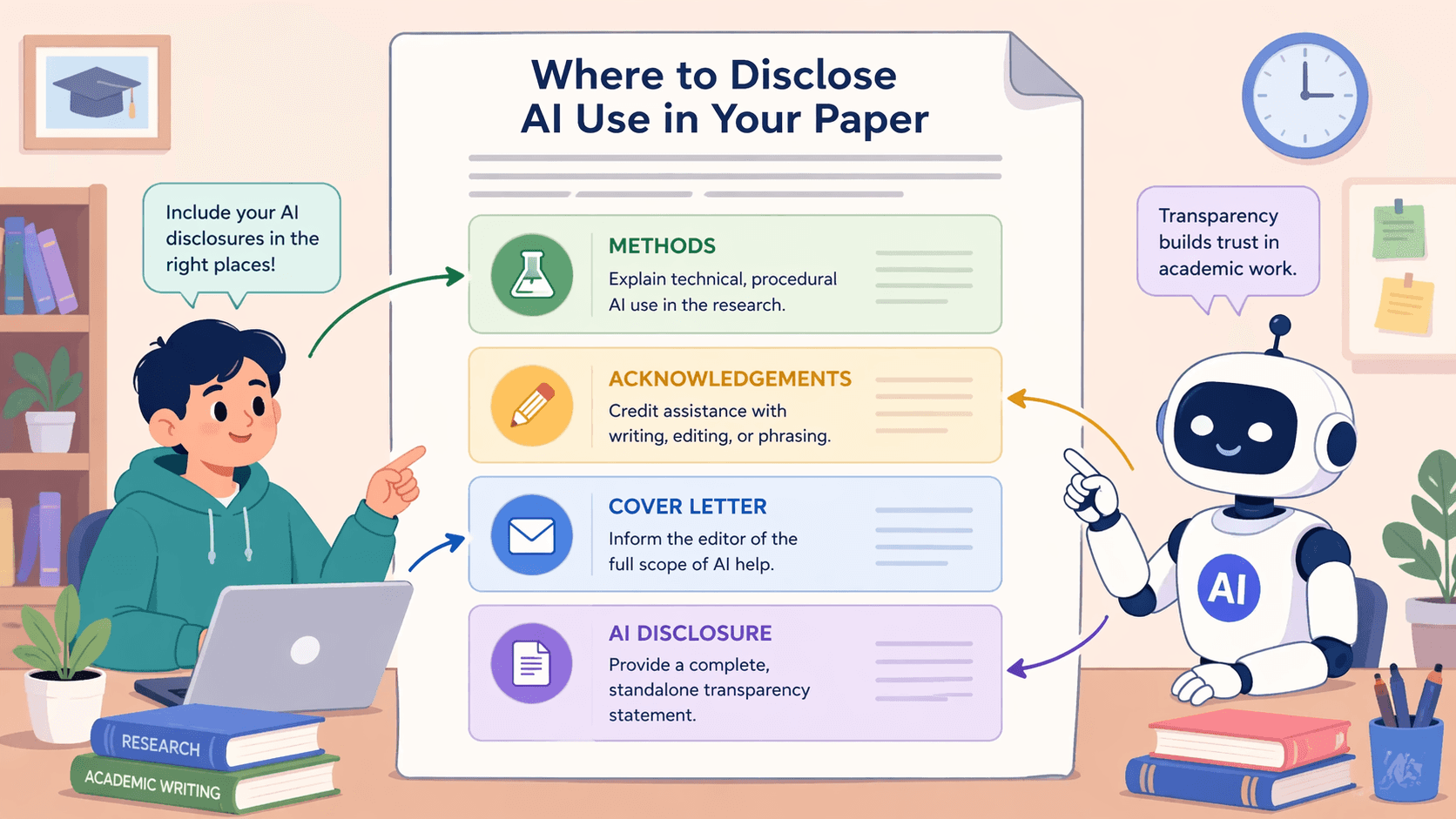
Most journals and university guidelines will tell you to include disclosures in these key areas:
The Methods section, if you used AI for data analysis, modeling, or any part of the research process itself.
The Acknowledgements, for any help with writing, editing, or phrasing.
Your cover letter to the editor, providing a summary of how AI was involved overall.
A dedicated AI section in the manuscript, which is becoming a common requirement.
Paper Section | What the Disclosure Does | Example of When to Use It |
Methods | Explains technical, procedural AI use. | You used an AI tool to analyze your dataset or build a model. |
Acknowledgements | Credits assistance with writing and editing. | You used Grammarly for grammar or ChatGPT to rephrase a tricky paragraph. |
Cover Letter | Informs the editor of the full scope of AI help. | A brief summary stating, "AI was used for language editing and to generate the initial literature review outline." |
Dedicated Section | Provides a complete, standalone transparency statement. | When a journal specifically asks for a section titled "Declaration of Generative AI and AI-assisted Technologies." |
Why you need to say it more than once
Each of these placements talks to a different person. The editor skims your cover letter first. The reviewer digs into your methods. The final reader looks at your published paper.
Putting the statement in all the relevant spots cuts down on confusion and shows you're taking transparency seriously. It makes your work more credible from the first look to the last.
<ProTip title="📌 Note:" description="Always check journal guidelines before submission since placement rules vary." />
What to Include in an AI Disclosure Statement
A good disclosure is specific. It's transparent. It should leave no room for guesswork about what the tool did and what you did.
The importance of detailed reporting is also reflected in broader research discussions on ai transparency in research writing, where clarity and accountability are key themes in maintaining research integrity.
The pieces you need to include
Every statement must cover these points:
Tool name and version (e.g., ChatGPT-4, Grammarly 7.0)
The specific purpose it served
Which sections of the paper it affected
The date or timeframe you used it
A clear statement of human review and final responsibility
From vague to precise
Don't write something weak and generic like: "AI tools were used."
Do write something exact. For example:
Tool: Chat GPT-4
Purpose: Summarizing key points from ten source articles.
Section: Literature Review (paragraphs 2-4).
Process: The authors reviewed, fact-checked, and rewrote all AI-generated text.
A complete example statement
Here’s what that looks like put together:
"In writing this manuscript, the authors used ChatGPT-4 (March 2025) to assist in summarizing background literature for the introduction. All content generated by the tool was subsequently reviewed, edited, and verified by the authors, who assume full responsibility for the work's accuracy and conclusions."
This level of detail matches what major publishers like Springer Nature and IEEE now expect.
What to leave out
Avoid these common errors that will raise a reviewer's eyebrow:
Listing the AI as a co-author. It's a tool, not a contributor.
Using fuzzy language like "AI helped with the writing." How, exactly?
Forgetting to state outright that you, the human author, are responsible for everything in the final document.
<ProTip title="💡 Pro Tip:" description="Specific details make your disclosure credible and reviewer friendly." />
AI Disclosure Templates You Can Use
Using a template is smart. It saves you time and makes sure you don't forget a required piece.
If you're organizing sources alongside AI-generated summaries, understanding what is citation manager is can also help streamline your workflow and ensure proper attribution.
Here are formats you can copy for different parts of your paper.
For the Methods or Acknowledgements section
"During the preparation of this work, the authors used [Tool Name and Version] on [Date or Month/Year] to assist with [Specific Purpose, e.g., summarizing literature, editing for clarity].
All outputs from this tool were reviewed, edited, and fact-checked by the authors, who take complete responsibility for the final content."
For your cover letter to the editor
"Please note that the preparation of this manuscript involved the use of AI-assisted technology. Specifically, [Tool Name] was used for [Specific Purpose, e.g., drafting the initial outline and improving language flow].
Every piece of AI-generated content was subsequently reviewed, verified for factual accuracy, and substantially edited by the authors. No unedited AI text appears in the submitted work."
For a dedicated AI statement section
Declaration on the use of generative AI and AI-assisted technologies In the writing of this manuscript, the authors utilized [Tool Name] to assist with [Specific Purpose]. The AI was not used to generate data, interpret results, or draw conclusions.
All text produced with its assistance was critically reviewed and edited by the authors. The authors affirm they are solely accountable for the published work's content, integrity, and accuracy.
These templates follow the common requirements from journals and help you avoid the simple mistakes that can lead to a desk rejection. Just fill in the bracketed details.
Publisher Guidelines You Must Know
While every journal has its own specific guidelines, they all circle back to the same two principles: be transparent, and remember that the human is always responsible.
If you're unsure how to choose the right AI tool while staying compliant, it helps to review guides on how to choose ai writing tool so your usage aligns with academic expectations from the start.
A quick look at major publisher policies
Publisher / Organization | Their Key Requirement |
Elsevier | Requires a dedicated section in the manuscript for AI disclosure. |
Wiley / COPE | Mandates disclosure for any "substantial" AI assistance in the work. |
Springer Nature | Calls for transparent reporting of the AI's role in the Methods or a similar section. |
IEEE | Demands full disclosure for AI use in generating text, code, or figures. |
ICMJE | Asks for disclosure both within the manuscript and in the cover letter to the editor. |
These policies aren't static. They're updating all the time. Checking the official author guidelines for your target journal right before you submit is a non-negotiable step.
The one universal rule
Across every single publisher and academic body, this is absolute: An AI tool cannot be listed as an author. Only a human being can be held accountable for the claims, data, and conclusions in a scholarly paper.
This rule isn't just bureaucratic. It's the foundation of accountability. It ensures that when a reader has a question, or a result needs to be verified, there is a person, not a piece of software, who is answerable.
Ethical Risks of Not Disclosing AI Use
The real-world risks of hiding AI help
This isn't just about following a rule. It's about what happens to your work and your reputation when you aren't open.
To keep your workflow structured and compliant, it's useful to explore tools and features explained in the citation manager features guide, especially when combining citations with AI-assisted writing.
Why trust disappears
There's a real conversation happening right now in faculty lounges and on academic forums. People are worried.
Recent bibliometric analyses suggest an increasing trend in AI-detectable patterns in academic submissions, highlighting the growing challenge of undisclosed AI usage.
When a reader, a reviewer, or a professor starts to wonder if parts of your paper came from a machine, their faith in everything you wrote begins to crumble. The doubt is corrosive.
What people are actually worried about
The ethical concerns aren't abstract. They're practical and frequently cited:
Losing your own voice. A paper should sound like you, not like a generic AI tone.
Skipping the hard work. The process of struggling with ideas is where real understanding is built. AI can shortcut that crucial effort.
Introducing subtle errors. AI "hallucinates" facts, citations, and data. If you don't catch it, those falsehoods become yours.
These aren't hypothetical fears. They're the direct reasons why departments and journals are tightening their rules.
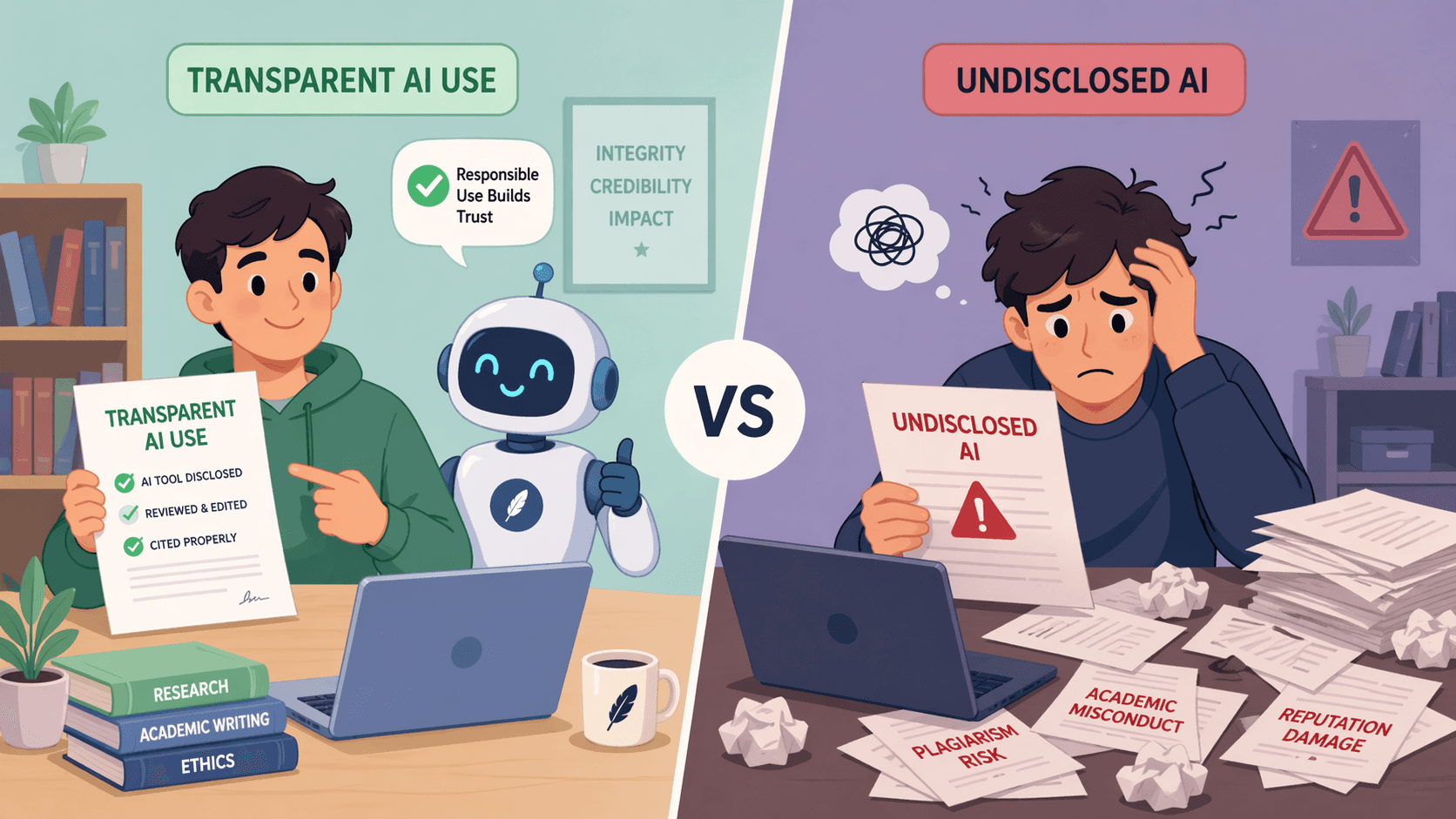
A simple choice: open or hidden
Your Approach | The Likely Outcome |
Being Transparent | Builds credibility with editors and readers. It meets policy requirements directly. |
Keeping it Hidden | Risks immediate manuscript rejection. If discovered later, it permanently damages your professional credibility. |
Choosing transparency isn't just about compliance. It's a professional signal. It tells people you are confident enough in your own work to be clear about how it was made.
<ProTip title="⚠️ Reminder:" description="Hiding AI use is riskier than using AI openly and responsibly." />
Step-by-Step: How to Disclose AI Use Properly
A practical guide to disclosing AI use
Here's a straight-forward process to document AI assistance in your academic work.
1. Pinpoint how you used AI Go through your project and note every instance where AI played a role. Common examples include:
Writing initial drafts.
Polishing language and editing text.
Running data analysis or generating summaries.
Brainstorming ideas or outlining structures.
2. Gauge the extent of assistance Decide how much the AI contributed. Was it a small tweak, a major structural edit, or something in between? When you're unsure, it's safer to disclose the use.
3. Draft your disclosure statement Be direct and factual. A simple template works well:
"AI tools were used in the development of this work for [specific task, e.g., language editing and initial drafting]. All content was reviewed and verified by the author."
4. Put the statement in the right place Where you include this note depends on the publication's rules. Typical locations are:
The Methods or Methodology section.
An Acknowledgements section.
A cover letter submitted to the journal. Always check the specific guidelines for your target publication first.
5. Keep your own records Save everything related to the AI's involvement. This means holding onto:
The exact prompts you gave the tool.
Different versions of your drafts.
A log of the edits you made after AI generation. This paper trail is crucial. If anyone questions your authorship, these records prove the work is ultimately yours.
Be Clear About AI Use Before It Becomes an Issue
You might think a small omission won’t matter, but unclear AI use can raise questions fast and put your work at risk. It creates doubt. That’s the problem.
<CTA title="Create Clear AI Disclosure Statements" description="Write accurate AI usage statements that meet journal and university requirements with ease." buttonLabel="Try Jenni Free" link="https://app.jenni.ai/register" />
The better move is to state exactly how you used AI and keep it consistent across your work, with tools like Jenni helping you organize clear disclosures without overthinking it; our AI writing assistant for researchers is built to support that kind of accountable workflow. It won’t take responsibility off you, but it makes it easier to stay transparent and meet academic expectations.