By
Justin Wong
—
Theory Testing in Research: Methods and Common Mistakes

Justin Wong
Head of Growth
Graduated with a Bachelor's in Global Business & Digital Arts, Minor in Entrepreneurship
Theory testing is what you are doing when the theory arrives before the data. You take a general claim somebody else established, work out what it implies for your particular case, and go and find out whether that implication holds. It is the deductive half of research, and it is the half most postgraduate work sits in.
The distinction that makes it useful is its opposite. Theory building starts from observations and produces a theory. Theory testing starts from a theory and produces a verdict. Which one you are doing determines your design, your analysis, and what counts as a good result.
<CTA title="Keep Theory and Evidence Properly Connected" description="Jenni helps you draft with sources attached and claims checked against what you showed" buttonLabel="Try Jenni Free" link="https://app.jenni.ai/register" />
What Theory Testing Actually Means
Bhattacherjee's open social science methods textbook puts the distinction as cleanly as anyone: in inductive research the goal is to infer theoretical concepts and patterns from observed data, while in deductive research the goal is to test concepts and patterns known from theory using new empirical data. He then names them directly: inductive research is theory-building research, and deductive research is theory-testing research.
Note what that means for your contribution. In theory-building work, the theory is your output and you are judged on whether it is a good one. In theory-testing work, the theory is your input, and you are judged on whether the test was fair.
Theory Building and Theory Testing Side by Side
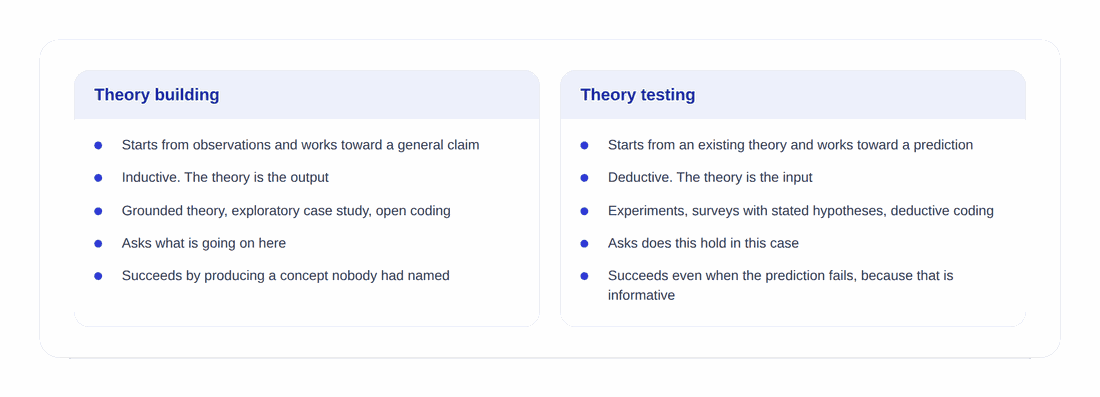
Theory building starts from observations and works toward a general claim. It is inductive, the theory is the output, and it lives in grounded theory, exploratory case studies, and open coding. It asks what is going on here, and it succeeds by producing a concept nobody had named.
Theory testing starts from an existing theory and works toward a prediction. It is deductive, the theory is the input, and it lives in experiments, surveys with stated hypotheses, and deductive coding against a prior framework. It asks whether the theory holds in this case, and it succeeds even when the prediction fails, because a failed prediction is informative in a way an inconclusive exploration is not.
Bhattacherjee is explicit that this is not a hierarchy: theory building and theory testing are both critical for the advancement of science. Fields move by cycling between them.
<ProTip title="🔁 Which mode:" description="If you can name the theory in your title, you are testing. If the theory would have to be written in your discussion because it did not exist before you looked, you are building" />
What a Testable Theory Has to Give You
Not every theory can be tested as stated, and discovering that in month eight is expensive. Three things have to be present.
A claim general enough to have implications. If the theory only describes the case it came from, there is nothing to carry into yours.
Constructs you can operationalize. Every concept has to be turned into something measurable, which means specifying precisely how it will be measured, with what instrument, and how the result will be interpreted. A theory whose central construct nobody can measure is untestable in practice even if it is coherent in principle.
A prediction that could come out false. This is the one people skip. If every possible result is compatible with the theory, you have not designed a test.
<ProTip title="🧪 Design it:" description="Write the sentence that would falsify your theory before you write the one that would support it. If you cannot produce the first sentence, redesign the study rather than the hypothesis" />
How a Theory Test Runs

The sequence is short and each step constrains the next.
Take the theory and state it in one sentence. Derive a prediction of the form if this theory holds, then in this population we should observe this. Operationalize both sides, so that the prediction points at a specific measured value rather than at a direction. Fix your measures before collecting, so the prediction is genuinely exposed. Then collect, analyze, and report what follows.
That last step is where theory testing goes wrong most often, and the error is a logical one. Confirming your prediction does not establish the theory, because other mechanisms could produce the same observation. Concluding otherwise is the fallacy of affirming the consequent. A failed prediction is logically much stronger, which is why negative results deserve more respect than they usually get.
There is one honest complication. When a prediction fails you have also been testing your measures, your sample, and your procedure. The failure tells you something in that bundle is wrong, not necessarily the theory. Saying so explicitly reads as rigor rather than as hedging.
<ProTip title="🔒 Lock it:" description="Write your prediction and your measures down before you collect anything, and date the document. A prediction specified after the data is not a test, and experienced examiners can spot one" />
Where Theory Testing Shows Up by Design
Design | What it tests | Typical output |
Experiment | Whether a manipulation produces the predicted effect | A supported or unsupported hypothesis |
Survey with stated hypotheses | Whether predicted relationships hold in a population | Model fit and coefficient signs against predictions |
Confirmatory case study | Whether the theory explains a case chosen because it should be a hard test | Support, qualification, or a boundary condition |
Deductive qualitative coding | Whether a prior framework accounts for what participants describe | Supported, contradicted, refined, or expanded constructs |
Replication | Whether an established finding recurs under specified conditions | A successful or failed replication, both publishable |
The qualitative row surprises people. Deductive qualitative analysis is a real tradition, described by Fife and Gossner as combining deductive and inductive work to examine supporting, contradicting, refining, and expanding evidence for the theory being examined. The theory tells you where to look. It does not tell you what you found.
<ProTip title="📉 Negative results:" description="A failed prediction is a finding, not a failure. Report it in the same voice you would have used for a confirmation, and address whether the theory or the measures are the likelier culprit" />
Test the Theory, Not Your Attachment to It
The mark of good theory-testing work is that a reader can see how it could have come out differently. State the theory, state what would count against it, fix that before you look, and report the result you got rather than the one you wanted.
<CTA title="Write Up a Test Your Examiner Can Follow" description="Structure your chapter, cite the theory properly, and check that your claims match your evidence" buttonLabel="Try Jenni Free" link="https://app.jenni.ai/register" />
If you are still deciding whether your project builds or tests, write the one-sentence prediction and see whether you can. Everything downstream, from the methodology section to how you handle the sources you rest the theory on, follows from that answer.