By
Justin Wong
—
Snowball vs Convenience Sampling: Key Differences Explained

Justin Wong
Head of Growth
Graduated with a Bachelor's in Global Business & Digital Arts, Minor in Entrepreneurship
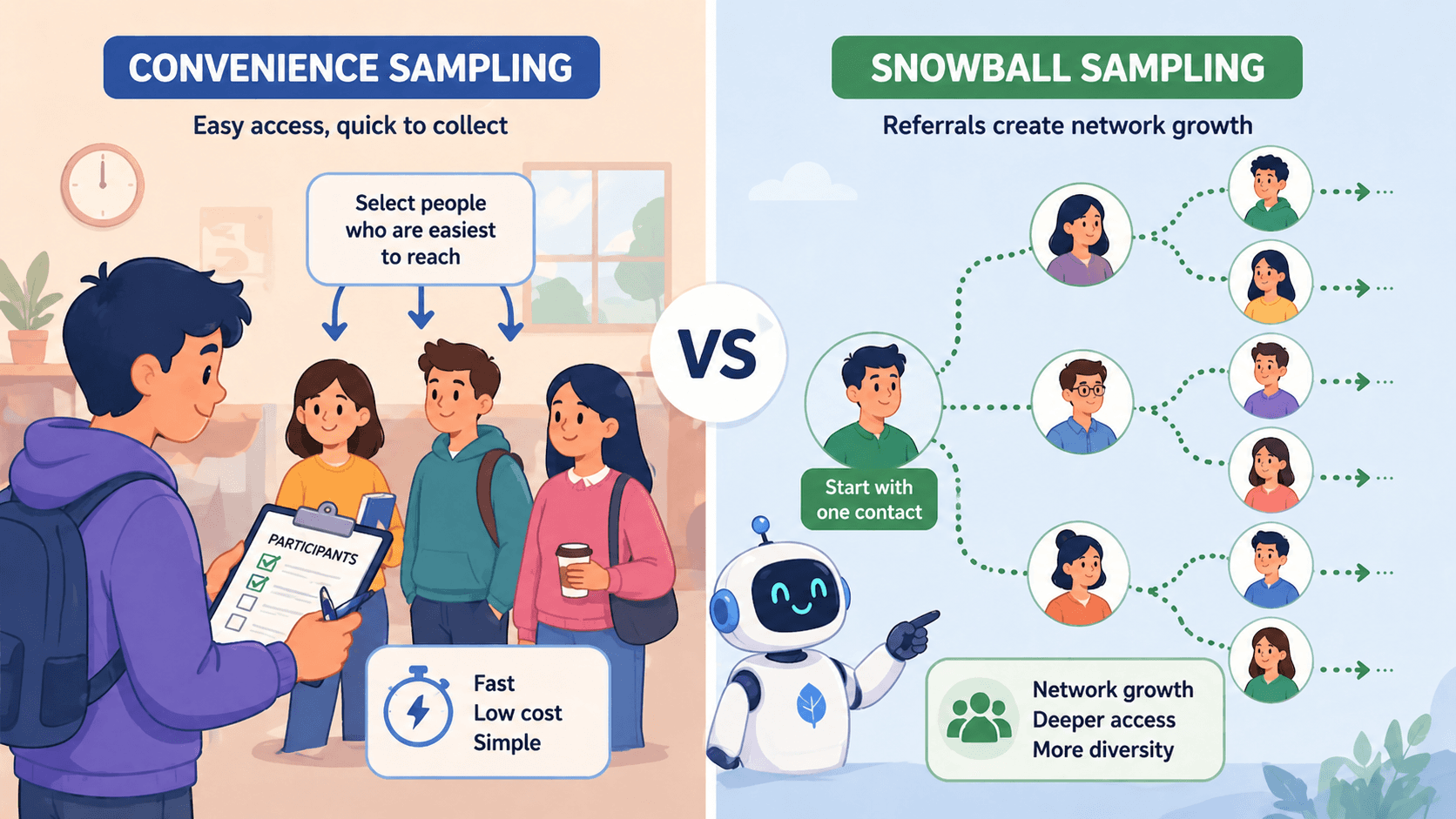
Choosing participants is a practical challenge in qualitative research. Snowball sampling asks existing participants to recruit others, building a network. Convenience sampling just uses whoever is easiest to reach, like students in a classroom.
The core difference is how bias enters your study from the start. Snowball can access hidden populations, while convenience is fast and cheap. Your choice depends entirely on your research question. Want to see how each method works in practice?
<CTA title="Design Better Sampling Strategies" description="Turn vague recruitment plans into structured research methods with clarity and precision." buttonLabel="Try Jenni Free" link="https://app.jenni.ai/register" />
What Snowball and Convenience Sampling Actually Mean
Neither snowball nor convenience sampling uses random selection. These non-probability sampling methods pick participants based on who you can reach or who your contacts know. They're standard in fields like public health where a random sample isn't practical.
Convenience Sampling in Practice
This method uses whoever is easiest to find. You might survey people in a shopping mall or students in your class. It's fast and cheap. You'll see it in pilot studies, classroom projects, or initial market research.
The selection is driven by simple access. For a deeper look at real-world applications, exploring convenience sampling examples can help clarify its limitations and strengths.
Snowball Sampling Explained
Here, you start with a few participants and ask them to refer to others. Your sample grows through a chain of personal connections.
It's the go-to method for studying groups that are hard to find, like undocumented workers, people with rare medical conditions, or niche online communities.
<ProTip title="💡 Pro Tip:" description="Use snowball sampling when trust is required since referrals increase participation rates." />
Snowball vs Convenience Sampling: Core Differences
The right method depends on your research goal. The table below shows the practical trade-offs and the pros cons of different sampling methods.
Aspect | Convenience Sampling | Snowball Sampling |
Recruitment | Direct access | Referral chains |
Speed | Very fast | Slower growth |
Cost | Low | Low |
Bias Type | Availability bias | Network homophily |
Best Use | Accessible groups | Hard-to-reach populations |
Diversity | Often limited | Network dependent |
What This Means in Practice
Convenience sampling is about speed. You use it when participants are easy to find, like surveying shoppers at a mall. Snowball sampling is about access.
You need it to study sensitive or hidden groups, like undocumented migrants. The referral chain builds trust.
A Simple Analogy
Convenience sampling is picking fruit from the lowest branch. Snowball sampling is asking a local where the hidden orchard is. Both get you fruit, but they come from very different trees.
<ProTip title="📌 Reminder:" description="Always justify your sampling choice in your methodology section to avoid reviewer rejection." />
Advantages and Disadvantages of Each Method
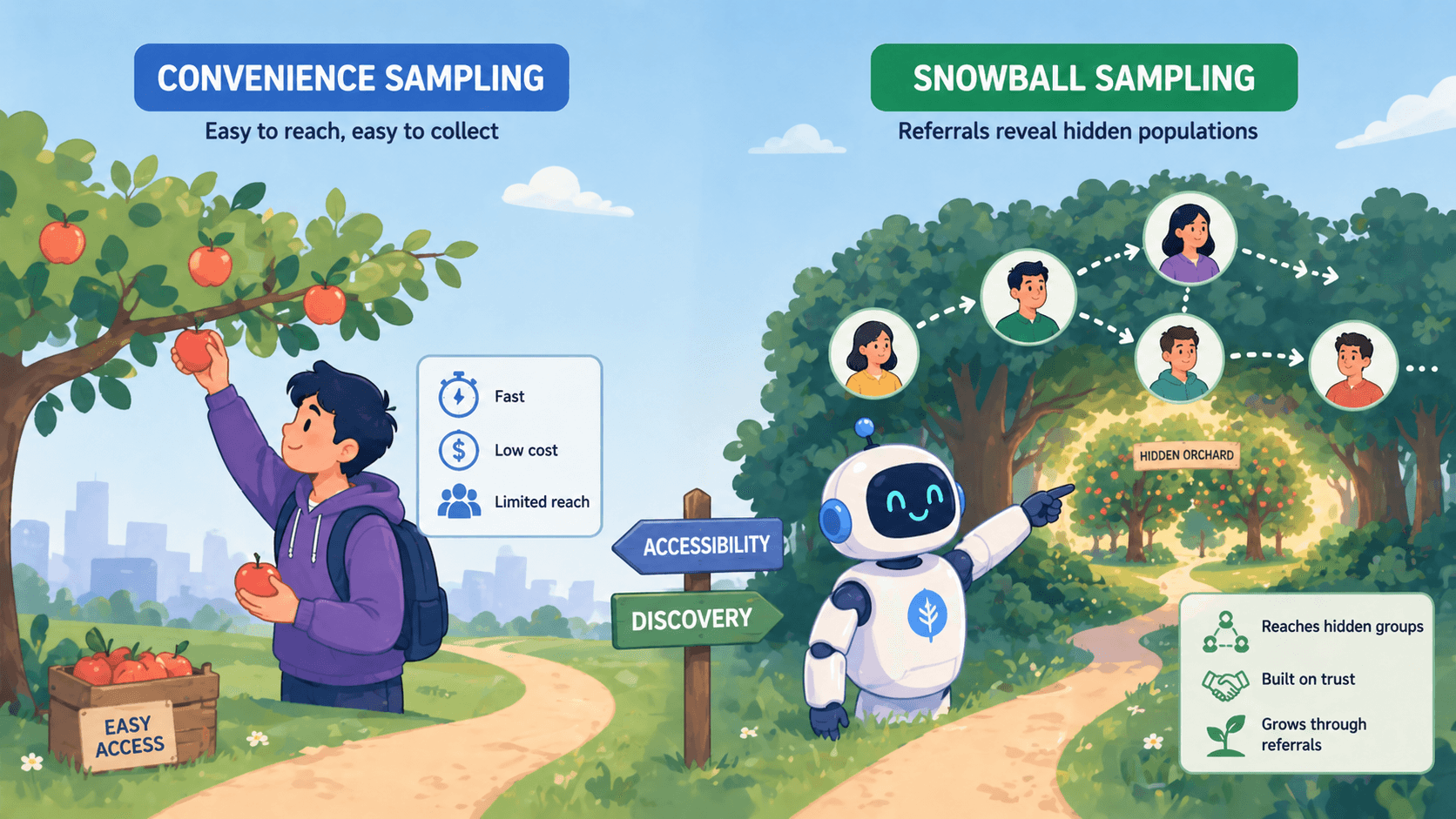
Every research method has its trade-offs. Knowing them helps you manage risk and set realistic expectations for your findings.
Advantages of Convenience Sampling
Convenience sampling is widely used because it lowers the barrier to getting started. If time, access, or budget is tight, it often makes practical sense.
Quick to implement: You can start collecting data almost immediately
Low cost: No need for complex recruitment strategies
Useful for pilot studies: Great for testing surveys or research design
Accessible populations: Works well when your target group is easy to reach
It’s especially helpful in early-stage research, like classroom projects or exploratory studies, where the goal is to get a rough sense of patterns rather than draw firm conclusions.
If your target group is large and easy to find, convenience sampling is often the most practical choice.
Disadvantages of Convenience Sampling
The trade-off for speed and ease is bias. The people who are easiest to reach are rarely representative of a larger population.
Availability bias: You only capture those who are accessible
Limited diversity: Certain groups may be overrepresented (e.g., students)
Weak external validity: Findings don’t generalize well
Self-selection issues: Participants who opt in may differ systematically
This doesn’t make the method useless, it just means you need to be careful about what claims you make based on the data.
Advantages of Snowball Sampling
Snowball sampling shines in situations where access is the main challenge. Some populations are difficult to identify or approach directly, and this method helps bridge that gap.
Access to hidden groups: Useful for hard-to-reach or sensitive populations
Built-in trust: Referrals make participants more willing to engage
Effective for qualitative research: Supports in-depth, detailed data collection
Flexible recruitment: Expands naturally through participant networks
Because of this, it’s commonly used in fields like sociology, ethnography, and public health, especially when studying topics that require trust and openness.
This is often the preferred choice when navigating different research paradigms that value subjective experience over broad generalizability.
Disadvantages of Snowball Sampling
The same network-based approach that makes snowball sampling effective can also introduce problems.
Network bias: Participants tend to refer people similar to themselves
Homogeneous samples: Perspectives can cluster within the same social circles
Limited control: Hard to predict who will be recruited next
Uncertain sample size: Recruitment depends on participant willingness
So while it can open doors that other methods can’t, it doesn’t guarantee a balanced or representative sample.
<ProTip title="⚠️ Note:" description="Limit referral waves to reduce clustering effects in snowball sampling." />
When to Use Snowball vs Convenience Sampling
Your choice isn't just about theory. It's a practical decision based on who you need to study, your timeline, and your resources. It also depends on your broader choice between qualitative vs quantitative research goals.
Use Convenience Sampling When
This method fits straightforward, accessible situations. Think of it as your default option when representation isn't the top priority. You should use it when:
Your participants are easy to find and reach.
You're working with a tight deadline.
Your budget is very small.
The goal is preliminary insight, not generalizable conclusions.
A typical example is handing out a feedback survey to the first 100 students who enter a campus library. It's fast, cheap, and gives you immediate data for an exploratory study or a pilot test.
Use Snowball Sampling When
Switch to snowball sampling when your target group is hidden or hard to identify. It's about access, not speed. You should use it when:
There's no public list or obvious place to find participants.
Building trust is essential for participation.
Social or professional networks define the group.
You need in-depth, qualitative understanding.
For instance, to study cryptocurrency traders operating in closed online forums, you'd need an initial contact to vouch for you and introduce you to others. This method is standard in sociology, ethnography, and public health for studying sensitive topics.
Combining Both Methods
In practice, researchers often blend these techniques. One way to do this is to start with an easy-to-find group of people.
After talking to them, you ask them to connect you with others who fit what you're looking for. This lets you reach more specific, or harder-to-find, groups through those referrals.
You might begin by surveying attendees at a public health clinic (convenience) and then ask interested participants if they know others with similar experiences to refer for follow-up interviews (snowball).
This mixed-method strategy, discussed in many methodology papers, can improve both access and feasibility in complex studies.
<ProTip title="🔄 Pro Tip:" description="Combine sampling methods to balance access, diversity, and feasibility." />
Bias, Validity, and Research Limitations
The main criticism of both methods is simple: the people you study aren't randomly chosen. This directly impacts what your findings can actually tell you.
Sampling Bias in Convenience Sampling
The bias here comes from who is available and who volunteers. You only get data from people who are easy to reach and willing to participate. This creates availability bias and volunteer bias.
The result is a sample that likely doesn't represent the broader population you're interested in. It weakens your study's external validity, meaning you can't confidently apply your conclusions to other groups or settings.
Sampling Bias in Snowball Sampling
The bias in snowball sampling is built into the referral chain. It's called homophily bias, the tendency for people to connect with others like themselves.
Your first few participants will refer to friends or colleagues who share similar backgrounds, opinions, and experiences.
This can give you a deep look at one specific network, but it often leads to a clustered, homogeneous sample with limited diversity of views.
Why This Matters
Biased sampling doesn't just make your study less robust; it can lead to flawed conclusions. Health bodies like the World Health Organization warn that skewed data from non-representative samples can misinform public policy and clinical guidelines.
This is why methodological transparency is non-negotiable. In any report, you must clearly state which sampling method you used, openly discuss its inherent limitations, and explain how those limits affect the interpretation of your results.
How to Reduce Bias
You can't eliminate this bias entirely, but you can manage it.
For convenience sampling, consider setting demographic quotas to force some diversity into your sample.
For snowball sampling, try to start with several diverse "seeds" and limit how many referral steps you allow.
A stronger approach is to combine methods, using a mix of sampling techniques or cross-checking your findings with other data sources, a process called triangulation. These steps won't fix the core issue, but they will improve the reliability and credibility of your work.
<ProTip title="🧠 Reminder:" description="Always discuss sampling limitations in your thesis to strengthen credibility." />
Small Sample Size Fears in Research
A lot of students and early-career researchers get anxious about small samples, especially for a thesis. Forum threads are full of people stressed about using snowball or convenience methods with just a few dozen participants.
Why Small Samples Are Not Always a Problem
In qualitative research, the goal isn’t to count people. It’s to understand a phenomenon in depth. What really matters is data saturation, the point where new interviews stop adding meaningful insights.
You can often reach that point with a relatively small group, sometimes around 12 to 20 participants, if they’re well chosen and the data is rich.
Depth over quantity: Detailed responses matter more than large numbers
Focus on saturation: Stop when no new themes emerge
Context matters: A tightly defined topic needs fewer participants
Participant relevance: The right people are more valuable than more people
So a small sample isn’t automatically a weakness. In many qualitative designs, it’s completely appropriate.
When Small Samples Become a Risk
Problems start when the research goals don’t match the sampling approach. A small, non-random sample can’t support broad statistical claims, no matter how clean the data looks.
Generalizing too far: Applying findings to a large population with limited data
Quantitative mismatch: Using small samples for surveys meant to produce percentages
Lack of diversity: Too few perspectives can skew results
Weak justification: Choosing a method without explaining why it fits
If your study aims to make population-level claims, then sample size and how you select participants become serious issues.
Practical Advice
Instead of getting stuck on the number, shift your focus to your reasoning. Reviewers and supervisors care less about hitting a magic sample size and more about whether your choices make sense.
Justify your method: Explain why snowball or convenience sampling was appropriate
Be transparent: Clearly describe how participants were recruited
Acknowledge limitations: Don’t try to hide bias, address it directly
Align method and goal: Make sure your sampling matches your research purpose
A well-explained small sample is far more convincing than a large, poorly collected one. When your methodology is clear and honest, readers can properly evaluate your work, and that’s what good research is really about.
How to Choose the Right Sampling Method
Picking a method isn't about finding the "best" one. It's about matching a practical tool to your specific situation. Start by honestly answering a few key questions about your project.
A Quick Decision Checklist
Ask yourself:
Access: Can I easily find and contact my ideal participants through public channels?
Trust: Will people need a personal referral to even consider talking to me?
Generalizability: Is my main goal to produce findings that apply to a broad, statistical population?
Resources: How much time and money do I actually have?
A Simple Guide
Your answers point to a path.
If your population is easy to find and you're tight on time or budget, convenience sampling is the straightforward choice. Use it for pilots, class projects, or initial explorations.
If your group is hidden, stigmatized, or bound by strong networks, snowball sampling is usually necessary. It's slower but builds the access and trust you need for deeper qualitative work.
Don't feel locked into one method. A hybrid approach is common. You might use a convenience sample for a broad survey, then employ snowball techniques to recruit a subset for detailed interviews.
The goal is alignment. Your sampling choice should fit your research question, not the other way around.
Choosing What Actually Works for Your Study
You’re trying to move forward, but picking between methods can feel slow and frustrating, especially when your data depends on real access. It’s not simple. You need something that fits your situation without wasting time or weakening your results.
<CTA title="Build a Strong Research Methodology" description="Clarify your sampling strategy and research design with structured academic writing support." buttonLabel="Try Jenni Free" link="https://app.jenni.ai/register" />
That’s where Jenni can help you cut through the noise and shape a clear approach. It helps you explain your choices in plain terms so your work holds up under review. Instead of second-guessing, you move ahead with a method that makes sense and a structure that supports it.