By
Nathan Auyeung
—
Snowball Sampling: Definition, Process, and Key Examples

Nathan Auyeung
Senior Accountant at EY
Graduated with a Bachelor's in Accounting, completed a Postgraduate Diploma of Accounting

Snowball sampling finds research participants through referrals, like a chain reaction. It's a practical, often necessary method for studying hidden groups, think undocumented migrants or patients with a rare disease, where no official list of people exists.
We'll explain how it works, its various types, and the clear steps to use it. This guide also covers its real strengths, its significant limitations, and the critical ethical issues researchers must address to make their findings credible.
<CTA title="Plan Your Sampling Strategy" description="Design a clear research method with structured prompts and academic clarity" buttonLabel="Try Jenni Free" link="https://app.jenni.ai/register" />
What Is Snowball Sampling and Why It’s Used
Snowball sampling works by asking your current participants to find the next ones from their own contacts. It’s a chain reaction. This method is essential because some groups of people are practically invisible to standard research approaches.
Often, there's simply no master list to sample from. This is the reality for studying people like undocumented workers, members of closed communities, or specialists in a very narrow field.
As explained in snowball sampling definition and methodology , when conventional methods can't reach a population, this becomes a practical alternative.
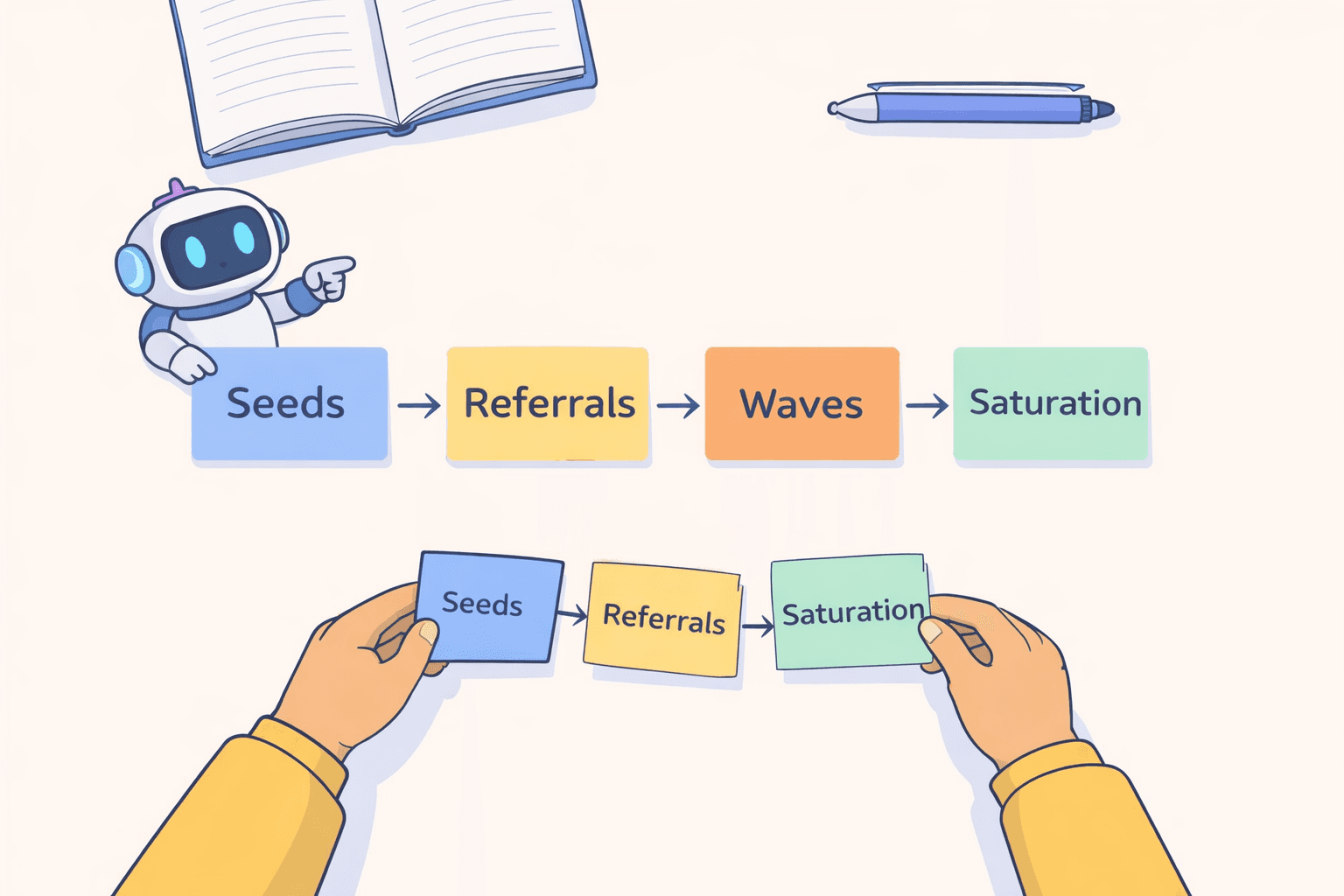
You start with a few initial contacts, called "seeds." They recommend others, who then recommend more people. Your sample size grows with each wave of referrals, much like a snowball getting larger as it rolls downhill.
You might also hear it called:
Network sampling
Referral sampling
Chain-referral sampling
You'll find this technique used frequently in fields like sociology, psychology, and public health, particularly during the early, exploratory stages of a project.
<ProTip title="💡 Pro Tip:" description="Use multiple starting participants to reduce bias and improve diversity in referral chains" />
How the Snowball Sampling Process Works
While it relies on personal networks, snowball sampling isn't a free-for-all. There's a clear, step-by-step procedure to follow, and skipping these stages is a common error.
Here’s how it typically unfolds:
Step 1: Find your "seeds." You begin by identifying and recruiting a small number of initial participants, usually 3 to 5 people, who fit the profile of your target population.
Step 2: Gather your first wave of data. You collect information from these seeds through interviews or surveys as part of your broader data collection. Crucially, you then ask each one to refer you to others they know who also qualify for the study.
Step 3: Grow the sample through referrals. The people referred by the seeds become your second wave. You then ask them for referrals, creating a third wave, and so on.
Step 4: Decide when to stop. You continue this cycle until you stop getting new, useful information (a point called saturation) or you hit a predetermined sample size. Many studies, as noted by Researcher.Life, end after 3 or 4 waves to prevent the sample from becoming too socially similar.
Step 5: Analyze with the right perspective. The data you get is interpreted as exploratory and context-rich. It's understood from the start that the results aren't statistically representative of a broader population.
For a structured breakdown of these steps and their implications, see step-by-step snowball sampling process, which outlines how researchers apply this method in real studies.
A Real-World Example Consider a study on a niche type of software developer. The researchers couldn't find a directory.
They started with a few contacts on LinkedIn, interviewed them, and then asked, "Who else do you know that does this kind of work?" Each new connection led to another.
This highlights the method's core truth: for some groups, you gain access through trust and personal networks, not through databases or random selection.
<ProTip title="📌 Note:" description="Define clear inclusion and exclusion criteria before starting recruitment to maintain consistency" />
Types of Snowball Sampling You Should Know
Snowball sampling isn't one method. The type you choose changes everything, how fast you find people, who you find, and what kind of bias sneaks in.
Linear sampling: the straight line
Here, you build a single chain. Person A knows Person B, who knows Person C, and so on. It's a narrow, controlled path.
Good for small, hard-to-find groups with very specific traits.
You trade a wide net for deeper, more focused connections. It’s useful, but you won't find many people this way.
Exponential sampling: the branching tree
This is the classic version most people use. One person recommends several others, who each recommend several more. Your sample can explode in size very quickly.
The clear upside is speed and scale.
The big downside? Everyone tends to know each other. You can end up with a tight-knit cluster instead of a diverse group. It's fast, but it can paint a very narrow picture of a community.
Respondent-driven sampling (RDS)
Public health researchers often use this more structured approach. It tries to fix the bias problem.
Participants get a small incentive to recruit their peers.
Researchers then use math to weight the results, attempting to correct for the fact that popular people get over-sampled. Studies, including those from Cambridge University Press, show RDS aims for better accuracy in hidden populations, though it's more complex to run.
A deeper methodological discussion can be found in respondent-driven sampling statistical analysis, which explores advanced statistical considerations in respondent-driven sampling.
<ProTip title="⚠️ Reminder:" description="Limit the number of referrals per participant to control exponential bias growth" />
Advantages of Snowball Sampling
This method has clear, practical benefits, particularly when you're dealing with people who aren't on any official list.
It’s especially useful in qualitative research contexts. If you're unsure whether your study fits a qualitative or quantitative approach, resources like qualitative vs quantitative research can help clarify where snowball sampling is most effective.
Reaching people who are off the grid This is the main reason to use it. Standard surveys fail with populations that are hidden, stigmatized, or just hard to find.
Studies on illicit drug use.
Research involving migrant workers without papers.
Building a cohort for a very rare medical condition. A formal invitation means nothing if you can't find an address to send it to. A trusted referral is the only key that works.
It's cheap and fast You don't need expensive mailing lists, advertising budgets, or complex screening protocols. The recruitment system is built into the community itself. The social connections do the heavy lifting, which saves both money and calendar time.
Research from Nova Southeastern University, for instance, used this approach to efficiently find professionals who weren't part of any formal association.
Built for deep, not wide, understanding Snowball sampling is a natural fit for qualitative work. If your goal is rich interviews, detailed case studies, or simply figuring out what questions to even ask next, this method gets you there.
It trades statistical breadth for the kind of depth you need to truly understand someone's story or a community's reality.
Limitations and Bias in Snowball Sampling
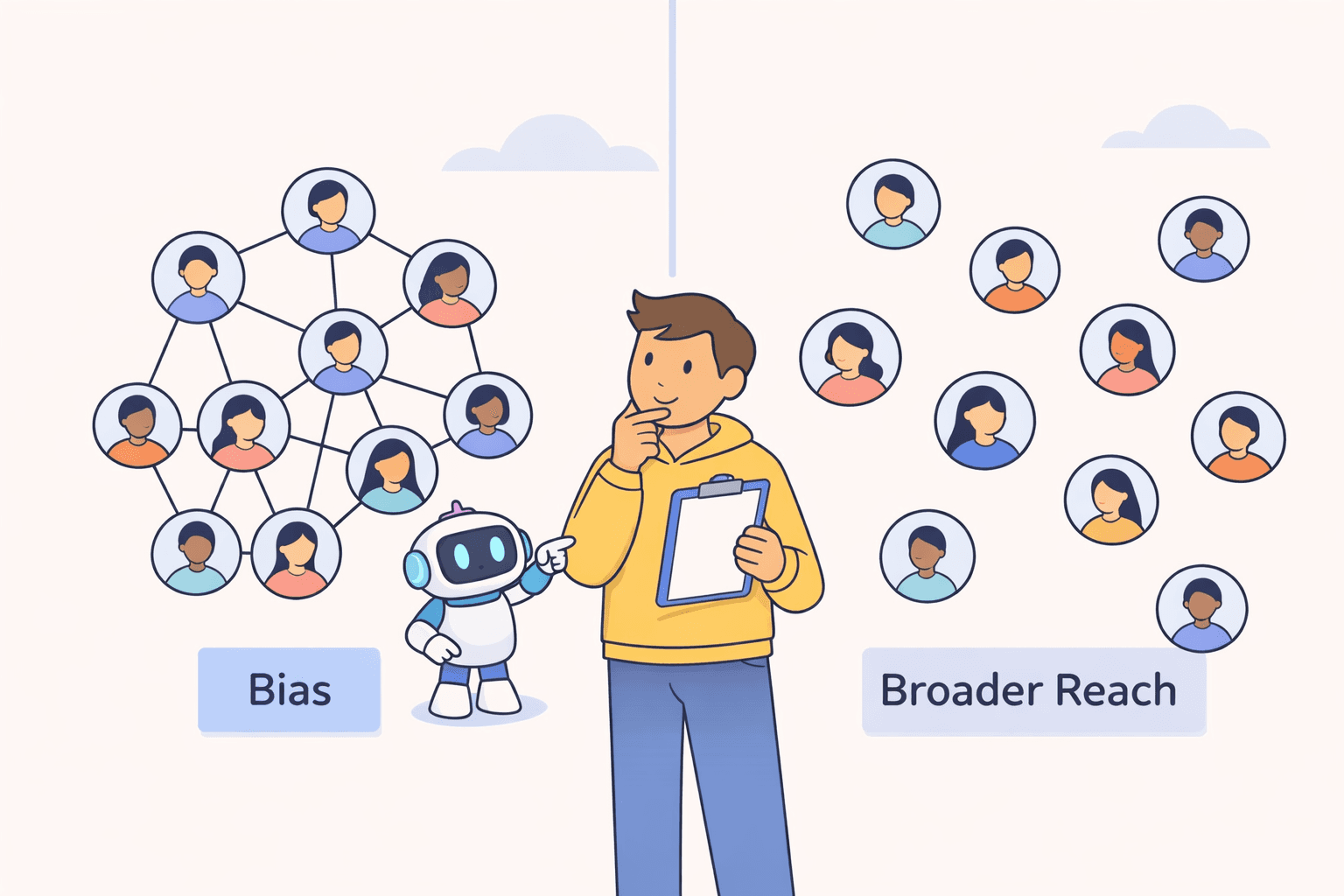
For all its practical use, this method has major flaws that can undermine your findings. Snowball sampling is a non-probability method, meaning it aligns with specific research paradigms rather than generalizable statistical models. When you do have a sampling frame, probability sampling methods are the standard route to more representative results.
If you're exploring this broader context, research paradigms provides useful background on how different methodologies shape research design.
Everyone knows everyone else The biggest issue is network bias. People naturally refer others who are like them, in background, opinion, or social circle. Your sample isn't a cross-section; it's a series of overlapping social clusters.
Start with one activist, and you'll mostly get their circle of fellow activists.
Start with one executive, and you'll mostly get other executives. You end up studying a single network, not the whole population. This built-in bias is often the method's fatal weakness.
You can't generalize the results Snowball sampling is a non-probability method. There's no random selection, so you can't claim your findings statistically represent the wider group.
You can identify themes, tell compelling stories, and explore experiences in detail, but you cannot say "X percent of all people in this group believe Y." The math doesn't support it.
The ethical tightrope Asking people to refer their friends creates immediate privacy and pressure problems.
Participants might feel obligated to provide names, risking their relationships.
There's always a concern about anonymity being broken within a tight-knit group. In research on sensitive topics, like illegal activity or health stigma, these aren't minor issues. They're central ethical challenges that can halt a study.
<ProTip title="🔒 Ethical Tip:" description="Use anonymous referral links instead of direct name sharing to protect participant privacy" />
Snowball Sampling vs Other Sampling Methods
Picking a sampling method is about trade-offs. Here’s how snowball sampling compares on key points.
Feature | Snowball Sampling | Random Sampling | Convenience Sampling | Stratified Sampling |
Type | Non-probability | Probability | Non-probability | Probability |
Sampling Frame | Not required | Required | Not required | Required |
Best Use | Hidden populations | General population | Easy access groups | Structured populations |
Bias Risk | High | Low | High | Medium |
Generalizability | Limited | Strong | Weak | Strong |
The table shows the core compromise. You use snowball sampling when access is your primary problem, accepting that you'll lose statistical strength and face significant bias. It gets you in the door when other methods can't even find the address.
If you're preparing to publish findings based on this method, choosing the right journal is also critical. A guide like choosing a journal for research can help you match your methodology with appropriate academic outlets.
Best Practices for Using Snowball Sampling Effectively
To make this method work, you need a plan that fights its inherent weaknesses.
Start from several places, not one Your first contacts, the "seeds", are everything. If you begin with just one person, you'll only map their social circle. Instead, find multiple starting points from different parts of the community.
This simple step is the best way to combat the clustering problem and get a more varied sample.
Know when to stop Without a plan, recruitment can spiral into more of the same. Set clear rules for ending data collection.
Limit the number of referral "waves" (e.g., stop after 3 or 4 rounds).
Stop when new interviews stop revealing new information, a point called "saturation." This prevents you from just digging deeper into the same network.
Keep a detailed log For your study to have any credibility, you must document the process meticulously. Write down exactly how you chose your initial seeds, how many referral waves you completed, any limits you placed on how many people one person could refer, and why you decided to stop.
This log doesn't fix the bias, but it makes your method transparent and your limitations clear.
Use it as one tool among many Rarely should snowball sampling stand alone. Pair it with other approaches.
Use it to find participants for a survey.
Combine it with purposive sampling to deliberately seek out missing perspectives.
Augment it with open online recruitment. A mixed-methods approach helps balance snowball sampling's deep access with broader, more controlled data collection.
Snowball Sampling: What to Do Next
You might find it hard to reach the right people, especially when your target group isn’t easy to identify and each step depends on referrals. It feels limiting. Snowball sampling helps you move forward, but the risk of bias can make your results harder to trust.
<CTA title="Write Your Methodology Section" description="Turn your sampling strategy into a clear academic section with structured guidance" buttonLabel="Try Jenni Free" link="https://app.jenni.ai/register" />
The key is to stay clear about how you recruit participants and when you stop collecting data. Tools like Jenni can help you write your methodology in a clean, structured way—see a clear guide to writing the methodology section of your research paper—so your decisions make sense to readers and your research feels more solid.