By
Nathan Auyeung
—
How to Choose a Journal for Your Research Without Costly Mistakes

Nathan Auyeung
Senior Accountant at EY
Graduated with a Bachelor's in Accounting, completed a Postgraduate Diploma of Accounting
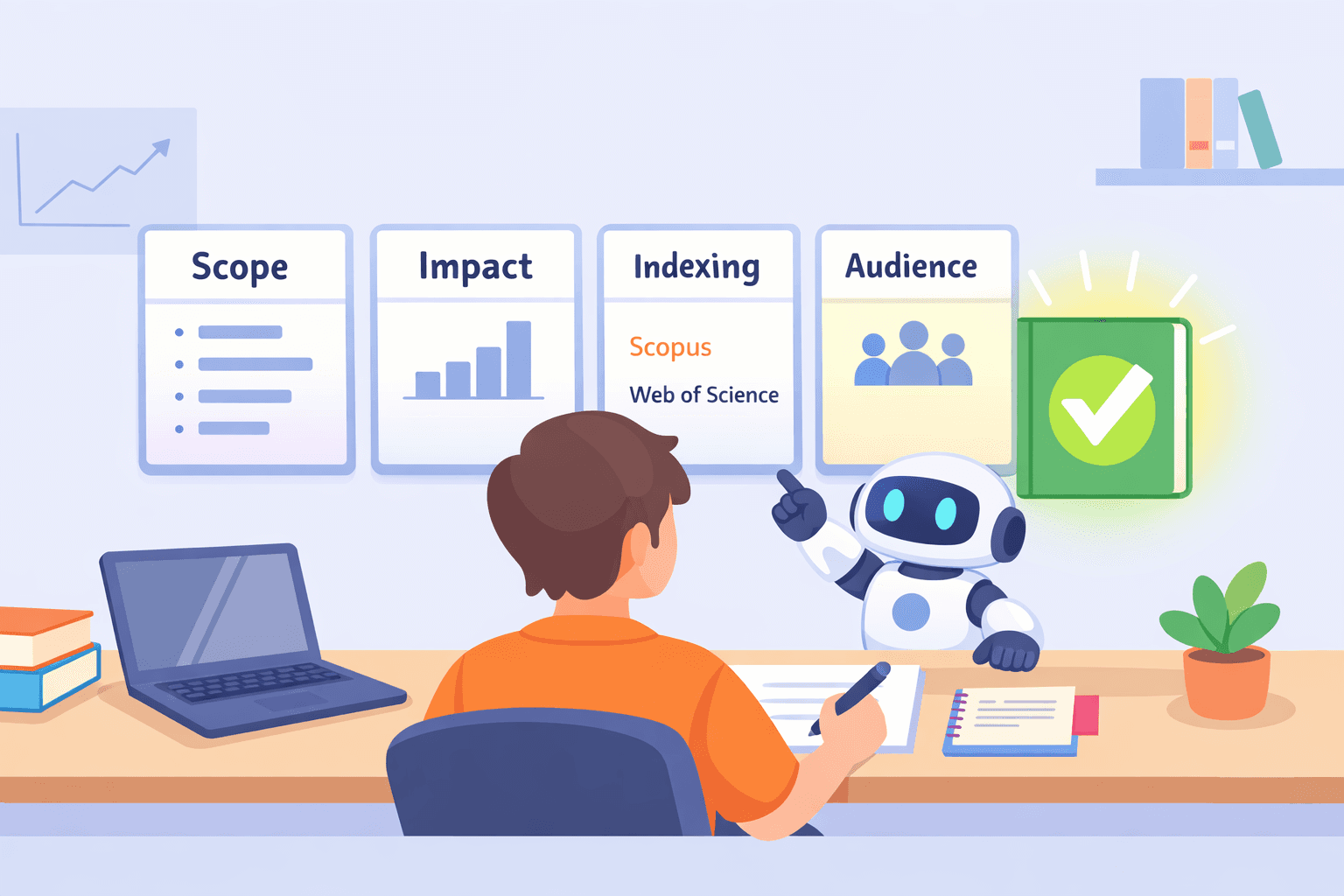
Your paper can get rejected just for being in the wrong place, no matter how good the research is. This happens all the time. To stop it, you need a real strategy.
Our step-by-step guide shows you how to find the right journal for your manuscript, dodge the usual traps, and finally get that acceptance. Let's get started.
<CTA title="Choose the Right Journal Faster" description="Match your research to the best journal with clarity and confidence no guesswork needed." buttonLabel="Try Jenni Free" link="https://app.jenni.ai/register" />
Step-by-Step: How to Choose a Journal for Your Research
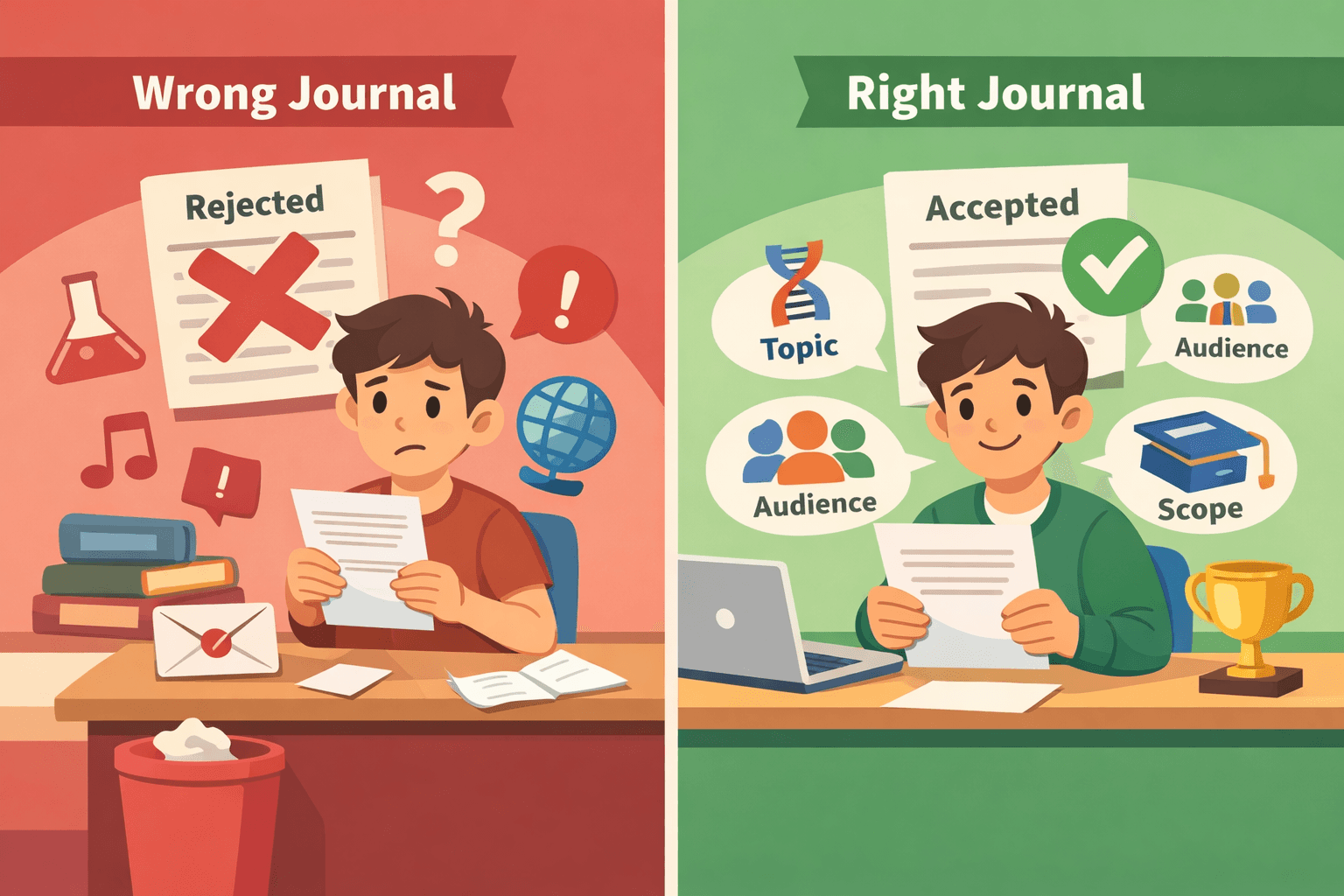
A guided process is the smartest way to choose. Each step here builds a stronger submission plan and cuts down on wasted effort.
1. Start With Your Research Identity
Your paper's type and its intended readers set the stage for every journal choice you'll make. A technical methods paper and a policy study belong in completely different places.
Think of your manuscript as a product. You have to find its market.
Ask yourself:
What is the paper's format? Is it original research, a review, or a case study?
Who needs to read it? Is the audience a narrow group of specialists or a wider academic field?
Is the work deeply technical, interdisciplinary, or focused on real-world application?
For instance, a machine learning paper packed with complex mathematics needs a specific technical journal. A general science publication would be the wrong fit.
<ProTip title="💡 Pro Tip:" description="Define your audience before choosing journals to avoid mismatched submissions and early rejection." />
2. Match Your Topic to Journal Scope
Topic mismatch is a top reason for instant desk rejection. Editors can spot an out-of-scope paper in minutes.
Here's a practical test:
Take your main keywords and search for them in databases like Scopus or Web of Science.
Look at the journals that come up. Scan the articles they've published in the last three to five years.
Compare your paper's methodology and structure to those published works.
If you see papers similar to yours appearing regularly in a journal's recent issues, that's a strong signal of a good fit. If you don't, keep looking.
For a deeper framework, see this guide on journal selection criteria for research publication which explains how scope and relevance affect acceptance.
<ProTip title="🧠 Reminder:" description="Check recent issues instead of relying on journal descriptions alone for better accuracy." />
3. Evaluate Journal Quality and Indexing
Journal quality varies widely. Where you publish directly affects your work's visibility and your own academic standing.
Indexing is critical here. For example, the U.S. National Library of Medicine states that being in MEDLINE boosts a journal's discoverability and the citation potential of its articles.
Prioritize journals indexed in major databases:
Scopus
Web of Science
The Directory of Open Access Journals (DOAJ)
You should also check:
The expertise and affiliations of the editorial board.
That the journal has a valid International Standard Serial Number (ISSN).
The reputation of the publisher, such as Elsevier, Springer Nature, or Wiley.
A structured approach like this journal evaluation framework for choosing where to publish highlights why factors like scope, audience, and indexing matter together, not separately.
Be cautious of any journal that lacks clear peer-review policies or isn't listed in a recognized index.
4. Understand Impact vs Relevance
Top-tier journals with high impact factors are fiercely competitive. Acceptance rates can drop below 10%, based on data from sources like Clarivate's Journal Citation Reports.
However, relevance to your specific field can matter more than raw prestige.
Consider the trade-offs:
Factor | High-Impact Journal | Mid-Tier Niche Journal |
Acceptance Rate | Very low | More moderate |
Audience Fit | Broad, general | Targeted, specialized |
Citation Potential | High, but highly competitive | Often strong within its niche |
Review Time | Typically longer | Usually faster |
A paper perfectly suited for a Q2 journal in its field can easily get more attention and citations than one struggling in a mismatched Q1 journal.
5. Consider Open Access, Cost, and Reach
Your choice of publishing model affects who can read your work and how much it costs.
Open access generally means wider global readership, as noted by resources like the Directory of Open Access Journals. But you need to weigh the benefits against the practical costs.
Key points to check:
Article Processing Charges (APCs): What is the fee to publish? These can range from nothing to well over $3,000.
Free-to-publish models: Some "diamond" OA journals charge no fees to authors or readers.
Hybrid options: Traditional subscription journals often offer an open access choice for an extra fee.
While open access can significantly improve your paper's reach, the associated fees are a major budget consideration for many researchers.
<ProTip title="💰 Pro Tip:" description="Check institutional funding or waivers before choosing high APC journals." />
6. Review Timeline and Acceptance Probability
In many fields, publication speed is critical. A review process can drag on for six months to a year at some journals.
When you're evaluating options, look for concrete information on:
The average time from submission to first decision.
The total publication turnaround time.
The journal's stated acceptance rate.
Journals that prioritize faster publication will usually advertise their review durations.
For example, if you're working on time-sensitive policy research, a journal known for a quick review cycle becomes a much more suitable choice than a slower, more prestigious one.
7. Check Submission Guidelines Early
A surprising number of manuscripts get rejected immediately, before any scientific review, simply for breaking formatting rules.
Don't let that happen. Review the journal's author instructions carefully. Pay close attention to:
Strict word or page limits and required manuscript structure.
The specific citation style (APA, Harvard, Vancouver, etc.).
Limits on the number of figures, tables, or supplementary files.
Taking the time to follow these guidelines precisely is one of the easiest ways to avoid a quick desk rejection. To pressure-test your draft against likely reviewer expectations, use AI for peer review to simulate reviewer feedback before submission.
<ProTip title="📄 Note:" description="Format your paper before submission to avoid unnecessary delays and rejections." />
8. Use Journal Matching Tools and Expert Input
Online tools can efficiently narrow down a long list of potential journals.
You can try platforms like:
Elsevier Journal Finder
Springer Journal Suggester
Clarivate's Manuscript Matcher
However, don't rely on them completely. You should combine their suggestions with human insight:
Get feedback from your supervisor or senior colleagues.
Analyze where the papers you cited were published.
Think about which journals your target audience actually reads.
The best decision comes from blending algorithmic suggestions with your own professional judgment.
9. Align With Your Career Goals
Choosing a journal is a strategic career decision, not just a technical one.
Your goals should guide the choice:
Early-career researchers often benefit from establishing a publication record in respected mid-tier journals with more reasonable acceptance rates.
Senior researchers may strategically target high-impact journals to solidify their standing.
Interdisciplinary work might find its best audience in a dedicated multidisciplinary journal.
Also think about the bigger picture. Is a regional journal more impactful for your local field, or is an international one necessary?
Are you prepared for the English-language editing if required? Sometimes, presenting at a key conference first can be more valuable than rushing into a lower-tier journal.
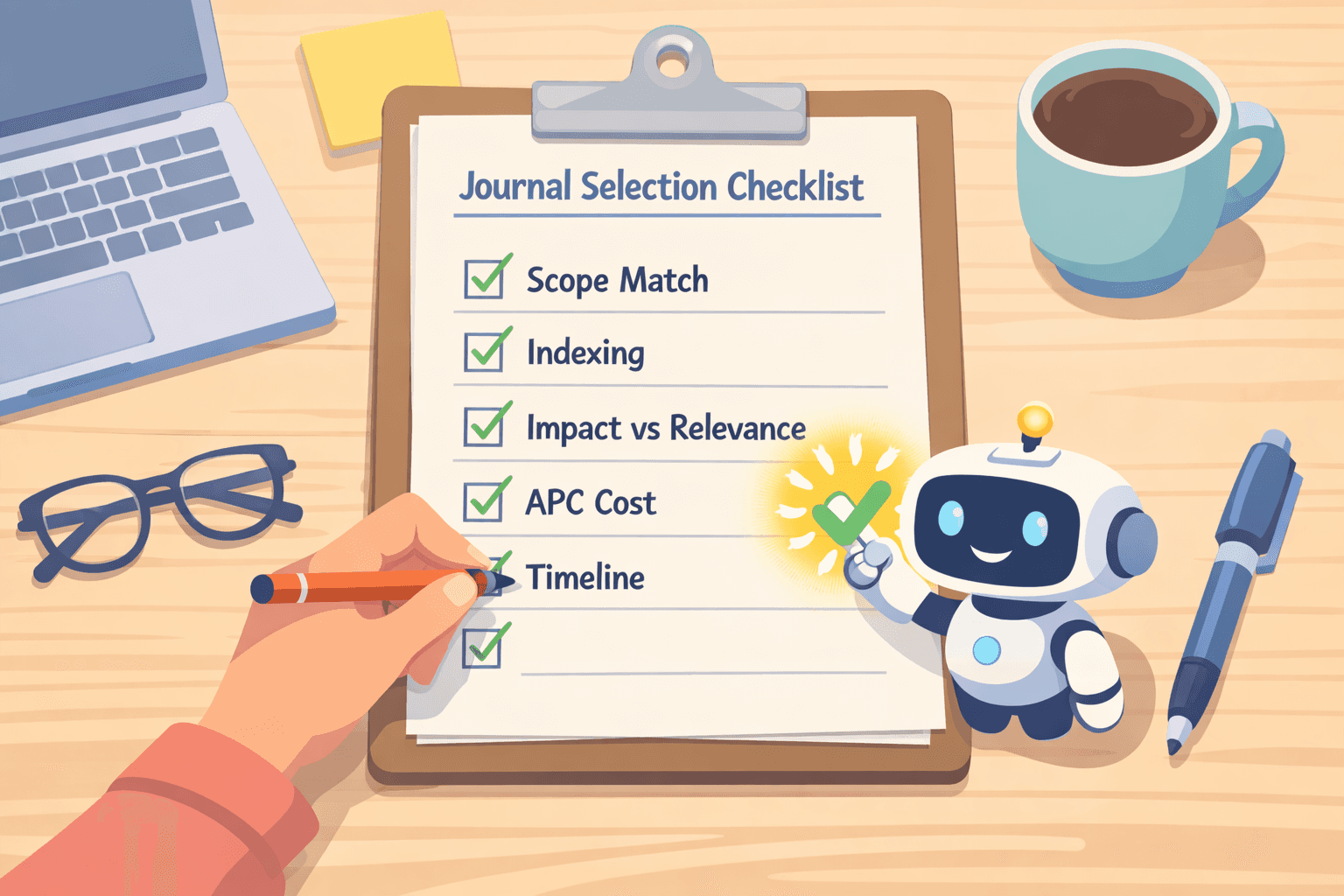
10. Final Journal Selection Checklist
Here’s a straightforward list to run through before you send your paper off. Tick each box to make sure you’ve got the basics covered.
Scope & Fit
Does the journal's stated scope actually match your paper's topic? □ Yes / □ No
Visibility & Reach
Is the journal indexed in major databases relevant to your field (like Scopus, Web of Science, PubMed, etc.)? □ Yes / □ No
Target Readers
Is the journal's primary audience the specific researchers, practitioners, or policymakers you want to reach? □ Yes / □ No
Timeline
Does the journal's average review time fit within your project's deadline or personal timeline? □ Yes / □ No
Manuscript Details
Have you formatted your manuscript exactly according to the journal's specific author guidelines? □ Yes / □ No
Running through this list can help you avoid common, easily-fixed reasons for a desk rejection.
Real-World Insights: What Researchers Get Wrong
Online forums show where researchers often trip up. The advice is out there, but the same mistakes keep happening.
On Reddit: The Prestige Trap The phrase "desk rejection roulette" comes up a lot. The core problem is clear: authors frequently aim for the most prestigious journal they can think of, ignoring whether their work actually fits that journal's scope. This leads to quick, automatic rejections.
A big reason this happens is a lack of clarity in the paper’s main focus. Learning how to write research question can help you define your contribution more clearly and avoid mismatched submissions.
There's also pressure from co-authors who insist on submitting to a top-tier title, even when it’s clearly not the right place for the paper.
On Quora: The Push for a System The advice here leans toward structured frameworks. Models like A.S.S.E.T. (Audience, Scope, Study design, Expense, Time) get recommended repeatedly.
This also reflects the importance of understanding your research foundation before choosing a journal. Exploring different research paradigms can help you better position your work within the right academic context.
This points to a real need for a practical, step-by-step checklist to cut through the confusion and make a logical choice.
On X (Twitter): The Quick Fix Fallacy Posts promising to "pick a journal in 5 minutes" get plenty of attention. But the replies tell a different story, they’re full of researchers dealing with burnout from a string of rejections.
The frustration often stems from focusing too much on journal metrics and not enough on simple relevance.
On YouTube: When Promises Don't Match Experience Tutorials often make the process seem straightforward. The comments section reveals the reality: unexpectedly long review times, surprise article processing charges (APCs) that weren't clear upfront, and the constant worry of accidentally submitting to a predatory journal.
This gap between the promised easy strategy and the messy reality is exactly why a careful, structured approach is necessary.
Avoiding Predatory Journals and Ethical Pitfalls
Some journals exist mainly to make money from researchers, not to publish good science. They use misleading metrics and offer almost no real peer review.
Part of avoiding these traps is understanding how research is evaluated. Knowing the difference between qualitative vs quantitative research helps you assess whether a journal is appropriately reviewing work like yours.
Here are specific warning signs to look for:
An Unclear or Fake Editorial Board. Check if the listed editors are real experts. A legitimate journal will have board members with verifiable affiliations and publications.
Promises That Are Too Good to Be True. Be wary of emails guaranteeing rapid acceptance, often within days. Real peer review takes time.
Hidden or Unclear Fees. The full Article Processing Charge (APC) should be clearly stated upfront, not revealed only after acceptance.
Fabricated or Misleading Metrics. Some journals invent their own "impact factors" or falsely claim indexing in major databases. Always verify claims independently.
The best way to protect your work is to follow established publishing standards. As explained in this research-based overview of how to evaluate journal credibility and avoid predatory publishing, authors must verify peer review processes, editorial boards, and ethical policies before submission.
<ProTip title="⚠️ Warning:" description="Verify indexing and editorial board credibility before submitting to avoid predatory journals." />
Choosing the Right Journal Without Second Guessing
You’re staring at a list of journals, unsure which one actually fits your work or just looks impressive. Everything starts to blur, and picking the wrong one could mean delays or rejection. It’s a risky move.
<CTA title="Plan Your Journal Strategy" description="Organize your research and target journals with clarity and precision no confusion involved." buttonLabel="Try Jenni Free" link="https://app.jenni.ai/register" />
That’s where Jenni helps you stay clear and focused from the start. It supports your planning so you can match your research with the right journal and avoid wasted effort. It’s a simple way to submit with more confidence instead of guessing.