By
Nathan Auyeung
—
Convenience Sampling Examples: Uses, Bias & When to Use

Nathan Auyeung
Senior Accountant at EY
Graduated with a Bachelor's in Accounting, completed a Postgraduate Diploma of Accounting
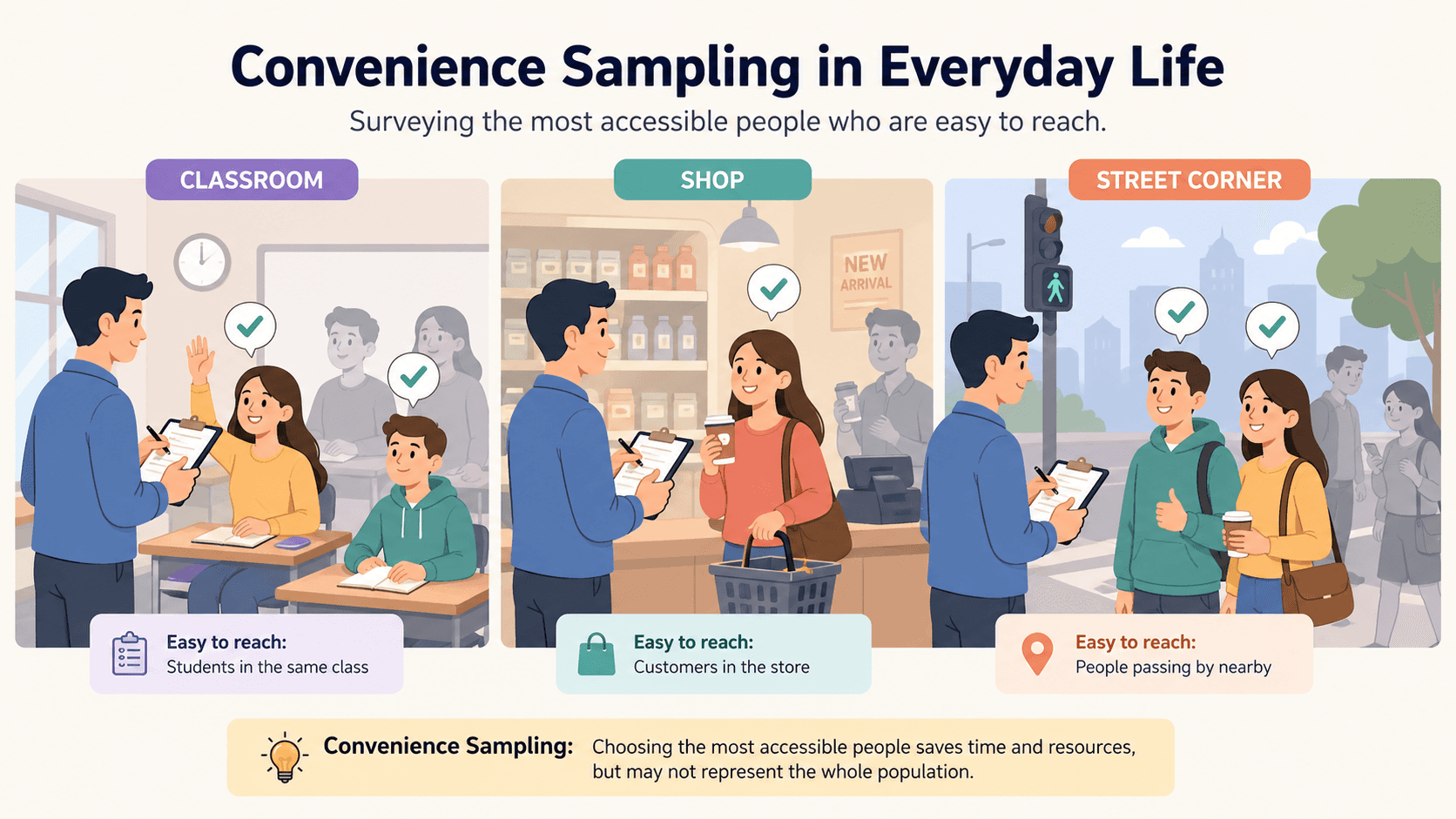
Convenience sampling means picking the most readily available people for a study, not a random group. It's quick and cheap, but the results usually carry a bias you can't ignore. You’ll see this method used everywhere from a professor’s classroom survey to a quick poll on a company’s internal website.
When time or money is tight, researchers often turn to it out of necessity. Let’s look at where it actually gets used, when it’s a valid choice, and how to report its limitations honestly. Keep reading for the full breakdown.
<CTA title="Plan Smarter Research Designs" description="Structure your sampling approach clearly and avoid bias in research projects" buttonLabel="Try Jenni Free" link="https://app.jenni.ai/register" />
What Convenience Sampling Really Means
Convenience sampling is exactly what it sounds like: you gather data from whoever is easiest to ask. It's a go-to method for many academics, listed by sites like Scribbr as a standard type of non-probability sampling.
The logic is simple. A researcher uses the people closest at hand: students in their lecture hall, customers in their store, or visitors to their website.
This makes the process fast and remarkably straightforward. However, it is essential to align this method with your broader research paradigms to ensure you aren't overclaiming what your data can actually prove.
In practice, this method trades accuracy for speed. Because the sample is inherently narrow, your data only reflects that specific, available group.
<ProTip title="💡 Pro Tip:" description="Use convenience sampling only for exploratory research or early testing stages" />
Everyday Convenience Sampling Examples
Convenience sampling isn't just a textbook term, it's happening all around you, often without anyone calling it out. These common situations show how easily bias slips into the data.
Classroom surveys are the classic case. A professor polls their own students on study habits. It's fast: you ask 30 people in one room.
But the findings only tell you about that specific class. You learn nothing about students in other majors, other years, or other universities. The perspective is instantly limited.
Consider workplace feedback. A manager might ask for input from their immediate team because they're right there.
It's practical, but it automatically leaves out remote employees, night-shift workers, or people in different departments. The results tend to over-represent the experiences of the most accessible staff, which can skew reports of overall morale.
Then there's the street survey. You've seen researchers in a mall or on a sidewalk stopping people who walk by. The sample isn't chosen; it's just who happens to be there at 2 PM on a Tuesday.
If you're surveying about consumer spending in a high-end mall, you're mostly talking to a certain income bracket. This method heavily skews results by age, income, and even the time of day, which is a direct form of convenience sampling bias.
Regardless of the example, the first step to successful data collection is knowing how to write a research question that fits the scope of a limited sample.
<ProTip title="🧠 Pro Tip:" description="Always describe your sample limitations clearly in your methodology section" />
Convenience Sampling in Business and Marketing
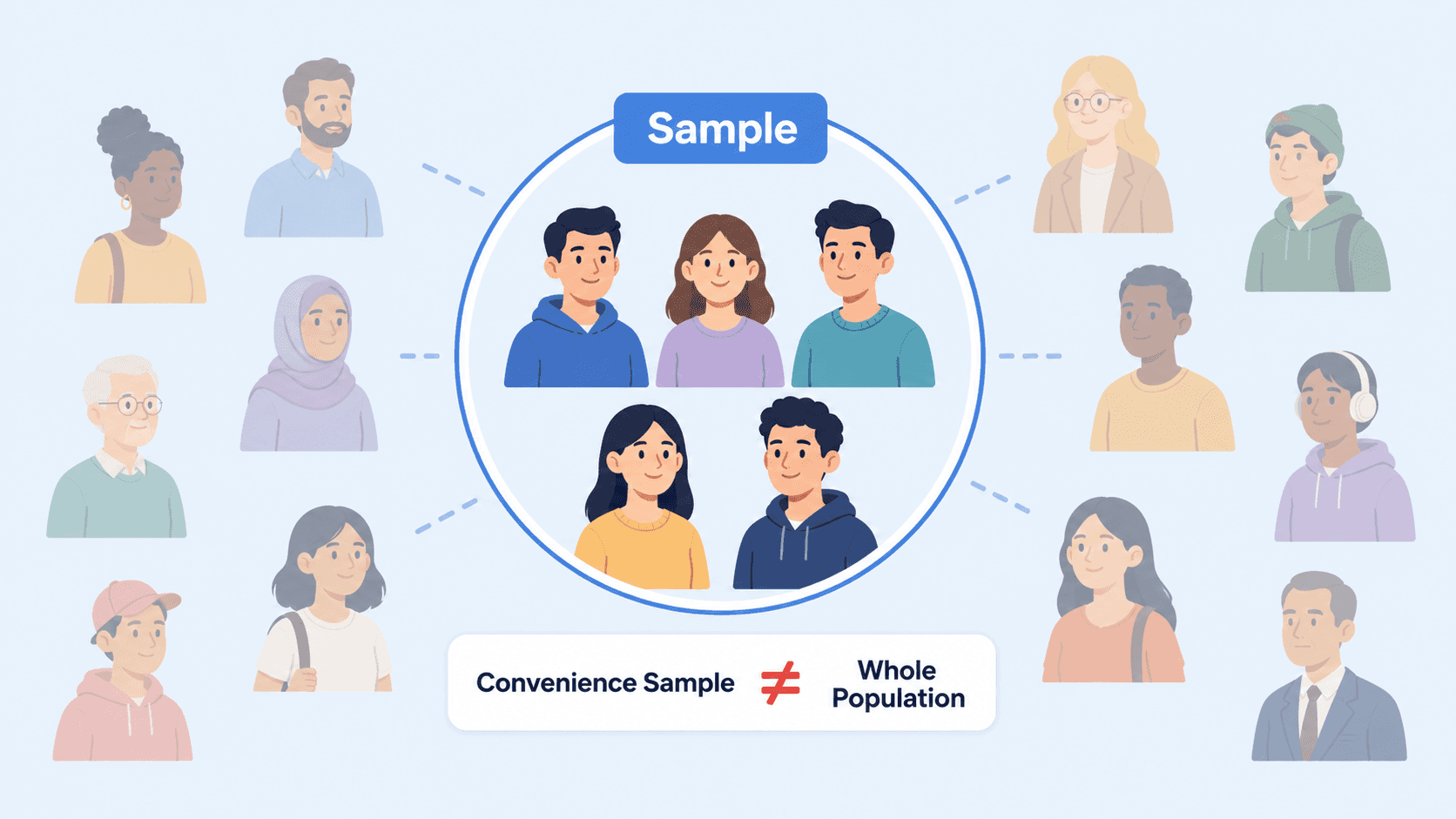
Businesses use convenience sampling constantly because it's fast and cheap. Insights from convenience sampling in market research come quickly, but they're almost always incomplete.
In-store customer surveys are a prime example. A clerk hands you a tablet with a few questions as you walk out. It grabs fresh impressions from people who just had the experience. But who does it miss?
Anyone who bought the item online. Anyone in a hurry who waved the tablet away. Anyone who shops at 9 AM, while the survey team works from noon to 5 PM. The feedback pool is narrow from the start.
Social media polls are another go-to. A company asks its Instagram followers to vote on a new logo or product color. You might get 500 responses in an hour from highly engaged fans.
That's valuable for gauging that core group's reaction. But it tells you nothing about the preferences of people who don't follow the brand, or who use different platforms entirely. You're only listening to your own audience.
Product testing at events has the same flaw. Feedback comes from early adopters who are generally more enthusiastic than a typical, skeptical customer.
While this falls under qualitative vs quantitative research depending on how you measure it, the results remain skewed toward the specific "event" demographic.
They're more forgiving and excited than a typical, skeptical customer picking the product off a shelf. The testing skews toward positivity, missing the more critical perspective of the average user.
<ProTip title="📈 Pro Tip:" description="Use convenience sampling for quick feedback but validate results with broader research later" />
Online Convenience Sampling: Fast but Biased
Online convenience sampling is everywhere now. It's quick, easy, and often the default for studies done on the internet.
Website Pop-Up Surveys
Think about those surveys that appear while you're browsing a site. They only catch people who are online at that exact moment and who bother to click.
They completely miss anyone who isn't visiting right then, anyone who hates pop-ups, or users in other parts of the world sleeping through the survey window.
Community and Forum Sampling
Researchers also frequently grab participants from online forums or Facebook groups. They'll just post a survey link and collect replies from whoever is around.
Say a study on video game habits uses only members of a specific forum. Its findings will tell you about that particular group's habits, not what every gamer does.
Online Panels and Platforms
Services like SurveyMonkey promise fast access. As Qualtrics notes, this is popular in UX research for its speed. Even though they're more organized, a lot of these panels are still convenience samples at heart.
Qualtrics points out that in UX research, this method is popular simply because it's fast and you can get it rolling almost immediately.
A quick look at the trade-offs:
Online Method | Strength | Limitation |
Pop-up surveys | Gets answers fast | Biased toward current visitors |
Social media polls | Can get lots of responses | Doesn't represent a broad audience |
Online panels | You can reach many people | Only people who opted-in join |
The bottom line? While these online methods are incredibly convenient, they usually fall short when it comes to getting a sample that truly represents the wider population.
<ProTip title="🌐 Pro Tip:" description="Combine online convenience samples with demographic filters to reduce bias" />
Convenience Sampling vs Random Sampling
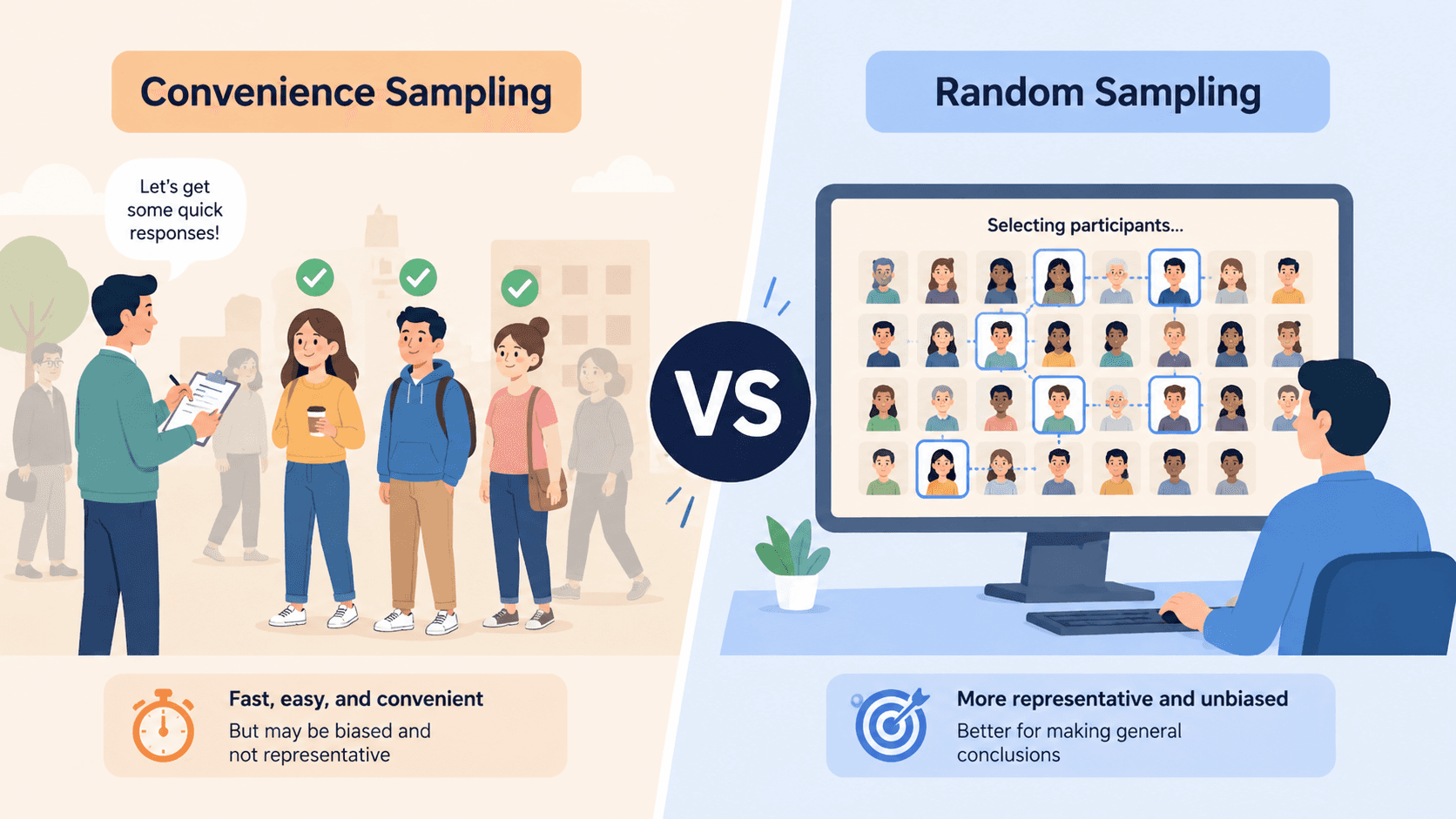
Knowing the difference between convenience sampling and random sampling is a big deal. It's the difference between a quick guess and a solid fact.
What's the Real Difference?
Feature | Convenience Sampling | Random Sampling |
How people are chosen | Whoever is easiest to get | Pure chance |
Bias | Usually high | Designed to be very low |
Can you apply it broadly? | Not really | Yes, that's the point |
Best used for | Early-stage, exploratory work | Making statistical conclusions |
You can't use fancy inferential statistics on data from a convenience sample. That toolbox only works with random sampling.
What This Means in Practice
Think of it this way: convenience sampling gives you a fast answer. Random sampling gives you a correct answer.
Asking your own classmates about a topic is convenience sampling.
Using a computer to randomly pick students from every high school in your state is random sampling.
They're both useful tools, but they're for completely different jobs. One is for a quick sketch; the other is for a precise blueprint.
When Convenience Sampling Is Actually Useful
Convenience sampling gets a bad rap, and for good reason, it's often biased. But writing it off completely would be a mistake. There are times when it's not just acceptable, it's the smartest choice.
Pilot Studies and Early Exploration
- Before committing to a massive, expensive study, researchers need to test the waters. Is this questionnaire confusing? Does this prototype work at all?
A small, easy-to-gather convenience sample is perfect for this. A tech startup, for instance, might get feedback from its first 20 users to iron out bugs before surveying thousands.
Studying Hard-to-Find Groups
- Sometimes, the people you need to study are just difficult to find through random methods. Think of rare disease patients, niche hobbyists, or undocumented workers.
In these cases, a convenience sample, finding participants through support groups, online forums, or community networks, might be the only realistic way to gather any data at all.
When Time is the Biggest Constraint
- Not every project has the luxury of months for data collection. For tight deadlines, convenience sampling is the go-to.
It's the backbone of quick internal reports, last-minute classroom projects, or rapid feedback cycles during a product's development sprint.
As Qualtrics notes, in UX testing, getting fast feedback to iterate a design now is often more valuable than perfectly representative data you get too late.
It's a tool for specific jobs: sketching an initial idea, reaching an elusive group, or beating the clock. It's not for drawing final conclusions about everyone.
<ProTip title="⚡ Pro Tip:" description="Treat convenience samples as hypothesis generators not final conclusions" />
Common Mistakes and How to Avoid Them
A lot of research trips up on convenience sampling, not because the method itself is wrong, but because it’s misapplied. The biggest errors come from forgetting what it is, a shortcut.
Mistake 1: Pretending It’s Representative
This is the most common and dangerous error. You surveyed 100 people from a single university forum and found that 80% prefer online classes.
That’s a finding about that forum, not about all students, or even all students at that university. The sample is almost never a true mirror of the wider population. Drawing broad conclusions from it is a fast track to flawed results.
Mistake 2: Acting Like the Bias Isn’t There
With convenience sampling, bias isn’t a maybe; it’s a guarantee. The sample is biased toward people who are available, willing, and findable by you.
Ignoring this fact, or just mentioning it in a footnote, means you’re presenting a skewed picture as if it were clear. You have to actively ask: "Who is not in my sample because of how I collected it?"
Mistake 3: Keeping the Process a Black Box
If you don’t thoroughly document how you got your participants, your work loses credibility. Saying you "surveyed users" is vague.
Did you post on Twitter? Use a panel? Hand out forms in one coffee shop? Readers need to see the limitations to judge your findings for themselves.
A Better Way to Handle It
You can’t eliminate the flaws of convenience sampling, but you can manage them honestly. Here’s a practical checklist:
Define Your Actual Population: Be brutally specific. Is it "online gamers" or "active members of the GameX subreddit as of March 2024"? The latter is accurate.
State the Method Clearly: Don’t bury "convenience sampling" in the methods section. Name it upfront.
Explain the Limitations, Out Loud: Don’t just list them; discuss how they might have skewed your data. Who might be missing, and how could that change the results?
Lock Down the Overgeneralizations: Frame your conclusions to match your sample. Use phrases like "among our participants..." or "this suggests a trend in this specific group..."
Triangulate When You Can: If resources allow, combine methods. Use your convenience sample for an initial finding, then test it with a more rigorous method on a different group.
Following these steps doesn’t make a convenience sample rigorous, but it makes your use of it transparent and responsible. It shifts the work from claiming false certainty to providing an honest, useful piece of a larger puzzle.
Use Convenience Sampling Without Weakening Your Research
You might feel stuck when your data is easy to collect but hard to defend, especially when others question how reliable it really is. It puts pressure on your results and makes your work seem less solid than it should be. That doubt shows.
<CTA title="Write Better Research Methodology" description="Structure clear sampling explanations and improve academic writing with guided AI support" buttonLabel="Try Jenni Free" link="https://app.jenni.ai/register" />
Using Jenni helps you explain your sampling clearly so it holds up under review. It guides how you present limits and justify your choices, so your research stays transparent and credible. It’s a simple step that makes your work easier to trust.