By
Justin Wong
—
Grant Proposal Template: Sections to Copy, With Examples

Justin Wong
Head of Growth
Graduated with a Bachelor's in Global Business & Digital Arts, Minor in Entrepreneurship

Last year the National Institutes of Health funded 13 out of every 100 research project applications, down from 18.7 the year before. The paperwork is not cheap either. The National Science Foundation estimates in its own public burden statement that a single proposal takes an average of 120 hours to prepare and submit.
That is three working weeks for a document most people rebuild from scratch every time. A template fixes part of that, but only if you treat it as a scoring guide rather than a set of blanks. Below is the structure funders expect, how long each section should run, what has to be inside it, and a written example line you can adapt.
<CTA title="Draft Your Grant Proposal in Hours, Not Weeks" description="Jenni helps you outline, draft, and cite a full grant proposal with sources you can verify" buttonLabel="Try Jenni Free" link="https://app.jenni.ai/register" />
What Sections Does a Grant Proposal Actually Need?
Eight. Funders name them differently, reorder them, and occasionally fold two together, but the underlying set is remarkably stable across community foundations, corporate giving programs, and federal agencies.
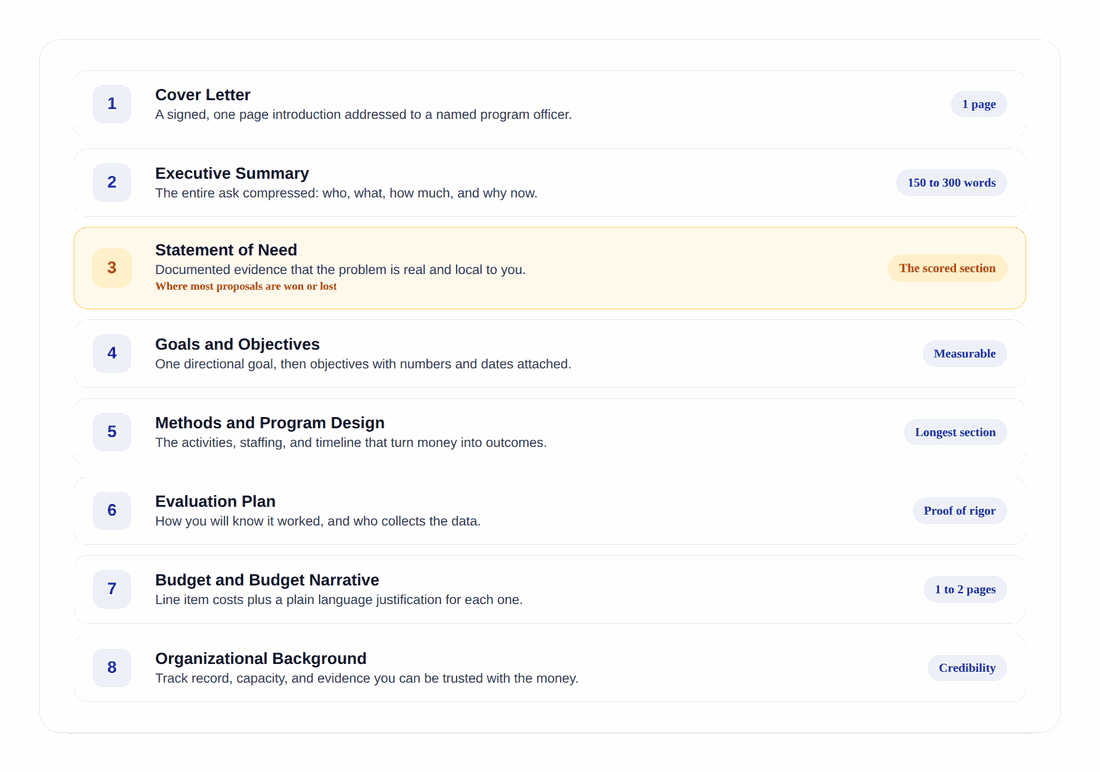
The wording varies more than the substance. A private foundation may ask for a "project narrative" that quietly contains your methods, timeline, and evaluation plan in one block. A federal science agency replaces the whole front half: the NIH uses a one page Specific Aims section and a twelve page Research Strategy, with limits published on its page limits page. Read the guidelines first, then map them onto this list. The mapping is almost always clean.
<ProTip title="📌 Remember:" description="Build the template around the funder headings, not your own. Reviewers score section by section, and a section they cannot find is a section that scores zero" />
How Long Should Each Section Be?
If the funder states a limit, that number wins, every time. NSF caps the Project Summary at one page and the Project Description at fifteen, spelled out in chapter two of its proposal guide. When no limit is given, and most foundation applications give none, the ranges below hold up well for a standard project grant in the 25,000 to 250,000 dollar band.
Section | Typical length | What it has to prove |
Cover letter | 1 page | A named human at your organization read the guidelines |
Executive summary | 150 to 300 words | The entire ask fits on one screen |
Statement of need | 400 to 800 words | The problem is real, local, and documented |
Goals and objectives | 200 to 400 words | Success has a number attached to it |
Methods and program design | 600 to 1,200 words | You can actually deliver what you promised |
Evaluation plan | 300 to 600 words | You will know whether it worked |
Budget and budget narrative | 1 to 2 pages | Every line is tied to an activity |
Organizational background | 200 to 400 words | You are a safe place to put the money |
Add those up and a full foundation proposal lands somewhere between eight and twelve pages including the budget. Anything much longer usually means the methods section has absorbed material that belongs in an appendix.
The Template, Section by Section
What follows is the skeleton for each section plus a sample line in italics. The examples come from one running scenario: a youth services nonprofit requesting 68,000 dollars for a summer STEM program. Swap the specifics, keep the shape.
1. Cover Letter
One page, on letterhead, signed by your executive director rather than the person who wrote the proposal. Its job is not to summarize the project. Its job is to signal that a decision maker at your organization stands behind the ask and understands the funder.
Name the program officer if you can find one. Name the specific fund or initiative you are applying to. State the amount in the first paragraph, because the reader is looking for it anyway.
"On behalf of Eastside Youth Collective, I am writing to request 68,000 dollars from the Hartwell Family Foundation Education Initiative to expand our summer STEM program to two additional middle schools in the 2027 cycle."
2. Executive Summary
Write this last and place it first. It is the only section some board members will read in full, so it has to answer five questions without requiring anything else:
Who you are, in one clause
What problem you are solving, with one number
What you will do about it
How much you are asking for and over what period
What will be measurably different at the end
"Eastside Youth Collective requests 68,000 dollars over twelve months to serve 240 middle school students across four campuses, raising the share who enroll in advanced science coursework from 31 percent to 45 percent."
<ProTip title="✅ Quick check:" description="If your executive summary does not contain a dollar figure, a headcount, and a date, it is a mission statement wearing a summary costume" />
3. Statement of Need
This is the section reviewers actually argue about. It has to establish that a problem exists, that it exists where you work, and that it is not already being solved by someone else down the road.
Does it need statistics? Yes, but fewer than most people use. Two or three well chosen figures with a named source beat a paragraph of national statistics that could describe anywhere. Pair the wide number with a local one, and then put a face on it. Reviewers remember the third sentence, not the second.
Avoid the most common failure, which is describing your organization's need for money instead of the community's need for the service. The funder is buying an outcome, not covering a gap in your budget.
"Only 31 percent of eighth graders at our four partner schools enroll in advanced science, compared with 58 percent district wide. Two of the four campuses lost their after school science programs when a state line item expired in 2024, and no other provider currently serves that catchment."
4. Goals and Objectives
These are not synonyms, and conflating them is one of the fastest ways to look inexperienced. A goal is directional and does not have to be measurable. An objective is a promise with a number and a deadline attached.
One goal is usually enough. Three to five objectives underneath it is the sweet spot. Each objective should be something you would be willing to be judged on twelve months later.
Goal: increase sustained participation in science among middle school students in the Eastside corridor. Objective 1: enroll 240 students across four campuses by July 2027, with at least 60 percent attending ten or more sessions.
5. Methods and Program Design
The longest section, and the one where vague writing does the most damage. A reviewer reading this is asking a single question: could this team actually run this? Give them the operational detail that answers it.
Activities. What happens, how often, and for how long
Staffing. Who delivers it, at what full time equivalent, and who supervises
Participants. How you recruit them and how you keep them
Timeline. A month by month table beats three paragraphs of prose
Partners. Named organizations, with letters of support in the appendix
If your program borrows a model that has been evaluated elsewhere, say so and cite it. Borrowed evidence is still evidence, and it costs a reviewer less effort to trust. The same logic that governs a methodology section in a research paper applies here: specificity reads as competence.
<ProTip title="⏳ Timing:" description="Build your project timeline before you write the methods narrative. The calendar exposes overlaps and staffing gaps that prose will happily hide" />
6. Evaluation Plan
Funders increasingly treat a weak evaluation plan as a proxy for a weak organization. The fix is not more sophistication. It is naming the instrument, the owner, and the cadence.
For each objective, state what data you will collect, who collects it, when, and what number counts as success. If you plan to use a validated survey, name it. If you are using attendance records, say who enters them. Two paragraphs of concrete process outrank a page of language about theories of change.
"Attendance is logged in Salesforce by the site coordinator at the end of each session. Advanced course enrollment is pulled from district records each September by our data manager. Success is defined as 45 percent or higher across the four partner campuses."
7. Budget and Budget Narrative
Two documents, not one. The budget is a table. The narrative explains each line in plain language and connects it to an activity in your methods section.
Round numbers invite suspicion. So does a personnel line that does not match the staffing you described three pages earlier. Check indirect cost rules before you write anything: many private foundations cap administrative overhead, and federal awards follow negotiated rates.
"Program Coordinator, 0.5 FTE for twelve months, 31,200 dollars. The coordinator delivers all four site sessions weekly and manages the volunteer instructor pool described in section 5."
8. Organizational Background
Short, factual, and pointed at capacity rather than history. Founding year, mission in one sentence, current annual budget, staff size, and then the two or three accomplishments that prove you can run this specific kind of program.
Resist the urge to list every award. A reviewer is assessing risk, and the relevant question is whether you have managed a grant of this size before.
"Founded in 2011, Eastside Youth Collective operates on a 1.4 million dollar annual budget with eleven full time staff, and has administered three prior awards between 50,000 and 90,000 dollars, all closed on schedule with full reporting."
Does the Template Change by Funder?
The sections stay. The rules around them change a great deal, and the two ends of the spectrum behave almost like different sports.
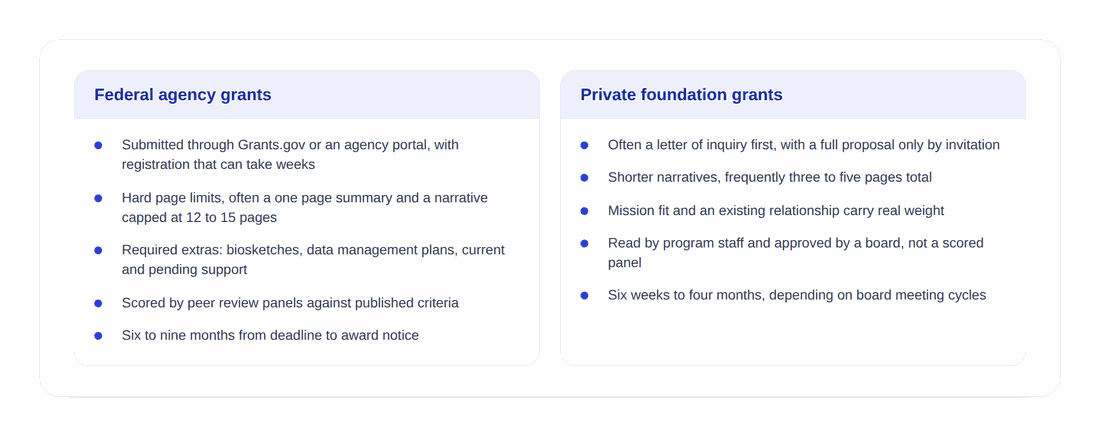
Corporate and community funders sit between the two. Corporate giving programs tend to want short applications and a visible connection to their business or their employees' volunteering. Community foundations often use a common application shared across several local funders, which is worth finding early because one well written version can serve four submissions.
Federal opportunities are all posted in one place. Grants.gov lists more than 1,000 grant programs from federal agencies distributing over 500 billion dollars a year, and registration alone can take several weeks, so start it long before you need it.
<ProTip title="⚠️ Caution:" description="Never reuse a proposal across funder types without rewriting the need statement. A federal reviewer and a family foundation board are persuaded by completely different evidence" />
What Reviewers Actually Do With Your Template
They read fast, and they read a lot. The USDA National Institute of Food and Agriculture notes in its grant writing fact sheet that a reviewer may be assigned ten to twenty proposals in a single cycle. Yours is not being studied. It is being triaged.
That reality shapes every formatting decision. The NIH's own grant writing guidance puts it bluntly: sentences of twenty words or less are easier to read. White space, informative subheadings, and a first sentence per paragraph that carries the point are not stylistic preferences here. They are the difference between being read and being skimmed.
It also helps to know which criticisms are survivable. The National Institute of Allergy and Infectious Diseases splits reviewer objections into fixable and hard to fix problems. Poor writing, thin experimental detail, and an unconvincing significance argument are fixable. A topic reviewers do not believe matters is not. If your first submission comes back, that distinction tells you whether to revise or to redirect.
One more habit worth stealing: build the timeline so the proposal is finished at least four weeks before the deadline, which is what the same NIFA fact sheet recommends. Portals fail. Signatories go on holiday. The last four weeks are where the writing gets good, and they only exist if you built them in.
How to Draft a Grant Proposal With Jenni
Once you have the funder guidelines and your own data, the drafting itself can move quickly. Here is the workflow.
Step 1. Describe the proposal you need. Open a new document and fill in the prompt with the funder, the amount, the population, and the outcome. The more specific the prompt, the less generic the draft.

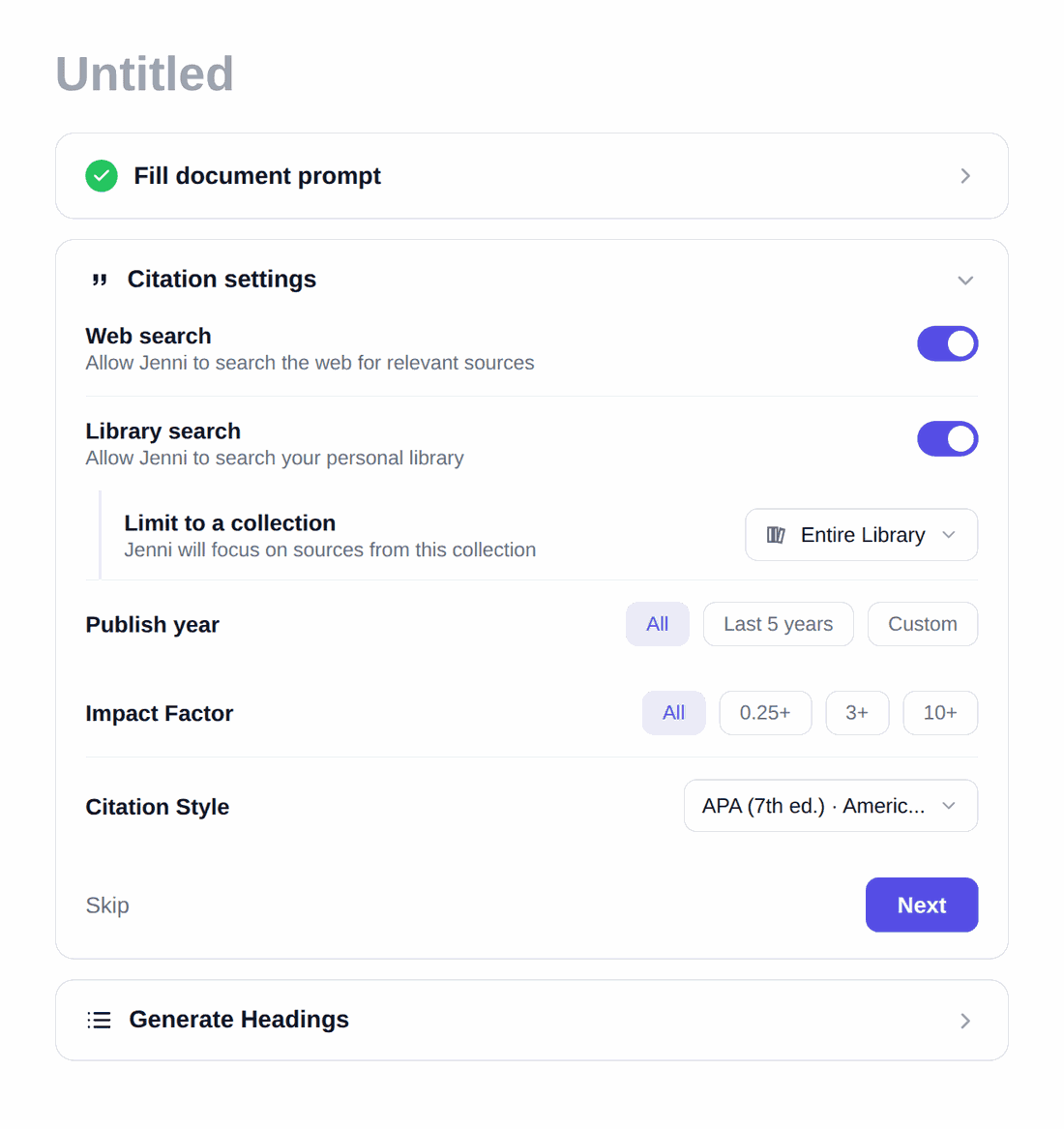
Step 2. Set your citation preferences. Choose the style your funder expects and how many sources to pull in. Grant reviewers check claims, so this matters more here than in most writing.
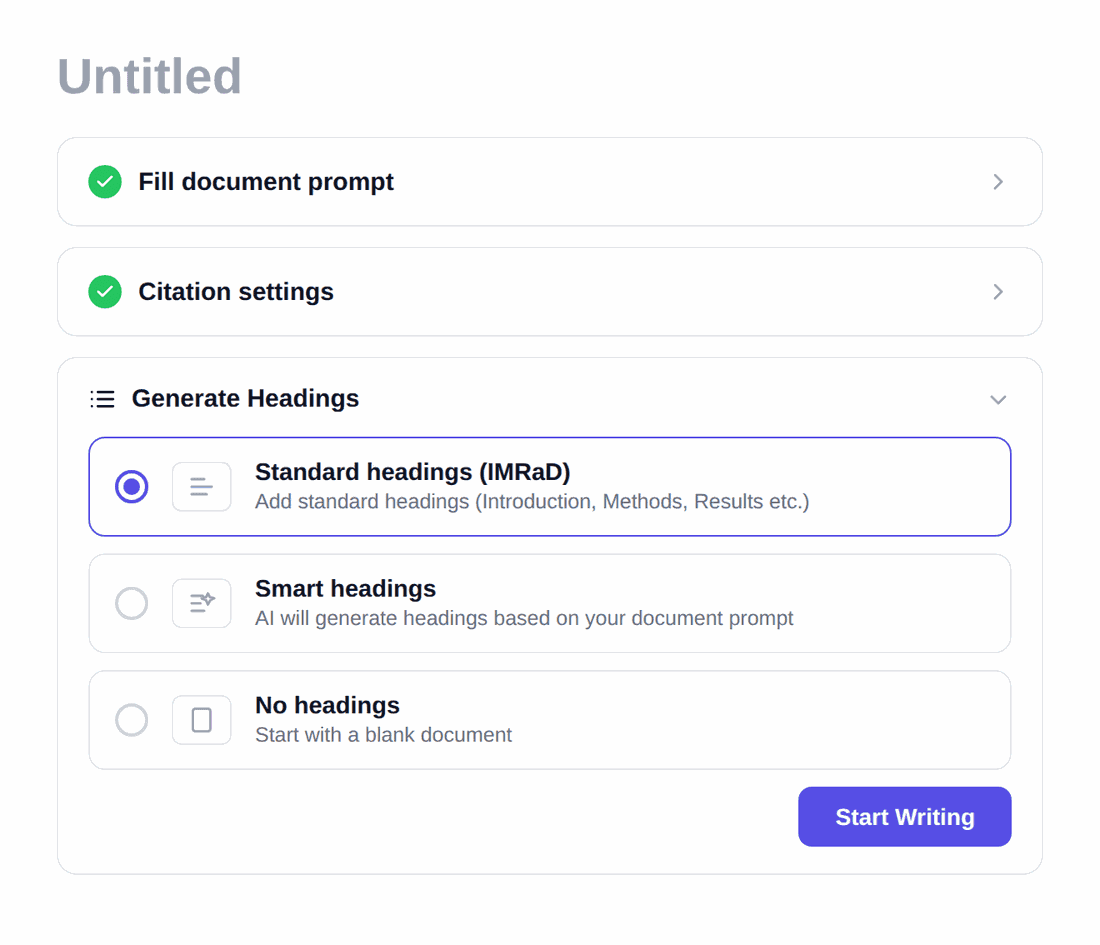
Step 3. Generate your headings. Jenni proposes an outline you can edit before a single paragraph is written. Replace its default headings with the funder's own section names, in the funder's order.
Step 4. Write section by section. Draft the need statement and methods first, since everything else depends on them. Use your own local data for every number, and let the tool handle transitions and structure rather than facts.
Step 5. Review before you submit. Run Claim Confidence and Source Quality over the finished draft to catch anything unsupported, then check that each cited source says what you claim it says. Verifying a credible source takes two minutes and saves an application.
<ProTip title="🔍 Watch out:" description="Never let a drafting tool supply a statistic about your own community. Pull those numbers from district records, census data, or your own service logs, and cite them" />
From Blank Template to Funded Project
A template will not make a weak program fundable. What it does is stop you from losing points on structure, so the reviewer spends their limited attention on the part that actually distinguishes you. Get the sections right, keep them inside the length the funder expects, and put your best writing in the need statement where it earns the most.
<CTA title="Start Your Next Proposal With a Real Outline" description="Turn funder guidelines into a structured, cited draft you can refine section by section" buttonLabel="Try Jenni Free" link="https://app.jenni.ai/register" />
If you want a deeper look at the writing itself, the University of Wisconsin's grant proposal handbook is one of the better free resources available, and it pairs well with practice in maintaining a formal tone and structuring a persuasive proposal. Write the next one four weeks early, and you will be surprised how much better it reads.