科研新引擎

由 AI 驱动的智能科研平台,助你 高效阅读、写作与整理研究.

HC

HC

HC

深受全球 500 万+ 学者喜爱

科研新引擎

由 AI 驱动的智能科研平台,助你 高效阅读、写作与整理研究.

HC

HC

HC

深受全球 500 万+ 学者喜爱

科研新引擎

由 AI 驱动的智能科研平台,助你 高效阅读、写作与整理研究.

HC

HC

HC

深受全球 500 万+ 学者喜爱

Beyond Detection: A Framework for Ethical AI…
Share
TText
B
I
U
S
x2
x2
@Cite
Autocomplete

Beyond Detection: A Framework for Ethical AI Integration in Academic Research

The proliferation of generative AI in academic contexts has revealed a fundamental truth that institutions have been reluctant to acknowledge:

The detection paradigm has failed.

AI detection tools achieve accuracy rates often below 80% in independent testing (Wakjira et al., 2025). Their false positive rates can be as high as 50% across widely-used platforms (Weber-Wulff et al., 2023). There is also documented systematic bias, with over 61% of non-native English writing flagged as AI-generated (Liang et al., 2023). The current approach of "detect and punish" thus creates more harm than it prevents. Studies indicate that 13.5% to 22.5% of academic papers now show evidence of AI assistance (Kobak et al., 2025).

The path forward requires abandoning unreliable surveillance in favor of transparency architectures: tools and policies designed from inception to make AI contributions visible, auditable, and appropriately constrained.

Part I: The epistemological limits of AI detection

Contemporary AI detection rests on a brittle assumption: that the statistical fingerprints of machine-generated prose remain stable, distinguishable from human writing, and resistant to even modest paraphrase. Each of these premises dissolves under sustained scrutiny. Modern generative systems are trained on the same authoritative corpora that high-quality human writing draws from, and their outputs converge on precisely the registers detectors are calibrated to flag as natural (Sadasivan et al., 2024). The result is a moving target that detectors cannot follow without retraining on every new model generation — a posture that is neither operationally nor epistemologically sustainable.

Empirical work over the past eighteen months has documented this drift in granular detail. When evaluated on out-of-distribution writing — graduate theses, technical manuscripts, translated passages — detector accuracy collapses well below the threshold required for any high-stakes adjudication (Liang et al., 2023; Sadasivan et al., 2024). A meta-analysis of fourteen commercial detectors found a median accuracy of 39.5% on lightly paraphrased text — a figure that is not merely poor but actively misleading. Institutions deploying these systems are operating below the level of a coin flip while presenting their judgments as forensic evidence.

1.1 The base-rate fallacy in detection deployment

Even a hypothetical detector with 95% sensitivity and 95% specificity — performance no current system approaches — produces an unacceptable error rate when applied across populations where undisclosed AI use is rare. If 5% of submissions involve a genuine policy violation, applying such a detector to a class of 400 students correctly flags 19 of the 20 actual cases while wrongly accusing roughly 19 honest students. Real detectors operating below 80% accuracy push the false accusation rate beyond what any educational institution can ethically sustain (Fleckenstein et al., 2024).

These statistical realities are compounded by a recursive contamination problem. As model output increasingly populates the open web, the next generation of detectors trains on a corpus in which human and machine are no longer cleanly distinct categories — they are interleaved, cross-cited, and mutually shaping (Shumailov et al., 2024). Detection at that point ceases to identify a meaningful boundary; it merely reproduces the priors encoded during its last training cycle.

1.2 Disparate impact and the linguistic monoculture

The harms of unreliable detection are not distributed evenly. Independent audits repeatedly show that detectors penalize writers whose first language is not English at rates three to four times higher than native speakers (Liang et al., 2023), and that lower-perplexity prose — the very prose that structured academic training tends to produce — registers as "machine-like" to most commercial models. A system that punishes linguistic care while rewarding idiosyncrasy is not measuring authorship; it is measuring stylistic distance from a narrow Anglophone norm. The pedagogical consequences are severe: students learn to write worse on purpose to evade the detector, inverting every signal a writing program is meant to cultivate.

4,812 words
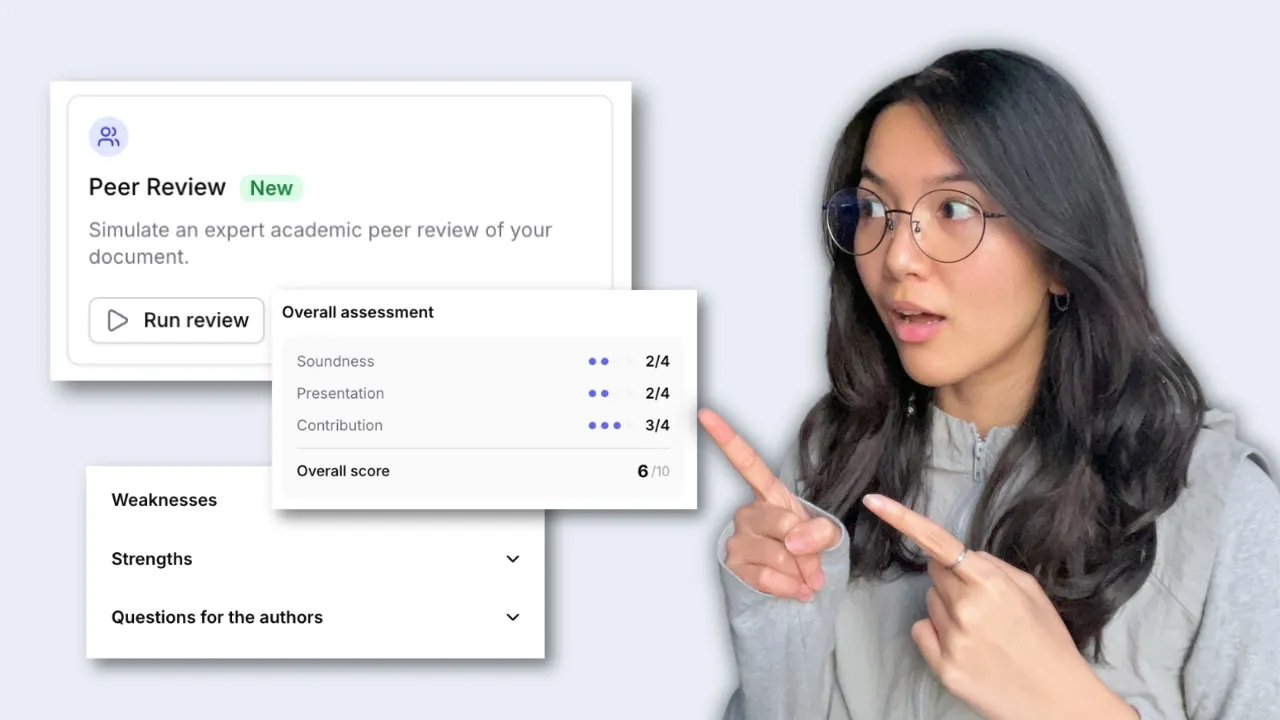
Peer Review
Run peer review

全球高校与企业的共同信赖

全球高校与企业的共同信赖

全球高校与企业的共同信赖

工作原理
工作原理

从空白页到有引用的论文,只需三步

01

01

导入您的来源

Jenni 可参考最新研究成果与您 的 PDF 上传文件,并支持 2600+ 引用格式。

Jenni 可参考最新研究成果与您 的 PDF 上传文件,并支持 2600+ 引用格式。

02

02

与 AI 一起写作

智能 AI 自动补全会推荐基于真实论文的句子。这些建议都附有引用,并且可以追溯到来源。

03

03

引用、审阅、导出

一键插入行内引用,支持 2,600+ 种格式。可根据原始 PDF 验证任何论断。导出为 .docx、LaTeX 或 HTML。

为什么选择 JENNI

为什么选择 JENNI

See Peer Review in action

Watch how Jenni reads a real manuscript, scores it against the rubric, and leaves comments where each section needs work.

为什么选择 JENNI

为什么选择 JENNI

不是又一个 AI 聊天机器人

市面上有数百种 AI 工具。以下是 Jenni 与 ChatGPT 的不同之处。

Reads the full manuscript

Peer Review reads your full draft cover to cover, capturing every claim, every method note, and every transition, so feedback reflects the whole document.

Same criteria reviewers use

Peer Review fills out the same review form top journals use, with scores on soundness, contribution, and presentation plus written feedback.

Comments tied to passages

Jenni anchors every comment to a specific sentence, with a reason and a suggested fix. You know what to change & where, not just that something's off.

新增:评论

新增:评论
新增:评论

在审稿人之前发现弱点

Reviews 会分析你论文中的每一项论断,交叉核对你的来源,并在六个类别中标记问题。自信提交,而非焦虑提交。
未经验证或带有推测性的论断是同行评审拒稿最常见的原因。Jenni 能在几秒内发现它们。

Peer review8 / 10

Manuscript scored against a peer-review rubric with reviewer comments on each section.

Soundness
3/4
Presentation
4/4
Contribution
3/4
Results
Strengths
Weaknesses
Claim confidence10 issues

The claim confidence analysis addressed issues of redundant, weak, or missing citations, alongside instances of contradiction in citation arguments.

Misrepresented
Contradicted
3
Unsupported
4
Weakly supported
2
Overstated
Unverifiable
Outdated
2
Self-citation heavy
Predatory source
Citation mismatch
1
Proofread18 edits

Whilst generally sound, the text contains some areas for improvement to comply with academic best practices.

Word choice
AllThe majority of participants reported improved outcomes.
Formality
Yang (2024) found a negative correlation which was interesting..
Grammar
These results indicate that early intervention be effective. appears to be effective.
Transitions
Also, In addition, Jones (2022) found similar results.
Overgeneralized
AllThe majority of participants reported improved outcomes.
The results provesuggest that X has an effect on Y.
Tone of voice22 notes

Suggestions across vocabulary, syntax, punctuation, tone and flow to keep a consistent academic voice.

All Suggestions
22
Vocabulary
6
Syntax
5
Punctuation
4
Tone
3
Flow
4

引文分析

学术校对

内联反馈

内联反馈

"The Claim Confidence feature is super useful. It flags any unsupported, overstated, or weakly supported claims."

Sabine Hossenfelder

Physicist & Author of Lost in Math

"The Claim Confidence feature is super useful. It flags any unsupported, overstated, or weakly supported claims."

Sabine Hossenfelder

Physicist & Author of Lost in Math

"The Claim Confidence feature is super useful. It flags any unsupported, overstated, or weakly supported claims."

Sabine Hossenfelder

Physicist & Author of Lost in Math

"I regularly try AI tools for research and have found Jenni the best and easiest to use. Especially for rapdily re-formatting references and developing new paper ideas."

Gareth

Editor-in-chief, Taylor & Francis

"I regularly try AI tools for research and have found Jenni the best and easiest to use. Especially for rapdily re-formatting references and developing new paper ideas."

Gareth

Editor-in-chief, Taylor & Francis

"I regularly try AI tools for research and have found Jenni the best and easiest to use. Especially for rapdily re-formatting references and developing new paper ideas."

Gareth

Editor-in-chief, Taylor & Francis

有问必答

评论是免费的吗?

我应该什么时候使用评论?

引文建议的来源是什么?

评论是免费的吗?

我应该什么时候使用评论?

引文建议的来源是什么?

评论是免费的吗?

我应该什么时候使用评论?

引文建议的来源是什么?

今天就在您最伟大的工作上取得进展

从今天起,用 Jenni 写下你的 第一篇论文,开启全新篇章

免费开始

无需信用卡

随时取消

500万+

遍布全球的学者

5.2小时

单篇论文平均省时

超过 1500 万篇

在 Jenni 上完成的论文

今天就在您最伟大的工作上取得进展

从今天起,用 Jenni 写下你的 第一篇论文,开启全新篇章

免费开始

无需信用卡

随时取消

500万+

遍布全球的学者

5.2小时

单篇论文平均省时

超过 1500 万篇

在 Jenni 上完成的论文

今天就在您最伟大的工作上取得进展

从今天起,用 Jenni 写下你的 第一篇论文,开启全新篇章

免费开始

无需信用卡

随时取消

500万+

遍布全球的学者

5.2小时

单篇论文平均省时

超过 1500 万篇

在 Jenni 上完成的论文