Elicit vs Consensus: Which Answers a Research Question Better for a Thesis?

Head of Growth
9 min read
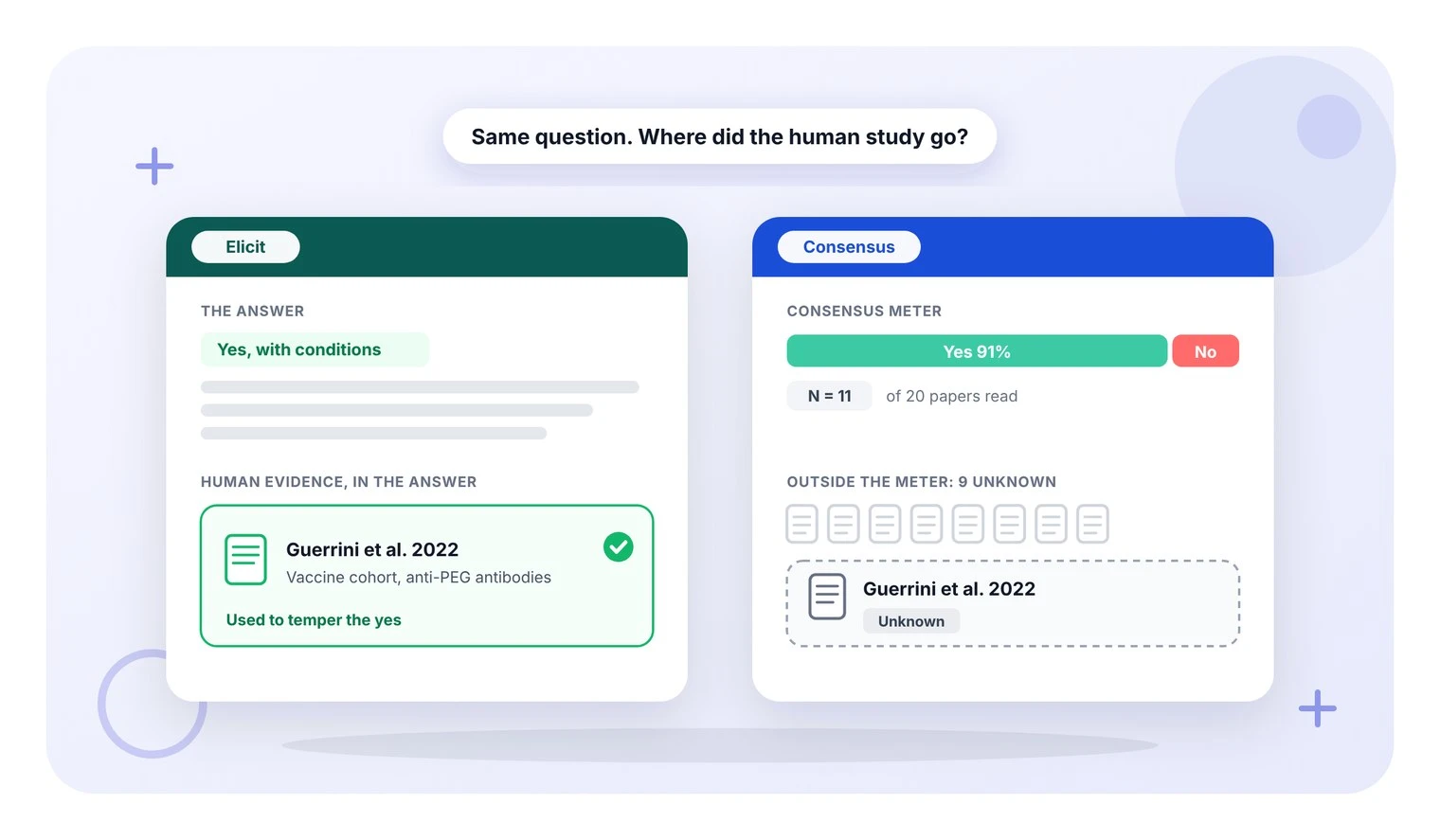
"Yes, repeat dosing triggers immune responses against PEG and lipid components, altering particle clearance." Consensus printed that line within about 10 seconds, over a meter reading Yes 91%. The slower Elicit yes came qualified in its own first sentence, and its last paragraph placed the strongest evidence in preclinical models, so a thesis chapter should start there.
Match each claim to the strength of its evidence
The hedge claim confidence edit rewrites an overstated sentence, and Claim Confidence is one of five reviews a chapter can go through
Try Jenni FreeElicit or Consensus: the decision up front
Start in Elicit - when a chapter has to say how far the evidence reaches. Its answer named the conditions in its first sentence and kept the animal and human findings apart.
Use Consensus - for a fast first look at a yes-or-no question. It answered within about 10 seconds, and its meter shows how the classified papers split.
With either - open the papers before citing them. One Elicit row carried a preprint label on a journal article, and the meter left out 9 of the 20 papers Consensus read.
Side by side
Elicit | Consensus | |
Answer on screen | Still working at 10.4 seconds, complete by the 74.8-second check | By the 10.5-second check |
Papers behind it | 99 reviewed, 7 cited | 20 read, 15 cited in the answer |
First sentence | Yes, with formulation, route, dose and species named | Yes, with PEG and lipid components named |
Human evidence | Its own paragraph, set against the animal studies | One sentence, under Pharmacokinetic Impacts |
Mechanism detail | Antibodies, complement and faster clearance | Adds TLR4 and CD1d, and a B-1 then B-2 antibody response |
The vaccine cohort study | Cited for the human findings | Cited, badged Unknown, outside the meter |
Yes-or-no tally | None | Yes 91%, No 9%, N = 11 |
Venue shown for the rat study | bioRxiv, 2023 | NPJ Vaccines, 2023 |
Formatted reference | None in the source panel | APA, MLA, Chicago, Harvard, BibTeX and AMA/Numeric |
Consensus was faster and put more on the page: an evidence table, figures and a citation in six formats. Elicit gave the answer a chapter can lean on, because it said where the evidence was strong and where it thinned out.

The same question in both
The question came from the paragraph on lipid nanoparticle delivery of CRISPR used across these tool reviews, which lists repeat dosing among the things still to be worked out: "Does repeat dosing of lipid nanoparticles trigger an immune response?"
It went into the Elicit Research agent and into the default Consensus search less than a minute apart, with no settings changed. The Deep review option in Consensus was not switched on.
The answer each tool gave
Consensus - the answer was on screen at the 10.5-second check. Its steps panel showed the search it ran, "repeat dosing of lipid nanoparticles and immune response", with 5.7M results and 20 papers read, then the headline quoted above.
Under it sat the Consensus Meter at Yes 91%, No 9%, N = 11, an evidence table rating two claims Strong and one Moderate, and two figures of its own. The line on what the evidence covered came last: "These findings reflect experimental animal models and clinical trial cohorts".
The body went further into mechanism than Elicit did. It named TLR4 and CD1d as the receptors behind the ionizable lipid response, and an early B-1 then later B-2 antibody response on re-dosing.
Between those, it listed four PEG alternatives from the papers it read, each with one citation, and offered follow-ups such as "How does accelerated blood clearance after LNP repeat administration affect mRNA efficacy?"
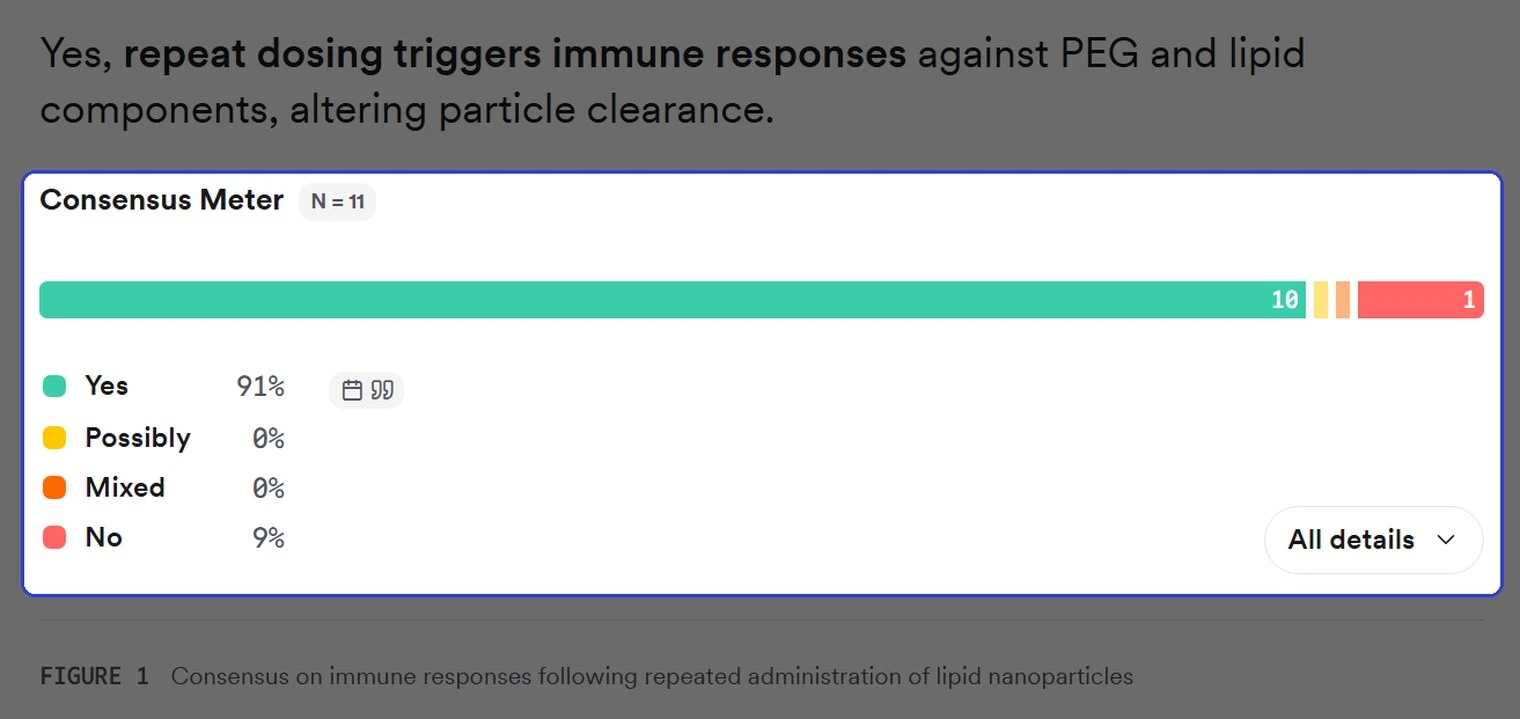
The Consensus headline and meter for the repeat-dosing question
Elicit - still working at the 10.4-second check, it had a finished answer by the 74.8-second check, headed "Reviewed 99 sources on immune responses to repeat LNP dosing". The session titled itself Lipid nanoparticle redosing immunity.
Its first sentence answered yes and said the response and its consequences "depend on the LNP formulation, route, dose, and species." The second paragraph opened "That effect is not inevitable or uniform."
A third paragraph turned to people: "Human vaccine findings are more reassuring about practical consequences than the animal redosing studies". The last placed the strongest evidence for faster clearance in preclinical models. Among its follow-ups was "What human evidence links anti-PEG antibodies to clinical outcomes?"
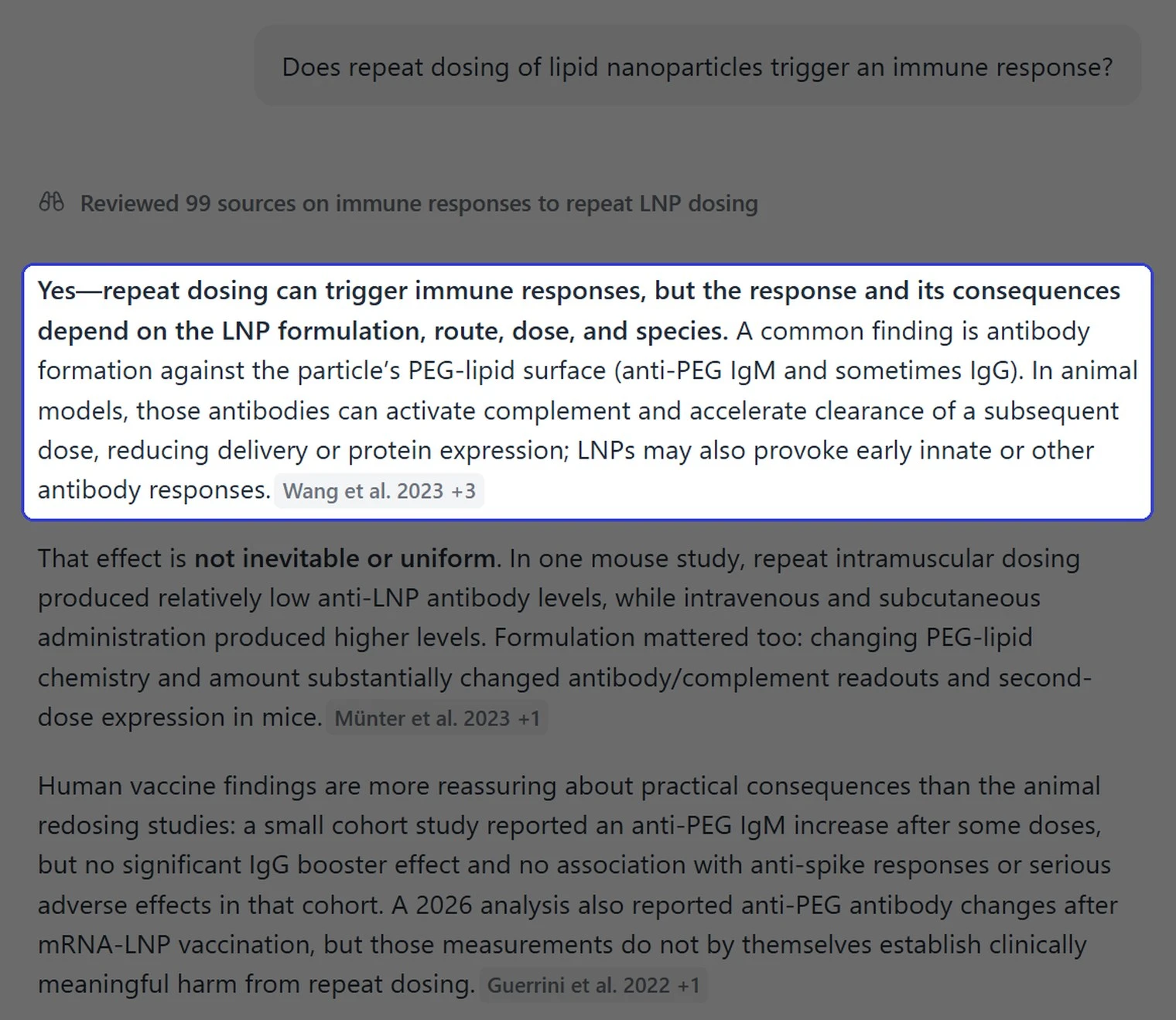
The Elicit answer, with formulation, route, dose and species in its first sentence
What the 91% counts
Each of the 20 papers carries a badge in the Consensus References panel. The badges added up to 10 Yes, 1 No and 9 Unknown, so the N = 11 behind the meter is the Yes and No papers alone.
The one No - Kim et al. (2023), a new ionizable lipid that, per its abstract, allowed repeated mRNA doses to fibrotic lungs in mice without loss of activity. Consensus tagged it "The lone dissent here."
Two of the 10 Yes - a Research Square preprint by Arral et al. with 0 citations, whose journal version is in Drug Delivery and Translational Research, and a 2026 conference abstract printed in Cancer Research.
Among the 9 Unknown - Guerrini et al. (2022), the vaccine cohort study both tools used for human evidence. Its key takeaway in Consensus reads "The presence of PEG in lipid-nanoparticle-based COVID-19 vaccines does not affect safety or efficacy, and anti-PEG antibodies do not show significant booster effects after repeated doses."
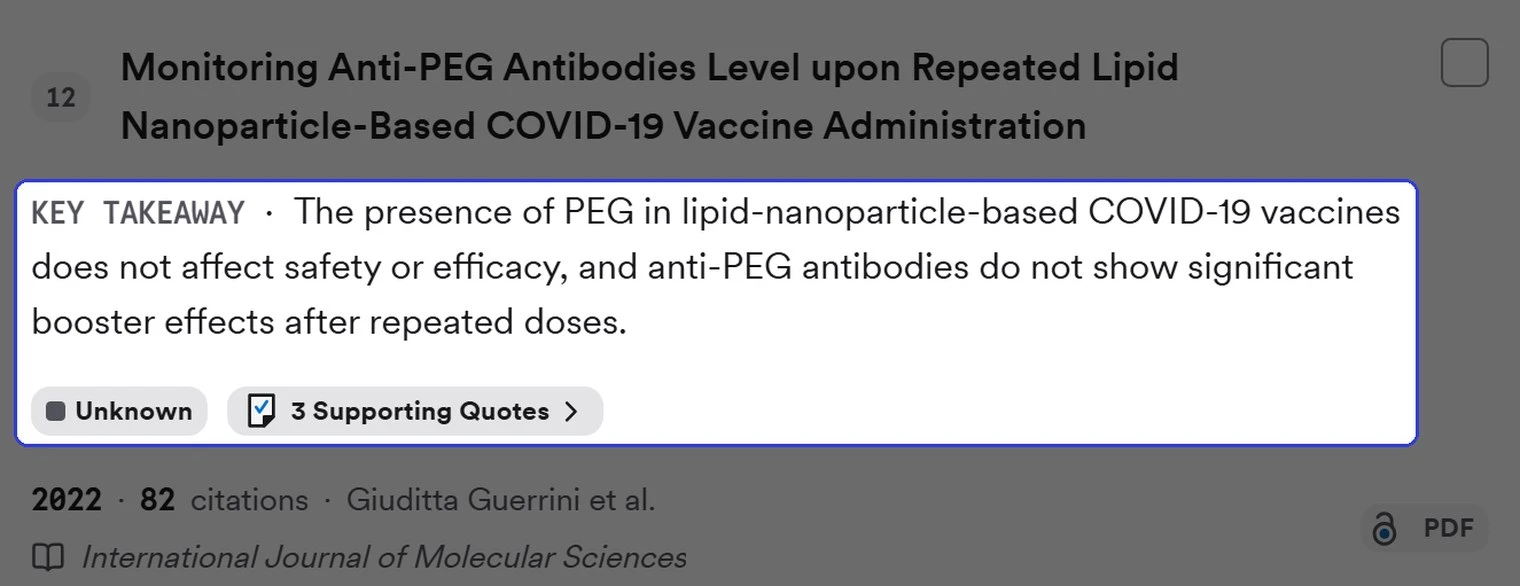
The vaccine cohort study in the Consensus references, badged Unknown
The abstract backs the safety part of that summary and the IgG part, but not all of it. Anti-PEG IgG showed no significant booster effect, while IgM rose significantly after the first and third doses, and PEG was not linked to any reported serious adverse effects in the cohort.
The two most-cited papers Consensus read were Unknown as well: a 2022 paper in Immunity with 616 citations and a 2023 literature review with 421.
So the human cohort study both tools leaned on sat outside the percentage. The guide to a real source behind a wrong claim shows how a sentence drifts from what its paper says.
The papers behind the Elicit answer
View 7 cited sources opened a table of the papers behind the answer:
Wang et al., shown as bioRxiv, 2023, 116 citations
Omata et al., Molecular Pharmaceutics, 2024
Lee et al., Biomaterials Research, 2024
Besin et al., ImmunoHorizons, 2019, abstract only
Münter et al., Molecular Therapy: Methods & Clinical Development, 2023
Guerrini et al., International Journal of Molecular Sciences, 2022
Facskó et al., Pharmaceutics, 2026, abstract only
Row 1 is the rat study that also led the Consensus evidence table. Elicit labelled it "bioRxiv · 2023", but its link opens the npj Vaccines article, under the same DOI that Consensus used.
The two are one study at two stages. A bioRxiv preprint with the same title was posted in 2022 and the journal version followed in 2023, so the Elicit row pairs the preprint server with the journal year.
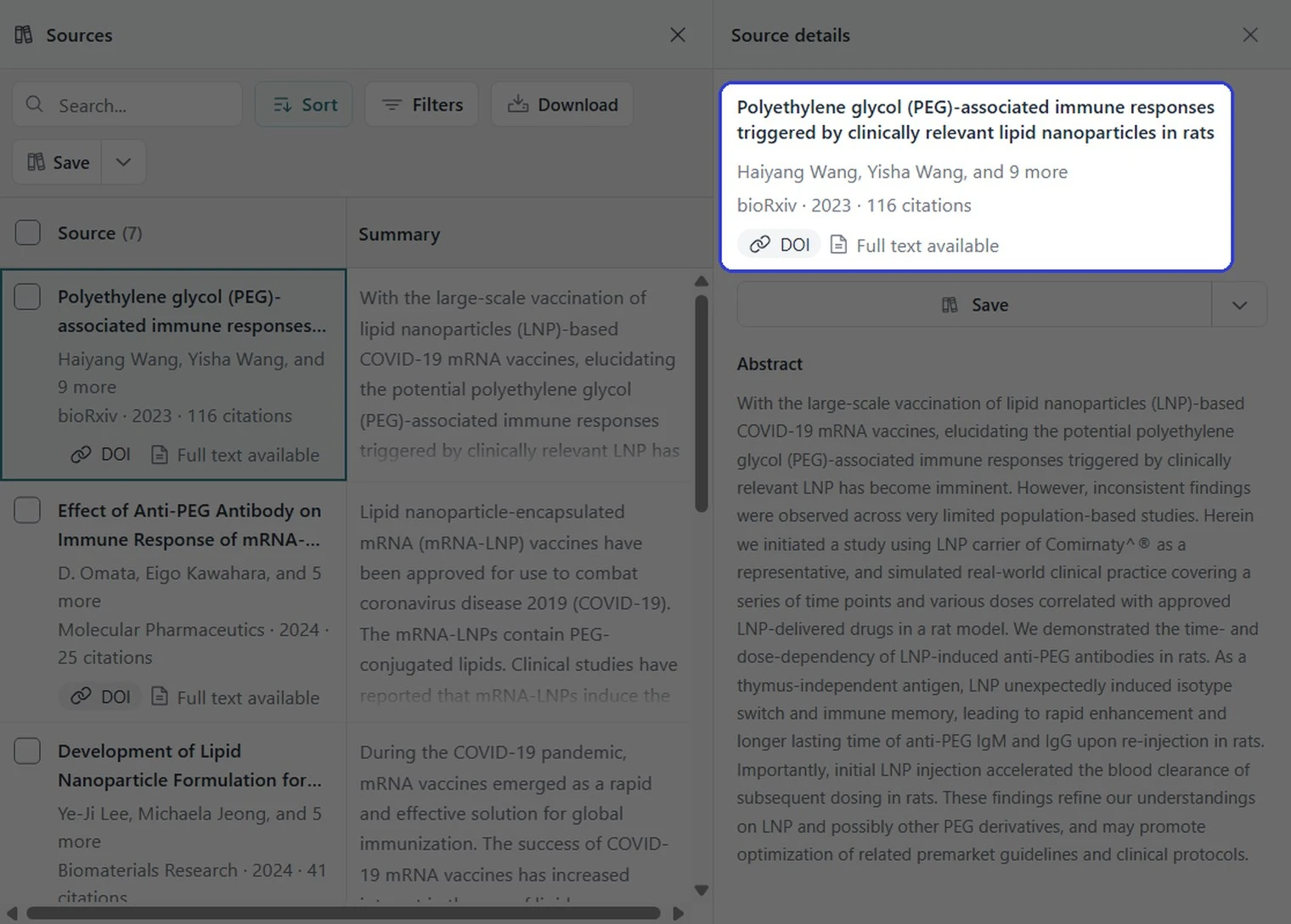
The Elicit source panel, with the preprint label on the journal article
The guide to telling whether an article is peer reviewed covers the same check by hand.
Where the two source lists overlap
Of the 7 Elicit sources, 4 were also among the 15 that Consensus cited: the rat study, the 2019 ImmunoHorizons paper on a two-phase antibody response, the 2024 formulation study by Lee et al. and the vaccine cohort study.
Elicit alone cited the other 3:
Route - Münter et al. (2023) compared intravenous, intramuscular and subcutaneous injection in mice, and found low antibody levels after intramuscular injection.
Antibodies and the payload - Omata et al. (2024) studied how anti-PEG antibodies affect the immune response to mRNA-loaded particles.
People - Facskó et al. (2026) analysed anti-PEG antibodies in human blood donors, comparing people who had and had not received mRNA-LNP vaccines.
The same rat study also carried two citation counts, 116 in Elicit and 117 in Consensus, while its publisher page showed 142. A count is a figure from one database, not a property of the paper.
Getting a reference out
Consensus - the quote icon on a reference card opens Cite this finding, with tabs for APA, MLA, Chicago, Harvard, BibTeX and AMA/Numeric. The APA entry for the rat study listed all 11 authors in order, with the DOI.
Its source part read "NPJ Vaccines, 8." with no issue or article number, while the publisher page lists issue 1 and article number 169 and styles the journal npj Vaccines.
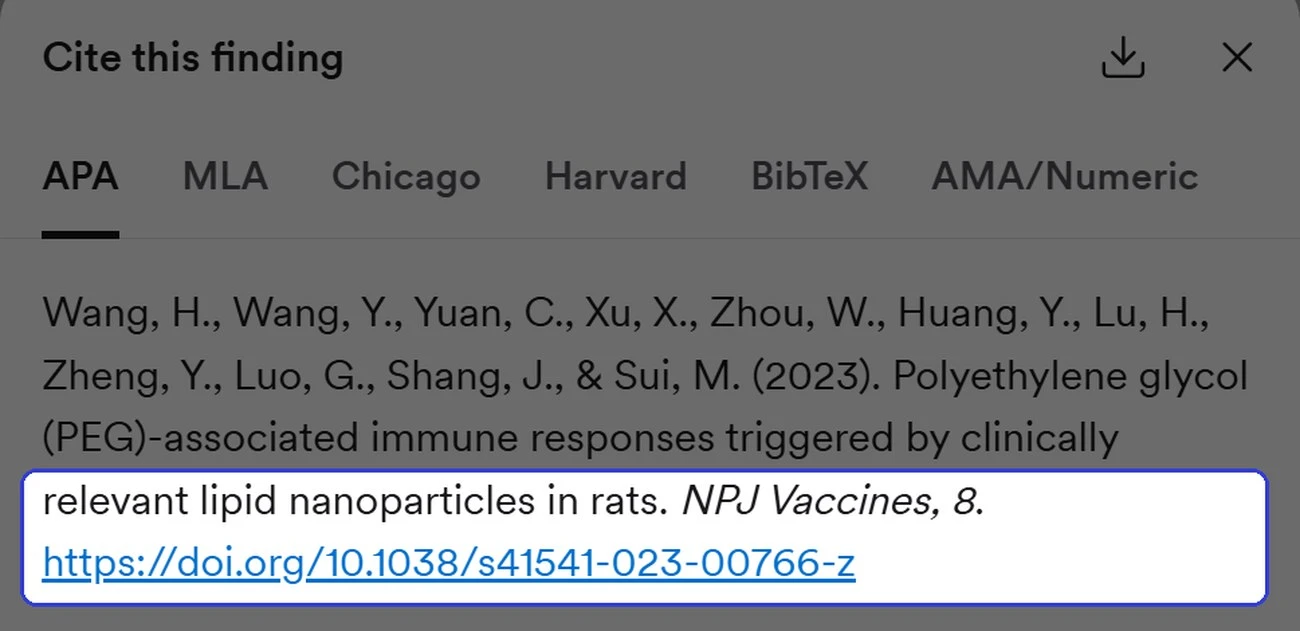
The Consensus APA entry, with no issue or article number
Elicit - the Source details panel gave the title, authors, the venue line, a DOI link, the abstract and a Save button. It had no formatted reference to copy.
The guide to finding a DOI shows where those details sit on a publisher page.
What each tool costs
Plan | Elicit (Academic prices) | Consensus |
Free | Basic, $0. Limited usage for Research Agent and Research Reports, unlimited search across more than 138 million papers | Free, $0. Basic Paper search, 10 Pro messages per month, up to 3 Deep reviews per month |
First paid tier | Plus: $19 a month, or $132 a year | Pro: $20 a month, or $144 a year |
Second paid tier | Pro: $69 a month, or $468 a year | Deep: $65 a month, or $540 a year |
Third tier and enterprise | Scale: $149 a month, or $1,068 a year. Enterprise: custom | Teams: $30 per seat a month. Enterprise: custom |
Prices from elicit.com/pricing and consensus.app/pricing.
Elicit Plus lists export to RIS, CSV, BIB, PDF and DOCX and 5 table columns at a time. Consensus Pro lists unlimited Pro messages and 15 Deep reviews a month, and Deep raises the reviews to 200.
The two first paid tiers sit $1 apart a month and $12 apart a year.
Using both
Ask Consensus first - for a quick look at a yes-or-no question, and note the N beside the meter.
Open the Unknown papers - the human cohort study both tools leaned on sat there, outside the percentage.
Ask Elicit the same question - for an answer that keeps animal and human findings apart, with its cited papers listed.
Check each paper at the publisher - confirm the version, the year and the issue before writing the reference.
The guide to writing a research question covers phrasing one these tools can answer, and the thesis literature review guide covers where the checked papers go.
Verdict: Elicit or Consensus?
Elicit, for a thesis chapter on a question like this one. Its answer named formulation, route, dose and species in its first sentence, kept the animal and human evidence apart, and listed its 7 sources in one table.
Consensus, for a fast first look at a yes-or-no question, with a meter, an evidence table and a citation in six formats. Read the meter beside its N, because 9 of the 20 papers it read sat outside it.
Bring a checked paper in by its DOI
Paste a DOI or PMID into Jenni and the paper joins your Library, ready to cite in APA, MLA, Chicago, IEEE or Harvard
Start Writing FreeThe Elicit review and the Consensus review test each tool on its own, and Elicit vs SciSpace puts the same paragraph through another pairing.
With the papers checked, the chapter itself is written in Jenni, where each hedged claim sits next to the source it rests on.