Par
Nathan Auyeung
—
Qualitatif vs quantitatif en matière de compétences en recherche académique

Nathan Auyeung
Expert-comptable senior chez EY
Diplômé avec une Licence en Comptabilité, suivi d'un Diplôme de Postgraduate en Comptabilité

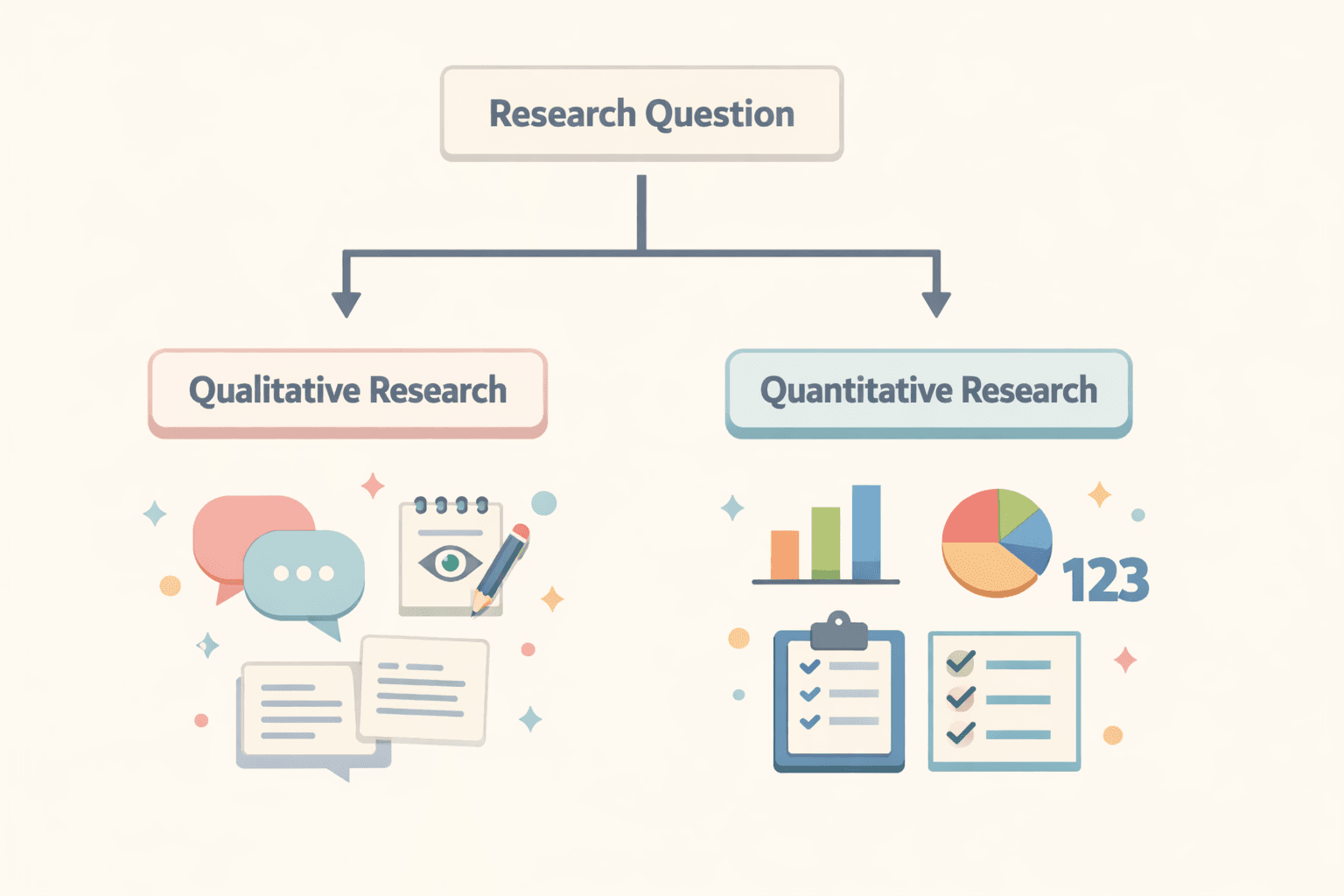
La recherche est la façon dont nous construisons le savoir. Elle est utilisée dans les écoles, les entreprises, les hôpitaux et les sciences sociales. Pour obtenir des réponses, les chercheurs ont besoin d'un plan pour recueillir et étudier l'information. Les deux principaux plans s'appellent la recherche qualitative et la recherche quantitative.
Elles visent toutes deux des résultats solides, mais fonctionnent différemment. Elles ont des objectifs, des conceptions, des données et des façons d'analyser distincts. Comprendre leurs différences vous aide à choisir la bonne approche, à construire une étude plus solide et à mieux interpréter ce que vos résultats signifient réellement.
<CTA title="Clarifiez tôt votre orientation de recherche" description="Transformez des idées de recherche larges en un plan d'étude clair et ciblé en quelques minutes avec Jenni." buttonLabel="Essayer Jenni gratuitement" link="https://app.jenni.ai/register" />
Comprendre la méthodologie de recherche
La méthodologie de recherche est le plan directeur d'une étude. C'est l'ensemble des décisions que vous prenez sur la manière de concevoir le projet, de choisir les participants, de recueillir l'information et d'analyser ce que vous découvrez au cours du processus de recherche et d'investigation systématique.
De manière générale, la méthodologie se répartit en trois grandes catégories :
Recherche qualitative
Recherche quantitative
Recherche à méthodes mixtes
Ces approches ne sont pas interchangeables. Choisir la mauvaise peut donner des données faibles, des résultats fragiles ou des conclusions qui ne tiennent pas vraiment la route.
<ProTip title="📝 Note :" description="Avant de choisir une méthode de recherche, rédigez votre question de recherche principale en une phrase claire et vérifiez si elle demande pourquoi ou comment, plutôt que combien ou à quel point." />
Qu'est-ce que la recherche qualitative ?
La recherche qualitative est axée sur l'exploration et l'interprétation. Cette approche suit un paradigme de recherche différent, visant à comprendre pourquoi les gens font certaines choses et ce que leurs expériences ressentent plutôt qu'à les réduire à des chiffres.
Elle explore les significations que les personnes trouvent dans leur vie quotidienne. Ici, vous n'utilisez pas de chiffres. À la place, vous écoutez, observez et interprétez. L'objectif est de voir le monde à travers les yeux de quelqu'un d'autre.
Choisissez cette méthode lorsque vous avez des questions larges et ouvertes, ou lorsque vous étudiez un sujet pour la première fois. Elle sert à la découverte, quand vous devez apprendre les bases avant même de commencer à mesurer quoi que ce soit.
L'objectif principal de la recherche qualitative est de :
Comprendre pourquoi et comment les choses se produisent.
Comprendre les points de vue personnels des gens, leurs motivations et leurs émotions.
Construire de nouvelles théories, pas seulement tester celles qui existent déjà.
Documenter toute la complexité, souvent chaotique, des situations telles qu'elles se déroulent réellement.
Elle valorise une compréhension profonde et détaillée plutôt que des enquêtes larges et superficielles. Dans cette approche, le contexte, c'est-à-dire les circonstances environnantes, est tout aussi essentiel que le contenu de ce qui est dit ou fait.
<ProTip title="🔍 Conseil :" description="La recherche qualitative fonctionne mieux lorsque vous laissez vos questions d'entretien évoluer à mesure que de nouveaux éclairages émergent des données." />
Données qualitatives et méthodes de collecte des données
Ce type de recherche travaille avec des données non numériques, ou textuelles. Elles sont détaillées et riches de sens, mais vous ne pouvez pas facilement les transformer en statistiques.
Méthodes courantes pour recueillir ces données
La manière de recueillir ces informations n'est pas rigide. Vous pouvez vous adapter au fur et à mesure de votre apprentissage. Les chercheurs collectent généralement les données à travers quelques activités principales :
Entretiens : Une conversation, souvent en tête-à-tête, avec des questions qui permettent aux personnes d'expliquer leurs expériences avec leurs propres mots.
Groupes de discussion : Animer une discussion avec un petit groupe pour entendre différents points de vue et voir où les personnes sont d'accord ou non.
Observations : Observer attentivement ce que les gens font dans leur environnement habituel, comme un lieu de travail ou un foyer, et prendre des notes.
Études de cas : Examiner une situation précise de manière extrêmement détaillée afin d'apprendre tout ce qu'il est possible à son sujet.
Ethnographie : Vivre avec une communauté, ou y passer une période prolongée, pour comprendre réellement comment ses membres vivent et interagissent.
Notes et enregistrements : Noter tout ce que vous voyez et entendez, et produire des transcriptions exactes des conversations.
Toutes ces techniques produisent une grande quantité de matériel original et détaillé, directement issu des personnes concernées.
Analyse des données qualitatives
Analyser des données qualitatives
Ici, vous recherchez des schémas, des significations et des thèmes, et non des relations statistiques.
Techniques courantes d'analyse
Analyse thématique : Repérer les idées ou sujets qui reviennent régulièrement dans vos données.
Analyse de contenu : Trier et étiqueter systématiquement des morceaux de texte dans des catégories.
Analyse narrative : Examiner de près les récits que les personnes racontent et la manière dont ils sont structurés.
Analyse du discours : Étudier la façon dont le langage est utilisé dans les interactions sociales.
Phénoménologie : Se concentrer sur les détails des expériences vécues directement par les personnes.
Théorie ancrée : Construire une nouvelle théorie à partir de zéro, en s'appuyant directement sur les données recueillies.
Les chercheurs prennent toutes ces informations détaillées et commencent à les organiser. Ils relisent tout, entretiens, notes, transcriptions, et cherchent des idées ou des sujets communs.
Ils attribuent à ces idées des codes, comme des étiquettes, afin de regrouper des éléments d'information similaires. Ils utilisent le même ensemble d'étiquettes tout au long du processus pour rester cohérents.
Ils continuent à lire et à trier jusqu'à remarquer quelque chose : les nouveaux entretiens ou notes n'apportent plus d'idées nouvelles. Les mêmes thèmes reviennent sans cesse.
Quand cela se produit, ils ont atteint ce qu'on appelle la « saturation des données ». Cela signifie qu'ils ont probablement entendu tous les points de vue importants sur le sujet, et qu'ils peuvent arrêter de recueillir de nouvelles informations.
<ProTip title="🧠 Rappel :" description="La saturation des données est atteinte lorsque les nouveaux entretiens n'ajoutent plus de nouveaux thèmes, et non lorsque vous êtes fatigué de collecter des données." />
Forces et limites de la recherche qualitative
Là où elle excelle
Elle offre des perspectives profondes et détaillées sur les expériences humaines.
Elle capture le contexte dans son ensemble, y compris les émotions et les significations personnelles.
Sa conception flexible permet à de nouvelles découvertes d'émerger pendant l'étude.
Elle est parfaitement adaptée aux travaux exploratoires menés en début de recherche sur un sujet.
Elle place au centre et valorise la voix des personnes étudiées.
Là où elle montre ses limites
La taille réduite des échantillons fait que les résultats ne peuvent souvent pas être généralisés largement.
La collecte et l'analyse des données prennent beaucoup de temps.
La perspective propre du chercheur peut influencer l'interprétation des données.
Il est difficile pour un autre chercheur de reproduire exactement l'étude.
Les résultats sont généralement liés au contexte spécifique dans lequel ils ont été recueillis.
Même avec ces limites, cette approche est essentielle pour explorer des questions sociales et humaines complexes.
Qu'est-ce que la recherche quantitative ?
La recherche quantitative est structurée et objective. Elle se concentre sur la mesure des variables et la vérification d'idées précises à l'aide de chiffres, de statistiques et de données quantitatives pour évaluer les tendances et les résultats.
L'objectif est de trouver des schémas, des relations ou des liens de cause à effet qui peuvent s'appliquer à des groupes plus larges.
Cette méthode repose sur l'analyse statistique et mathématique.
La recherche quantitative vise à :
Mesurer les choses avec précision et cohérence.
Tester des hypothèses ou des prédictions claires et prédéfinies.
Examiner les relations entre différents facteurs mesurés.
Produire des résultats pouvant être généralisés à une population plus large et reproduits par d'autres.
C'est la méthode à utiliser lorsque vous avez besoin de réponses claires et quantifiables pour de grandes questions. Pensez à un sondage national demandant pour qui les gens vont voter. Ou à un essai médical testant si une nouvelle pilule est sûre.
Ou à une étude vérifiant si un nouveau programme scolaire a aidé les élèves à mieux lire. Pour tous ces cas, vous utilisez la recherche quantitative. Elle vous donne des chiffres pour démontrer ce qui se passe.
<ProTip title="📊 Conseil :" description="Si votre question de recherche peut être répondue par un nombre ou un pourcentage, la recherche quantitative est généralement le meilleur choix." />
Données quantitatives et méthodes de collecte des données
Cette recherche travaille avec des données numériques recueillies à l'aide d'outils standardisés et cohérents, souvent comparées aux approches qualitatives lorsqu'on examine les différences qualitatif vs quantitatif dans la conception de l'étude.
Méthodes courantes pour recueillir ces données
Enquêtes et questionnaires
Expériences contrôlées
Sondages et études de population à grande échelle
Questions avec des choix de réponse fixes et prédéfinis
Outils de mesure comme les échelles de Likert
Vous pouvez obtenir vous-même les chiffres en menant une enquête ou une expérience. Cela s'appelle la collecte de données primaires.
Mais vous n'êtes pas toujours obligé de repartir de zéro. Vous pouvez aussi utiliser des chiffres déjà recueillis par quelqu'un d'autre. Cela s'appelle des données secondaires.
Vous pouvez les trouver, par exemple, dans une base de données de santé publique, un rapport gouvernemental sur l'économie ou la section des résultats d'un ancien article de recherche.
Échelles de mesure et variables
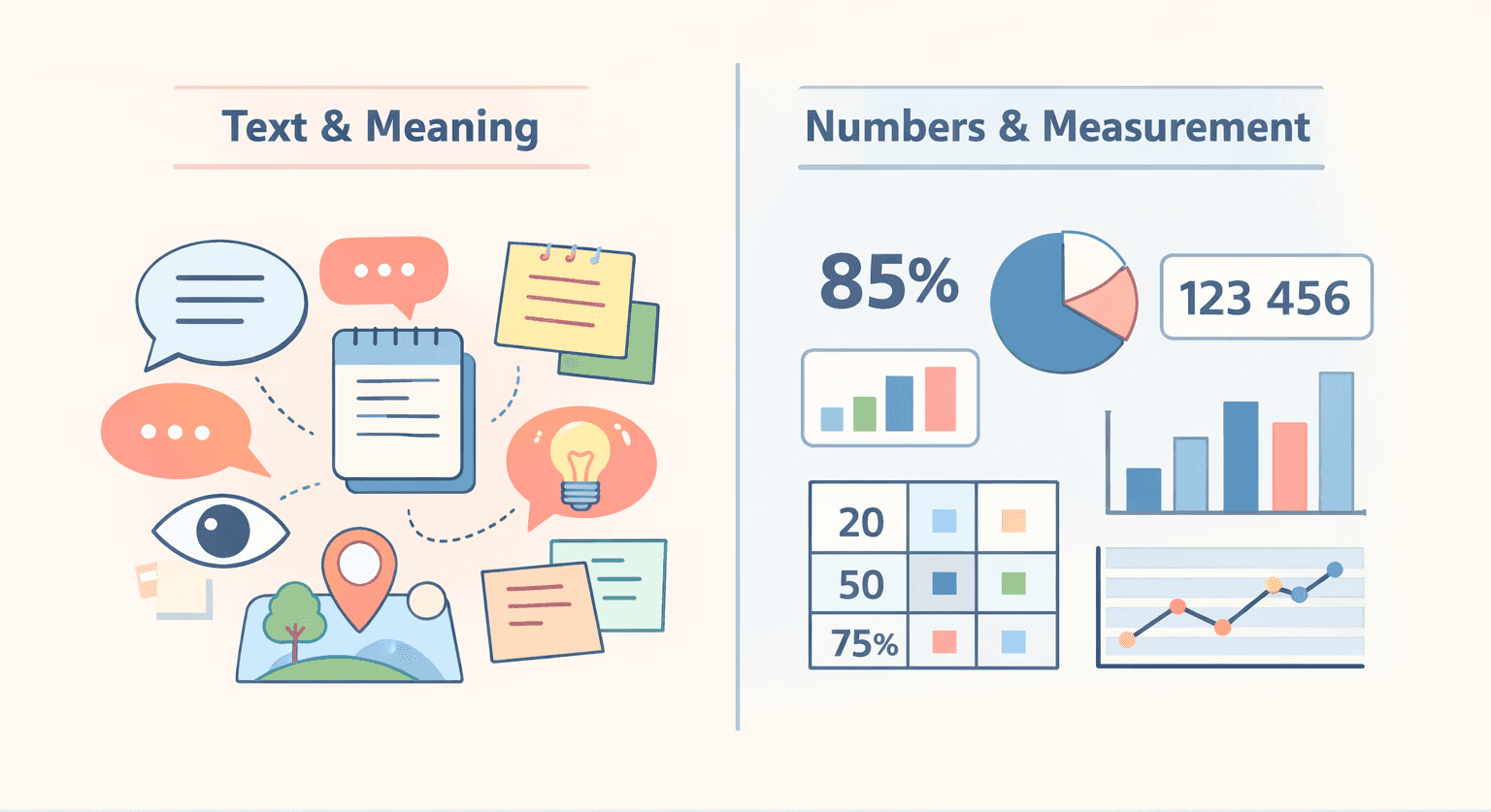
La mesure précise est fondamentale dans le travail quantitatif.
Types de variables
Variable indépendante : Le facteur que vous modifiez ou classez pour voir son effet.
Variable dépendante : Le résultat que vous mesurez pour voir s'il a été affecté.
Échelles de mesure Ces échelles déterminent quel type de calcul vous pouvez effectuer avec vos chiffres.
Nominale : Données qui sont simplement des catégories nommées, sans ordre inhérent (par exemple, des types de fruits).
Ordinale : Données que vous pouvez classer, mais dont les écarts entre les rangs ne sont pas égaux (par exemple, 1er, 2e, 3e place).
Intervalle : Données avec des distances égales entre les valeurs, mais sans vrai point zéro (par exemple, la température en Celsius).
Rapport : Données avec des distances égales et un point zéro significatif, permettant des affirmations comme « deux fois plus » (par exemple, la taille, le poids).
Choisir la bonne échelle est essentiel dans votre cadre de recherche global. Elle détermine les tests statistiques que vous pouvez utiliser et si votre analyse sera valide.
Analyse des données quantitatives
Cette analyse utilise des techniques mathématiques et statistiques pour donner du sens aux chiffres.
Méthodes statistiques courantes
Statistiques descriptives : Résumer les données avec des outils comme la moyenne, la médiane, les effectifs et les pourcentages.
Statistiques inférentielles : Utiliser des tests comme les tests t, le chi carré et l'ANOVA pour tirer des conclusions sur une population plus large à partir d'un échantillon.
Analyse de régression : Modéliser la relation entre les variables pour prédire des résultats.
Analyse de corrélation : Mesurer la force du lien entre deux variables.
Test d'hypothèse : Tester formellement une prédiction précise à l'aide des données.
Les chercheurs utilisent des indicateurs clés pour évaluer leurs résultats :
Significativité statistique : Le résultat observé est-il probablement réel, ou simplement dû au hasard ?
Valeur p : La probabilité que le résultat soit survenu uniquement par hasard.
Intervalle de confiance : Une plage de valeurs dans laquelle la vraie valeur de la population a de fortes chances de se situer.
Les résultats sont fréquemment présentés sous forme de graphiques, de diagrammes et de tableaux afin de rendre les tendances et les comparaisons plus claires.
<ProTip title="📐 Note :" description="Associez toujours votre test statistique à votre échelle de mesure pour éviter des conclusions non valides." />
Forces et limites de la recherche quantitative
Là où elle excelle
Elle vise une forte objectivité, et ses méthodes sont fiables.
Les outils standardisés aident à réduire les biais du chercheur.
De grands échantillons permettent de généraliser les résultats à des groupes plus importants.
Le processus structuré rend les études plus faciles à reproduire et à vérifier.
Elle est efficace pour recueillir des données auprès d'un grand nombre de personnes.
Là où elle montre ses limites
Elle peut simplifier à l'excès des comportements humains complexes en chiffres.
Elle a souvent du mal à saisir tout le contexte ou le sens plus profond derrière les données.
Sa conception rigide laisse peu de place aux découvertes inattendues pendant l'étude.
La qualité des résultats dépend entièrement de la qualité des outils de mesure utilisés.
Même avec ses limites, vous ne pouvez pas prendre des décisions intelligentes et fondées sur des faits sans ce type de recherche. Elle fournit les chiffres solides sur lesquels reposent de bonnes politiques et une bonne science.
Principales différences entre la recherche qualitative et la recherche quantitative
Aspect | Recherche qualitative | Recherche quantitative |
Nature | Subjective et interprétative | Objective et mesurable |
Type de données | Textes, images, observations | Chiffres, statistiques |
Objectif principal | Comprendre le sens et l'expérience | Tester des hypothèses précises |
Taille de l'échantillon | Petite, ciblée et spécifique | Grande, avec l'objectif d'être représentative |
Méthode d'échantillonnage | Échantillonnage raisonné ou théorique | Échantillonnage aléatoire ou probabiliste |
Collecte des données | Entretiens, groupes de discussion, observations | Enquêtes, expériences contrôlées |
Analyse | Identification des thèmes, interprétation du texte | Tests statistiques et mathématiques |
Résultat principal | Perspectives approfondies, spécifiques au contexte | Résultats pouvant être généralisés |
Contexte typique | Environnements naturels et flexibles | Environnements contrôlés et structurés |
Cette comparaison côte à côte montre comment chaque méthode est conçue pour un type de question différent.
Validité, fiabilité et généralisation
S'assurer que votre étude est solide est crucial, quelle que soit la méthode utilisée, et cela commence par une question de recherche clairement définie, qui détermine ce que validité et fiabilité signifient réellement pour votre étude.
Validité
Validité interne : Le degré de confiance que vous pouvez avoir dans le fait qu'une variable a réellement causé un changement dans une autre.
Validité externe : La capacité de vos résultats à s'appliquer à d'autres personnes ou situations en dehors de votre étude précise.
Fiabilité et reproductibilité
Fiabilité : la cohérence. Obtiendrez-vous les mêmes résultats si vous répétez la mesure ?
Reproductibilité signifie qu'un autre chercheur peut suivre vos étapes et obtenir des résultats similaires.
L'accent diffère selon l'approche. La recherche qualitative met l'accent sur la crédibilité et la fiabilité de ses interprétations. La recherche quantitative privilégie la fiabilité statistique et la précision.
Éthique dans la recherche qualitative et quantitative
Toute étude impliquant des personnes doit respecter des normes éthiques.
Les principes clés sont les mêmes pour les deux approches :
Consentement éclairé : Les participants doivent comprendre en quoi consiste l'étude et accepter d'y prendre part volontairement.
Confidentialité et anonymat : Protéger l'identité et les informations personnelles des participants.
Transparence : Être clair sur la manière dont les données ont été collectées et analysées.
Rapport honnête : Présenter les résultats avec précision, sans les déformer ni en cacher certains aspects.
Réduction des biais : Rechercher l'objectivité et reconnaître les limites de l'étude.
Ces obligations éthiques deviennent encore plus importantes lorsque la recherche implique des groupes vulnérables ou aborde des sujets personnels sensibles.
Quand utiliser la recherche qualitative
Cette méthode est le bon choix lorsque vous devez :
Explorer un sujet totalement nouveau, ou un sujet encore mal compris.
Étudier des expériences, croyances ou perceptions personnelles.
Mener un examen approfondi et détaillé d'un cas ou d'un exemple unique.
Développer de nouvelles théories ou de nouveaux cadres conceptuels à partir de zéro.
Comprendre le contexte social ou culturel qui entoure un comportement.
Parmi les exemples typiques, on trouve des études sur l'expérience des patients face à une maladie, l'analyse des raisons pour lesquelles les consommateurs font certains choix, ou l'étude de la culture au sein d'une entreprise précise.
Quand utiliser la recherche quantitative
Cette approche est idéale lorsque vous devez :
Mesurer la fréquence à laquelle quelque chose se produit ou son degré de распространение.
Comparer différentes variables ou groupes à l'aide de chiffres.
Tester une hypothèse ou une prédiction précise.
Mener des études qui suivent des changements dans le temps ou comparent différents groupes à un moment donné.
Évaluer l'efficacité mesurable d'un programme ou d'une intervention.
Parmi les exemples courants, on peut citer l'analyse de données de sondages à grande échelle, le test de l'amélioration des scores à un examen grâce à une nouvelle méthode d'enseignement, ou la mesure de l'impact d'une nouvelle politique de santé publique.
Recherche à méthodes mixtes : combiner les deux approches
La recherche à méthodes mixtes utilise à la fois des techniques qualitatives et quantitatives dans une même étude. Elle cherche à tirer le meilleur des deux mondes, en utilisant la profondeur de l'une pour compenser les limites de l'autre.
Pourquoi les combiner ?
Elle permet une triangulation, en utilisant différentes méthodes pour vérifier et confirmer les résultats.
Elle peut améliorer la validité globale et la richesse de votre interprétation.
Elle combine la profondeur (compréhension détaillée) avec l'ampleur (applicabilité plus large).
Elle conduit souvent à des résultats de recherche plus complets et convaincants.
Un exemple classique consiste à mener un grand sondage pour trouver une tendance statistique, puis à poursuivre avec des entretiens approfondis pour comprendre pourquoi cette tendance existe.
<ProTip title="🔗 Stratégie :" description="Utilisez les résultats qualitatifs pour concevoir de meilleurs sondages et les résultats quantitatifs pour valider les insights qualitatifs." />
Faire correspondre votre méthode à votre objectif de recherche
La recherche qualitative et la recherche quantitative sont deux chemins différents pour construire du savoir. L'une vous apporte une compréhension profonde et contextuelle à partir des mots et des observations. L'autre fournit des résultats objectifs et mesurables à partir des chiffres et des statistiques.
<CTA title="Construisez un énoncé de problème solide" description="Créez un énoncé de problème précis, prêt à être publié, en quelques minutes avec l'aide de l'IA." buttonLabel="Essayer Jenni gratuitement" link="https://app.jenni.ai/register" />
Votre question de recherche, vos objectifs et vos ressources détermineront la voie à suivre. Souvent, l'image la plus complète vient du fait d'utiliser les deux ensemble dans une approche à méthodes mixtes. Comprendre le fonctionnement de chacune vous permet de concevoir des études plus solides, de mieux interpréter vos données et d'apporter une contribution vraiment utile à ce que nous savons.