Par
Nathan Auyeung
—
Paradigmes de recherche : positivisme vs interprétativisme

Nathan Auyeung
Expert-comptable senior chez EY
Diplômé avec une Licence en Comptabilité, suivi d'un Diplôme de Postgraduate en Comptabilité

La recherche peut sembler déroutante. Vous pouvez vous demander : Qu’est-ce que la réalité ? Comment savons-nous qu’une chose est vraie ? Pourquoi les chercheurs débattent-ils des méthodes ? Ces questions sont au cœur des paradigmes de recherche. Sans paradigme clair, une étude peut sembler floue ou fragile.
Dans ce guide, vous apprendrez ce que signifient les paradigmes de recherche et pourquoi ils comptent. Vous explorerez l’ontologie, l’épistémologie, l’axiologie et la méthodologie en termes simples. Si vous rédigez votre étude, des outils comme Jenni peuvent vous aider à transformer des idées complexes en une rédaction structurée et assurée.
<CTA title="Rédigez sur les paradigmes de recherche avec plus de clarté" description="Utilisez Jenni pour organiser vos idées et rédiger des explications plus claires des paradigmes de recherche dans votre article." buttonLabel="Commencer à écrire avec clarté" link="https://app.jenni.ai/register" />
Que sont les paradigmes de recherche ?
Un paradigme de recherche est un système de croyances. Il façonne votre vision de la réalité, du savoir et de la vérité. Il guide votre vision du monde et vos présupposés philosophiques.
Pensez à un paradigme comme à une paire de lunettes. Les lunettes modifient la façon dont vous voyez le monde. De la même manière, un paradigme façonne la façon dont vous étudiez le monde.
Chaque paradigme repose sur quatre piliers :
Ontologie – Qu’est-ce que la réalité ?
Épistémologie – Comment acquérons-nous le savoir ?
Axiologie – Quel rôle jouent les valeurs ?
Méthodologie – Comment étudions-nous le monde ?
Ces piliers doivent être alignés. Cet alignement crée une cohérence philosophique. Sans cela, votre recherche peut manquer de clarté.
<ProTip title="✨ Aperçu :" description="Vérifiez toujours si vos croyances de recherche et vos méthodes sont alignées. Une forte cohérence construit des études solides." />
Les piliers fondamentaux des paradigmes de recherche
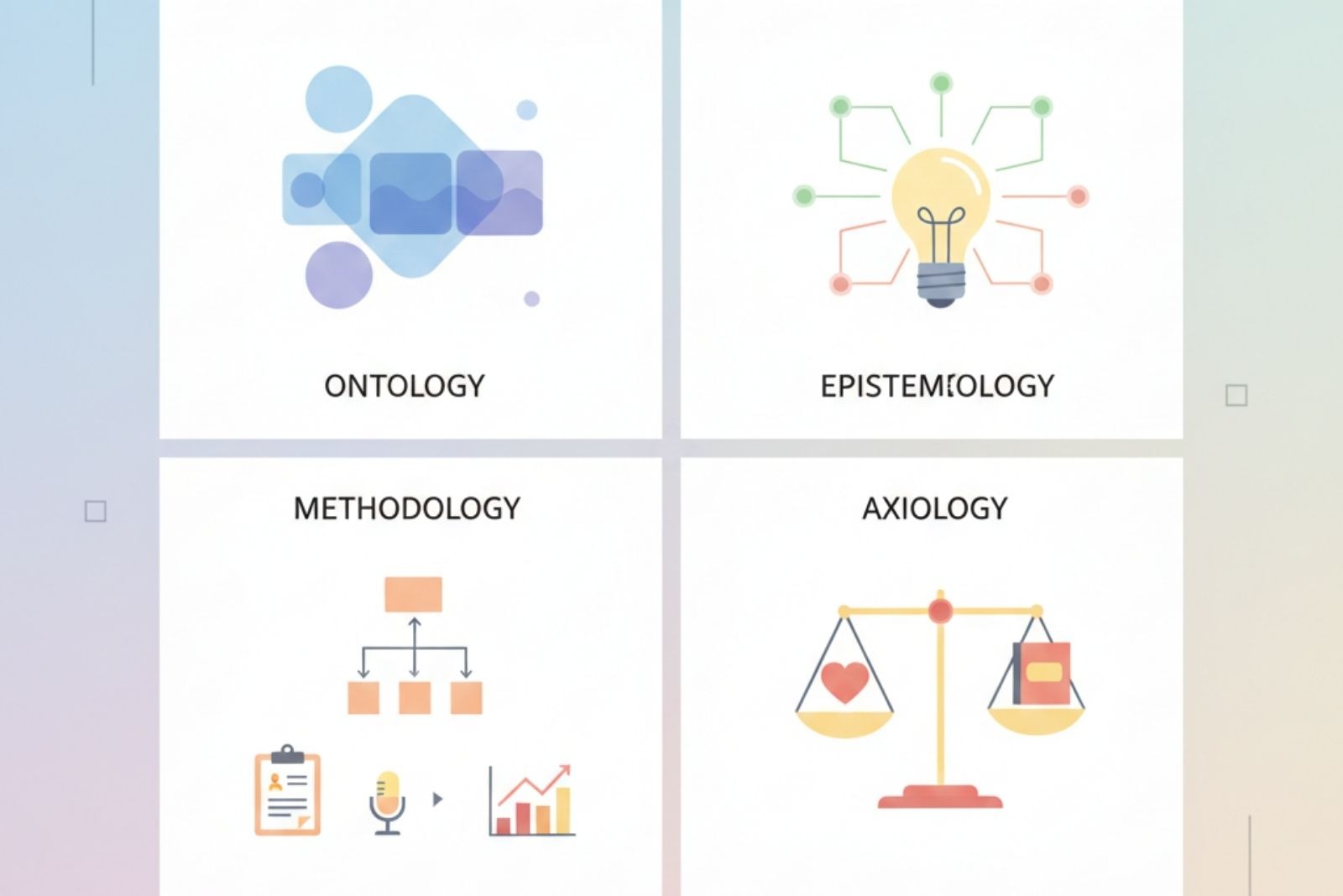
Cette section explique les quatre fondements de tout paradigme. Chaque pilier façonne votre conception et vos décisions.
Ontologie : la nature de la réalité
L’ontologie pose une question simple, mais profonde : qu’est-ce que la réalité ?
Certains chercheurs croient au réalisme. Ils soutiennent que la réalité existe en dehors de nous. Elle est stable et peut être observée.
D’autres croient au relativisme ou au constructionnisme social. Ils soutiennent que la réalité est façonnée par la culture et l’interaction.
Voici quelques idées connexes :
Ontologie critique – La réalité existe, mais le pouvoir façonne la façon dont nous la percevons.
Nominalisme – Les catégories sont des étiquettes que nous créons.
Si vous croyez en une seule réalité, vous penchez vers l’objectivité. Si vous croyez en plusieurs réalités, vous penchez vers la subjectivité.
Épistémologie : la nature du savoir
L’épistémologie pose la question suivante : comment acquérons-nous le savoir ?
Certains chercheurs suivent l’empirisme. Ils font confiance à l’observation et aux données. D’autres soutiennent le rationalisme, qui valorise la logique et le raisonnement.
Les idées sur la vérité diffèrent également :
La théorie de la correspondance affirme que la vérité correspond à la réalité.
La théorie de la cohérence affirme que la vérité s’inscrit dans un système de croyances.
Votre épistémologie influence le fait que vous utilisiez le raisonnement inductif, déductif ou abductif.
Axiologie : le rôle des valeurs
L’axiologie étudie les valeurs dans la recherche. Certains chercheurs visent une recherche sans valeur. Ils essaient d’éliminer les biais.
D’autres acceptent une recherche chargée de valeurs, en particulier dans les études critiques ou transformatrices. Des pratiques comme la réflexivité et le bracketing aident les chercheurs à réfléchir à leur influence.
Méthodologie : le plan d’action
La méthodologie relie la philosophie à la pratique. Elle définit la façon dont vous collectez et analysez les données.
Vous pouvez utiliser :
Méthodes quantitatives
Méthodes qualitatives
Méthodes mixtes
Choisir entre des approches quantitatives et qualitatives est plus simple lorsque vous comprenez les compromis — consultez notre guide de recherche qualitative vs quantitative.
Votre méthodologie doit montrer une adéquation méthodologique avec votre paradigme.
<ProTip title="📌 Rappel :" description="Avant de choisir des outils comme les sondages ou les entretiens, confirmez que votre paradigme les prend en charge." />
Principaux types de paradigmes de recherche
Chaque paradigme reflète une vision du monde différente. Voici les principaux types expliqués dans un langage simple.
Positivisme
Le positivisme croit en une réalité objective unique. Le savoir est acquis par la mesure et l’observation.
Il valorise :
L’objectivité
Le test d’hypothèses
La falsification
L’inférence statistique
Les méthodes courantes incluent la recherche par sondage et la conception expérimentale.
Post-positivisme
Le post-positivisme accepte que la réalité existe, mais qu’elle ne peut pas être connue parfaitement. Il est souvent associé au réalisme critique.
Il soutient à la fois les méthodes quantitatives et qualitatives.
Les chercheurs se concentrent sur la validité et la fiabilité.
Interprétativisme et constructivisme
L’interprétativisme et le constructivisme soutiennent que la réalité est socialement construite.
Ils explorent l’expérience vécue à l’aide de :
La phénoménologie
L’ethnographie
L’enquête narrative
L’analyse du discours
La théorie ancrée
Ils s’appuient souvent sur l’induction et acceptent la subjectivité.
Pragmatisme
Le pragmatisme se concentre sur ce qui fonctionne.
Il soutient le pluralisme pragmatiste et la recherche à méthodes mixtes.
Les conceptions courantes comprennent :
La conception parallèle convergente
La conception séquentielle explicative
La conception séquentielle exploratoire
La conception imbriquée
Le pragmatisme est courant dans la recherche interdisciplinaire.
Théorie critique et paradigme transformateur
La théorie critique examine le pouvoir et les inégalités.
Elle comprend :
Le paradigme féministe
La théorie postcoloniale
La théorie queer
Les études sur le handicap
Le paradigme transformateur vise à créer un changement social.
La recherche-action participative est souvent utilisée ici.
<ProTip title="🔎 Aperçu :" description="Si votre recherche vise à remettre en cause l’injustice, un paradigme critique ou transformateur peut offrir un meilleur alignement." />
Recherche qualitative vs recherche quantitative
Des chiffres ou des récits ? Des graphiques ou des conversations ? Lorsque les chercheurs cherchent à répondre à une question, ils choisissent généralement entre deux approches puissantes : la recherche quantitative vs recherche qualitative.
Au fond, la différence est simple. La recherche quantitative mesure et compte. Elle cherche des motifs dans les chiffres et teste des hypothèses claires. La recherche qualitative, quant à elle, explore le sens et l’expérience. Elle cherche à comprendre les points de vue, les motivations et les raisons profondes du comportement humain.
Recherche quantitative
La recherche quantitative se concentre sur la mesure des chiffres et l’identification des motifs. Son objectif principal est de tester des idées, de confirmer des théories et de découvrir des lois générales qui s’appliquent à des groupes plus larges. Les chercheurs collectent des données structurées qui peuvent être comptées et analysées statistiquement.
Elle utilise souvent :
La recherche par sondage
La conception expérimentale
Le test d’hypothèses
L’inférence statistique
Elle valorise la fiabilité et la validité. Elle suit souvent la déduction.
Recherche qualitative
La recherche qualitative explore le sens, les expériences et les points de vue. Plutôt que de se concentrer sur les chiffres, elle cherche à comprendre comment les personnes interprètent le monde qui les entoure. Elle répond à des questions telles que « pourquoi ? » et « comment ? » plutôt qu’à « combien ? »
Elle peut utiliser :
L’étude de cas
L’ethnographie
La phénoménologie
La théorie ancrée
L’analyse thématique
Elle valorise la transférabilité et la confirmabilité. Elle suit souvent l’induction.
Recherche à méthodes mixtes
La recherche à méthodes mixtes combine les approches quantitative et qualitative. Les chercheurs recueillent des données numériques et des informations descriptives afin d’obtenir une compréhension plus complète d’un sujet.
Les chercheurs peuvent utiliser la triangulation pour comparer les résultats. Les méthodes mixtes gagnent du terrain dans de nombreux domaines.
<ProTip title="🧠 Note :" description="Commencez d’abord par votre question de recherche. Ensuite, décidez entre les méthodes qualitatives, quantitatives ou mixtes." />
Comment rédiger une question de recherche
Une question de recherche est le fondement de votre étude. Elle guide votre plan de recherche, détermine les données que vous collectez et façonne la manière dont vous analysez vos résultats. Une question claire permet de garder votre projet ciblé et pertinent.
Exemple simple
Question faible :
Pourquoi les étudiants ont-ils des difficultés ?
Question plus forte :
Comment l’apprentissage en ligne influence-t-il la motivation des étudiants dans les lycées ruraux ?
La deuxième question est ciblée et claire.
Étapes à suivre
Identifiez votre sujet
Resserrez votre focus
Alignez-le sur votre paradigme
Vérifiez sa faisabilité
Si vous prévoyez un test d’hypothèses, utilisez des termes mesurables. Si vous explorez l’expérience, utilisez un langage ouvert. Ainsi, votre question définit votre orientation.
Une bonne question de recherche est claire, ciblée, faisable en recherche et alignée avec votre méthode. Bien rédigée, elle devient la feuille de route de l’ensemble de votre étude.
Comment créer un cadre de recherche
Apprendre comment créer un cadre de recherche aide à organiser votre étude.
Un cadre de recherche montre :
Les concepts ou variables principaux
Les relations
La base théorique
L’oignon de recherche, aussi appelé l’oignon de recherche de Saunders, est un modèle utile.
Aperçu de l’oignon de recherche
Couche | Focus |
Philosophie | Ontologie et épistémologie |
Approche | Induction ou déduction |
Stratégie | Étude de cas, sondage, expérience |
Temps | Transversal ou longitudinal |
Techniques | Outils de collecte des données |
Chaque couche s’appuie sur la précédente.
Analogie simple
Pensez à votre cadre comme à la construction d’une maison.
L’ontologie est le sol.
L’épistémologie est le plan.
La méthodologie est le plan de construction.
Les méthodes sont les outils.
Si le sol est instable, la maison peut s’effondrer.
<ProTip title="📚 Rappel :" description="Utilisez un cadre clair pour montrer comment vos idées s’articulent logiquement, de la philosophie aux données." />
Guerres des paradigmes et changement de paradigme

Par le passé, les chercheurs débattaient vivement. Ces débats étaient appelés guerres des paradigmes.
« Une révolution kuhnienne décrit comment la science change lors d’une révolution scientifique. Ce changement majeur est appelé un changement de paradigme. » - Simply Psychology [2].
Différents paradigmes peuvent faire face à l’incommensurabilité, c’est-à-dire qu’ils ne peuvent pas être comparés directement.
Aujourd’hui, de nombreux chercheurs soutiennent l’intégration et la recherche interdisciplinaire.
Garantir la qualité et la rigueur
La qualité dépend de votre paradigme.
Dans les études quantitatives, concentrez-vous sur :
La validité
La fiabilité
L’inférence statistique
Dans les études qualitatives, concentrez-vous sur :
La transférabilité
La confirmabilité
La réflexivité
La perspective émique
La perspective étique
Le bracketing
La revue systématique et la méta-analyse aident à combiner les résultats.
La triangulation renforce la crédibilité.
Obtenir une adéquation méthodologique
L’adéquation méthodologique garantit que votre vision du monde, votre question et vos méthodes sont alignées.
Par exemple :
Positivisme + test d’hypothèses + conception expérimentale
Interprétativisme + enquête narrative + analyse thématique
Pragmatisme + méthodes mixtes + triangulation
Les normes disciplinaires peuvent influencer vos choix. Cependant, la clarté et la cohérence comptent le plus.
Réunir votre paradigme de recherche
Ils influencent la manière de rédiger une question de recherche et la façon de créer des idées de cadre de recherche. Du positivisme à la théorie critique, chaque paradigme offre une vision différente de la réalité, du savoir et de la vérité.
<CTA title="Expliquez les paradigmes de recherche plus clairement dans votre article" description="Utilisez Jenni pour structurer votre explication, améliorer la fluidité et rédiger avec plus d’assurance tout en conservant votre ton académique." buttonLabel="Améliorer mon brouillon" link="https://app.jenni.ai/register" />
Comprendre ces idées est la première étape. Les appliquer à l’écriture est la suivante. Jenni peut vous aider à transformer une théorie complexe en brouillons structurés grâce à un générateur de plan d’essai IA, tandis que les outils de grammaire affinent la clarté et le ton. Ensemble, ils rendent la rédaction de travaux de recherche plus fluide et plus assurée.