Par
Justin Wong
—
Revue de littérature narrative : structure et exemples

Justin Wong
Responsable du développement
Diplômé d'un baccalauréat en affaires mondiales et arts numériques, avec une mineure en entrepreneuriat
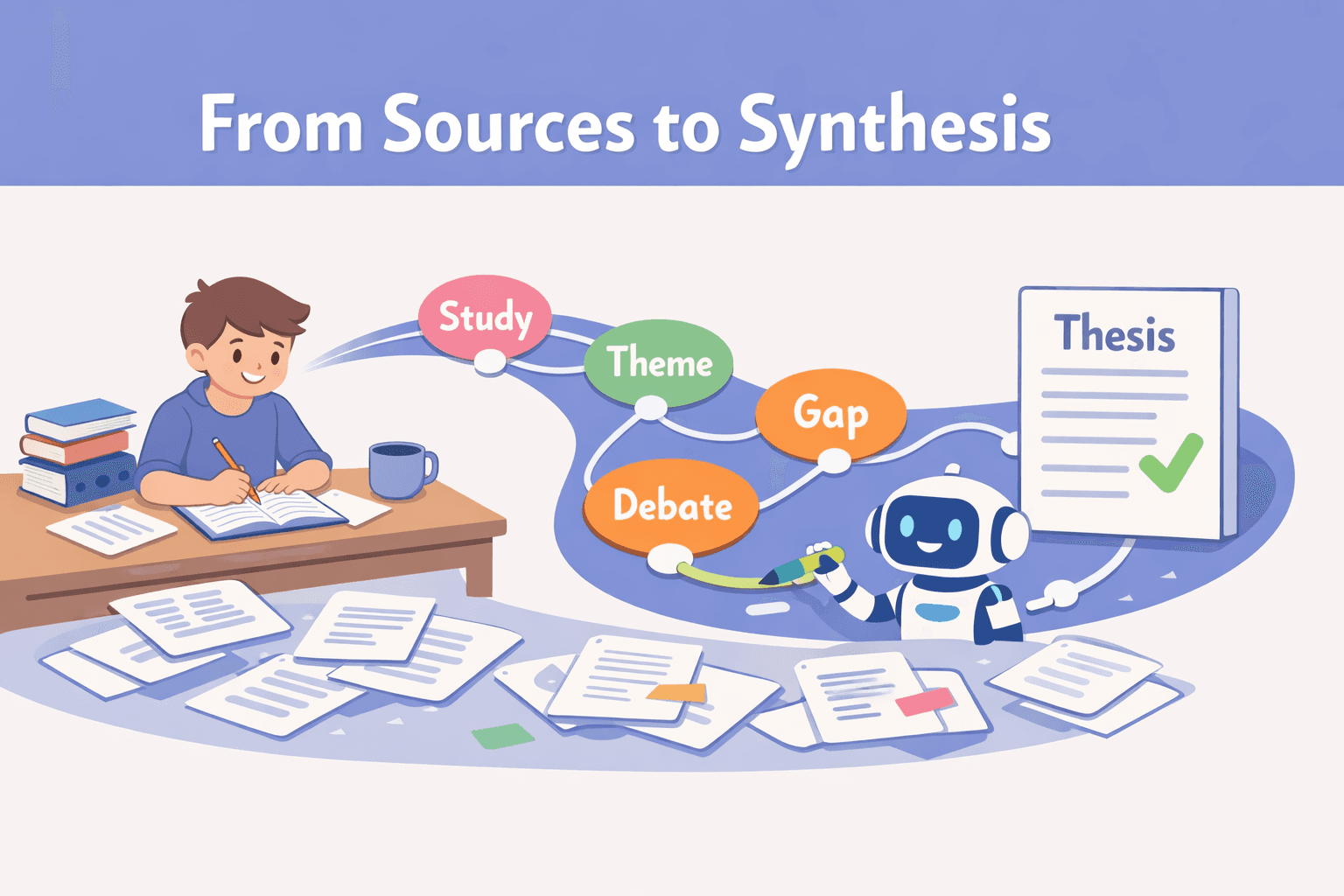
Les revues de littérature sont le point de départ d’une bonne recherche. Elles montrent ce qui existe déjà, ce qui manque et où vous devriez chercher ensuite. Une revue narrative est une manière courante de procéder. Plutôt que de simplement énumérer des études, elle vous invite à les relier dans un récit logique autour de votre sujet.
Bien structurer la revue est essentiel. Cela vous aide à donner du sens à une pile d’articles, à combiner leurs conclusions et à évaluer leurs forces et leurs faiblesses. Ce guide explique comment construire cette structure, les principaux points sur lesquels vous concentrer pendant la rédaction, et à quoi ressemble concrètement une version aboutie.
<CTA title="Construisez un énoncé de problème solide" description="Générez en quelques minutes un énoncé précis, prêt à être publié — sans stress ni superflu." buttonLabel="Essayez Jenni gratuitement" link="https://app.jenni.ai/register" />
Qu’est-ce qu’une revue narrative de la littérature ?
Une revue narrative de la littérature est bien plus qu’une liste de sources, et comprendre ce qui définit une revue narrative de la littérature aide à clarifier son objectif.
C’est une synthèse critique qui donne du sens aux recherches menées sur un sujet. Son rôle principal est de rassembler différentes études, de repérer les tendances et les divergences, et d’offrir une interprétation argumentée.
Vous choisirez ce type de revue lorsque vous avez besoin d’une compréhension large et qualitative d’un sujet complexe, et non d’une analyse statistique stricte.
Contrairement aux revues systématiques, les revues narratives n’exigent pas de critères de recherche prédéfinis ni d’évaluation formelle de la qualité. Alors, qu’est-ce qui distingue une revue narrative ?
Elle est flexible. Vous pouvez choisir les études qui soutiennent le mieux le récit que vous construisez autour de la recherche.
Elle est interprétative. L’objectif est de comprendre, d’évaluer et de relier les idées à travers les études, et pas seulement d’en rapporter les résultats individuels.
Elle est critique. Vous devez examiner les forces, les faiblesses et les lacunes de la littérature, et pas seulement la décrire.
Elle est thématique. Vous organisez l’ensemble autour d’idées centrales, de tendances ou de démarches de recherche.
Les revues narratives sont couramment utilisées dans des disciplines qui tirent parti d’une interprétation large et contextuelle, comme les sciences sociales, l’éducation et les soins de santé.
<ProTip title="🧠 Conseil de pro :" description="Utilisez Jenni AI pour créer facilement l’introduction de votre thèse !" />
Structure de base d’une revue narrative de la littérature
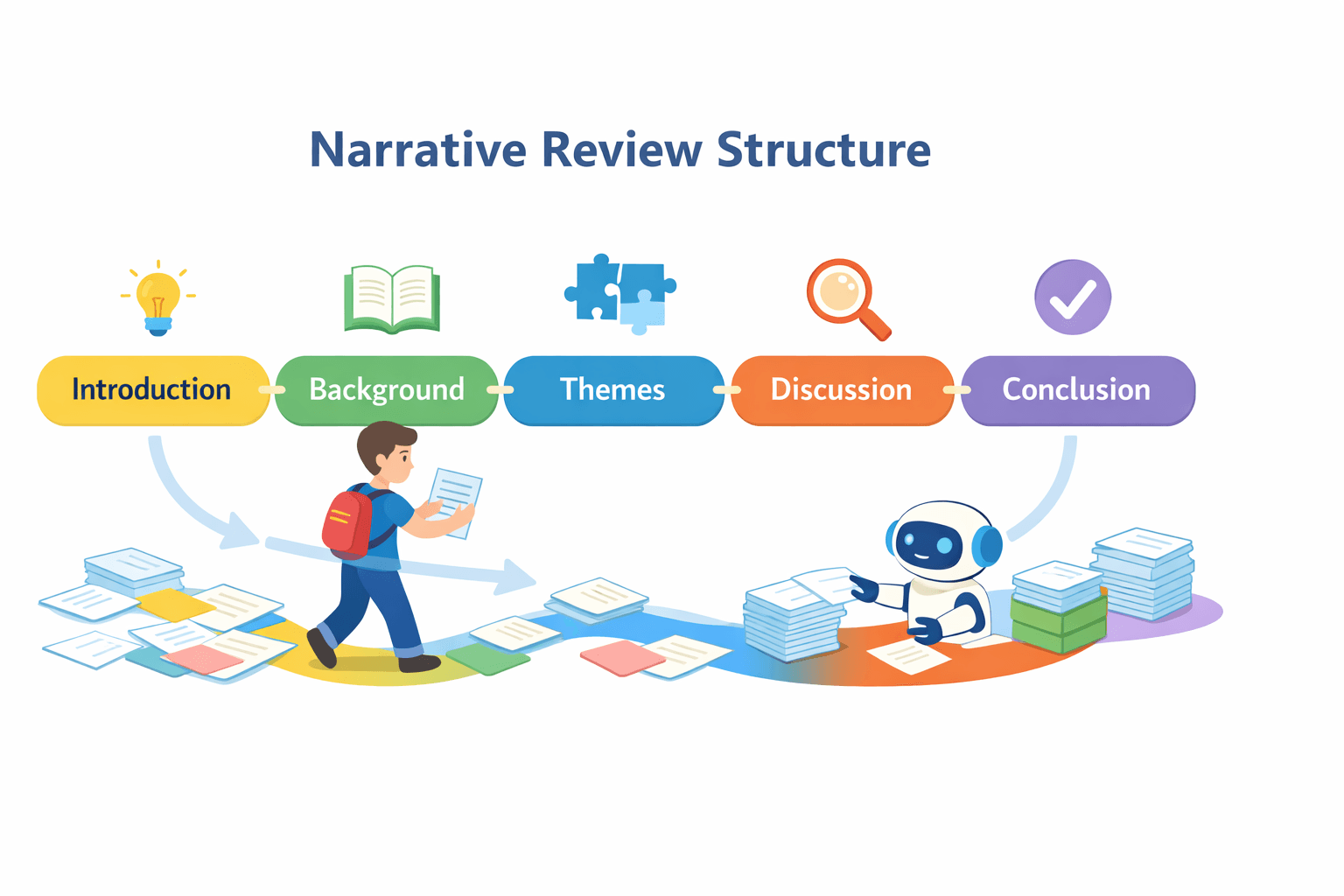
Les revues narratives bénéficient d’une structure logique adaptée au sujet, mais le format exact peut varier selon la discipline ou la revue. Elles peuvent aussi varier en longueur selon les exigences de la revue ou du devoir.
Les revues narratives comprennent souvent une introduction, un corps de texte, une discussion et une conclusion, mais les formats varient selon la discipline et la revue. Savoir comment rédiger le plan d’une revue de littérature peut vous aider à la structurer efficacement.
1. L’introduction C’est ici que vous posez votre sujet. Si vous souhaitez un accompagnement plus détaillé sur la façon de cadrer le périmètre et la question de recherche, consultez nos conseils pour rédiger l’introduction de votre revue de littérature. Vous devez définir précisément ce que vous examinez, expliquer votre objectif (par exemple en demandant « Qu’est-ce qui cause l’épuisement professionnel chez les infirmières ? ») et présenter les principaux thèmes que vous aborderez.
L’introduction justifie aussi l’importance de votre revue. Qu’apporte-t-elle à la conversation, et comment peut-elle ouvrir la voie à de nouvelles recherches ?
Exemple : "Cette revue examine comment les humains numériques sont utilisés dans les soins de santé. En regroupant des études sur la confiance, la conception et les résultats pour les patients, elle met en évidence un manque de données à long terme et ce que cela implique pour l’utilisation concrète de cette technologie."
Cet exemple illustre comment les revues narratives synthétisent les résultats et mettent en lumière les lacunes.
2. Le contexte Les informations de contexte ou de cadrage peuvent être intégrées à l’introduction ou présentées dans une section distincte, selon la revue.
Comment ce domaine s’est-il développé ? Quels sont les termes clés que tout le monde doit connaître ? Existe-t-il des théories ou des modèles particuliers qui façonnent la manière dont les chercheurs abordent le sujet ?
Cette section s’assure que tout le monde part sur une base commune avant que vous ne plongiez dans l’analyse.
Exemple : "Les humains numériques, ou avatars IA, sont apparus au début des années 2000 comme outils d’interaction avec les patients. La recherche actuelle est souvent guidée par les théories de l’interaction homme-machine et par les études sur la confiance, qui s’intéressent à la manière dont les utilisateurs perçoivent ces outils et aux questions éthiques qu’ils soulèvent."
3. Le corps du texte : les sections thématiques C’est le cœur de la revue. Vous organisez les recherches existantes en thèmes clairs, en débats ou en types de méthodes, souvent à l’aide d’un modèle de matrice pour revue de littérature pour suivre les tendances à travers les études.
Vous pouvez créer des sections sur les tendances, les domaines où les études s’accordent ou se contredisent, les lacunes évidentes dans la recherche, ou encore des observations sur la manière dont les études ont été menées.
L’utilisation de sous-titres pour chaque thème rend le texte plus lisible. Des expressions comme « Cependant, » ou « De même, » facilitent une transition fluide d’une idée à l’autre.
Exemple de thème : l’épuisement professionnel dans le secteur de la santé "Les recherches montrent que les taux d’épuisement augmentent chez les professionnels de santé aux États-Unis. Les causes fréquentes incluent des charges de travail lourdes, la culture du lieu de travail et le stress émotionnel. Des programmes comme la formation à la pleine conscience peuvent aider à court terme, mais on dispose de très peu de données sur la durée de ces bénéfices."
Exemple de thème : l’intégration des humains numériques "Les premières études sur les avatars IA font état d’un meilleur engagement des patients. Mais les chercheurs utilisent différentes méthodes pour mesurer le succès, et presque personne n’a étudié ce qui se passe sur le long terme."
4. La discussion C’est ici que vous prenez du recul et analysez tout ce que vous avez présenté. Comparez les résultats de différentes études. Parlez des forces et des faiblesses des méthodes de recherche que vous avez observées. Mettez en évidence les incohérences et les biais possibles dans la littérature.
Le plus important, utilisez cette section pour indiquer ce qui devrait être étudié ensuite.
Exemple : "De nombreux programmes tentent de réduire l’épuisement professionnel, mais sans études à long terme, il est impossible de savoir s’ils fonctionnent plus de quelques mois. Les recherches futures doivent examiner à la fois les politiques organisationnelles et les expériences individuelles, en utilisant un mélange de types de données."
5. La conclusion Concluez en reformulant vos points principaux et leur importance concrète ou théorique. Que devrait-il se passer ensuite dans ce champ d’étude ? N’ajoutez ici aucune nouvelle information ni citation.
Exemple : "Cette revue montre que la gestion de l’épuisement professionnel dans le secteur de la santé reste difficile et que les solutions doivent probablement agir sur plusieurs facteurs à la fois. L’absence de recherches à long terme constitue une lacune majeure. Mettre ce problème en évidence offre une orientation claire pour les études futures."
<ProTip title="📝 Rappel :" description="Utilisez les informations de contexte pour vous assurer que vos lecteurs comprennent bien le cadre et la pertinence des études incluses." />
Principes clés de rédaction pour les revues narratives

Une bonne revue narrative ne se contente pas de lister ce que les autres ont trouvé. Pour bien la rédiger, gardez quelques idées clés à l’esprit.
Analysez, ne vous contentez pas de résumer Analysez, ne vous contentez pas de résumer en appliquant des méthodes de revue narrative de la littérature adaptées pour évaluer les études de manière critique. Votre rôle principal est de porter un regard critique sur les études que vous incluez.
Posez des questions. Cette recherche est-elle pertinente ? A-t-elle été menée correctement ? Qu’apporte-t-elle réellement au domaine ? Ne vous contentez pas de décrire chaque article.
Citez avec intention Chaque affirmation que vous avancez doit être étayée par une source solide. Choisissez vos références avec soin pour renforcer votre crédibilité. La qualité de vos citations compte autant que leur quantité. Si vous gérez une vaste bibliothèque, notre intégration Zotero et Mendeley pour les chercheurs peut simplifier l’importation et la citation des sources.
Maintenez la cohésion thématique Organisez votre revue de manière à raconter une histoire logique. Chaque section doit s’enchaîner avec la suivante, et chaque thème doit clairement revenir à votre question centrale. Le lecteur ne devrait jamais se demander pourquoi une étude donnée a été incluse.
Présentez une vision équilibrée Vous devez montrer tous les points de vue. Soulignez où les études s’accordent, mais tout aussi important, mettez en évidence là où elles se contredisent. Évitez les affirmations générales que la littérature ne soutient pas pleinement.
Soignez le fil narratif Guide le lecteur. Utilisez des transitions claires entre les paragraphes et les sections pour expliquer comment une idée mène à la suivante. C’est ce fil conducteur qui transforme un ensemble de résumés en une argumentation cohérente et compréhensible.
<ProTip title="🧠 Conseil de pro :" description="Mettez en évidence les lacunes de la recherche pour orienter les études futures et montrer votre esprit critique dans la revue." />
Exemples concrets dans différents domaines
Vous trouverez des revues narratives de littérature dans presque toutes les disciplines universitaires. Elles suivent toutes la même approche de base : organiser par thème, évaluer de manière critique et mettre en évidence ce qui manque.
Voici quelques exemples concrets.
Sujet | Axe principal | Source d’exemple |
Épuisement professionnel chez les travailleurs de la santé aux États-Unis | Tendances dans le temps, causes profondes, tentatives de solutions. | Reith (2018) |
Biais implicites dans les soins de santé | Fréquence, effets sur les soins aux patients, stratégies pour les réduire. | Zestcott et al. (2016) |
Humains numériques dans les soins de santé | Confiance des patients envers les avatars IA, impacts sur les résultats de santé, principes de conception. | Exemple de synthèse thématique |
Activité physique à l’école | Impact de l’exercice sur la pensée et l’apprentissage des élèves. | Mavilidi et al. (2018) |
Dans chaque cas, la revue ne se contente pas d’énumérer les résultats, et comprendre la différence entre une revue de cadrage et une revue systématique aide à expliquer comment différentes approches de synthèse des données sont utilisées selon les disciplines. Elle construit une argumentation.
Par exemple, une revue sur l’épuisement professionnel pourrait noter que, même si de nombreuses interventions existent, il y a un manque flagrant d’études qui suivent leur efficacité sur plusieurs années.
Une revue sur les humains numériques pourrait souligner que les chercheurs ne s’entendent pas sur la manière de mesurer la « confiance », ce qui rend les comparaisons entre études difficiles.
Ces lacunes, comme le besoin de données à long terme ou de mesures cohérentes, sont précisément ce qu’une revue narrative est censée mettre au jour.
<ProTip title="💡 Conseil de pro :" description="Organisez vos thèmes de façon logique afin que chacun s’enchaîne naturellement avec le suivant et conserve la cohérence narrative." />
Checklist : rédiger une revue narrative de la littérature
Une checklist rapide pour votre revue
Avant de terminer, passez en revue ces points pour vous assurer que votre revue narrative de la littérature est bien sur la bonne voie.
Clarifiez l’objectif de votre revue. Définissez le périmètre au besoin ; la formulation de la question peut rester flexible.
Posez le contexte. Donnez au lecteur le contexte historique ou théorique nécessaire pour comprendre le sujet.
Construisez le corps autour de thèmes. Organisez votre discussion autour de thèmes ou d’idées centrales, en veillant à la clarté et à la fluidité logique ; les méthodes pour y parvenir peuvent varier.
Critiquez, ne vous contentez pas de décrire. Pour chaque étude ou thème, discutez de ses qualités et de ses défauts.
Soulignez ce qui manque. Identifiez explicitement les lacunes de la recherche et suggérez ce qui devrait être étudié ensuite.
Terminez par une conclusion solide. Résumez vos principales conclusions et précisez leurs implications concrètes ou académiques.
Utilisez vos citations avec discernement. Chaque référence doit soutenir directement l’idée que vous avancez.
Faites avancer le récit. Relisez votre brouillon pour vérifier qu’une idée mène logiquement à la suivante, créant une argumentation cohérente du début à la fin.
<ProTip title="💡 Conseil de pro :" description="Utilisez cette checklist pour vous assurer que votre revue narrative est structurée, cohérente et solide sur le plan analytique." />
Synthétiser des idées grâce aux revues narratives de la littérature
Une revue narrative de la littérature transforme une pile d’articles en une argumentation claire et fondée. C’est un travail d’interprétation. Une structure solide — introduction, contexte, analyse thématique, discussion, conclusion — offre aux lecteurs un parcours fiable à travers des contenus parfois denses ou contradictoires. L’objectif est de mettre en évidence les tendances, de révéler les contradictions et de préciser exactement où les connaissances font défaut.
<CTA title="Construisez un énoncé de problème solide" description="Générez en quelques minutes un énoncé précis, prêt à être publié — sans stress ni superflu." buttonLabel="Essayez Jenni gratuitement" link="https://app.jenni.ai/register" />
Obtenir les bons thèmes, analyser les études de manière critique et choisir ses citations avec soin : voilà ce qui rend une revue utile, et pas seulement exhaustive. Cette méthode est une compétence fondamentale dans des domaines allant de la médecine à la sociologie. Bien menée, elle ne se contente pas de présenter les recherches existantes ; elle clarifie ce que nous savons, remet en question ce que nous croyons savoir et influence directement les sujets étudiés ensuite. Pour vous aider à rédiger et organiser vos sections avec des citations crédibles, consultez notre générateur de revue de littérature et de RRL basé sur l’IA.