Par
Nathan Auyeung
—
Comment rédiger une question de recherche qui améliore la conception de votre étude

Nathan Auyeung
Expert-comptable senior chez EY
Diplômé avec une Licence en Comptabilité, suivi d'un Diplôme de Postgraduate en Comptabilité
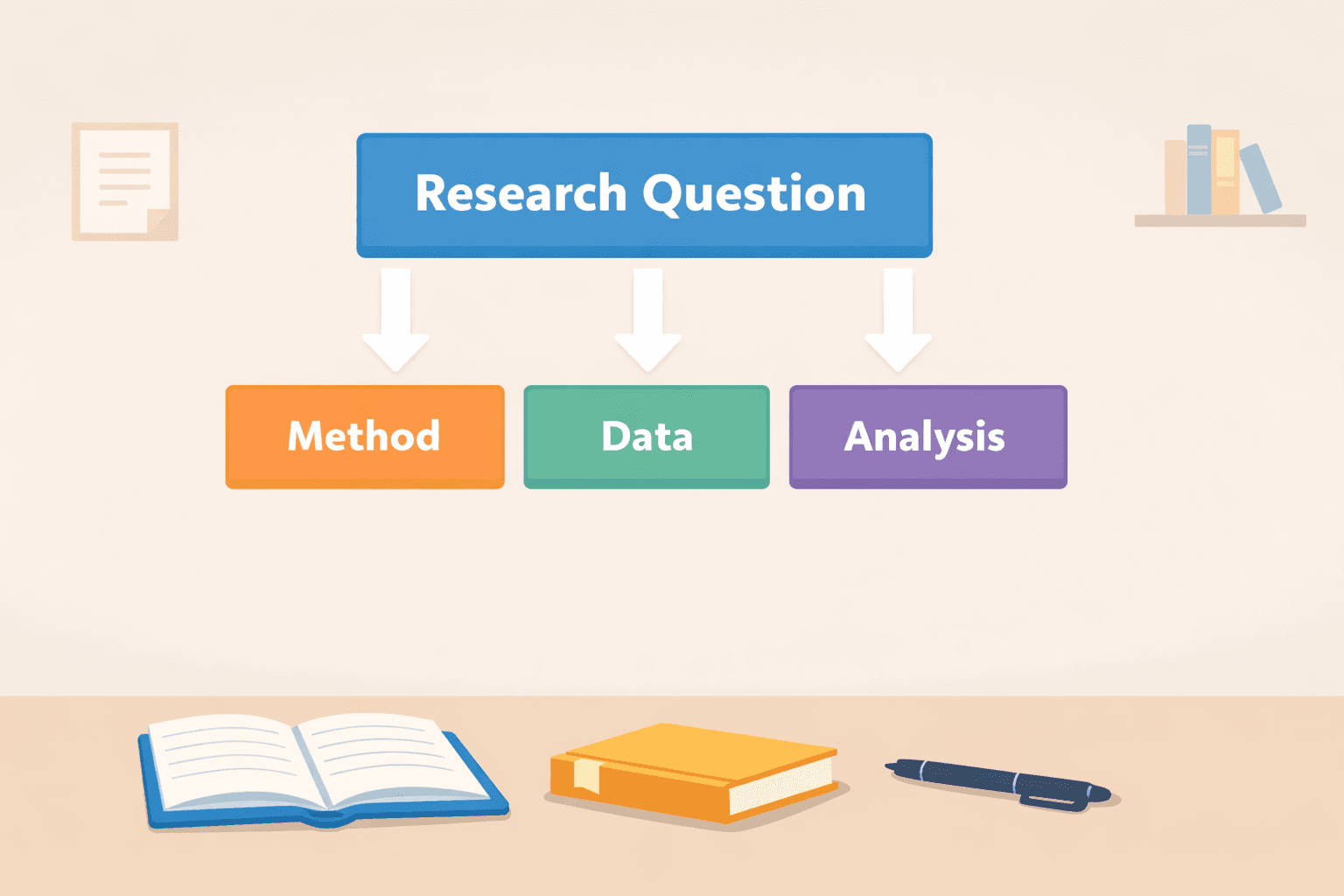
Une question de recherche solide est la base de l’ensemble de votre projet. Elle détermine ce que vous allez étudier et la manière dont vous allez l’étudier. Si la question n’est pas claire, vos résultats seront faibles. Une bonne question permet au reste du travail de s’imbriquer naturellement.
De nombreux projets échouent parce que la question de départ est mal définie. Apprendre à rédiger une question ciblée et formulable est une compétence essentielle pour tout étudiant ou chercheur. Voici comment la formuler correctement.
<CTA title="Construisez plus rapidement une question de recherche solide" description="Transformez des idées générales en questions ciblées et exploitables en quelques minutes. Jenni vous aide à clarifier le périmètre et les variables en toute confiance." buttonLabel="Essayer Jenni gratuitement" link="https://app.jenni.ai/register" />
Qu’est-ce qu’une question de recherche ?
Une question de recherche est l’élément précis que votre étude cherche à clarifier. Elle doit être claire et formulable.
Elle transforme un sujet général en une question précise que vous pouvez réellement examiner, constituant le cœur des questions de recherche qui guident l’investigation académique.
Par exemple, « l’hydroponie » n’est qu’un sujet. C’est trop vaste. Une véritable question de recherche serait quelque chose comme : « Comment la modification du pH de la solution nutritive affecte-t-elle le rendement des tomates dans un système hydroponique ? »
Cette version vous indique exactement ce qui est mesuré et dans quel contexte.
Elle est aussi différente d’une hypothèse. Une hypothèse est votre supposition éclairée sur la réponse. La question de recherche, elle, correspond à ce que vous demandez dès le départ.
Dans certains types de recherche, la question guide une exploration ouverte. Dans d’autres, elle établit une prédiction précise à tester.
<ProTip title="💡 Conseil pro :" description="Si vous pouvez souligner les variables et le contexte dans votre question, elle est généralement suffisamment spécifique pour une recherche académique." />
Pourquoi la rédaction d’une bonne question de recherche est-elle si importante ?
Votre question de recherche est l’épine dorsale de tout votre projet. Chaque décision que vous prenez — quelles données recueillir, comment les analyser — découle de cette seule question.
D’abord, elle apporte de la clarté. Une question précise empêche votre travail de dériver vers des sujets sans rapport. Sans elle, vous finissez par collecter des informations inutiles et votre argumentation s’effondre.
Ensuite, elle détermine votre méthode. La question décide si vous avez besoin d’enquêtes, d’expériences en laboratoire ou d’entretiens approfondis, surtout lorsque votre objectif est d’expliquer des relations de cause à effet typiques de la recherche explicative. Utiliser la mauvaise méthode pour votre question rend vos résultats peu fiables.
Troisièmement, elle définit la portée. Une bonne recherche doit apporter quelque chose de nouveau à la discussion. Une question solide montre exactement quelle lacune vous comblez ou quel problème vous résolvez.
Enfin, elle communique votre intention. Les évaluateurs et les encadrants jugent votre travail à partir de cette question. Une question claire et bien justifiée établit immédiatement votre projet comme sérieux et structuré, en donnant dès le départ une forme solide à l’introduction d’un article de recherche.
<ProTip title="📝 Remarque :" description="Une question de recherche solide devrait rendre votre méthodologie évidente pour le lecteur." />
Caractéristiques clés d’une bonne question de recherche
Une bonne question de recherche n’est ni vague ni aléatoire. Elle doit répondre à des critères précis pour être utile dans une véritable étude et s’aligner sur la définition opérationnelle d’un article de recherche dans votre discipline.
Caractéristique | Description |
Claire | La question est facile à comprendre et exempte de formulation vague ou confuse. |
Ciblée | Elle traite d’un seul problème ou d’une seule relation plutôt que de plusieurs sujets à la fois. |
Concisе | Elle est formulée de manière directe et précise, sans mots superflus. |
Complexe | Elle nécessite une analyse et une explication plutôt qu’une simple réponse par oui ou non. |
Discutable | La réponse ne fait pas l’unanimité et laisse place à l’interprétation ou au débat. |
Exploitablе | Des données ou preuves suffisantes peuvent raisonnablement être obtenues pour y répondre. |
Réaliste | La question peut être étudiée dans le temps, avec les ressources et l’accès disponibles. |
Spécifique | Les variables clés, la population et le contexte sont clairement définis. |
Pertinente | La question contribue à la recherche existante ou répond à un problème concret du monde réel. |
<ProTip title="🔍 Rappel :" description="Si votre question paraît impressionnante mais impossible à tester, elle doit être davantage recentrée." />
Processus étape par étape pour élaborer une question de recherche
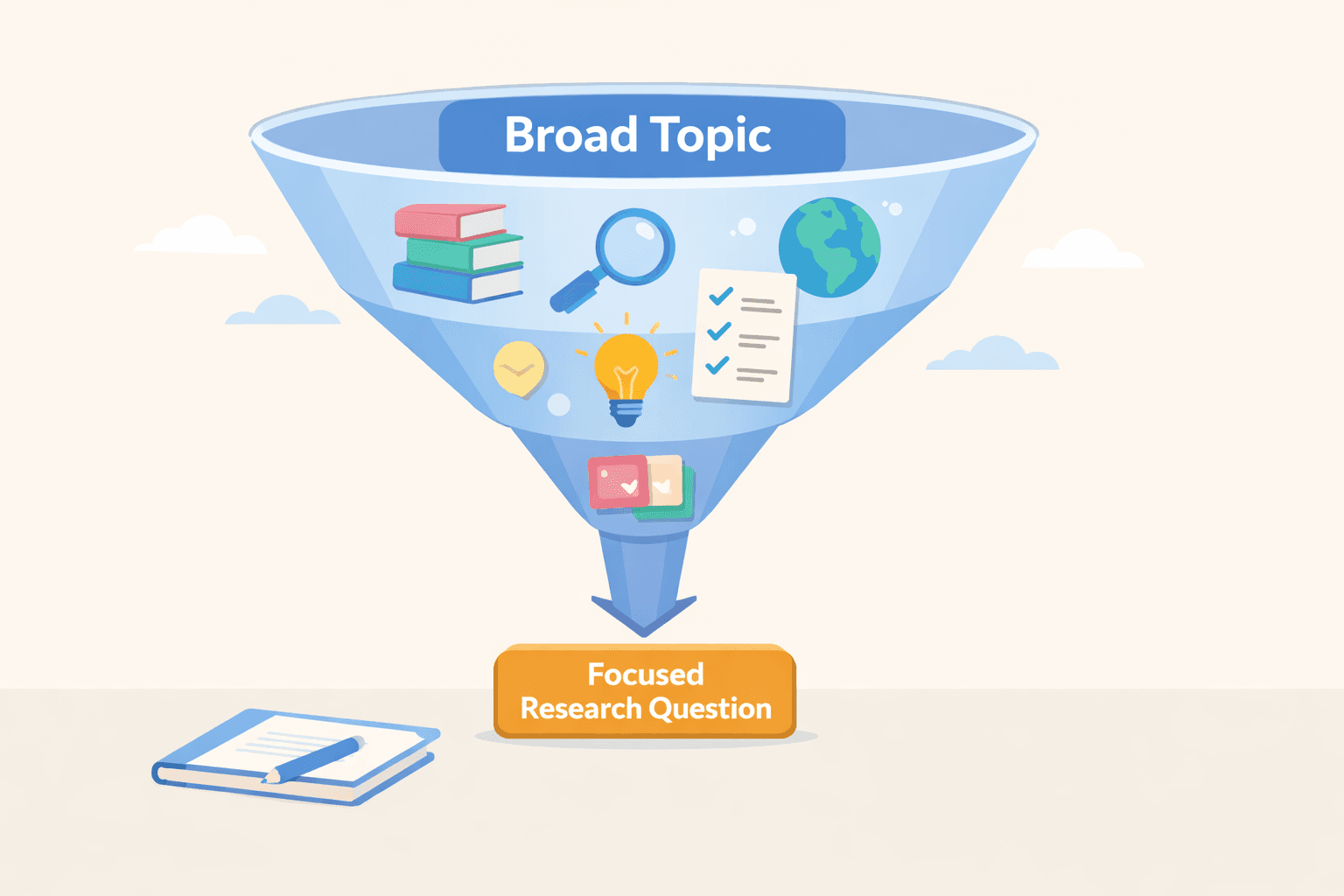
On ne s’assoit pas simplement pour écrire la question parfaite. C’est un processus de recentrage, et vous la réécrirez probablement plusieurs fois.
Étape 1 : Choisissez un sujet large
Commencez par un domaine général qui vous intéresse et qui correspond à votre discipline. Il peut venir d’un cours, de votre travail ou d’un sujet que vous avez lu.
Par exemple, vous êtes peut-être curieux à propos de « l’agriculture urbaine » ou de « l’apprentissage en ligne ». Ne vous souciez pas encore d’être précis.
Étape 2 : Faites une première lecture
Examinez ce que d’autres chercheurs ont déjà publié. Vous cherchez à savoir ce qui a été fait et, plus important encore, ce qui ne l’a pas été. Soyez attentif aux débats dans le domaine et aux endroits où les auteurs indiquent qu’il faut poursuivre les travaux.
Vous pourriez constater que, si de nombreuses études portent sur les notes des étudiants dans les cours en ligne, peu examinent l’effet d’outils pédagogiques précis sur la participation.
Étape 3 : Identifiez la lacune ou le problème
C’est le cœur de votre question. Quelle information précise manque dans les connaissances actuelles ? S’agit-il d’un groupe de personnes que personne n’a étudié ?
D’une méthode que personne n’a essayée ? D’un résultat qui n’a pas de sens ? Formuler clairement ce problème donne une raison d’être à votre recherche.
Pour vous aider à transformer cette lacune en problème de recherche formel, consultez notre guide pour rédiger un énoncé du problème de recherche.
<ProTip title="🧠 Conseil :" description="Portez une attention particulière aux sections de limitations dans les articles de revue pour repérer les lacunes de recherche." />
Étape 4 : Réduisez considérablement votre champ d’étude
Prenez votre sujet large et rendez-le très précis. Définissez exactement qui vous étudiez, ce que vous mesurez et où cela se passe, afin que la question s’aligne sur un cadre de recherche clair qui structure l’étude.
Au lieu de « l’apprentissage en ligne », vous pourriez vous concentrer sur « l’utilisation d’un retour vidéo hebdomadaire sur les taux de remise des devoirs chez les étudiants de première année en biologie dans des collèges communautaires ». Cela rend votre projet réalisable.
Étape 5 : Rédigez quelques brouillons
Commencez à reformuler votre champ d’étude recentré en vraies questions. Utilisez des mots comme « Comment », « Pourquoi », « Quoi » ou « Dans quelle mesure ». Rédigez plusieurs versions.
Par exemple : « Comment le retour vidéo hebdomadaire de l’enseignant influence-t-il la remise des devoirs ? » ou « Pourquoi les étudiants interagissent-ils davantage avec le retour vidéo qu’avec des commentaires écrits ? »
Étape 6 : Testez vos brouillons
Passez vos questions de travail à l’épreuve. Pouvez-vous réellement mener cette étude avec votre temps et vos ressources ? La réponse est-elle déjà bien connue ? Est-ce éthique ?
Dépend-elle de sources que vous pouvez citer avec assurance dans une recherche académique, par exemple pour savoir si l’utilisation de Wikipédia est appropriée ? Est-ce important pour quelqu’un ? Si une question échoue à ces vérifications, révisez-la ou abandonnez-la.
Étape 7 : Peaufinez la version finale
Affinez la formulation jusqu’à ce qu’elle soit parfaitement claire et qu’elle corresponde à la manière dont vous allez réellement mener la recherche. La question finale doit indiquer directement votre méthode.
Une bonne version finale pourrait être : « Dans quelle mesure un retour vidéo hebdomadaire de l’enseignant, comparé à des commentaires écrits, augmente-t-il la remise des devoirs dans les délais dans un cours de biologie de première année en collège communautaire ? »
Types de questions de recherche et exemples
Le type de question que vous posez dépend de ce que vous essayez de découvrir et du paradigme de recherche sous-jacent qui façonne l’approche du savoir. Voici trois types courants.
Type de question de recherche | Objectif | Exemple |
Descriptive | Décrire des caractéristiques, des tendances ou des conditions sans expliquer les causes | Quels défis les enseignants signalent-ils lorsqu’ils utilisent une nouvelle plateforme numérique de notation ? |
Explicative | Expliquer pourquoi ou comment quelque chose se produit en identifiant des causes ou des mécanismes, ce qui est au cœur de la recherche explicative centrée sur la compréhension des relations sous-jacentes | Pourquoi les étudiants réussissent-ils mieux les tâches de résolution de problèmes dans une classe inversée ? |
Évaluative | Évaluer l’efficacité, l’impact ou la valeur d’un programme ou d’une intervention | Dans quelle mesure le nouveau programme de tutorat a-t-il amélioré les taux de persévérance en première année ? |
<ProTip title="📌 Conseil :" description="Faites correspondre le type de question à votre objectif de recherche avant de choisir vos méthodes." />
Comment votre question de recherche façonne votre méthode
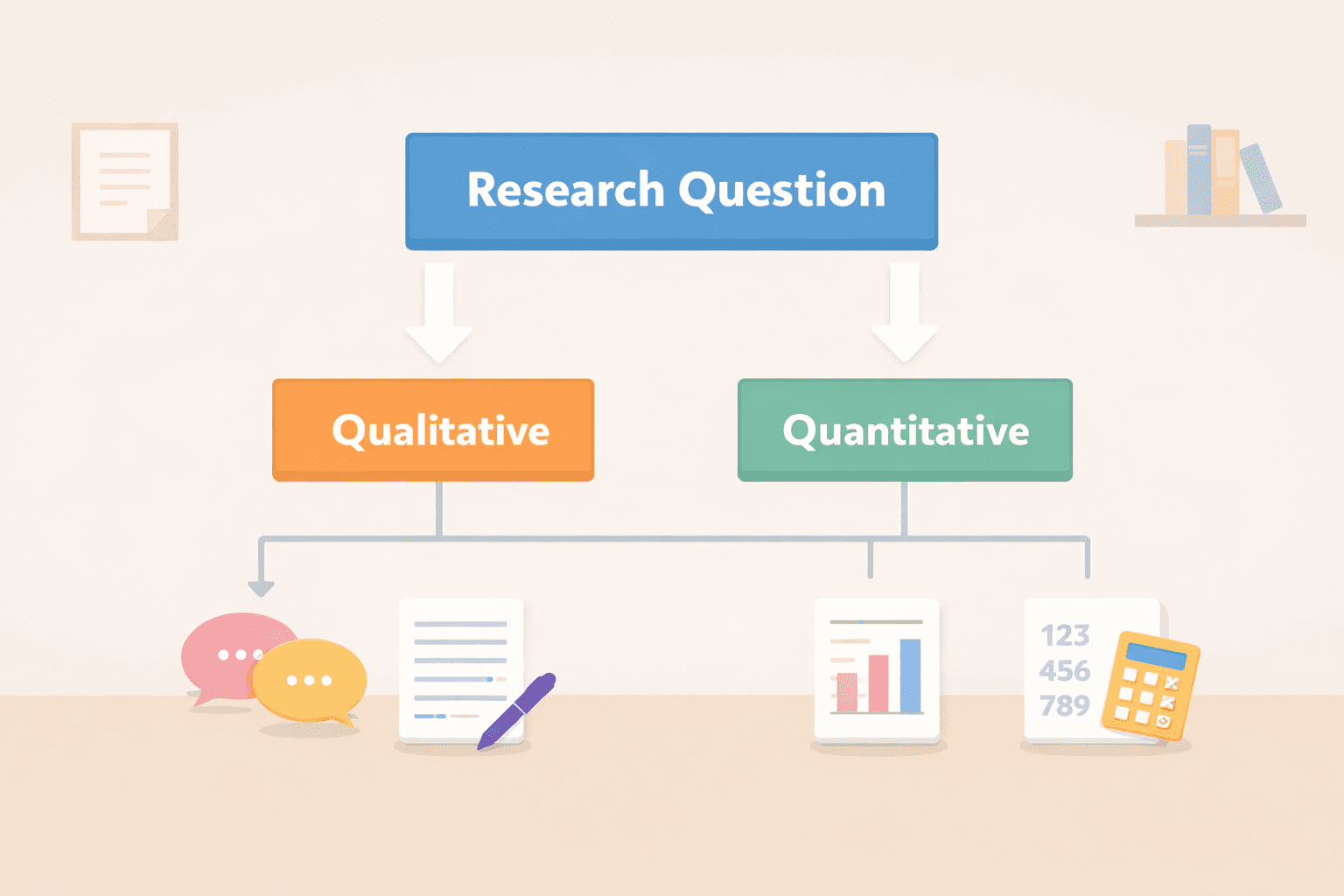
Votre question et votre design de recherche doivent aller ensemble. Si ce n’est pas le cas, tout votre projet s’effondre.
Les questions qualitatives explorent généralement le comment ou le pourquoi. Elles approfondissent les expériences, les significations et les processus, ce qui contraste avec la recherche quantitative qui se concentre sur la mesure et les variables définies. Les méthodes pour y répondre sont par exemple les entretiens, les observations ou l’analyse de textes.
Exemple de question : « Comment les graphistes indépendants vivent-ils et gèrent-ils l’épuisement créatif ? »
Les questions quantitatives recherchent des relations mesurables entre des éléments. Elles portent sur des quantités, des fréquences ou des relations de cause à effet en définissant des variables telles que des résultats dépendants et des facteurs indépendants. Les méthodes sont les enquêtes, les expériences ou l’analyse de données numériques.
Exemple de question : « Quelle est la relation entre le temps d’écran quotidien et la qualité du sommeil autodéclarée chez les adolescents ? »
Les questions mixtes combinent les deux approches. Vous pouvez avoir une question quantitative principale et une question qualitative de suivi pour expliquer les chiffres. Cela exige une planification rigoureuse afin que les deux parties s’articulent logiquement.
Exemple d’ensemble de questions : « Dans quelle mesure une application de pleine conscience réduit-elle les niveaux de stress chez les étudiants universitaires ? Comment les participants décrivent-ils leur expérience avec les exercices de l’application ? »
Obtenir cet alignement est ce qui rend votre étude valide. La bonne question vous indique quels outils utiliser, et utiliser les bons outils vous permet d’obtenir des réponses crédibles.
Pièges courants des questions de recherche
Il est facile de rédiger une mauvaise question. Voici les pièges les plus fréquents qui fragilisent une étude.
La question est trop large - Des questions comme « Qu’est-ce qui cause le changement climatique ? » ou « Comment améliorer l’éducation ? » sont impossibles à traiter dans un seul projet. Ce sont des sujets, pas des questions de recherche. Une bonne question a un champ étroit et spécifique que vous pouvez réellement gérer.
Elle peut être résolue par « oui » ou « non » - Une question comme « L’exercice améliore-t-il la santé mentale ? » bloque l’analyse. Elle conduit à une réponse simple plutôt qu’à une explication. De meilleures questions commencent par comment, pourquoi ou dans quelle mesure pour forcer une investigation plus approfondie.
Elle est impossible à traiter - Parfois, une question est excellente en théorie mais irréalisable en pratique. Peut-être que les données n’existent pas, que vous n’avez pas accès à la population concernée, ou qu’il serait contraire à l’éthique de l’étudier. Votre question doit être réalisable avec vos ressources et contraintes réelles.
S’arrêter au premier brouillon - Votre première tentative est rarement la meilleure. Les questions solides se peaufinent avec le temps. Vous devez les réviser à partir des retours, d’une exploration plus approfondie de la recherche existante et d’un regard honnête sur ce que vous pouvez réellement accomplir. Se contenter de votre idée initiale revient souvent à se contenter d’une étude plus faible.
Affiner votre question pour en faire une direction de recherche claire
Tout dans votre projet de recherche dépend de la question de départ. Une question claire, ciblée et formulable est ce qui distingue une étude solide d’une étude confuse.
<CTA title="Construisez un énoncé du problème solide" description="Créez en quelques minutes un énoncé précis et prêt à être publié, avec clarté et structure." buttonLabel="Essayer Jenni gratuitement" link="https://app.jenni.ai/register" />
Le processus n’a rien de magique. Vous choisissez un intérêt général, lisez ce qui existe déjà, identifiez une lacune précise, puis resserrez votre champ d’étude jusqu’à obtenir une question que vous pouvez réellement traiter. Une bonne question de recherche est bien plus qu’une simple ligne sur une page. C’est le plan directeur. Elle montre que vous avez réfléchi en profondeur à votre sujet et elle pose les bases d’un travail que les autres prendront au sérieux.