Par
Nathan Auyeung
—
Comment répondre aux commentaires des pairs : Exemples, modèle et conseils pour les chercheurs

Nathan Auyeung
Expert-comptable senior chez EY
Diplômé avec une Licence en Comptabilité, suivi d'un Diplôme de Postgraduate en Comptabilité

Obtenir une décision de révision et de resoumission est une bonne nouvelle. Cela signifie que la revue s'intéresse à votre article. Mais s'installer pour répondre à 47 commentaires de relecteurs est un tout autre défi. Le courrier de réponse est une étape que la plupart des chercheurs découvrent par eux-mêmes, ce qui est précisément la raison pour laquelle tant d'entre eux s'y prennent mal.
Ce guide vous montre comment répondre aux commentaires de l'évaluation par les pairs étape par étape : des exemples concrets pour formuler vos réponses, un modèle à utiliser immédiatement, et des conseils pour gérer les situations où vous êtes en désaccord avec un relecteur.
<CTA title="Corrigez les problèmes avant de resoumettre" description="Utilisez Jenni pour renforcer votre manuscrit révisé. Vérifiez vos affirmations, comblez les lacunes de citation et peaufinez le tout avant de le renvoyer." buttonLabel="Essayer Jenni gratuitement" link="https://app.jenni.ai/register" />
Ce que les éditeurs recherchent réellement dans votre réponse
Les éditeurs lisent la lettre de réponse comme une preuve du sérieux avec lequel vous avez pris en compte l'évaluation. Ce n'est pas une formalité. Les éditeurs la lisent en parallèle du manuscrit révisé pour évaluer si les préoccupations soulevées ont été traitées en profondeur ou simplement survolées. Trois éléments comptent par-dessus tout :
L'exhaustivité : Chaque commentaire doit recevoir une réponse, même si celle-ci est « nous exprimons respectueusement notre désaccord ».
La clarté : Il doit être facile de repérer précisément où chaque modification a été apportée dans le manuscrit.
Le professionnalisme : Pas de défensive, pas de ton dédaigneux, pas de débats stériles.
Une lettre de réponse qui omet ne serait-ce qu'un seul commentaire, aussi mineur soit-il, indique à l'éditeur que la révision n'a pas été rigoureuse. L'exhaustivité est non négociable. Comprendre les types d'évaluation par les pairs utilisés par votre revue peut également vous indiquer le niveau de formalité requis pour votre réponse. Les processus d'évaluation ouverte, par exemple, peuvent exiger des explications plus détaillées puisque votre réponse peut devenir publique.
Comment structurer votre lettre de réponse
Le paragraphe d'introduction
Commencez par des remerciements professionnels et brefs. Une ou deux phrases suffisent. Soyez sincère et précis, pas de formule toute faite. Évitez les introductions trop générales qui pourraient s'appliquer à n'importe quel manuscrit. Saluez l'engagement constructif des relecteurs lorsque cela est justifié.
« Nous tenons à remercier l’éditeur et les deux relecteurs pour leurs commentaires approfondis et constructifs. Nous avons répondu avec soin à chaque remarque ci-dessous et sommes convaincus que le manuscrit en ressort considérablement renforcé. »
Le format Commentaire-Réponse
Citez chaque commentaire de relecteur mot pour mot avant de rédiger votre réponse. Ne paraphrasez jamais. La paraphrase introduit une ambiguïté sur ce à quoi vous répondez réellement, et les éditeurs repèrent immédiatement la différence.
Le format est simple : d'abord la citation, puis votre réponse juste en dessous.
Relecteur 1, Commentaire 3 : « La section discussion surestime la généralisation des résultats compte tenu de la taille de l'échantillon. »
Réponse : « Nous partageons cette préoccupation. Nous avons révisé le dernier paragraphe de la Discussion (page 14, lignes 312-318) pour limiter nos affirmations de généralisation à la population spécifique étudiée. Nous avons également ajouté une sous-section sur les limites de l'étude pour traiter directement ce point. »
<ProTip title="📌 Rappel :" description="Citez toujours le commentaire du relecteur mot pour mot avant votre réponse. Ne le paraphrasez jamais. La paraphrase introduit une ambiguïté sur ce à quoi vous répondez réellement." />
Comment exprimer son désaccord de manière respectueuse
Exprimer son désaccord est parfaitement acceptable. Envisagez cela comme la présentation d'un contre-argument à un collègue, et非 comme une autodéfense. Soyez précis, restez professionnel et orientez l'éditeur vers des preuves qui soutiennent votre position.
« Nous apprécions la remarque du relecteur concernant le choix du modèle statistique. Cependant, nous maintenons respectueusement notre approche initiale car [raison spécifique]. Nous avons ajouté une note de bas de page à la page 8 expliquant cette décision méthodologique plus en détail. »
La recherche confirme qu'un désaccord respectueux est une partie normale du processus d'évaluation par les pairs. Ce que les éditeurs veulent voir, c'est que vous avez pris la préoccupation au sérieux, même si vous n'en tirez pas la même conclusion. Un argumentaire bien étayé est bien plus crédible qu'une concession forcée.
Comment répondre aux commentaires de relecture, étape par étape
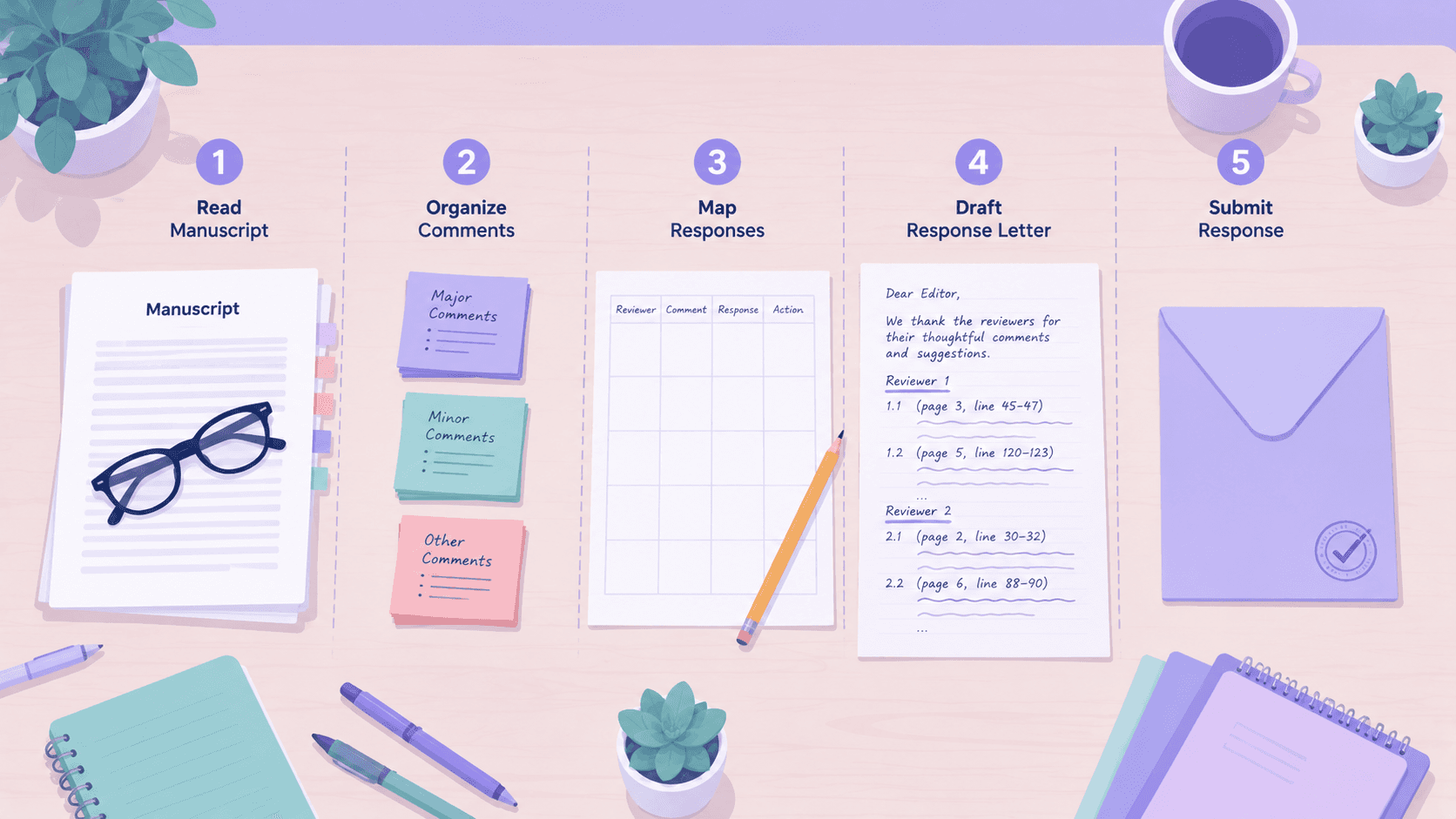
Suivez ces étapes dans l'ordre. Se précipiter pour rédiger des réponses avant d'avoir tout lu est la source d'erreurs la plus fréquente dans les lettres de révision.
Étape 1 — Lisez tout avant de répondre à quoi que ce soit
Lisez l'ensemble des commentaires des relecteurs du début à la fin avant d'écrire le moindre mot. Parfois, une remarque du Relecteur 2 explique pourquoi un commentaire du Relecteur 1 semblait contradictoire. Avoir une vue d'ensemble vous évite de faire des modifications qui se contredisent. Cela vous aide également à repérer des tendances : si deux relecteurs demandent la même clarification, cela mérite d'être traité en détail.
Étape 2 — Catégorisez chaque commentaire
Avant de rédiger, classez chaque commentaire dans l'une de ces trois catégories. Cela vous donnera une vision claire de l'ampleur des révisions à effectuer avant de vous lancer.
Correction simple : Corrections factuelles, coquilles, clarifications mineures que vous pouvez régler rapidement.
Révision majeure : Demandes de nouvelles analyses, de restructuration ou de données supplémentaires qui nécessitent un travail important.
Désaccord : Cas où vous estimez que le relecteur commet une erreur factuelle ou que sa demande dépasse le cadre de votre article.
Étape 3 — Créez votre tableau de suivi des réponses
Avant de rédiger la lettre officielle, créez un tableau de suivi dans un document Google Doc ou Word. Colonnes : Numéro du relecteur, Numéro du commentaire, Résumé du commentaire, Votre réponse prévue, Emplacement de la modification dans le manuscrit. Ce document sera votre guide de référence et garantira que rien n'est oublié.
<ProTip title="💡 Conseil d'expert :" description="Créez le tableau dans un Google Doc ou un fichier Word avant de rédiger votre lettre officielle. Il deviendra votre document de suivi principal et rendra presque impossible l'oubli accidentel d'un commentaire." />
Étape 4 — Rédigez vos réponses avec des références précises au manuscrit
Chaque réponse doit indiquer à l'éditeur exactement où la modification a été effectuée. Des réponses vagues comme « nous avons modifié le manuscrit en conséquence » frustrent les relecteurs et ne parviennent pas à convaincre les éditeurs. Indiquez systématiquement les numéros de page et de ligne à chaque fois.
« Nous avons révisé [section] à la page X, lignes Y-Z pour répondre à cette préoccupation. »
« Nous avons ajouté un nouveau paragraphe dans la Discussion (page 12) expliquant... »
« La figure a été mise à jour pour inclure des barres d'erreur comme demandé (actuellement Figure 3). »
<ProTip title="📝 Note :" description="Si un relecteur formule une demande que vous ne pouvez pas satisfaire, expliquez clairement pourquoi et proposez une alternative. Une réponse argumentée expliquant ce que vous avez fait à la place vaut toujours mieux que le silence." />
Étape 5 — Suivez les modifications dans le manuscrit
Soumettez votre manuscrit révisé avec le suivi des modifications activé afin que les relecteurs et l'éditeur puissent voir précisément ce qui a changé et où. Joignez également une copie propre sans marques de révision. Consultez d'abord les consignes de soumission de la revue, car certaines n'acceptent que des copies propres.
Modèle de lettre de réponse aux relecteurs
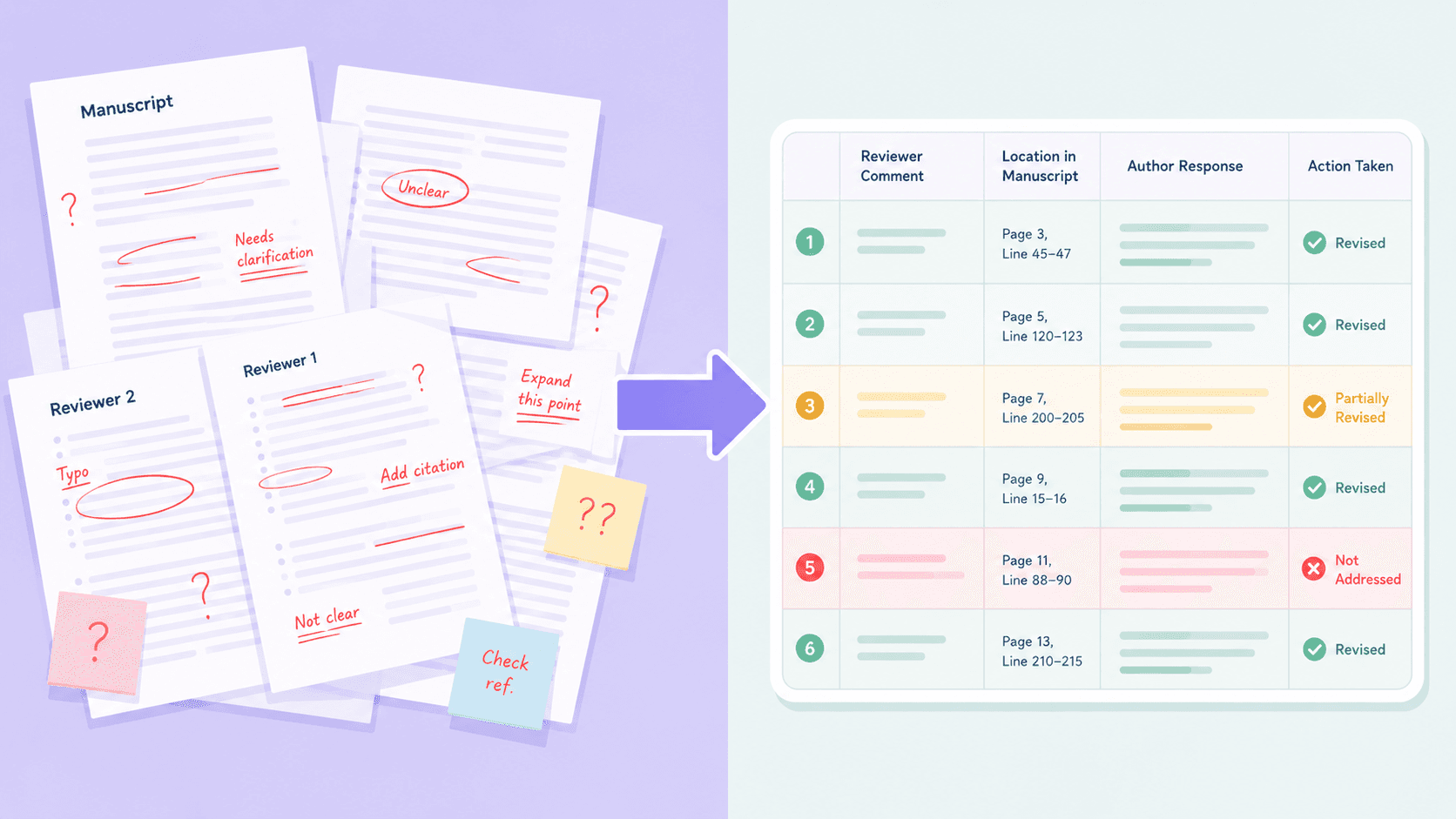
Copiez et sauvegardez ce texte comme document de base. Remplissez-le pour chaque révision que vous soumettez. Cette structure fonctionne pour toutes les revues et disciplines académiques, vous évitant de devoir repartir de zéro à chaque fois.
<ProTip title="💡 Conseil d'expert :" description="Enregistrez ce modèle comme fichier de base et remplissez-le pour chaque révision que vous soumettez. Ce format est cohérent d'une revue à l'autre, vous évitant ainsi de repartir d'une page blanche." />
Comment utiliser Jenni pour rédiger votre lettre de réponse
Jenni peut vous aider à enrichir et parfaire les révisions de votre manuscrit afin que vos réponses reposent sur une version encore plus solide et rigoureuse. Commencez par le fond, puis peaufinez la forme — pour un guide structuré sur les modifications de manuscrit, consultez notre article comment réviser un article de recherche.
Étape 1 : Ouvrez votre manuscrit révisé dans Jenni Téléchargez votre manuscrit révisé dans la bibliothèque de documents de Jenni. Gardez-le à côté de la version originale si vous souhaitez comparer directement les modifications durant la rédaction de vos réponses.
Étape 2 : Vérifiez que vos nouvelles affirmations sont bien étayées
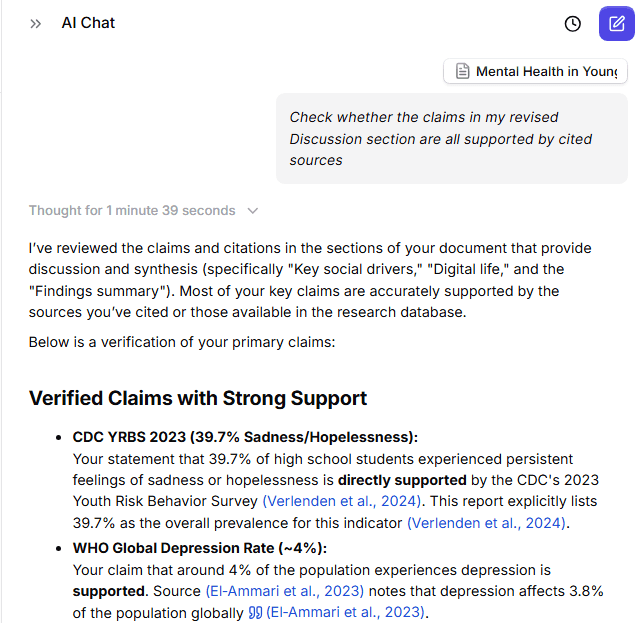
Avant de rédiger vos réponses, assurez-vous que les modifications apportées sont solides. Sélectionnez votre document, ouvrez le Chat IA et lancez cette invite :
« Vérifie si les affirmations de ma section Discussion révisée sont toutes soutenues par les sources citées »
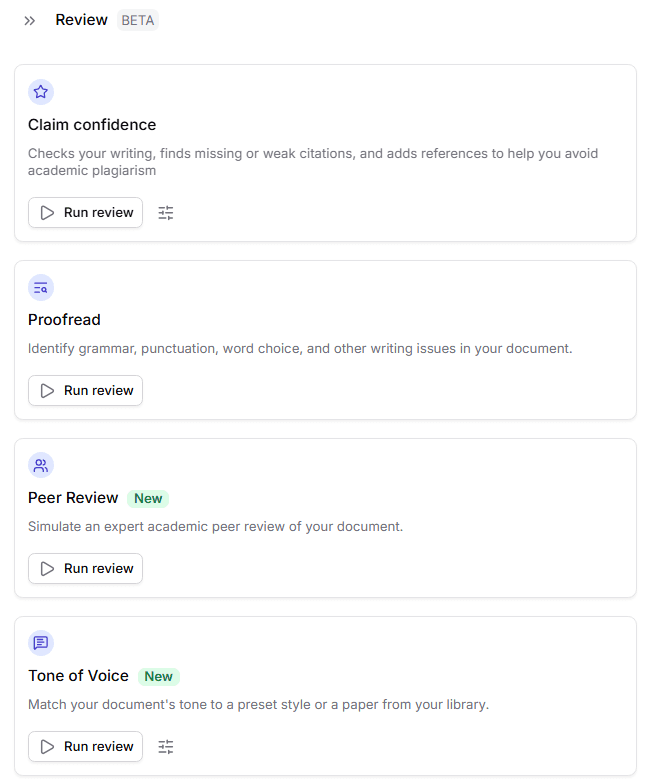
Étape 4 : Lancez une dernière analyse avec Jenni Reviews avant la soumission Avant d'envoyer votre manuscrit finalisé, effectuez une dernière vérification grâce à la fonctionnalité Jenni Reviews. Les phases de réécriture peuvent parfois introduire de légères erreurs ; Jenni s'assure qu'aucune affirmation non étayée ne se glisse dans votre version finale.
Foire aux questions
Quelle doit être la longueur d'une réponse aux relecteurs ?
Une réponse aux relecteurs doit être aussi longue que nécessaire pour répondre précisément à chaque remarque. La plupart des lettres comptent entre deux et six pages, selon le nombre de commentaires. Il n'y a pas de limite maximale. L'essentiel est de traiter chaque point clairement, en mentionnant des repères précis dans le texte révisé.
Que faire si je suis en désaccord avec un relecteur ?
Partager un avis divergent avec un relecteur est tout à fait acceptable, voire parfois requis. Indiquez la remarque exacte, détaillez vos arguments scientifiques et renvoyez l'éditeur vers des données fiables. N'écartez jamais un commentaire d'un revers de main. Un désaccord bien motivé aura toujours plus de poids auprès d'un éditeur qu'une acceptation artificielle.
Dois-je appliquer toutes les modifications suggérées par un relecteur ?
Non. Rien ne vous oblige à accepter chaque suggestion, mais vous devez mentionner chaque remarque. Lorsque vous déclinez une modification, exposez clairement vos raisons et proposez une alternative pertinente si possible. Les éditeurs ont conscience que certaines demandes dépassent le cadre initial de l'étude. Des explications claires et pro sont toujours appréciées.
Que signifie « réviser et resoumettre » ?
Cette décision signifie que l'éditeur s'intéresse vivement à votre article, mais exige des ajustements avant de l'accepter définitivement. Ce n'est en aucun cas un refus. L'éditeur vous invite à retravailler votre texte et à lui renvoyer une version enrichie, accompagnée d'un courrier de réponse exposant chaque changement.
Dois-je utiliser le suivi des modifications pour ma resoumission ?
Oui, c'est vivement recommandé dans la majorité des cas. Envoyez votre manuscrit révisé avec le suivi activé afin de faciliter la tâche des évaluateurs. Ajoutez également une version finalisée sans marques de révision. Pensez à vérifier les règles spécifiques de la revue au préalable, car certaines d'entre elles exigent uniquement des fichiers propres.
Votre lettre de réponse est un élément clé de votre publication
Rédiger une lettre de réponse solide n'est pas une simple formalité : c’est un levier déterminant pour l'acceptation de votre article. Les éditeurs l'analysent de près. Accordez-lui la même rigueur scientifique qu'à votre manuscrit : soyez précis, professionnel, et montrez aux relecteurs que vous avez pris en compte leurs remarques avec le plus grand sérieux.
<CTA title="Renforcez vos révisions avant de resoumettre" description="Utilisez Jenni pour valider vos modifications, combler les manques de citations et vous assurer que votre manuscrit est prêt pour l'étape suivante." buttonLabel="Essayer Jenni gratuitement" link="https://app.jenni.ai/register" />
Une fois votre réponse soumise et votre document validé pour les dernières retouches, faites confiance à Jenni pour un ultime contrôle qualité. Si vous devez rédiger vous-même un rapport d'évaluation plutôt que d'y répondre, découvrez notre guide complet pour savoir comment rédiger un rapport d'évaluation par les pairs. Pour aller plus loin dans la gestion de ce processus, consultez nos conseils pour optimiser vos retours de relecture.