Par
Nathan Auyeung
—
Comment créer un cadre de recherche : de la théorie à la méthodologie

Nathan Auyeung
Expert-comptable senior chez EY
Diplômé avec une Licence en Comptabilité, suivi d'un Diplôme de Postgraduate en Comptabilité
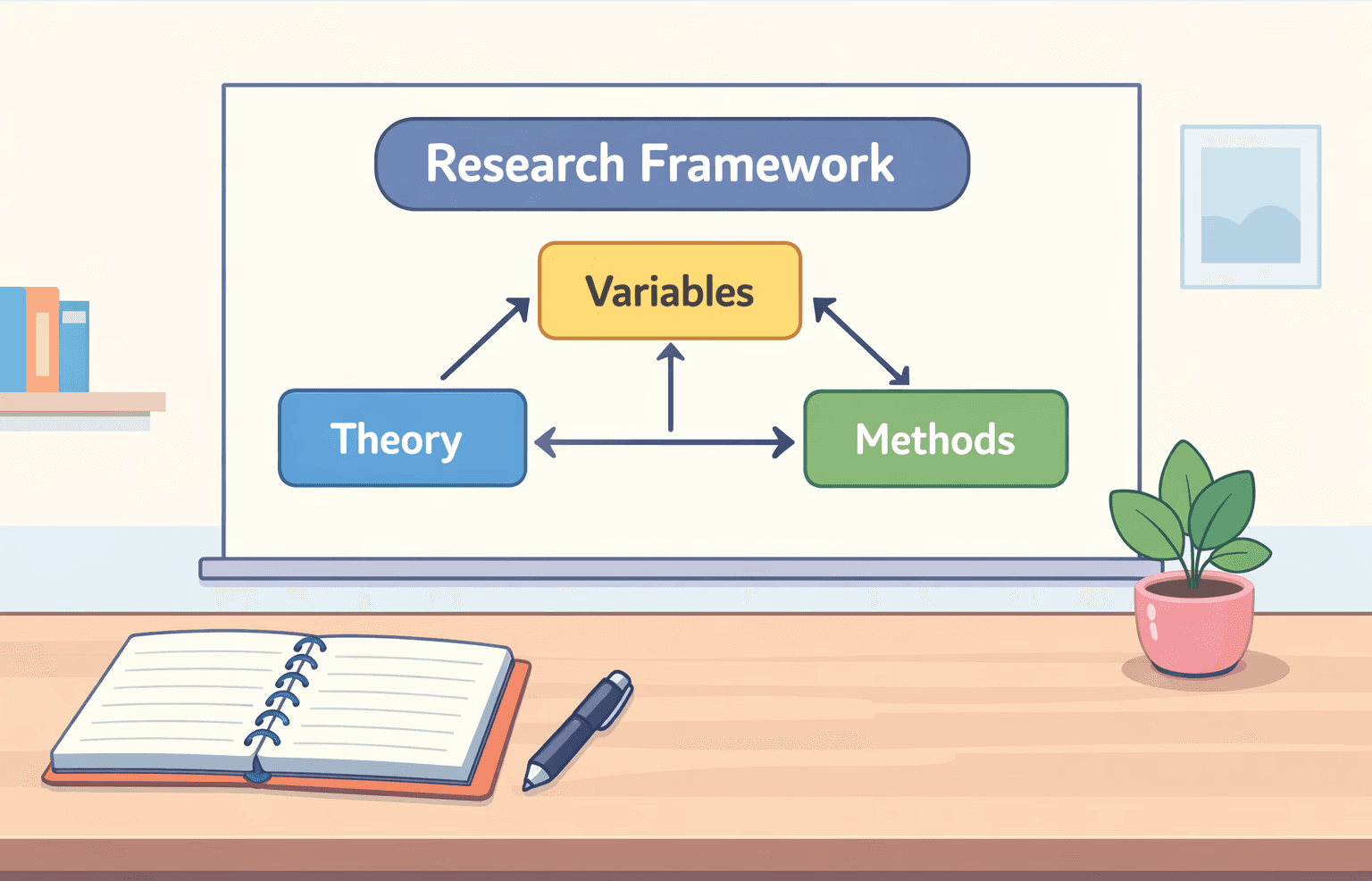
Si votre recherche n’a pas de cadre solide, elle est construite sur du sable. Ce n’est pas seulement du jargon universitaire : c’est la structure pratique qui relie ce que vous pensez se passer à la manière dont vous le prouverez. Sautez cette étape, et vous risquez d’obtenir des données intéressantes qui répondent entièrement à la mauvaise question.
Construire un cadre ne consiste pas à cocher une case. C’est un travail intentionnel qui aligne votre théorie avec vos méthodes. Le processus présenté ci-dessous est conçu pour vous aider à bâtir cet échafaudage essentiel, pièce par pièce, de façon logique.
<CTA title="Construisez un énoncé de problème solide" description="Créez en quelques minutes un problème de recherche précis, prêt à publier, sans stress ni superflu." buttonLabel="Essayer Jenni gratuitement" link="https://app.jenni.ai/register" />
Qu’est-ce qu’un cadre de recherche ?
À la base, un cadre de recherche est la structure logique de votre étude. C’est la façon dont vous montrez la relation entre vos grandes idées, les éléments précis que vous mesurerez (vos variables), la théorie que vous utilisez et les méthodes que vous avez choisies.
Voyez-le moins comme un simple schéma et davantage comme le câblage sous-jacent qui alimente votre conception de recherche et chacune de vos décisions.
En pratique, cette structure remplit quatre fonctions clés. Elle définit l’objet précis de votre étude. Elle justifie pourquoi vous incluez certaines variables et pas d’autres.
Elle explique comment vous comptez tester les liens entre ces variables. Enfin, elle trace une limite claire entre ce que votre recherche couvrira et ce qu’elle n’abordera pas. Bien maîtriser cet aspect, c’est transformer un problème de recherche flou en un modèle testable.
L’objectif est que vos objectifs, vos questions et vos hypothèses ne restent pas séparés les uns des autres : ils doivent être servis directement et logiquement par votre méthodologie.
<ProTip title="💡 Conseil de pro :" description="Rédigez d’abord votre cadre de recherche en langage simple. La clarté compte davantage que les diagrammes au début." />
Pourquoi un cadre de recherche est-il important ?
De nombreuses recherches échouent tout simplement parce qu’elles sont structurellement fragiles. Le sujet peut être excellent, mais l’étude elle-même est mal construite. Un cadre de recherche corrige cela en obligeant chaque composante de votre travail à s’aligner.
Son importance tient à რამდენიმე fonctions concrètes. D’abord, il garantit la clarté conceptuelle. Vous devez définir vos concepts, décider comment vous allez les mesurer et préciser vos termes. Cette clarté est essentielle lorsque vous rédigez des questions de recherche suffisamment précises pour guider une analyse et une interprétation pertinentes.
Ensuite, il renforce directement votre plan de recherche. En cartographiant les relations entre les variables et ce que vous supposez être la cause de quoi, vous pouvez choisir les bonnes méthodes de collecte et d’analyse des données. Ce n’est pas une supposition ; c’est un choix raisonné.
Troisièmement, il améliore la validité et la fiabilité. Lorsque votre théorie, vos variables et vos méthodes sont reliées de façon logique, vos résultats sont plus dignes de confiance. Vous mesurez réellement ce que vous prétendez mesurer.
Quatrièmement, il guide l’ensemble du processus. De votre première proposition jusqu’à l’analyse finale des données, le cadre est votre feuille de route. C’est ce que vous vérifiez pour rester sur la bonne voie et éviter les détours.
Enfin, il établit votre crédibilité. Un cadre solide montre aux évaluateurs que vous avez réfléchi au sujet. Il démontre la rigueur, le raisonnement logique et la maîtrise de la théorie, le strict minimum pour un travail universitaire sérieux.
<ProTip title="🧠 À retenir :" description="Si vous ne pouvez pas expliquer votre cadre oralement en une minute, votre plan d’étude n’est pas encore assez clair." />
Les types de cadres de recherche
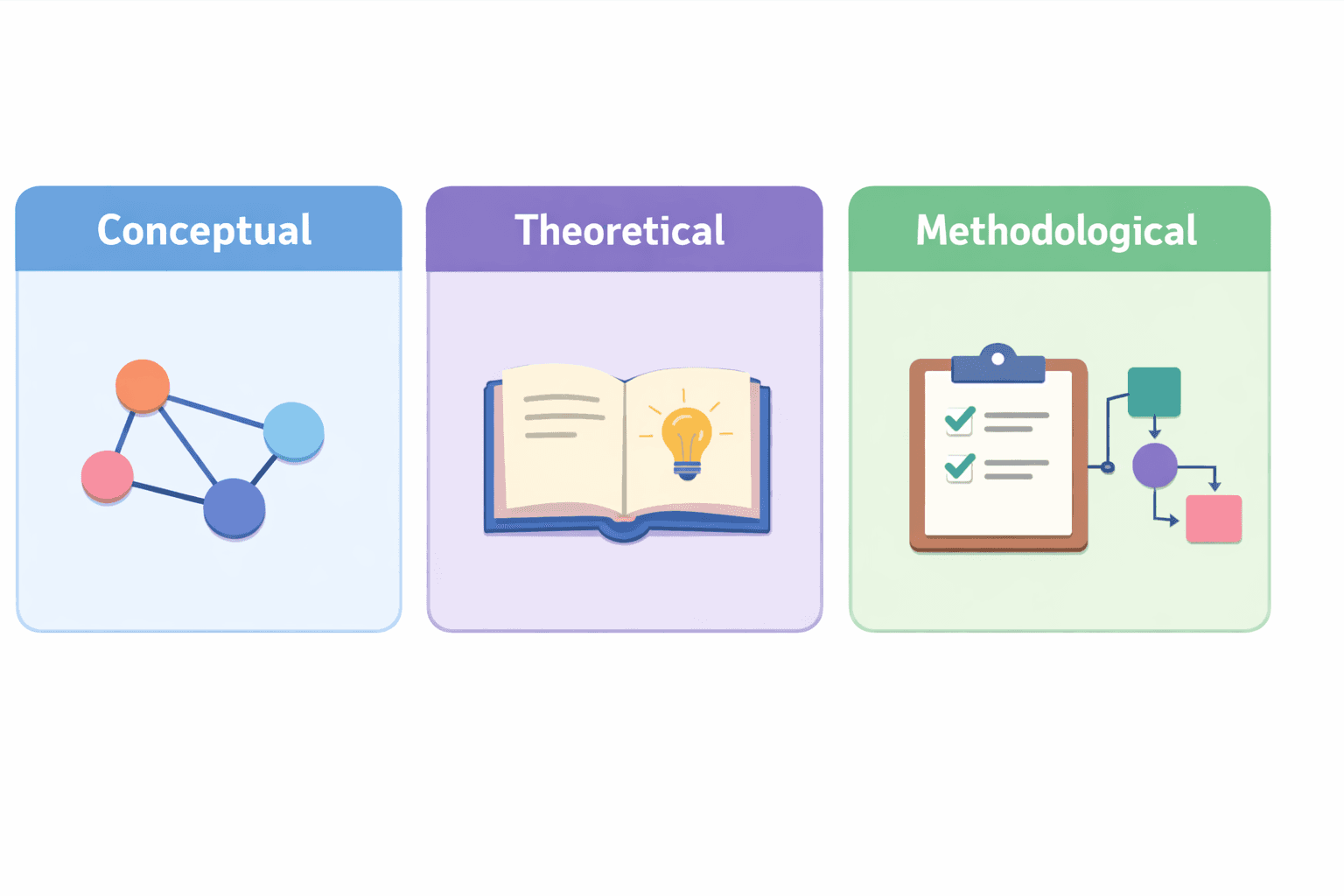
Les cadres de recherche ne sont pas universels. Celui que vous utiliserez dépend de votre domaine, de vos objectifs et de votre approche globale.
La plupart des études entrent dans l’une de ces trois catégories, ou combinent plusieurs d’entre elles, en reflétant différents paradigmes de recherche qui façonnent la manière dont la connaissance est définie et testée.
Cadre conceptuel
Ce type de cadre consiste à dresser une carte de vos idées principales et à montrer comment elles peuvent être liées. Il est courant dans des domaines comme les affaires, l’éducation ou les sciences de la santé. Son objectif principal est d’identifier les éléments importants de votre étude.
Vous déterminez quelles sont les causes potentielles (variables indépendantes), quels sont les résultats (variables dépendantes) et s’il existe d’autres facteurs qui expliquent ou modifient ce lien de cause à effet (ce sont les médiateurs ou les modérateurs).
Vous montrez ensuite ces relations, souvent à l’aide d’un schéma ou d’un tableau simple. L’idée est de prendre tout ce que vous avez lu dans d’autres études et de l’organiser en une image unique, claire et logique.
Même si vous n’utilisez pas une grande théorie reconnue, votre carte doit tout de même reposer sur des données probantes issues de recherches antérieures.
Par exemple, si vous étudiez pourquoi certaines équipes sont plus productives, votre schéma pourrait montrer une flèche allant du « style de leadership du manager » vers la « motivation de l’équipe », puis une autre de la « motivation de l’équipe » vers le « travail réalisé ».
Cadre théorique
Avec ce type de cadre, vous basez toute votre étude sur une théorie existante et nommée. Vous n’inventez pas les liens vous-même ; vous vous appuyez sur une explication prête à l’emploi de la manière dont les choses se produisent.
Vous tirez cette explication directement d’une théorie connue dans des domaines comme la psychologie ou l’économie. La théorie vous donne le « pourquoi » derrière la relation de cause à effet que vous examinez, et ce « pourquoi » soutient vos prédictions (vos hypothèses).
Vous choisiriez cette approche lorsque votre objectif principal est de mettre une théorie précise à l’épreuve, pour voir si elle tient, s’il faut l’ajuster, ou si elle est peut-être erronée.
Par exemple, si vous recherchez pourquoi certaines personnes recyclent et d’autres non, vous pourriez utiliser la « théorie du comportement planifié. »
Cette théorie serait votre point de départ et suggérerait que les croyances d’une personne au sujet du recyclage et ce qu’elle pense que ses voisins attendent d’elle façonnent finalement ses actions. Votre étude vérifierait ensuite si cela est réellement vrai.
Cadre méthodologique
Ce cadre porte avant tout sur le « comment ». Il s’intéresse moins aux grandes idées ou aux théories qu’au plan détaillé, étape par étape, de réalisation de l’étude.
Il décrit votre design de recherche en toute simplicité. Utilisez-vous des entretiens (qualitatif), des questionnaires chiffrés (quantitatif) ou une combinaison des deux ? Comment choisirez-vous les personnes que vous étudierez ou les documents que vous examinerez ?
Quels questionnaires, guides d’entretien ou capteurs précis utiliserez-vous pour recueillir vos informations ? Et surtout, quel est votre plan exact pour donner du sens à toutes ces données une fois obtenues ?
Ce type de cadre est essentiel pour les recherches de terrain, comme l’évaluation d’un programme communautaire ou le travail à l’interface de plusieurs disciplines, lorsque la principale question est le « comment faire » pour obtenir des réponses.
<ProTip title="📌 Note :" description="De nombreuses études solides combinent des cadres conceptuels et méthodologiques au lieu d’en choisir un seul." />
Éléments clés d’un cadre de recherche
Même si l’apparence d’un cadre peut varier, ses composantes fondamentales restent les mêmes. Elles doivent être reliées entre elles de manière logique.
Composante | Rôle dans le cadre | Question clé à laquelle elle répond |
Problème de recherche | Définit l’enjeu spécifique ou la lacune que l’étude traite | Qu’est-ce qui manque exactement ou n’est pas résolu ? |
Objectifs de recherche | Transforme le problème en objectifs de recherche clairs | Que cherche à accomplir l’étude ? |
Questions de recherche | Oriente l’étude vers des questions auxquelles on peut répondre | Quelles questions la recherche va-t-elle résoudre ? |
Revue de la littérature | Ancre le cadre dans la théorie et les résultats existants | Qu’est-ce qui est déjà connu, et où sont les lacunes ? |
Variables de l’étude | Identifie ce qui est mesuré et analysé | Quels facteurs sont examinés dans l’étude ? |
Relations entre variables | Explique comment les variables sont censées interagir | Comment les variables sont-elles reliées ? |
Portée et limites | Délimite le champ de l’étude | Qu’est-ce qui est inclus et exclu ? |
Hypothèses et limites | Énonce les conditions et les contraintes | Dans quelles conditions les résultats sont-ils valables ? |
<ProTip title="⚙️ Conseil pratique :" description="Rédigez d’abord vos relations entre variables sous forme de phrases simples du type si... alors..., avant de les transformer en hypothèses." />
Guide étape par étape pour créer un cadre de recherche
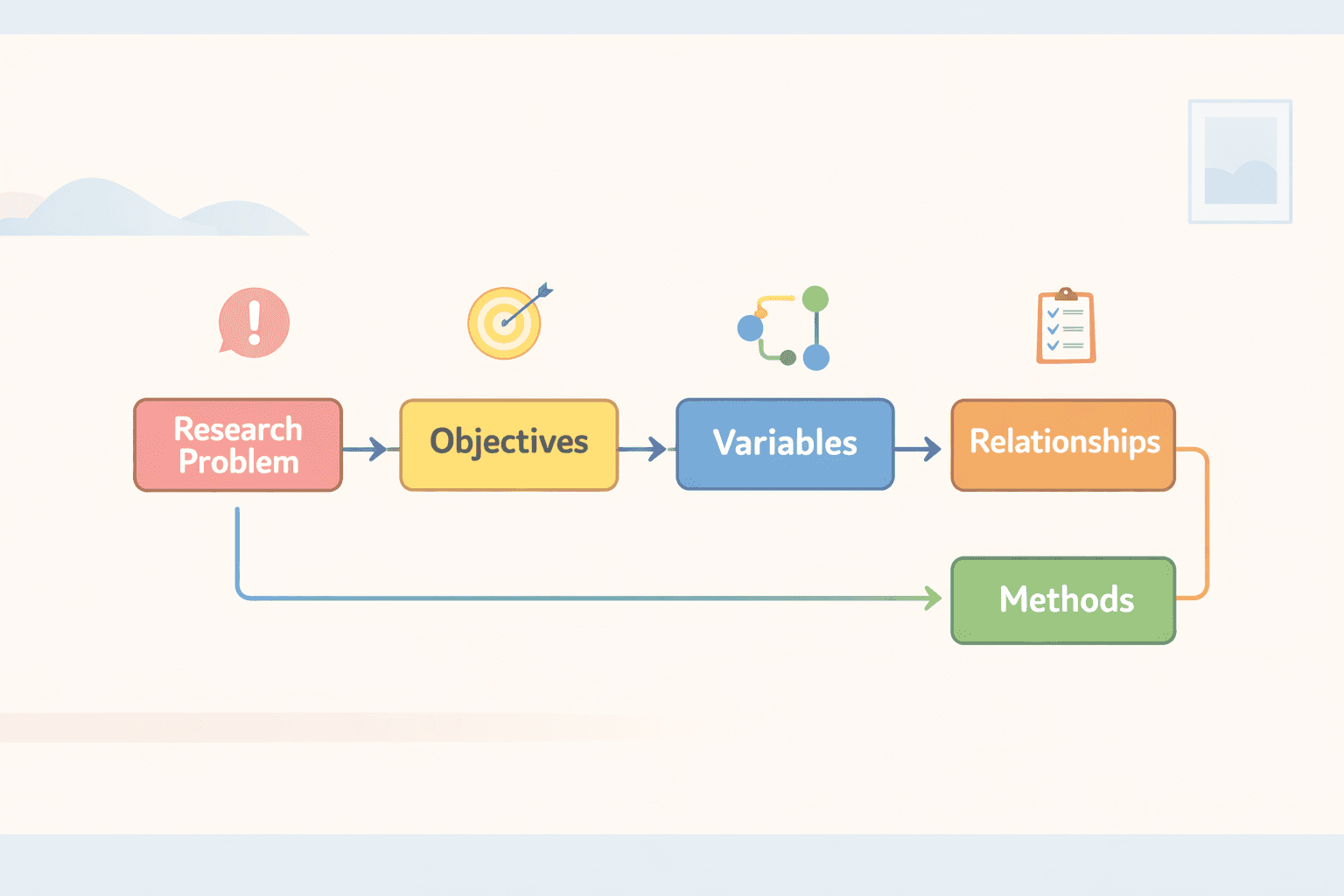
Étape 1 : Identifiez précisément le problème
Commencez par formuler la lacune précise que votre recherche viendra combler. Un bon énoncé du problème montre clairement la différence entre ce qui est déjà connu et ce que votre étude va découvrir.
Évitez les problèmes trop larges ou trop vagues. Concentrez-vous sur quelque chose de concret que vous pouvez réellement étudier.
Étape 2 : Fixez vos objectifs et vos questions
Une fois le problème défini, décrivez ce que vous souhaitez accomplir, c’est-à-dire vos objectifs de recherche. Ceux-ci doivent s’attaquer directement au problème. Ensuite, transformez ces objectifs en questions de recherche ciblées.
Chaque question doit être précise, pouvoir être traitée par la recherche et correspondre aux données et aux méthodes que vous pouvez réellement utiliser. L’ensemble de votre cadre montrera comment vous y répondrez.
Étape 3 : Examinez la littérature avec intention
Ne vous contentez pas de lister des études antérieures. Menez une revue ciblée pour trouver ce dont vous avez besoin afin de construire votre cadre.
Repérez les concepts communs utilisés par d’autres chercheurs, les relations qu’ils ont établies, les modèles théoriques pertinents et les méthodes courantes dans votre domaine.
Synthétisez ces informations pour identifier les tendances et, surtout, les lacunes que votre propre travail viendra combler.
Étape 4 : Nommez et définissez vos variables
Identifiez chaque facteur que vous allez étudier. Définissez clairement chacun d’eux en précisant exactement comment vous allez le mesurer ou l’identifier (c’est la définition opérationnelle).
Classez-les : quelles sont vos variables indépendantes (les causes supposées) ? Vos variables dépendantes (les résultats) ?
Y a-t-il des médiateurs qui expliquent le processus, ou des modérateurs qui changent l’intensité ou la direction d’une relation ? Des définitions claires évitent la confusion par la suite.
Étape 5 : Cartographiez les liens entre les variables
C’est le cœur du cadre. Précisez les relations entre vos variables. L’une en cause-t-elle une autre (causale) ? Sont-elles simplement associées (corrélationnelles) ?
La relation n’apparaît-elle que dans certaines conditions (conditionnelle) ? Pour les études quantitatives, ces relations constitueront vos hypothèses testables.
Étape 6 : Dessinez un schéma
Un modèle visuel rend les relations complexes compréhensibles en un coup d’œil. Créez un schéma ou un organigramme simple.
Utilisez des flèches pour montrer le sens, des étiquettes pour clarifier, et gardez une présentation épurée. Cela vous aide, ainsi que votre lecteur, à voir la logique de votre étude.
Étape 7 : Choisissez votre design de recherche
Votre cadre doit s’accorder avec l’approche choisie. Décidez si vous utiliserez une recherche qualitative ou quantitative, ou des méthodes mixtes.
Cette décision détermine presque tout ce qui suit : la manière dont vous collecterez les données, qui ou quoi vous étudierez, et comment vous analyserez les résultats. Un décalage à ce niveau peut invalider tout votre projet.
Étape 8 : Alignez vos méthodes, vos données et votre analyse
Vérifiez que chaque choix pratique soutient votre cadre. Le groupe de participants que vous avez sélectionné (votre échantillon) correspond-il à vos objectifs ?
Vos outils de collecte de données captureront-ils réellement les variables que vous avez définies ? L’analyse prévue permettra-t-elle vraiment de tester les relations que vous proposez ? Cette étape transforme votre plan conceptuel en un plan exécutable.
Étape 9 : Énoncez les limites et les contraintes
Enfin, soyez explicite sur les limites de votre travail. Définissez la portée, c’est-à-dire ce que vous étudiez et ce que vous n’étudiez pas. Énoncez vos hypothèses, les conditions que vous tenez pour acquises.
Reconnaissez vos limites, les contraintes du monde réel qui auront un impact sur vos résultats. Cette transparence n’affaiblit pas votre travail ; elle le rend crédible.
Exemple pratique d’un cadre de recherche
Supposons que vous étudiez pourquoi les rendements des cultures hydroponiques sont si irréguliers. Vous commenceriez par lister les principaux éléments. Les facteurs que vous pensez déterminants, appelons-les les variables de « cause », pourraient être l’acidité de l’eau et l’intensité lumineuse. Le résultat que vous suivez, la variable d’« effet », est la vitesse de croissance des plantes.
Vous pourriez également supposer que le type de système utilisé change les règles ; peut-être qu’un bassin à eau profonde réagit différemment d’un film nutritif mince. C’est un type particulier de variable appelé modérateur.
Votre plan de test — cultiver des plantes dans une salle contrôlée, prendre des mesures exactes et analyser les chiffres — correspond à votre méthode. Le cadre est ce qui relie la théorie et la méthode. Vous dessineriez ensuite un modèle simple. Il montrerait des flèches allant du pH et de l’intensité lumineuse vers le taux de croissance, avec une ligne indiquant que le type de système influence ces flèches.
Erreurs courantes à éviter
De nombreux cadres s’effondrent à cause d’erreurs simples et évitables :
Ajouter des variables sans lien. Inclure trop de facteurs qui ne sont pas reliés logiquement crée une étude encombrée et sans focus.
Utiliser des concepts vagues. Si vous ne pouvez pas définir clairement un concept comme « engagement » ou « efficacité », votre plan de mesure ne fonctionnera pas.
Ignorer la théorie. Sans fondement dans la littérature ou la théorie existante, vos relations proposées ne sont qu’une hypothèse gratuite.
Incohérence entre cadre et méthode. Concevoir un modèle conceptuel complexe tout en choisissant un simple questionnaire incapable de le tester correctement.
Négliger la faisabilité. Proposer des variables que vous ne pouvez pas mesurer ou des relations que vous n’avez pas les données ou l’accès nécessaires pour tester.
Ne pas réviser. Considérer la première version comme définitive. Un bon cadre s’affine au fur et à mesure que vous apprenez.
N’oubliez pas que votre première version n’est jamais la version finale. Un cadre doit être révisé et resserré à mesure que vous apprenez davantage grâce à la littérature et à la mise à l’épreuve de vos propres hypothèses.
<ProTip title="🚫 À éviter :" description="N’ajoutez pas de variables simplement parce que des données sont disponibles. Chaque variable doit mériter sa place dans le cadre." />
Affiner et valider le cadre
Ne considérez pas votre cadre comme un produit final et parfaitement abouti. C’est plutôt un plan de travail. Une fois que vous commencez à recueillir vos données et à examiner les résultats, il se peut que vous deviez l’ajuster.
Vous réaliserez peut-être qu’un de vos termes a été mal défini, ou qu’une relation dont vous étiez certain n’apparaît tout simplement pas dans les données.
Parlez régulièrement à vos directeurs, superviseurs ou pairs. Montrez-leur votre cadre. Ils verront des failles dans votre raisonnement que vous avez manquées. Ils vous demanderont si votre plan est réellement réalisable. Ils vous pousseront à le rendre plus rigoureux.
Ces allers-retours entre retours et ajustements ne signifient pas que vous vous êtes trompé. C’est l’inverse : c’est ainsi que vous renforcez toute votre étude, étape par étape, et que vos résultats finaux deviennent crédibles.
Structurer votre étude autour d’un cadre cohérent
Un cadre de recherche n’est pas une simple formalité à cocher. C’est la pièce maîtresse qui détermine si votre étude a du sens, si elle résiste à l’examen et si elle peut réellement répondre aux questions que vous posez.
<CTA title="Transformez votre cadre en plan de recherche clair" description="Mettez en pratique ce que vous avez appris en construisant plus rapidement un cadre structuré grâce à un accompagnement guidé en rédaction académique." buttonLabel="Essayer Jenni gratuitement" link="https://app.jenni.ai/register" />
Le cadre vous oblige à faire le travail essentiel. Vous devez définir votre problème avec clarté. Ce processus rigoureux est ce qui transforme quelques idées intéressantes en une étude solide et crédible. Apprendre à construire un cadre, c’est, au fond, apprendre à bâtir un pont digne de confiance.