By
Justin Wong
—
What Is Medical Writing? Types, Skills, and Career Paths

Justin Wong
Head of Growth
Graduated with a Bachelor's in Global Business & Digital Arts, Minor in Entrepreneurship

Medical writing is one of the few careers where the job title tells you almost nothing about the work. Two people can both call themselves medical writers and share no deliverables, no audience, no regulator, and no deadline pressure in common. One is drafting a 300 page clinical study report for the FDA. The other is writing a plain language summary a patient will read on their phone.
This guide sorts that out: what the work actually is, the six areas it splits into, who employs medical writers, what the pay data really says, and the publication ethics rules that separate a medical writer from a ghostwriter.
<CTA title="Write Clearly About Complicated Science" description="Jenni helps you draft, structure, and cite technical writing without losing the thread" buttonLabel="Try Jenni Free" link="https://app.jenni.ai/register" />
What Is Medical Writing?
Medical writing is the practice of turning clinical and scientific information into documents that a specific audience can act on, in the format that audience requires. The audience is the variable that matters. A regulatory reviewer, a cardiologist, a payer committee, and a trial participant all need the same underlying data expressed in completely different ways.
What unites the field is not subject matter but constraint. Almost every medical document is written against an external specification: a regulatory guideline, a journal's instructions to authors, an accreditation standard, or a readability requirement. Medical writers rarely get to decide what goes in a document. They decide how well it goes in.
That is also what makes it a distinct skill from science journalism or general technical writing. You are accountable for accuracy at the level of a single word, because in this field the difference between "reduced mortality" and "was associated with reduced mortality" is a regulatory and legal one.
<ProTip title="🔬 Be precise:" description="Learn the difference between association and causation until it is automatic. More medical writing errors come from that single confusion than from any other source" />
The Six Kinds of Medical Writing
Worth saying plainly, because most articles present this as settled: there is no official taxonomy. Neither the American Medical Writers Association nor its European counterpart publishes a canonical list of categories. What follows is industry convention, useful for orienting yourself and not something to quote as a standard.
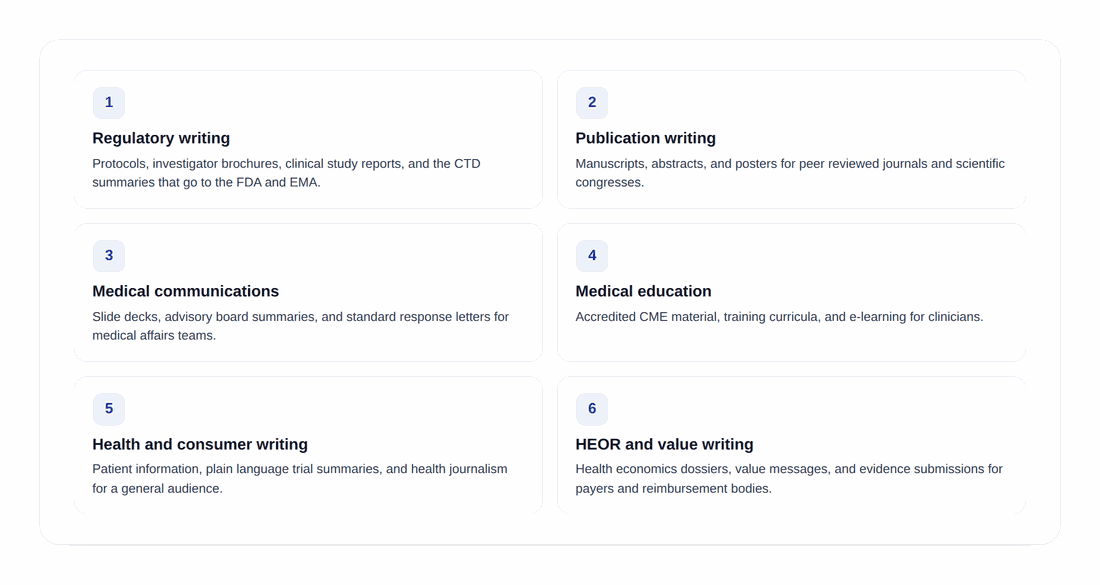
Regulatory writing
Documents that go to a regulator. Clinical trial protocols, investigator brochures, informed consent forms, clinical study reports, and the clinical overview and summary sections of a marketing application. The structure of most of these is set by ICH guidelines rather than by you, and every sentence will be reviewed by people who are accountable for it. This is the most procedurally constrained of the six, and usually the best paid.
Publication writing
Manuscripts, abstracts, and congress posters that report study results in the peer reviewed literature. The rulebook here is the journal's instructions to authors plus the ICMJE recommendations, and the ethical framework matters as much as the writing: who qualifies as an author, how writing support is disclosed, and what a sponsor may and may not influence.
Medical communications
Material produced for medical affairs teams rather than for regulators. Slide decks, advisory board reports, congress summaries, and standard response letters, which are the pre approved answers a company gives when a clinician asks an unsolicited question about a product. Fast paced, client driven, and usually agency based.
Medical education
Accredited continuing medical education, training curricula, and e-learning for clinicians. Where the activity is accredited, it must be independent of promotional influence, which makes this a genuinely different writing discipline from medical communications even though the two look similar from outside.
Health and consumer writing
Patient information, plain language summaries of trial results, decision aids, and health journalism. The scientific content is simpler and the writing problem is harder. Explaining a hazard ratio to somebody who has never met one, without either frightening or misleading them, is the most underrated skill in the field.
HEOR and value writing
Health economics and outcomes research, plus the value dossiers and submissions that go to payers and health technology assessment bodies. The argument here is not whether a treatment works but whether it is worth funding, which requires a different kind of evidence and a different kind of sentence.
Most careers do not stay in one box. Publication writing and medical communications overlap constantly, and plenty of regulatory writers were originally bench scientists who discovered they preferred writing about experiments to running them.
Who Actually Hires Medical Writers

Four employer types dominate, and the choice between them shapes the job more than the specialty does.
Pharmaceutical and biotech companies hire in house writers, usually into regulatory affairs or medical affairs. The work is deep, the documents are long, and you may spend a year on one product. Contract research organizations do the same work for many sponsors at once, which means more variety, faster turnover, and often the best training ground for a new writer. Medical communications agencies serve pharmaceutical clients with publications, congress material, and advisory board work, at agency pace. Freelance covers all of the above, with the trade off you would expect.
Academic medical centers, medical device manufacturers, health technology assessment bodies, and health systems also hire, though usually in smaller numbers and often under a different title.
<ProTip title="🩺 Field note:" description="A CRO is the fastest route into regulatory writing for someone with no industry experience. You will see more document types in two years there than in five years at a single sponsor" />
The Skills That Separate a Medical Writer From a Good Writer

Writing ability is table stakes. These four are what actually differentiate people in the field.
Reading a paper critically, at speed. You need to look at a results table and know whether the conclusion in the abstract is supported by it. That means comfort with study design, confidence intervals, and the difference between a primary and an exploratory endpoint. It also means knowing what makes a source credible in a field where preprints, sponsored studies, and retracted papers all circulate freely.
Working inside a specification. Regulatory guidelines, journal author instructions, and style manuals are not suggestions. A large part of the job is knowing which document follows which rulebook, and checking rather than remembering.
Absorbing review from many directions. A single document may be reviewed by a statistician, a clinician, a regulatory affairs lead, and a lawyer, whose comments will contradict each other. Reconciling those without losing the thread of the document is a genuine skill and it is the one new writers underestimate most.
Restraint. Medical writing rewards saying less. The tone stays formal, the claims stay inside the data, and the temptation to make a finding sound more interesting than it is has to be resisted permanently.
What Medical Writing Pays

The honest answer starts with an inconvenient fact: the Bureau of Labor Statistics has no occupational category for medical writers. The work is split across two codes that were designed for other jobs, which is why the public wage data and the industry survey data disagree so sharply.
Source | Figure | What it actually measures |
91,670 dollars median, May 2024 | All technical writers. The BLS profile does not mention medical writing at all | |
72,270 dollars median, May 2024 | A much broader pool including journalists and copywriters | |
149,846 dollars mean, employed writing, 2023 data | Self selected survey of association members. A mean, not a median |
The AMWA survey also reports a mean of 214,227 dollars for full time freelance writing income, from a sample of 124 respondents. Treat both AMWA figures as the ceiling of a self selecting group rather than a market average, and treat the BLS figures as a floor that includes a lot of people doing unrelated work. The real answer sits between them, and it moves with employer type and therapeutic area.
Growth projections deserve the same skepticism. Market research firms put the global medical writing market on a roughly 10 percent compound growth rate. The BLS projects technical writing employment growing 1 percent between 2024 and 2034, and writers and authors 4 percent. Both cannot be describing the same thing. The vendor number measures outsourced spend; the BLS number measures headcount in codes that only partly contain this job.
<ProTip title="⚖️ Weigh it:" description="When you see a medical writing salary figure, check three things before believing it: whether it is a mean or a median, who was surveyed, and what year the data was collected" />
Do You Need a PhD?
No, and the strongest evidence is structural rather than anecdotal. The Medical Writer Certified credential, the main certification in the field, requires only a bachelor's or advanced degree in any field, plus two years of paid work experience where medical communication was the professional focus rather than a side effect of a clinical or research job.
That said, most people in the field do hold one. AMWA has reported that around 78 percent of medical writers held an advanced degree as of 2019. So the accurate framing is that a doctorate is common, not required, and it functions mostly as a shortcut to demonstrating you can read primary literature. Without one, you demonstrate that with a portfolio instead.
Certification is worth understanding properly, because the two main bodies do opposite things. AMWA offers the MWC credential, an actual certification with an exam. The European Medical Writers Association offers professional development certificates and is unusually direct that these are not an endorsement of professional competence, and that holders should not describe themselves as EMWA certified. Knowing that distinction will save you an embarrassing line on a CV.
The Ethics Layer Nobody Mentions
Here is the part that career guides skip, and it is the part that defines the profession's legitimacy.
The International Committee of Medical Journal Editors sets four criteria for authorship, all of which must be met. Its recommendations are explicit that writing assistance, technical editing, language editing, and proofreading do not by themselves qualify a person for authorship. Those contributors are named in the acknowledgments instead, with their contribution described, and the corresponding author is expected to obtain their written permission first.
This is what separates a professional medical writer from a ghostwriter. The writer is disclosed. The named authors are accountable for the content. A medical writer who meets all four ICMJE criteria can be an author, and one who does not is acknowledged, but either way the involvement appears in print. The same recommendations now ask that AI writing assistance be reported in the acknowledgments as well.
On the industry side, the Good Publication Practice 2022 guidelines cover company sponsored biomedical research and set out how writing support should be disclosed and how authorship should be handled. If you intend to work on the publications side, read both documents before your first project rather than after your first awkward conversation.
<ProTip title="📚 Worth reading:" description="The ICMJE recommendations take about forty minutes to read in full and they will explain more about how medical publishing works than any course you can pay for" />
Where to Point Yourself Next
If you are deciding whether this is for you, the useful test is not whether you enjoy writing. It is whether you enjoy being edited, whether you can hold a claim exactly at the boundary the evidence supports, and whether a 200 page document with a numbered structure sounds like relief or like a sentence. Those preferences predict success in this field far better than a degree does.
<CTA title="Build the Writing Habits the Field Runs On" description="Draft with citations attached from the start and check every claim against its source" buttonLabel="Try Jenni Free" link="https://app.jenni.ai/register" />
A practical first move is to write one thing properly. Take a recent trial in an area you know, pull the paper into a reference library by its PMID or DOI, and write a 400 word plain language summary of what it found and what it did not. It will teach you more about the gap between reading science and communicating it than any amount of reading about the career will. From there, the mechanics of how a paper is assembled and how methods are described are the next things worth studying closely.