By
Nathan Auyeung
—
Top 5 Citation Generators for APA, MLA, and Chicago

Nathan Auyeung
Senior Accountant at EY
Graduated with a Bachelor's in Accounting, completed a Postgraduate Diploma of Accounting
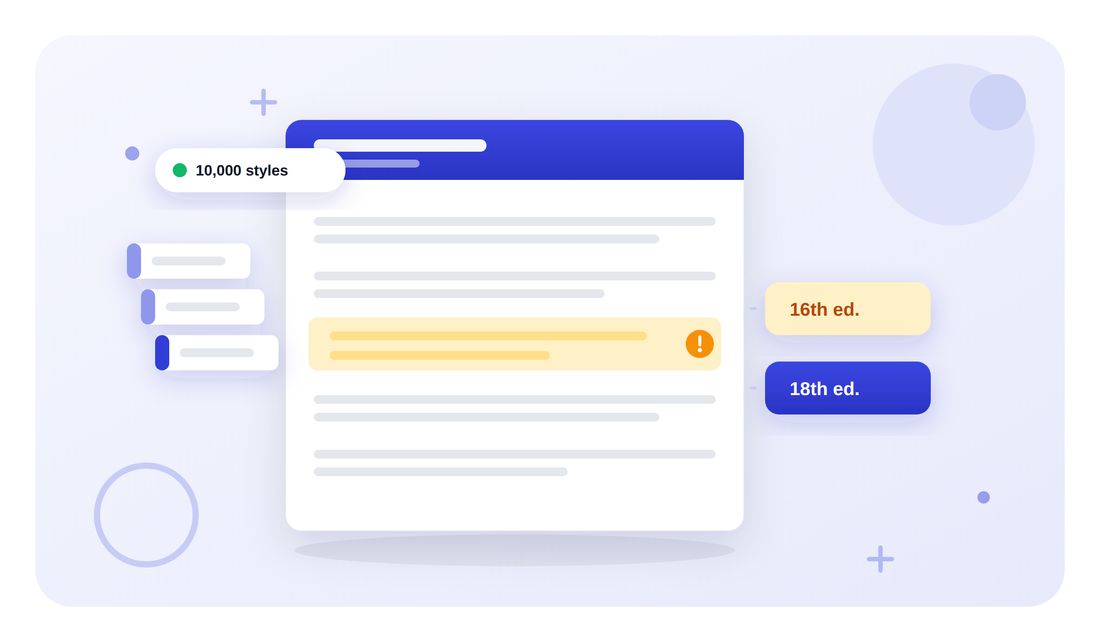
The Chicago Manual of Style reached its 18th edition in September 2024. As of August 2026, EasyBib and Cite This For Me both still tell you on their own pages that they cite Chicago 16th. That is two editions behind, and it is not mentioned in any roundup currently ranking for this search.
Below are five generators worth using, the ownership map nobody publishes, and the thirty second check that catches what all of them get wrong.
<CTA title="Cite While You Write, Not Afterwards" description="Jenni attaches sources as you draft so the reference list builds itself" buttonLabel="Try Jenni Free" link="https://app.jenni.ai/register" />
The short answer
Use ZoteroBib for a one-off bibliography: free, no account, no ads, 10,000 styles. Move to Zotero the moment you have a project rather than an assignment. Use MyBib if you want a generator with no ads and no account either. BibGuru if you capture sources from the browser. Scribbr only if the big four styles are all you need.
Then check the output, because the evidence on that is worse than the category admits.
Which edition is your generator actually on?
This is the check almost nobody runs, and it is the one that decides whether the output is correct at all. A tool can be flawless at APA and still hand you a Chicago citation formatted to a manual that was superseded two years ago.
The Chicago Manual of Style is in its 18th edition, published September 2024 and described by the publisher as the most extensive revision in two decades. The open style repository that most of these tools draw from updated its Chicago styles to the 18th edition in February 2025. The consumer generators mostly have not.
Tool | Chicago edition, per its own page | Editions behind |
CSL style repository | 18th | Current |
Citation Machine | 17th | One |
BibMe | 17th | One |
Scribbr | 17th | One |
EasyBib | 16th | Two |
Cite This For Me | 16th | Two |
EasyBib and Cite This For Me carry a character-identical sentence: "We cite according to the 9th edition of MLA, 7th edition of APA, and 16th edition of Chicago." Citation Machine and BibMe both state 17th.
<ProTip title="📖 Edition check:" description="Before you trust any generator with Chicago, search its site for the words Chicago edition. If the number is not 18, every Chicago citation it produces needs manual review against the current manual." />
Why they nearly all format APA identically

Because they are reading the same style files. Citation Style Language, or CSL, is an open XML-based language describing how citations and bibliographies should be formatted, maintained by an independent project that runs "a crowdsourced repository with over 10,000 free CSL citation styles." The repository is on GitHub under a Creative Commons license.
CSL publishes a list of the applications built on it. Of the tools in this post, that list names BibGuru, Cite This For Me, EasyBib, Mendeley, MyBib, Paperpile, Scribbr, Zotero and ZoteroBib. It does not name Citation Machine, BibMe or EndNote, so do not assume those three behave the same way.
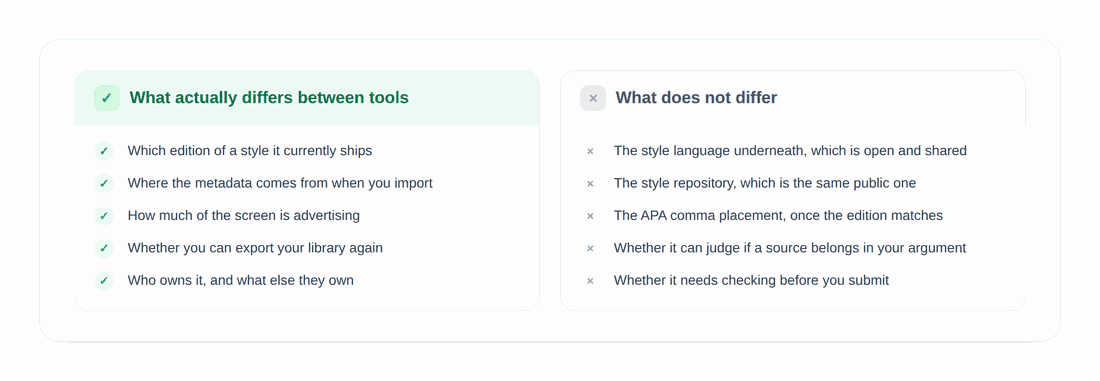
What this means practically: a tool is rarely better at formatting APA than another tool, because they are reading the same style file. The differences live somewhere else.
Who actually owns these tools

Not one company. Three clusters, and most roundups mention none of them.
Chegg owns four of the names you know
In May 2016 Chegg acquired Imagine Easy Solutions for approximately $42 million, bringing EasyBib, Citation Machine, BibMe and Cite This For Me under one roof. All four still carry a 2026 Chegg copyright line in their footers.
If a roundup recommends four of them as independent options, it has recommended one company four times.
Worth watching
Chegg announced a strategic alternatives process in its Q1 2025 earnings, alongside a 22% workforce reduction. This ownership map is accurate as of August 2026 and may not stay that way.
Scribbr belongs to QuillBot
Scribbr states it plainly: "Scribbr is proud to be a part of QuillBot, within the broader Learneo family of businesses." Learneo, formerly Course Hero, also owns Bartleby, CliffsNotes, LanguageTool, LitCharts and Symbolab.
BibGuru belongs to Paperpile
The BibGuru footer reads "© 2025 Paperpile LLC". So the free generator and the $2.99 a month reference manager (billed annually) are the same company, which is worth knowing before you treat them as independent recommendations.
<ProTip title="🏷️ Read the footer:" description="Scroll to the bottom of any citation tool and read the copyright line. It is the fastest way to find out whether the three tools a roundup recommended are actually one company." />
How accurate are automatic citations?
Less accurate than the category implies, and this is the part no listicle covers.
The study people misquote
A 2024 study in the Journal of the Medical Library Association assessed 60 citations, 30 each from the built-in citation tools of two MEDLINE platforms. The finding: zero of the sixty citations examined were 100% correct, and the authors concluded librarians should continue advising students not to rely solely on citation generators in these databases.
Two things to keep straight. It tested database auto-cite buttons in PubMed and Ovid MEDLINE, not EasyBib or Zotero. And it is a small sample in one domain. It is still the sharpest single data point available, and it is routinely misattributed to consumer generators.
The head-to-head comparison
A 2017 study in the Journal of Academic Librarianship tested reference managers across 15 biomedical journals and the NLM style. The fewest mistakes were in references generated by Zotero, the second fewest in Mendeley, with EndNote and RefWorks producing the most. All of them struggled with URLs and access dates.
The review that covers the field
A 2025 scoping review in Evidence Based Library and Information Practice synthesized 32 studies on APA reference accuracy, 14 of which evaluated automated tools. It cataloged 17 pre-identified error types plus 9 more that emerged, measured across 64 different metrics. The short version: everyone measures this differently, and everyone finds errors.
Purdue OWL gives the reason: "Citation generators cannot exercise any judgment of their own. They do not 'understand' the task of citation in the way that humans do." And: "If you give a citation generator incorrect information, it will probably give you an inaccurate citation."
<ProTip title="🧯 Failure mode:" description="The dangerous errors are not the ugly ones. A citation that looks perfectly formatted but carries the wrong year or a dropped page range passes every visual check and fails the one an examiner runs" />
The five worth using
Prices and features below are as stated by each tool on its own site, checked August 2026.
Tool | Cost | Styles | Account | Ads |
ZoteroBib | Free | Over 10,000 | Not required | States it is ad-free |
Zotero | Free, storage from $20/yr | Over 9,000 | Needed to sync | None, nonprofit |
MyBib | Free | Over 9,000 | Optional | States no ads or trackers |
BibGuru | Free, Plus $4.99/mo | Over 8,000 | Not needed to start | Ad-free is a paid feature |
Scribbr | Free generator | 4 styles | Not stated | Not stated |
ZoteroBib, for a bibliography you need once
The right default for most people. ZoteroBib describes itself as "a free service that helps you build a bibliography instantly from any computer or device, without creating an account or installing any software", says it is "completely free and ad-free", and supports over 10,000 CSL styles.
Do not confuse it with Zotero. Same nonprofit, different products.
Zotero, once you have a project
The moment you are managing a thesis rather than an essay, a generator stops being the right tool. Zotero stores your library, syncs it, holds PDFs, and inserts citations "directly inside Word, LibreOffice, and Google Docs." Over 9,000 styles by its own count.
Storage is where it costs money: 300 MB free, then $20 a year for 2 GB, $60 for 6 GB, $120 for unlimited.
Librarians tend to agree. Illinois puts Zotero at about 30 minutes to learn against 1 to 2 hours for EndNote, and UNC notes Zotero is free while EndNote runs $108 for its students.
MyBib, the cleanest free generator
Why it is on the list
MyBib states it is "100% free. No ads, privacy trackers, time limits, or restrictions", which is a stronger claim than most of the category makes, and it is the main reason it is here. Over 9,000 styles, and it appears on the CSL application list.
BibGuru, for capturing as you browse
Over 8,000 styles and browser extensions for Chrome and Edge, so sources go in as you find them. Free to start with no sign-in.
One caveat: an ad-free experience is listed among the paid BibGuru Plus features at $4.99 a month, which tells you something about what the free tier is.
Scribbr, if the big four are enough
Four styles: APA, MLA, Chicago and Harvard. That is a real limitation if your department uses anything unusual, and its Chicago is still 17th edition. Free, and it exports BibTeX.
The ones people expect to see here
EasyBib, Citation Machine, BibMe and Cite This For Me all work, and all four are Chegg products. Two things are worth knowing before you use them.
First, the paywall. Cite This For Me states that its free tier covers Harvard only, saves citations for seven days, and puts "MLA, APA, Chicago, Harvard & 7,000 more" behind a £6.99 a month subscription.
Second, the ads. EasyBib's ad-free mode is time-gated: its own gateway page reads "ad-free experience can only be activated during school hours. Try again from 8am - 3pm."
Where the errors actually come from

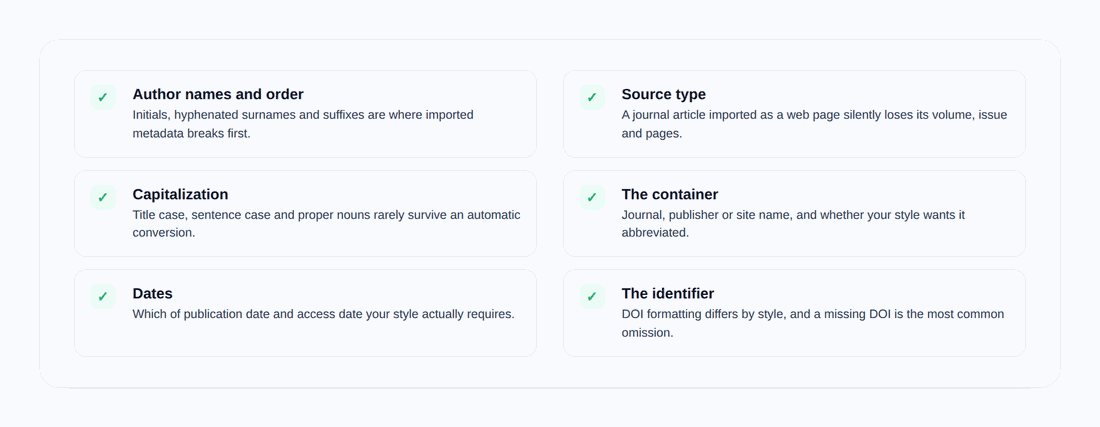
Almost never from the style engine. They enter at the metadata layer, and knowing that explains the pattern.
Generators pull bibliographic data from open databases. Crossref covers most journal articles with DOIs, PubMed covers biomedical literature, OpenAlex holds an open catalog of scholarly works. Books and web pages are messier, which is exactly why book chapters and websites are where generated citations go wrong most often.
The practical consequence: look a source up by its identifier rather than pasting a URL. A DOI, PMID or ISBN retrieves structured metadata from a maintained database. A URL forces the tool to guess from whatever the page exposed, which is how a journal article becomes a web page and loses half its fields.
<ProTip title="🗄️ Metadata:" description="If a citation comes out wrong, do not fix the output. Fix the input by re-importing the source with its DOI, because a hand-corrected citation will break again the next time you switch styles" />
The thirty second check
Whichever tool you use, this pass catches nearly everything.
<ProTip title="🧷 Spot check:" description="Check three references at random before you submit, chosen from different source types. If all three are clean, the rest probably are. If one is wrong, check every citation of that source type" />
Where Jenni fits, and where it does not
Disclosure: this post is published by Jenni, which has citation features of its own. Jenni is listed here at the end rather than in the ranking above, because it is a different kind of tool and putting it at number one would make the rest of this page worth less.
Jenni is not a standalone citation generator. If you need one bibliography for one assignment, ZoteroBib will do it faster and you should use that.
What Jenni does is keep the citation attached to the claim while you write. You import sources by DOI, PMID or ISBN, or bring a library across from Zotero or Mendeley, and citations go in as you draft rather than being reconstructed afterwards. The style picker searches the same Zotero CSL repository the rest of this post has been describing, so the same 10,000 styles are available. Exports go to Word and LaTeX.
The honest comparison: a generator solves formatting. A reference manager solves organization. Jenni is aimed at the gap between them, which is the drafting itself, and it is only the right answer if that is the part you are struggling with.
Pick One, Then Check Its Work
The honest summary of a decade of research on this category is that automated citations are a substantial time saver and an unreliable final product. Use ZoteroBib for one-off bibliographies, move to a reference manager when you have a project rather than an assignment, import by identifier rather than by URL, check the Chicago edition before you trust it, and spot check three citations before you submit.
<CTA title="Keep Your Sources Attached From the First Draft" description="Import by DOI or PMID, draft with citations in place, and check what each source actually supports" buttonLabel="Try Jenni Free" link="https://app.jenni.ai/register" />
None of these tools will tell you whether a source belongs in your argument in the first place, which remains the harder problem. Our guides on what a citation manager does, citations versus references and the most common citation mistake cover the part no engine does for you.