By
Justin Wong
—
Citations vs References: Key Differences, Examples, and Rules

Justin Wong
Head of Growth
Graduated with a Bachelor's in Global Business & Digital Arts, Minor in Entrepreneurship
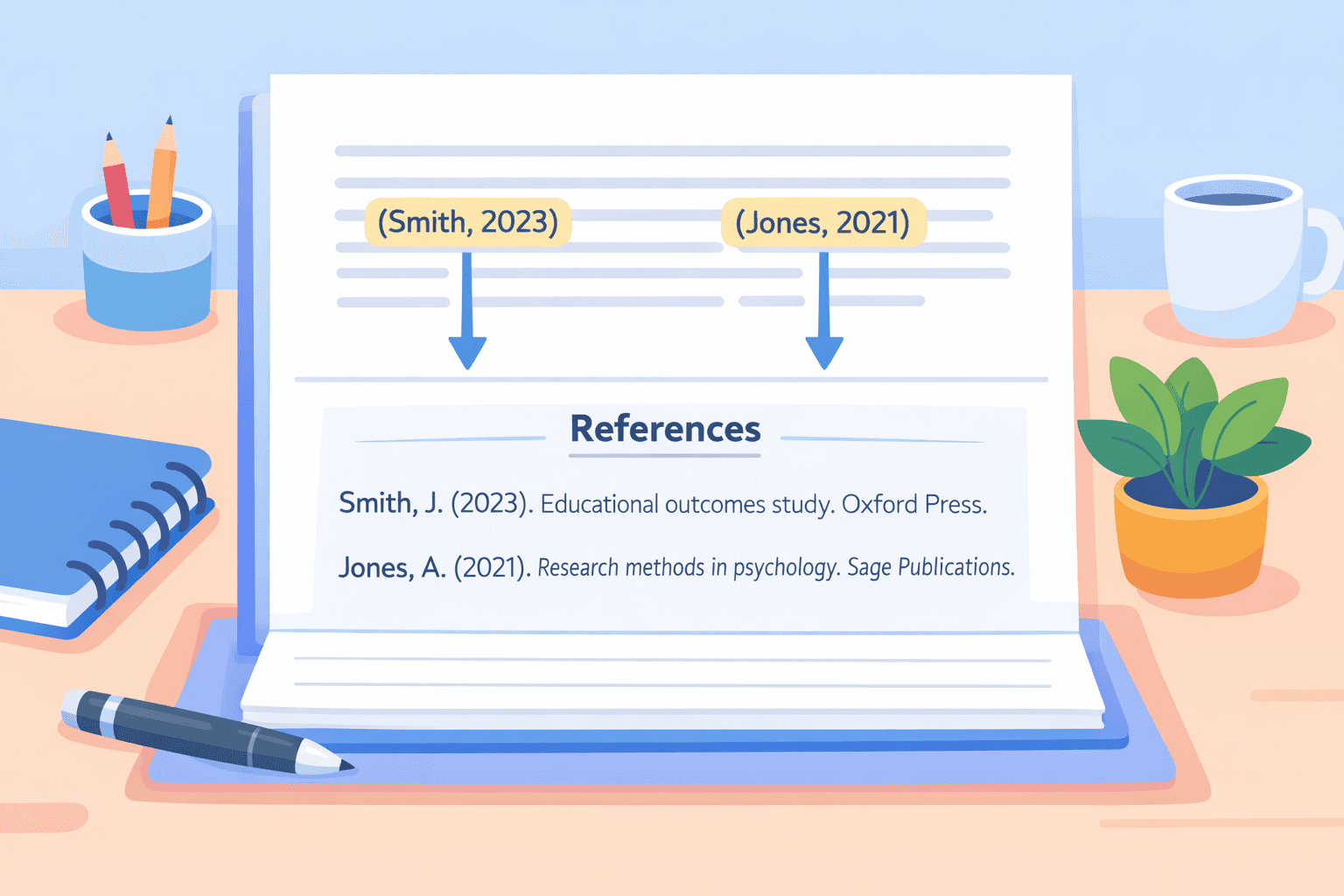
The difference between citations and references is straightforward. Citations are the brief markers within your sentences, pointing to a source.
References are the complete list of those sources at the end of your document. This basic structure underpins academic writing.
Students often blur the two, and that confusion has real consequences. Getting them wrong can damage your argument's credibility, cost you points, and, in serious cases, raise questions about plagiarism.
Here, you'll get a clear breakdown of each, see practical examples, and learn how to use both correctly in your own work.
<CTA title="Write With Proper Citations Every Time" description="Structure citations and references correctly without confusion or formatting stress." buttonLabel="Try Jenni Free" link="https://app.jenni.ai/register" />
What Is a Citation vs Reference?
Let’s start with the definitions.
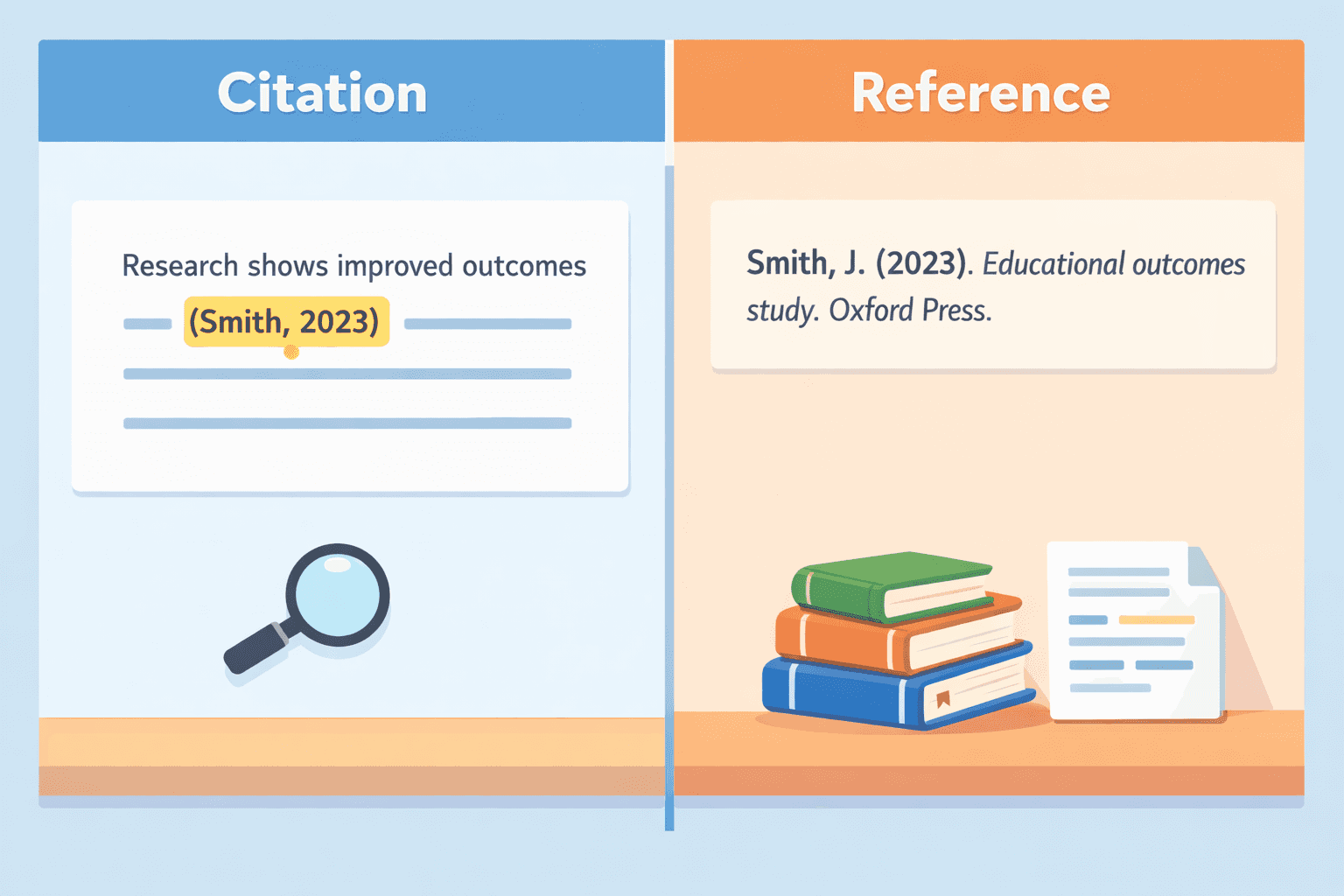
A citation is a brief note, placed directly in your text, that points to a source. It typically includes just the author's name and the publication year, enough to signal where an idea, quote, or piece of data originated.
If you're unsure how to cite online materials, this guide on how to cite a website properly can help clarify the structure.
A reference is the complete, detailed listing of that source. You find it at the end of your paper, providing all the information needed to locate the original work: author, title, publisher, date, and so on.
If you're also creating an annotated bibliography, our guide to annotated sources vs. references explains how those entries differ from a standard reference list.
As outlined in these official APA citation style guidelines, the system works like this: citations act as signposts within your writing, while the reference list serves as the master directory. Think of it as a simple map.
Citation = the in-text marker. Reference = the full source description.
<ProTip title="💡 Pro Tip:" description="Think citation equals pointer and reference equals full address of the source." />
In-Text Citation vs Reference List
Let’s look at them side-by-side.
Feature | Citation | Reference |
Location | Inside your text, in the body of your writing. | At the end of your paper, in a dedicated list. |
Purpose | To show the immediate source of a specific idea or quote. | To provide the complete details needed to find that source. |
Length | Short, often just a name and a year in parentheses. | Long, a full entry with author, title, publisher, and more. |
Example | (Smith, 2023) | Smith, J. (2023). Educational outcomes study. Oxford Press. |
They are two parts of a single system. A citation without its corresponding reference is useless; a reference without a citation is just a list of books you didn’t actually use.
A Simple Example
Here’s how they link up in practice:
In-text citation: "Research shows improved outcomes (Smith, 2023)."
Reference list entry: Smith, J. (2023). Educational outcomes study. Oxford Press.
The citation is the brief pointer. The reference is the full explanation.
Why Getting It Right Matters
Mixing up citations and references isn't just a technical error. It causes practical issues:
If you omit citations, you risk plagiarism.
If you omit references, your reader cannot check your sources.
If entries are mismatched, your work loses credibility.
<ProTip title="📌 Reminder:" description="Every citation must match one reference entry exactly." />
How Citations and References Work Together
Citations and references are not separate chores; they are a linked system that works together. Think of them as a call-and-response.
A single source can be cited many times throughout your paper. But in your reference list, that same source appears only once.
To better understand the broader context of academic frameworks behind sourcing, you can explore different research paradigms in academic writing.
For instance, if you reference a particular study five times in your writing, you still create just one entry for it at the end. This is a fundamental rule in academic writing.
The Core Rule
The relationship is strict, but not perfectly symmetrical:
Every citation must point to a corresponding reference.
Every reference must be cited somewhere in your text, at least once.
However, one reference can, and often does, support multiple citations. That's why your reference list is usually shorter than the total number of citations in your paper.
Where to Put Citations
You place citations directly where you use someone else's idea. They should appear:
After a sentence you've paraphrased from a source.
After a direct quote.
After you present specific data or statistics.
Putting them in the right spot makes your research more accurate and your argument's logic clearer.
How to Build Your Reference Page
All your references are collected in a single list at the end of your document. This list follows precise formatting rules, which include:
Arranging entries in alphabetical order.
Applying a consistent style (like APA, MLA, or Chicago) throughout.
Providing the full publication details for each source.
If you need broader formatting help, these comprehensive research and citation resources cover multiple styles and examples in detail.
These rules apply to all types of sources. For example, the APA style guide provides specific formats for YouTube videos, requiring details like the channel name, upload date, and URL.
<ProTip title="🧠 Pro Tip:" description="Always format references in alphabetical order to meet academic standards." />
Citation Styles Comparison (APA, MLA, Chicago)
The basic job of citations and references is the same across all styles, to point to your sources. But each style has its own way of dressing them up. For a broader overview of how these formats differ in practice, see our citation styles guide for students.
APA Style (Social Sciences, Psychology)
APA is common in fields where the date of research is crucial.
In-text citation: Looks like (Smith, 2023). The author and year are the key identifiers.
Reference: Lists the author, publication year, title, and the source (like a journal name or publisher).
MLA Style (Literature, Humanities)
MLA is often used for analyzing texts, so page numbers are important.
In-text citation: Looks like (Smith 45). It typically uses the author's last name and the specific page number.
Reference: Focuses on the author, the full title of the work, and the publisher.
Chicago Style (History, Various Disciplines)
Chicago is more flexible and offers two main paths:
The Author-Date system, which works much like APA.
The Notes and Bibliography system, which uses footnotes or endnotes for citations. This introduces another layer: a footnote is a citation placed at the bottom of the page, while an endnote is collected at the end of a chapter or the entire document.
Which One Should You Use?
Your choice usually depends on your subject:
APA: Psychology, education, nursing, and other social sciences.
MLA: English, literature, philosophy, and the arts.
Chicago: History, theology, and some publishing.
For example, understanding qualitative vs quantitative research methods in practice can help you choose the appropriate citation style for your discipline.
Where Students Actually Get Confused
Knowing the rules is one thing. Using them correctly is another. Online forums show where students consistently trip up.
Reddit: The Anxiety Zone
On Reddit, the worry is palpable. In one thread, a student asks a fundamental question: "Is this a citation, a reference, or neither?" The discussion reveals a deep fear of making a mistake.
Another post debates whether to add citations even when an assignment doesn't explicitly require them. The common concerns here are:
A pervasive fear of doing it wrong.
Confusion over when paraphrasing needs a citation.
Overthinking the rules for informal writing.
Some users phrase their uncertainty bluntly, asking things like, "Is this a citation, or is it just a 'trust me bro'?" This highlights the real anxiety students feel about proper citation practice.
Quora: The Step-by-Step Fix
Quora users often seek structured, definition-driven answers. A typical guide there lays out a clear comparison, breaking down the purpose, location, and format of each term. The advice tends to be checklist-style:
Define both terms clearly first.
Ensure every citation has a matching reference.
Follow the style rules (APA, MLA, etc.) strictly.
Students treat these explanations like a study guide for an exam.
X (Twitter): Frustration and New Worries
The conversation on X is more direct and often skeptical. Many users express frustration with the meticulous formatting rules.
There's also a growing discussion about whether citations matter as much when AI tools can generate text. Common reactions include:
Annoyance with "nitpicky" academic standards.
Doubts about the system's real value.
Concern about AI-generated papers lacking proper or accurate references.
This points to an increasing interest in tools that can manage citations automatically.
YouTube: The Gap Between Explanation and Execution
YouTube tutorials aim for clarity. A typical beginner guide will explain the core idea simply: citations go in the text, references go at the end.
But the comments under these videos tell a different story. Viewers share their real struggles:
Forgetting to include the year in an APA citation.
Accidentally mixing MLA and APA formats in the same paper.
Still confusing what information belongs in a citation versus a reference entry.
This gap between the simple explanation and the messy reality shows why formatting errors remain so common.
<ProTip title="🎯 Pro Tip:" description="Always double check citation format before submitting assignments." />
Common Mistakes and How to Avoid Them
Even people who've been writing for years can slip up with citations. The mistakes are usually simple, but they have big consequences.
The Most Frequent Errors
These are the problems that trip up almost everyone:
Listing sources you didn't cite. Your reference list should only include works you actually mentioned in your text. Adding extra sources just to look thorough is a red flag.
Citing a source without listing it. If you mention an author's idea in your paper, that author's work must appear in your references. A citation without a reference is a dead end.
Mixing formatting styles. Using APA-style citations in the text but MLA-style references at the end creates confusion. Pick one system and stick with it for everything.
Missing key details. Forgetting the publication year in an APA citation, or the page number in an MLA citation, makes your source hard to verify.
A Quick Pre-Submission Checklist
Before you turn in any paper, run through this list:
Does every in-text citation point to a full reference?
Does every reference in the list correspond to at least one citation?
Is the formatting (punctuation, order, italics) consistent from the first citation to the last reference?
Is your reference list alphabetized correctly?
Why This Precision Matters
Getting this right isn't just about following rules. It's about building a trustworthy argument. Accurate citations and references:
Show your academic integrity.
Build trust with your reader, who can easily check your sources.
Strengthen the credibility of your own research.
Many citation mistakes also affect the reliability of your research. Ensuring accuracy is closely tied to concepts like different types of validity in research studies , which help determine whether your sources and conclusions are trustworthy.
Most practically, it protects you. A sloppy system can lead to accusations of plagiarism, even if it was just an honest mistake.
Citations vs References Made Simple
You’ve probably struggled to keep track of sources while writing, unsure if you’re citing things the right way or missing key details. It gets confusing fast. Mixing up citations and references can make your work look messy, even when your ideas are solid.
<CTA title="Organize Your Citations Without Stress" description="Keep citations and references consistent and accurate using structured writing support." buttonLabel="Try Jenni Free" link="https://app.jenni.ai/register" />
The fix is to treat citations as quick in-text notes and references as the full record at the end. Tools like Jenni can help you keep everything consistent and organized, so you’re not second-guessing formats and can focus more on your actual writing.