By
Nathan Auyeung
—
Types of Validity in Research Explained Clearly

Nathan Auyeung
Senior Accountant at EY
Graduated with a Bachelor's in Accounting, completed a Postgraduate Diploma of Accounting

Research findings are only useful if they actually measure what the researchers say they do. Without this validity, a study's conclusions can be misleading or just plain wrong.
This guide explains the core types of validity you'll encounter, like internal, external, and construct validity, using clear examples from psychology and clinical trials.
We'll show you how to spot them and why they matter for your own work. Ready to make your research more robust? Let's get into it.
<CTA title="Build Stronger Research Foundations" description="Use Jenni to organize your research focus, refine your study direction, and write with more clarity." buttonLabel="Try Jenni Free" link="https://app.jenni.ai/register" />
Understanding Types of Validity in Research
Research validity isn't a single score. It's the entire foundation of a study. If your method doesn't measure the concept you're targeting, your findings are built on sand.
The American Psychological Association treats it as a mandatory standard for credible work in psychology and related fields. Without this foundation, even sophisticated statistics become meaningless.
Researchers categorize validity to examine different parts of a study's accuracy. Each type has its own job, it helps check things like whether your tools are good and whether your results would still work in real-life situations.
The key is to see them as a connected system, not a checklist.
If you want to better understand how research approaches shape validity decisions, you can explore research paradigms, which explains the philosophical foundations behind different study designs.
Why does this matter so much? Validity influences every single choice you make, from how you write a survey question to how you interpret the final data.
It determines if your conclusions are trustworthy and if they can be applied beyond your specific sample.
In practice, strong validity minimizes bias, leads to more robust scientific claims, and is absolutely critical for getting your work through peer review. It’s the difference between a finding and a fact.
<ProTip title="💡 Pro Tip:" description="Before analyzing data, map out which validity types your study needs to satisfy." />
Measurement Validity Types
Measurement validity is about your tools. It asks: does your survey, test, or instrument actually capture the concept you're studying? If your thermometer measured optimism instead of temperature, your data would be useless.
When designing your study, especially when comparing methods like those discussed in qualitative vs quantitative-research, your measurement choices directly impact validity outcomes.
Researchers typically assess this through three core types: construct, content, and face validity. For a complementary look at consistency (and how it differs from validity), see our types of reliability in research guide.
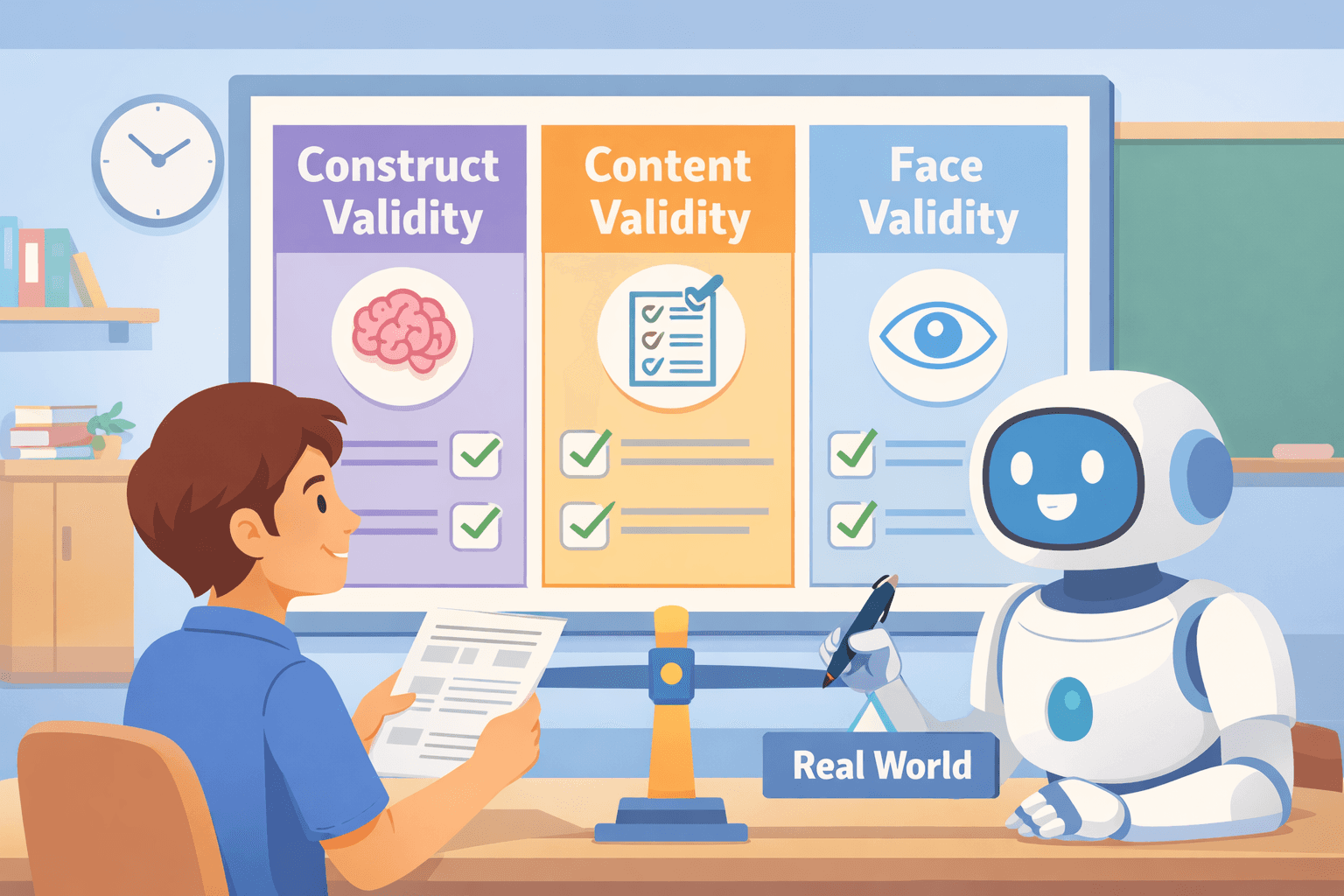
Construct validity is the deepest check. It checks if your tool really measures what you want, like “resilience” or “customer loyalty”, and not something different.
Content validity is about coverage. It ensures your measurement touches on all the important aspects of the concept. A good job satisfaction survey should address pay, work environment, and career growth, not just one of those.
Face validity is the simplest. It's a surface-level review: does the tool look like it measures what it's supposed to? While subjective, poor face validity can undermine participant trust.
For example, a good depression test should look at many symptoms, both emotional and physical, not just sadness alone.
Criterion Validity: The Real-World Test
This type moves from theory to practice. Criterion validity checks your measurement against an external, real-world benchmark. It has two main forms:
Predictive validity asks if your tool can forecast a future outcome. A strong college entrance exam should predict first-year GPA.
Concurrent validity checks if your tool agrees with a known measurement taken at the same time. A new, quick anxiety screen should correlate with scores from an established, longer clinical interview.
Type of Validity | What It Checks | Example | Strength |
Construct Validity | Theoretical accuracy | Does this test really measure intelligence? | High |
Content Validity | Coverage completeness | Does our survey include all key aspects of job satisfaction? | Medium |
Face Validity | Surface appearance | Does this questionnaire seem relevant to the topic? | Low |
Criterion Validity | External comparison | Does our new risk score match known patient outcomes? | High |
The table shows how validity starts from a simple, face validity, and moves toward stronger, evidence-based checks.
<ProTip title="💡 Pro Tip:" description="Use expert panels when reviewing survey questions. They can help confirm whether your measurement covers the full concept." />
Experimental and Design Validity
When a study aims to prove that A causes B, its experimental validity is on the line. If you're analyzing relationships without manipulating variables, our correlational research overview explains what conclusions you can and can't draw. This is the basic way to show cause and effect, and it’s very important in areas like clinical trials and education research.
According to the Centers for Disease Control and Prevention (CDC), if your study is poorly planned, you can’t tell if your results came from your hard work or were just a fluke. Essentially, a weak study makes it impossible to prove that your work truly made the difference.
Internal Validity: Isolating the Cause
This is the core of experimental logic. Internal validity asks: did the change you made actually produce the result you saw, or could something else explain it? Researchers work to control "threats" that muddy this connection.
Before even testing these, it’s essential to define a clear research focus. If you're unsure how to frame your study properly, this guide on how to write research question can help ensure your validity efforts start on solid ground.
Common threats include:
Selection bias, where groups aren't equivalent at the start.
History effects, where an outside event influences results.
Instrumentation changes, like using different measurement tools mid-study.
Participant attrition, where dropout rates skew the final sample.
In a drug trial, researchers have to make sure the medicine is actually what helped the patients. If the patients also started eating better at the same time, it’s hard to tell if they got healthy because of the pill or because of their new diet.
You can explore a deeper explanation of validity in research and its different types to better understand how these threats impact study accuracy.
<ProTip title="💡 Pro Tip:" description="Randomization is one of the strongest ways to protect internal validity in experimental research." />
External Validity: Beyond the Lab
If internal validity asks "did it work here?", external validity asks "will it work out there?" It assesses how broadly you can apply your findings, to other people, in other places, or at other times.
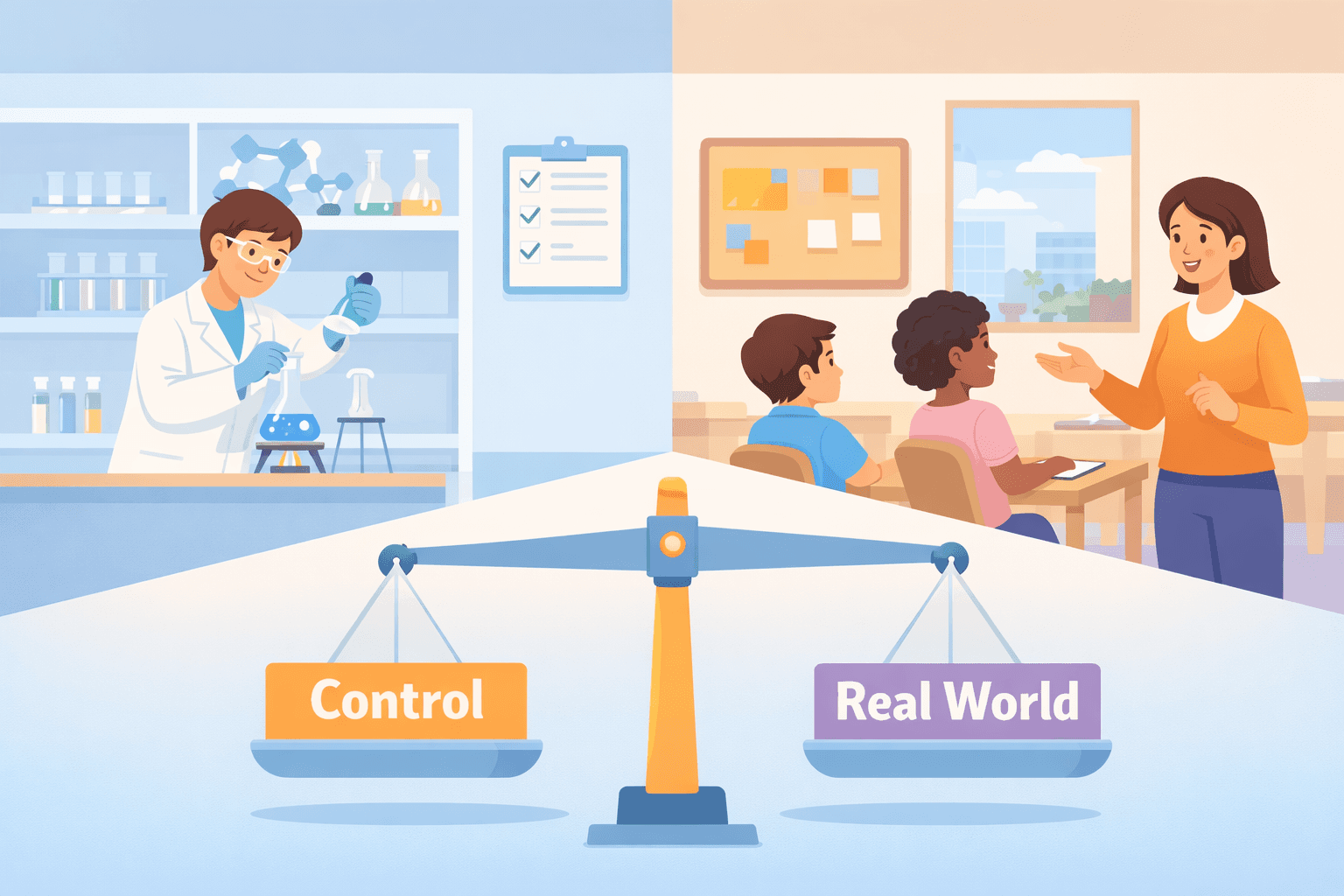
There's often a tension here. An experiment might work perfectly in a lab, but if the setting is too "fake," the results might not work the same way in the real world.
A large-scale national survey, by contrast, typically has stronger external validity but faces more challenges in controlling for every variable.
Ecological Validity: The Real-Life Test
This is a specific aspect of external validity. Ecological validity focuses on how naturally the study setting and tasks mirror the real-world context you're trying to understand. It's crucial in psychology, education, and user experience research.
Studying how children solve problems in their actual classroom has higher ecological validity than bringing them into a sterile, quiet lab to do the same task. The former captures the noise, distractions, and social dynamics that are part of the real phenomenon.
<ProTip title="💡 Pro Tip:" description="Field studies can improve ecological validity because they test behavior in more natural settings." />
Advanced Validity Evidence
Once you've established the basic types, you can build a stronger case for your measurement with advanced validity evidence. These methods reinforce construct validity by providing converging proof from different directions.
Convergent and Discriminant Validity
Think of this as a double-check for your theoretical concepts.
Convergent validity provides evidence that your measurement correlates strongly with other tools designed to assess the same or a very similar construct. If your new "Resilience Scale" doesn't correlate with existing, trusted resilience questionnaires, that's a problem.
Discriminant validity provides evidence that your measurement does not strongly correlate with tools designed to measure theoretically different concepts. Your resilience scale shouldn't produce scores that look identical to a general happiness survey.
For instance, scores from a well-designed anxiety scale should show a meaningful relationship with a stress inventory (convergent validity).
However, those same anxiety scores shouldn't be strongly linked to scores on a calculus test (discriminant validity). This pattern confirms that "anxiety" is a distinct and meaningful concept in your study.
Statistical Conclusion Validity
This type is less about what you're measuring and more about how you analyze the data. Statistical conclusion validity asks whether your statistical tests are properly set up to detect a real relationship or effect if one exists.
It focuses on avoiding two key errors: falsely finding an effect that isn't there (Type I error) and missing an effect that is there (Type II error).
For a more applied breakdown, see this guide on validity types and examples, which connects statistical reasoning with real study design.
Researchers in quantitative fields like epidemiology or economics pay close attention to this. It involves checking assumptions for tests like regression or correlation, ensuring adequate sample size (power), and correctly interpreting p-values and confidence intervals.
Weak statistical conclusion validity means you can't trust the basic numerical findings of your analysis, regardless of how good your measurement tools are.
<ProTip title="💡 Pro Tip:" description="Poor sample size can weaken statistical conclusion validity, even when the study design looks solid." />
Internal vs External Validity in Research
When doing a study, researchers try to do two things at once: show what causes what, and make sure the results still make sense in real life. This is the core tension between internal and external validity.
Internal validity is about control and precision. It asks, "Can I be confident that my intervention caused the change I observed in this specific experiment?" It requires tightly managed conditions to rule out alternative explanations.
External validity is about breadth and application. It asks, "Would this finding hold true for other people, in other places, or at other times?" It seeks real-world relevance.
There's an inherent trade-off. A perfectly controlled lab experiment, with every variable locked down, maximizes internal validity. But its artificial setting can weaken external validity, making it hard to say if the results apply outside the lab.
A study done in a real-life place, like a classroom or community, feels more natural and matches real life better. But it has less control, so it’s harder to be sure about cause and effect.
The right balance depends entirely on your research question. A pharmacologist testing a new drug's mechanism prioritizes internal validity. A public health official designing a community wellness program needs stronger external validity.
Factor | Internal Validity | External Validity |
Primary Focus | Establishing cause and effect | Generalizing findings |
Typical Setting | Controlled laboratory | Real-world environment |
Key Strength | High precision and control | High real-world applicability |
A well-designed study doesn't achieve maximum scores in both columns. Instead, the study chooses the type of validity that matters most for its goal. Then it designs the research around that choice and accepts the limits that come with it.
<ProTip title="💡 Pro Tip:" description="Decide your validity priority before building your methodology. Some studies need more control, while others need more real world relevance." />
Validity in Academic Discussions and Real World Confusion
The theory of validity is neat. Applying it is messy. Even researchers don’t always agree on the exact meanings, and the ideas often overlap. Because of that, what you learn in textbooks doesn’t always match how things are used in real research.
Students and early-career researchers often hit the same walls. On forums like Reddit's r/statistics, a common thread is mixing up construct and criterion validity.
People usually run into the same problems: they confuse different types of validity, struggle with abstract ideas, and try to fit messy. Without concrete examples, the theory feels disconnected.
Platforms like Quora see a different approach. Experts there frequently try to bridge the gap by offering structured, step-by-step frameworks.
They focus on the math tools, like factor analysis or regression, that researchers use to show their results are valid. This shift from "what it is" to "how you prove it" is crucial for moving from theory to practice.
On social media, particularly X (Twitter), the conversation flattens. Validity gets distilled into pithy, shareable advice: "measure what you intend to measure."
While not wrong, this slogan strips away all the necessary complexity. It doesn't help someone decide if their study needs better internal control or broader sampling.
YouTube tutorials present another challenge. To fit the topic into a short video, creators often make it too simple and leave out important details.
The comments on these videos are very revealing. Many people are asking for clearer, more detailed explanations. Others feel frustrated because the simple model doesn’t work well when they try to use it in their own research or assignments.
The demand isn't for more theory, but for a translation into the actual language of research design and critique.
<ProTip title="💡 Pro Tip:" description="Test validity concepts with real research examples, not definitions alone. This makes the differences easier to spot." />
Validity Checklist Framework for Researchers
Here’s a practical framework to make sure you cover all the different types of validity when designing your study.
How to run through it
Spell out exactly what you're trying to measure.
Make sure your tools actually measure that concept.
Look for anything inside your study that might mess up the results.
Figure out how far your findings can be applied elsewhere.
Run the numbers to see if your measurements are consistent.
See if your results actually line up with the theory you started with.
To align your study with formal standards, review the official APA reporting standards for research (JARS), which outline best practices for transparent and valid reporting.
What it’s for Imagine you’re building a bridge. Each check in this list is like adding another support beam. If you skip one, the whole structure gets weaker.
Using this approach helps reduce bias and makes your research more reliable. It works across different fields like psychology, economics, and more, so your results are easier to trust.
<ProTip title="💡 Pro Tip:" description="Use a pilot study before full data collection to catch validity issues early." />
Turn Validity into Clear, Reliable Research
You’ve probably tried to make sense of different validity types and still felt unsure if your study really holds up. It gets confusing fast. Doubt creeps in.
<CTA title="Turn Validity Into Clearer Research Writing" description="Use Jenni to explain your study design, refine your reasoning, and write stronger academic sections." buttonLabel="Try Jenni Free" link="https://app.jenni.ai/register" />