By
Nathan Auyeung
—
Source Synthesis Mistakes in Literature Reviews: Fix Common Errors

Nathan Auyeung
Senior Accountant at EY
Graduated with a Bachelor's in Accounting, completed a Postgraduate Diploma of Accounting
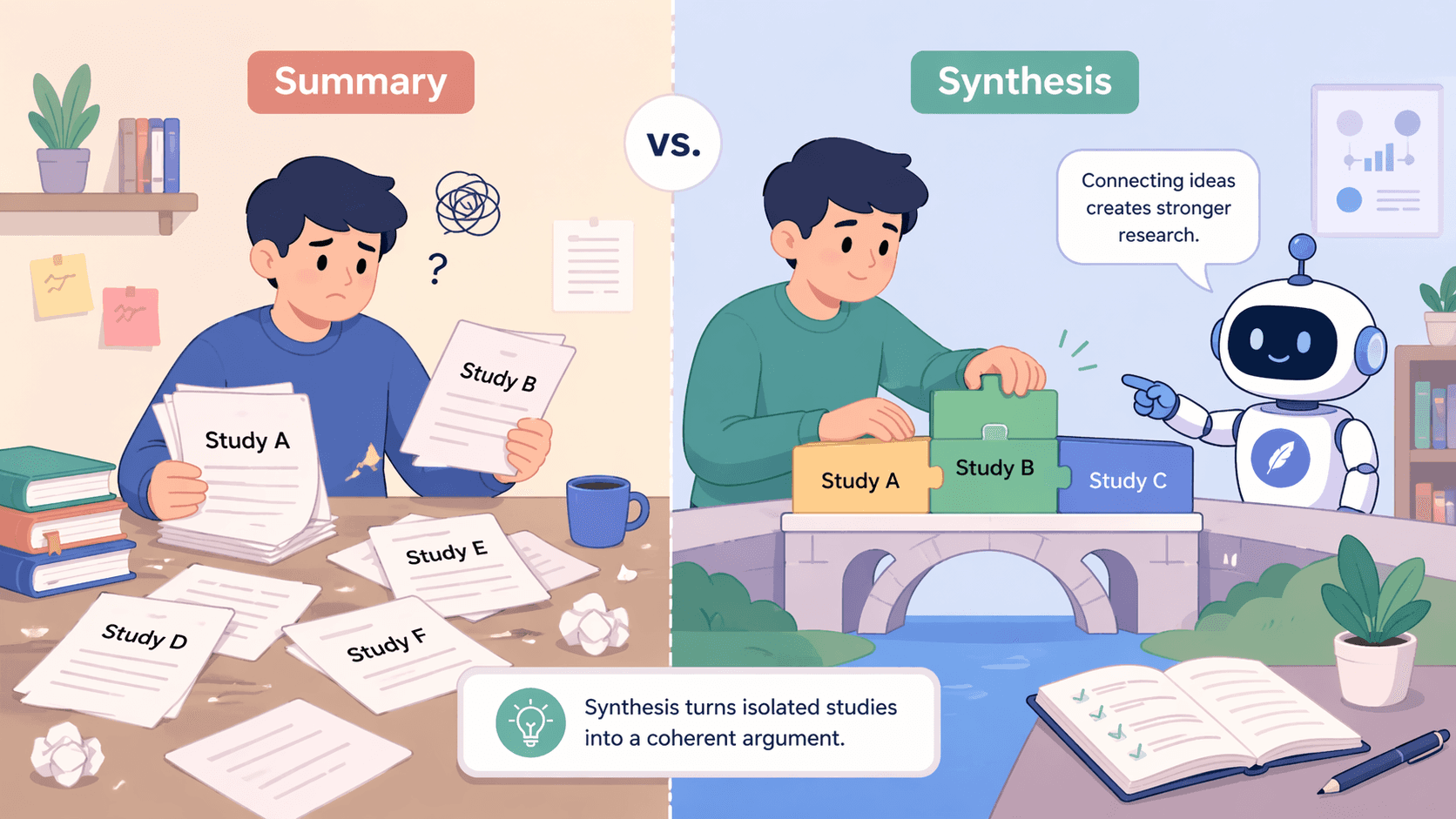
Turning a list of quotes and citations into a real argument is tough. Too often, a literature review just summarizes each source one after another, like a grocery list.
It feels disjointed. The real problem is treating each book or paper as an isolated fact, rather than seeing how they connect, or clash, to build a case.
That approach doesn’t just make the review boring to read; it undermines the whole point of your research, leaving key insights buried and your credibility shaky. This piece walks through the usual pitfalls and lays out some straightforward, step-by-step fixes.
<CTA title="Write Strong Literature Reviews Faster" description="Organize sources and build clear synthesis with structured prompts and guided writing workflows" buttonLabel="Try Jenni Free" link="https://app.jenni.ai/register" />
What Source Synthesis Really Means
It’s not about summarizing each study on its own. Synthesis is the work of weaving multiple sources into a single, coherent argument.
The Harvard Writing Center puts it clearly: the core task is to identify the relationships between your sources, how they agree, disagree, or build upon each other. That’s what separates a persuasive review from a weak one.
If you are struggling with the basic structure of this process, learning how to write literature review outline can help you visualize these connections before you begin drafting.
A good literature review should feel like a conversation. One paper responds to another. Another challenges an old assumption.
A third builds a new framework on top of previous work. If your review lacks this back-and-forth, it just reads as a series of disconnected statements.
The data backs this up. Academic assessments consistently show that the primary weakness in low-scoring literature reviews is a reliance on descriptive summary rather than critical synthesis.
The result is a lack of analytical depth, and a research direction that feels unclear.
A Quick Look: Summary vs. Synthesis
Approach | What It Does | Result |
Summary | Lists findings from each source | Fragmented, list-like writing |
Synthesis | Connects ideas across sources | A coherent, evolving argument |
A simple way to picture it: synthesis is like building a bridge. Each source is a structural beam. If you just lay the beams side-by-side without linking them, the whole structure falls apart.
The Most Common Source Synthesis Errors
A lot of literature review problems come from a few predictable habits. Spotting them early can save you from writing a weak, disconnected argument.
Listing Sources Without Connecting Them
This is the single most frequent error in academic writing. It often results in a narrative literature review that feels more like a story of who said what rather than a critical analysis. It looks like this: “Smith found X. Jones found Y. Lee found Z.”
You’ve just created a narrative summary, not a synthesis. There’s no comparison between the studies, no sense of tension, and no logical progression for your reader.
A stronger approach links the ideas together: “While Smith’s work identifies X, Jones challenges this conclusion by demonstrating Y, which suggests methodological differences might be influencing the outcomes.”
<ProTip title="💡 Pro Tip:" description="After every cited study add one sentence explaining how it connects to another source" />
That one extra sentence is a small shift, but it completely changes your writing from descriptive to analytical.
Ignoring Contradictions and Research Gaps
A strong literature review actively highlights disagreements and unanswered questions. A weak one pretends they don’t exist.
Understanding the nuances of literature reviews is essential for building a research argument. If you ignore contradictions, you create the false impression that everything in the field is already settled.
The University of North Carolina Writing Center notes that identifying contradictions is essential for building a research argument. If you ignore them, you create the false impression that everything in the field is already settled.
Example: Weak: “Smith (2020) found X, and Jones (2021) also found X.'” Strong: “Recent studies have begun to challenge the earlier findings on A, indicating there are still unresolved questions about the underlying mechanism.”
This is where failing to point out research gaps becomes a serious problem. If there are no gaps, you have no clear justification for your own new research.
Over-Reliance on Low-Quality or Secondary Sources
Using textbooks, blogs, or secondhand summaries reduces your credibility. Peer-reviewed sources from databases like PubMed or Scopus provide the primary evidence you need. Secondary citations often distort the original findings.
Elsevier highlights that excessive reliance on secondary sources significantly increases the risk of misinterpreting original data, which can compromise the integrity of your scholarly work.
To keep your synthesis trustworthy:
Prioritize primary studies.
Use secondary sources only for broad context.
Verify the original claims before you cite them.
<ProTip title="🔍 Pro Tip:" description="Always trace claims back to the original study instead of citing summaries or textbooks" />
Structural Mistakes That Break Coherence
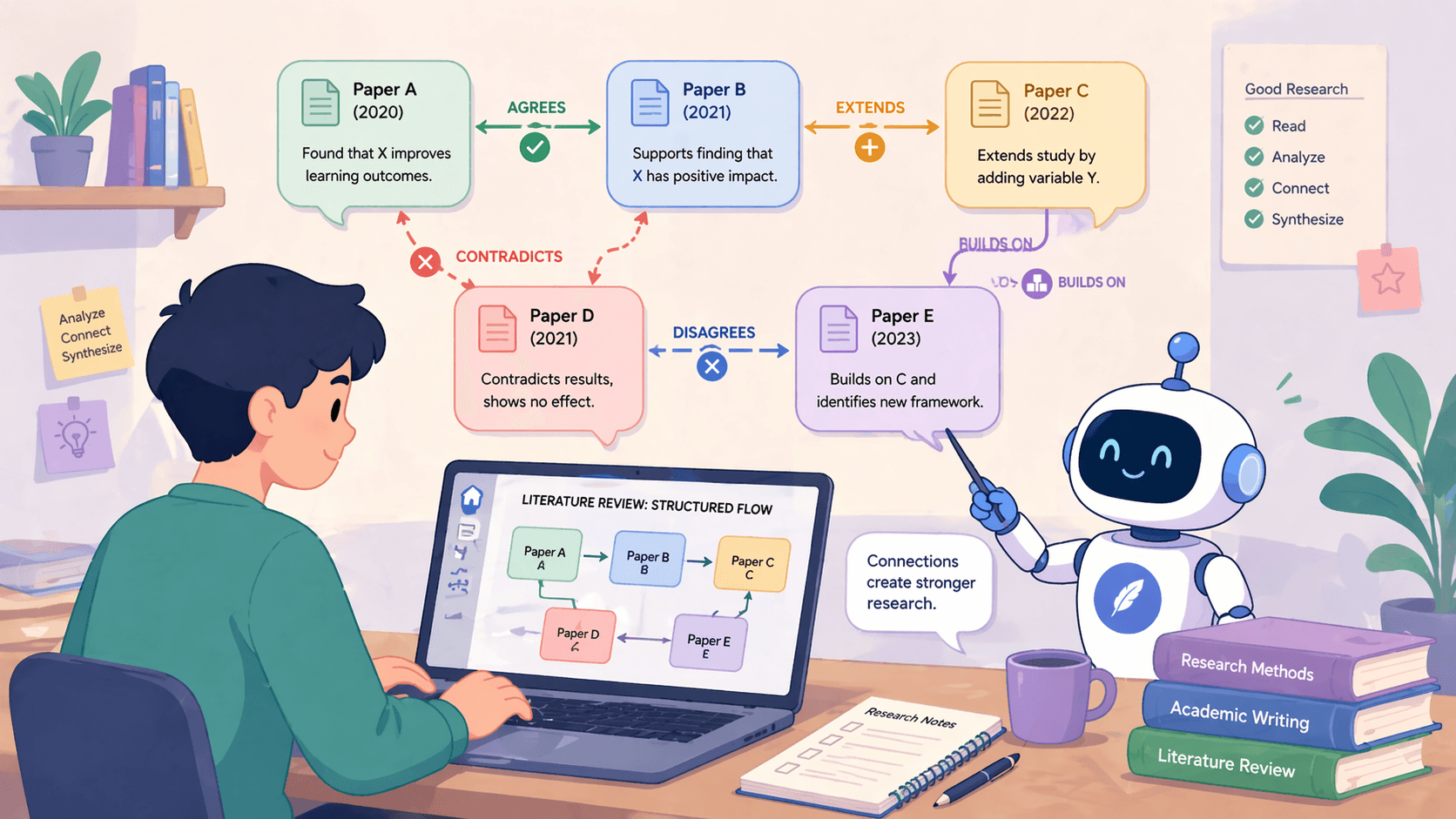
Even with good sources, poor organization can ruin your argument. How you structure your review directly impacts its quality and clarity.
Lack of Thematic Organization
Your literature review should be organized by themes, not by authors or publication dates. A simple chronological list of studies results in a jumble of ideas and weak connections between them.
Instead, you need to group studies by concepts:
Shared methodology
Converging or conflicting findings
Key debates or contradictions
This thematic grouping creates a logical flow for the reader and supports much stronger analytical connections. This is especially critical when you conduct meta-analysis, where statistical synthesis must be grounded in a logical thematic framework.
Weak Transitions Between Studies
Transitions are the signposts that guide your reader through your argument. Without them, the review feels like a series of abrupt stops and starts.
Compare these two approaches:
Weak: "Smith found X. Jones found Y."
Strong: "Building on Smith's findings about X, Jones demonstrates Y..."
Transitions act like glue. They connect ideas and maintain the coherence of your entire section.
<ProTip title="🧠 Pro Tip:" description="Use transition phrases like 'conversely,' 'similarly,' and 'building on this' to connect studies smoothly" />
No Link to the Research Question
A literature review must serve a clear purpose: it should support your research goal. When sources are presented without being tied back to your central question, the review becomes unfocused and seems pointless.
Every paragraph should implicitly answer:
How does this information help define or clarify the research problem?
If you lose this link, you end up with weak thesis statements and arguments that feel unclear and disconnected from your own work.
Content-Level Errors in Literature Reviews
Structural problems are one thing, but mistakes in the content itself can really undermine your review's credibility and depth. These errors can seem small, but their impact is serious.
Overquoting Instead of Paraphrasing
Using too many direct quotes breaks the flow of your writing and weakens your own scholarly voice.
Instead of leaning on quotes, try paraphrasing and adding your own analysis. This demonstrates a deeper understanding of evidence-based research synthesis rather than just repeating technical data you are discussing.
Instead of leaning on quotes, try paraphrasing and adding your own analysis.
Weak: “As the author states, ‘direct quote from study.’”
Strong: The study’s findings suggest X, a point that later aligns with Y in subsequent research.
This approach strengthens your voice and makes the text much easier to read.
Cherry-Picking Evidence
This is selective reporting bias. It happens when you only include studies that support your argument, ignoring those that contradict it.
A strong, honest synthesis needs to account for evidence that supports your position as well as findings that challenge it. Failing to do so can lead to a critical systematic review failure in the validity of your conclusions.
A strong, honest synthesis needs to account for:
Evidence that supports your position.
Findings that contradict or challenge it.
The limitations of the studies you're using.
Ignoring opposing evidence is a clear signal that you haven’t done a proper critical evaluation of the literature.
Misinterpreting or Overgeneralizing Findings
Misinterpretation occurs when you take a study's results out of their original context. Overgeneralization is when you apply those findings too broadly, beyond what the data actually supports.
Weak: “This method works in all cases.”
Strong: “This method has shown effectiveness under specific conditions, such as A and B.”
According to the National Institutes of Health, this kind of misinterpretation is a leading cause of flawed research conclusions later down the line. It’s a fundamental error that distorts the entire field.
<ProTip title="⚠️ Reminder:" description="Always consider study context before applying findings to broader claims" />
A Practical Framework for Strong Source Synthesis
You need a repeatable system to fix these mistakes. Here’s a straightforward workflow that works.
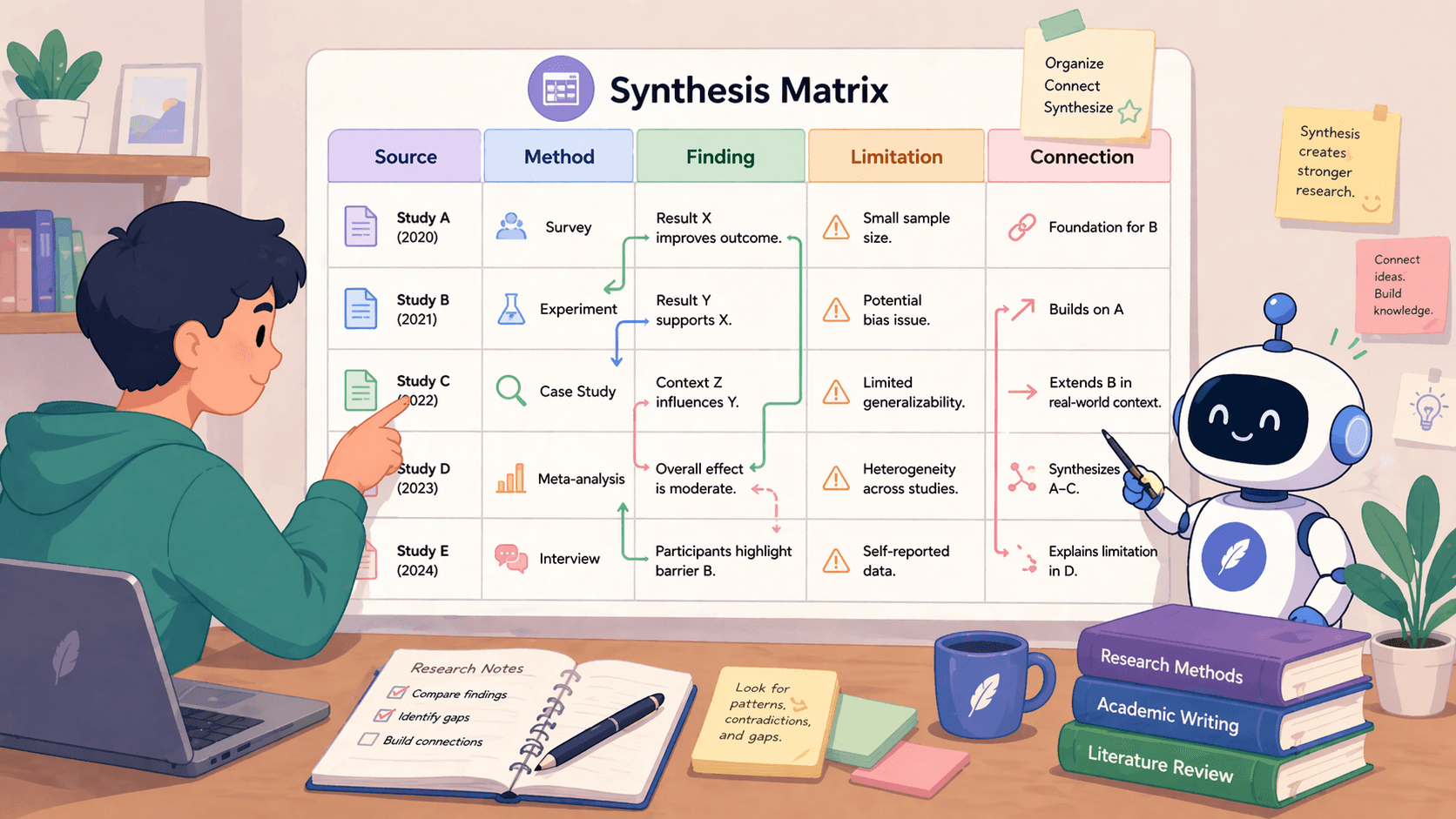
The Synthesis Matrix Method
Organize your sources before you start writing. A synthesis matrix is a simple table that forces you to see relationships—using a literature review matrix template can make it easier to compare studies across themes.
Source | Method | Key Finding | Limitation | Connection |
Study A | Survey | Result X | Small sample | Supports B |
Study B | Experiment | Result Y | Bias issue | Contradicts A |
Creating this table helps you visually identify:
Patterns across studies.
Clear contradictions.
Gaps in the existing research.
It’s a tool that improves thematic organization from the start and stops you from writing in a fragmented way.
Thematic Writing Approach
Don’t write about one source, then the next. Write about one theme, then the next.
Example themes could be:
Methodological differences in the field.
Areas where findings conflict.
Emerging trends or consensus.
Each paragraph you write should combine evidence from multiple sources under that theme. This approach drastically improves the coherence of your review and strengthens the flow of your argument.
The “Connection Sentence” Technique
This is a simple, mechanical fix. After you present a piece of evidence from a source, add one sentence that explicitly links it to another study or to your main idea.
Example: “These findings align with earlier research by Smith, but differ significantly in their sample size and methodology.”
This technique directly targets the most common failure: not connecting ideas across different sources. It turns a summary into a synthesis.
<ProTip title="✍️ Pro Tip:" description="Add one linking sentence after every source to build clear relationships across studies" />
Wrap It Up Without Losing the Thread
You can feel it when your review isn’t working, the ideas feel scattered and you keep repeating points without moving forward. It gets frustrating fast. That’s the problem.
<CTA title="Improve Your Literature Review Workflow" description="Use structured prompts and synthesis frameworks to write clearer more analytical reviews" buttonLabel="Try Jenni Free" link="https://app.jenni.ai/register" />
The fix is keeping your focus on connections, not summaries, and using tools like Jenni as a simple way to stay organized while you write. It won’t do the thinking for you, but it helps you keep everything aligned so your argument actually builds and lands.