By
Justin Wong
—
Regulatory Medical Writing: Key Documents and How to Write Them

Justin Wong
Head of Growth
Graduated with a Bachelor's in Global Business & Digital Arts, Minor in Entrepreneurship

Regulatory medical writing is described almost everywhere as a career and almost nowhere as a set of deliverables. You can read three long guides about the role and still not know which documents you would be producing, or which guideline tells you how to structure each one.
This fixes that. Below is the document by document map, with the governing guideline and a link for every item, plus how the submission structure works, what genuinely changed in 2025, and how the review cycle actually runs.
<CTA title="Draft Technical Documents With Fewer Loose Ends" description="Jenni helps you structure long documents and keep terminology consistent across every section" buttonLabel="Try Jenni Free" link="https://app.jenni.ai/register" />
What Regulatory Medical Writing Is
Regulatory medical writing is the production of the documents that go to a medicines or device regulator: the FDA, the EMA, the MHRA, the PMDA, and their counterparts. It runs the length of a product's life, from the first protocol written before anyone is dosed, through the marketing application, and on into the periodic safety reports filed for as long as the product is on the market.
Two features define the work. The structure is decided before you start, by a guideline that is public and free to read. And the reader is a regulatory reviewer who is professionally obliged to notice inconsistency. That combination makes the job less about expression than about accuracy, traceability, and knowing which rulebook applies to the document in front of you.
<ProTip title="🗺️ Orientation:" description="The fastest way to look competent in a regulatory writing interview is to name the guideline that governs each document. That knowledge is free and most candidates have not bothered" />
The CTD, and Why Every Document Has a Module Number
Marketing applications are organized as a Common Technical Document, defined by ICH M4. Everything you write lands somewhere in its five modules, and regulatory conversations are conducted in module numbers rather than document names.
Module 1, administrative information and prescribing information. Region specific, and technically not part of the CTD proper.
Module 2, the summaries. This is where most senior regulatory writing happens. It contains the Quality Overall Summary, the Nonclinical Overview, and, most importantly for clinical writers, the Clinical Overview at 2.5 and the Clinical Summary at 2.7.
Module 3, quality. Chemistry, manufacturing, and controls.
Module 4, nonclinical study reports.
Module 5, clinical study reports. Individual trial reports live here.
The distinction that matters most in practice is between Module 5 and Module 2. A clinical study report describes one trial. The Clinical Overview at 2.5 makes the argument about the product across all of them, and the Clinical Summary at 2.7 assembles the evidence, with 2.7.3 covering efficacy, 2.7.4 covering safety, and 2.7.6 collecting the synopses of individual studies. Their content requirements come from ICH M4E, not from ICH E3.
The electronic format for all of this is the eCTD. The FDA describes it as the standard format for submissions to CDER and CBER, and it is required for new drug applications, abbreviated applications, biologics license applications, and commercial investigational new drug applications. Version 4.0 has been supported since September 2024.
The Documents You Will Actually Write

Here is the map. Every one of these guidelines is free to read, and reading the one that governs your next document is the highest value hour available to you.
Document | What it is | Governed by |
Clinical trial protocol | The plan for a trial: design, population, treatments, endpoints, statistics | ICH E6(R3), Annex 1, Appendix B |
Investigator brochure | Everything known about the product, compiled for the people running the trial | ICH E6(R3), Annex 1, Appendix A |
Informed consent form | What a participant is told before agreeing to take part | ICH E6(R3) section 2.8, and in the US 21 CFR 50.25 |
Clinical study report | The full account of one completed trial, in sixteen sections | |
Clinical Overview (2.5) and Clinical Summary (2.7) | The product level argument and evidence assembly in a marketing application | |
Plain language summary of results | A lay summary of trial results, required in the EU | EU Regulation 536/2014 Article 37, with Good Lay Summary Practice |
Periodic benefit risk evaluation report | Ongoing safety reporting for a marketed product | |
Development safety update report | Annual safety reporting for a product still in development | |
Clinical evaluation report | The clinical evidence dossier for a medical device in Europe | EU MDR 2017/745, Article 61 and Annex XIV, with MEDDEV 2.7/1 revision 4 as the working template |
Briefing documents and meeting packages | Material prepared for an agency meeting or advisory committee | No single guideline. Procedure specific, set by the agency and the meeting type |
Three of these deserve a note. The plain language summary is the most underrated document in the field: the EU requires one within twelve months of the end of a trial, six months for pediatric trials, and the Good Lay Summary Practice guidance sets a readability target aimed at readers from about age 12 upwards. Writing one well is genuinely hard and the skill transfers everywhere.
The informed consent form is where regulatory writing meets real people. E6(R3) requires simple, concise language, and 21 CFR 50.25 sets out eight basic elements plus six additional ones. It is short, heavily scrutinized, and a good early assignment.
Briefing documents are the exception that proves the rule: no ICH guideline governs them, so their structure comes from the agency, the procedure, and precedent. The same is true of pediatric investigation plans and orphan designation applications, which are governed by regional regulation rather than by ICH.
<ProTip title="🔗 Traceability:" description="Every number you write should be traceable to a source document in one step. If you cannot say which table or report a figure came from, you do not yet know whether it is right" />
How Regulatory Writing Differs From Medical Communications
People often choose between these two without understanding how different the days are.
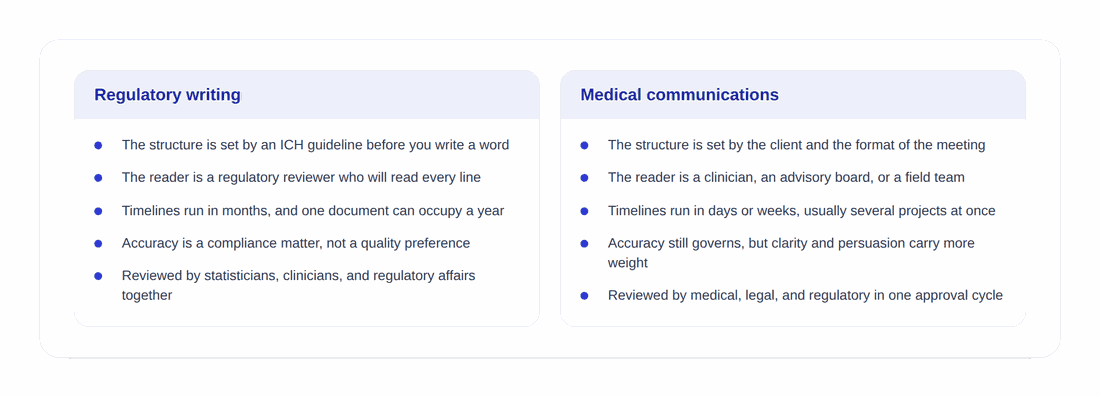
In regulatory writing, the structure is set by a guideline before you write a word, the reader is a reviewer who will read every line, timelines run in months and a single document can occupy a year, accuracy is a compliance matter rather than a quality preference, and review happens with statisticians, clinicians, and regulatory affairs in the room together.
In medical communications, the structure is set by the client and the format of the meeting, the reader is a clinician or an advisory board or a field team, timelines run in days or weeks with several projects running at once, clarity and persuasion carry more weight alongside accuracy, and review runs through a single medical, legal, and regulatory approval cycle.
Neither is harder. They suit different temperaments. Regulatory rewards patience, precision, and tolerance for procedure. Medical communications rewards speed, range, and comfort with ambiguity.
What Changed in 2025
Most published guidance on this subject predates the following, which is worth knowing if you are reading older material.
ICH E6(R3) reached step 4 on 6 January 2025. This is the current version of Good Clinical Practice and it restructures the guideline considerably, moving protocol and investigator brochure content requirements into Annex 1 appendices. Any course or article referring to E6(R2) as current is now out of date.
SPIRIT 2025 was published in April 2025, appearing simultaneously in Nature Medicine, The Lancet, JAMA, and BMJ. It updates the reporting checklist for trial protocols and is the reference point most journals and many sponsors now use alongside the regulatory requirement.
eCTD v4.0 has been supported by the FDA since September 2024. This is a submission format change rather than a writing change, but it affects how documents are assembled and versioned, which is very much a writer's problem in practice.
How the Review Cycle Actually Works

A regulatory document does not get written and then approved. It goes round a loop, usually several times, and the loop is where new writers lose time.
A typical cycle runs: a shell or outline agreed with the team, a first draft circulated to a defined review group, comments returned within a fixed window, a comment resolution meeting where contradictory comments are settled in the room, a revised draft, a quality control check against source documents, and finally sign off. Larger documents repeat the middle of that sequence two or three times.
Two habits separate people who handle this well. The first is never accepting a comment you do not understand. If a clinician asks for a change that contradicts a statistician's earlier comment, the answer is a conversation, not a compromise phrasing that satisfies neither. The second is version discipline. Knowing which draft a comment was made against, and being able to say so, prevents the most common failure in a long review cycle, which is a correction being silently undone two versions later.
<ProTip title="📑 Version control:" description="Keep a short decision log alongside the document recording what was changed, why, and who asked. It takes minutes per round and it answers the question that always comes up three months later" />
How to Get Into Regulatory Writing
The most reliable entry point is a contract research organization, because they run many sponsors' documents at once and therefore train people deliberately. In house sponsor roles are usually a second step rather than a first. Freelance regulatory work exists but is difficult early, since clients are buying judgment about compliance and that is exactly what a new writer does not yet have.
What you can do before anyone hires you is read. Read ICH E3 and E6(R3) end to end. Then write a mock synopsis of a published trial using the E3 section list, which is public, and the data from the paper. That single sample demonstrates more than any certificate, because it shows you can work inside a specification. The AMWA guide to regulatory writing is a reasonable free overview of the career alongside it.
<ProTip title="🧰 Toolkit:" description="Learn advanced styles, cross referencing, and track changes in your word processor properly before your first role. Regulatory writers spend more time in those features than in any other tool" />
The Guideline Is the Job Description
If there is one idea worth carrying out of this, it is that regulatory writing is not a mysterious specialism you can only learn on the inside. The specifications are published, free, and readable. What separates a competent regulatory writer from a beginner is not access to secret templates, it is having read the relevant guideline recently enough to know what it actually says, rather than what everyone assumes it says.
<CTA title="Bring Order to Long Technical Drafts" description="Structure, draft, and check complex documents without losing consistency between sections" buttonLabel="Try Jenni Free" link="https://app.jenni.ai/register" />
Start with the document type you are most likely to be handed first, which is usually a protocol summary, a consent form, or a lay summary. Read its guideline, write one, and have somebody who does it for a living mark it up. The underlying discipline, describing methods precisely, holding a consistent formal register, and being able to point to the source behind every claim, is the same everywhere in this field.