By
Nathan Auyeung
—
Rationale vs Significance of the Study: Key Differences Explained

Nathan Auyeung
Senior Accountant at EY
Graduated with a Bachelor's in Accounting, completed a Postgraduate Diploma of Accounting

These two sections get confused because they answer questions that sound identical. Why does this study matter? Why should anyone care? Put like that they are the same question. Put precisely, they are not.
The rationale looks backwards, at what the field has already done, and argues that something is missing. The significance looks forwards, at what your results would enable, and names who would benefit. One is about a gap. The other is about a consequence.
<CTA title="Make the Case Before You Make the Argument" description="Jenni helps you draft an introduction where every claim is tied to a source" buttonLabel="Try Jenni Free" link="https://app.jenni.ai/register" />
The Difference, Precisely
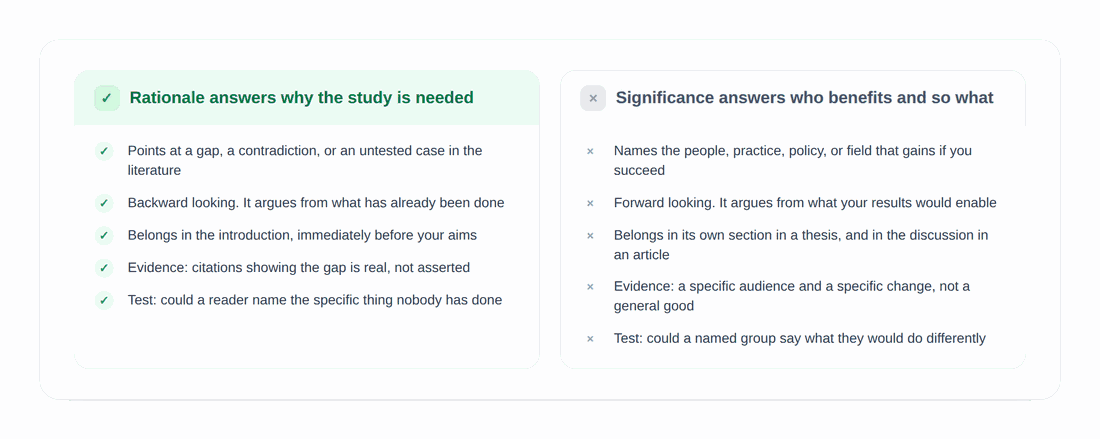
The rationale points at a gap, a contradiction, or an untested case in the existing literature. It is backward looking, arguing from what has already been done. It belongs in the introduction, immediately before your aims, and its evidence is citations showing the gap is real rather than asserted. The test: could a reader name the specific thing nobody has done?
The significance names the people, practice, policy, or field that gains if you succeed. It is forward looking, arguing from what your results would enable. In a thesis it usually gets its own section; in a journal article it dissolves into the discussion. Its evidence is a specific audience and a specific change, not a general appeal to importance. The test: could a named group say what they would do differently?
The rationale is doing what Swales called establishing a niche, which in the CARS model is executed by counter-claiming, indicating a gap in previous research, raising a question, or continuing a tradition. Your aims then occupy that niche. Significance is a different move entirely, closer to what the NIH asks reviewers to score when it asks whether a project addresses an important problem or critical barrier to progress in the field, and how scientific knowledge, technical capability, or clinical practice would be improved if the aims were achieved.
The Same Study, Written Both Ways

Take a study of teacher retention in rural schools.
Rationale. Research on teacher attrition has concentrated on urban districts, where the majority of national datasets are collected. The three studies that examine rural retention are limited to a single state and predate the 2020 shift to hybrid instruction. No study has yet examined whether the factors identified in urban settings operate the same way in districts serving fewer than 2,000 students.
Significance. Rural districts employ roughly one in five teachers nationally and report the highest vacancy rates. Findings would give district administrators a basis for targeting retention spending, and would give state education agencies evidence for whether urban-derived incentive schemes are appropriate for rural contexts.
Notice what makes each work. The rationale names what exists and what does not, with enough specificity that a reader could check. The significance names actors and what they would do differently. Neither one says the topic is important, because saying a topic is important is what people write when they have neither.
<ProTip title="🪤 The tell:" description="If your significance section could be pasted into any thesis in your discipline with three words changed, it is not a significance section yet. Name a group and name the decision they would make differently" />
<ProTip title="🔗 Chain them:" description="Your rationale should make your aims feel inevitable. If a reader could finish the rationale and predict a different set of aims, the two are not connected tightly enough" />
Where Each One Goes
This is where a lot of the confusion originates, because the answer depends on what you are writing.
In a thesis | In a journal article | |
Rationale | In the introduction or background, ending in the problem statement | The final third of the introduction, immediately before the aims |
Significance | Often its own numbered section in chapter one | No heading. Dissolved into the discussion, the implications, and sometimes a dedicated significance statement |
Length | Rationale a few paragraphs, significance half a page to a page | Rationale two or three paragraphs, significance a paragraph in the discussion |
Audience | Examiners checking that you understand your field | Reviewers deciding whether the contribution justifies the space |
The disappearing significance heading catches people out when they convert a thesis chapter into an article. Journals rarely have a section called Significance of the Study. That does not mean the content is unwanted; it means it moves. Some journals go further and require a short standalone significance statement written for a general readership, which is worth checking for in the author guidelines rather than discovering at submission.
A Note on Regional Convention
Worth saying plainly, because it explains why some readers have never met this section and others cannot imagine a thesis without it. A dedicated Significance of the Study section is a strong convention in some national traditions and largely absent in others.
The University of the Philippines Manila thesis manual, for example, prescribes chapter one as background of the study, statement of the problem, objectives, significance of the study, and scope and limitations, with no separately named rationale section at all. Many UK and North American programs invert that, expecting a rationale woven through the introduction and no significance heading whatsoever.
The practical instruction: follow your institution's manual over any generic advice, including this page. If your manual prescribes both sections, write both and keep them doing different jobs. If it prescribes neither, the content still has to be in the introduction somewhere.
<ProTip title="📘 Check the manual:" description="Read your own program thesis format manual before drafting chapter one. Section names and their order are usually prescribed, and rewriting a chapter to match them afterwards is entirely avoidable work" />
How to Write Each One
For the rationale, work in three moves. Say what is established, in a sentence or two with citations. Say what is missing, specifically, naming the population, setting, method, or period nobody has covered. Then say why that absence matters for the question at hand. If your gap is only that nobody has studied your exact topic, that is a description rather than a rationale; plenty of things are unstudied because they are not worth studying.
For the significance, name at least two distinct beneficiaries and be concrete about each. Practitioners who would change something. Policymakers who would have evidence they lack. Researchers who would gain a measure, a dataset, or a resolved contradiction. Then state what changes for each. Avoid the phrase "will contribute to the body of knowledge", which appears in an enormous number of theses and means nothing.
<ProTip title="✍️ Two beneficiaries:" description="Write your significance section as a list of who benefits and how before you turn it into prose. If the list has one entry and it is other researchers, keep going" />
One Looks Back, One Looks Forward
Hold on to that and the sections stop blurring. The rationale is an argument about the literature, evidenced by citations. The significance is an argument about consequences, evidenced by naming who acts differently. A reader should be able to finish your introduction knowing exactly what has not been done and exactly who is waiting for it to be.
<CTA title="Write an Introduction That Earns Its Aims" description="Draft the gap and the contribution with sources attached and claims checked" buttonLabel="Try Jenni Free" link="https://app.jenni.ai/register" />
Both sections rest on the same foundation, which is a literature review that actually demonstrated the gap rather than announcing it. Getting the parts of the document in the right order, and making sure every claim rests on a source that can carry it, is what makes both of these paragraphs writable in the first place.