By
Nathan Auyeung
—
How to Write a Rationale: Clear Structure and Examples

Nathan Auyeung
Senior Accountant at EY
Graduated with a Bachelor's in Accounting, completed a Postgraduate Diploma of Accounting
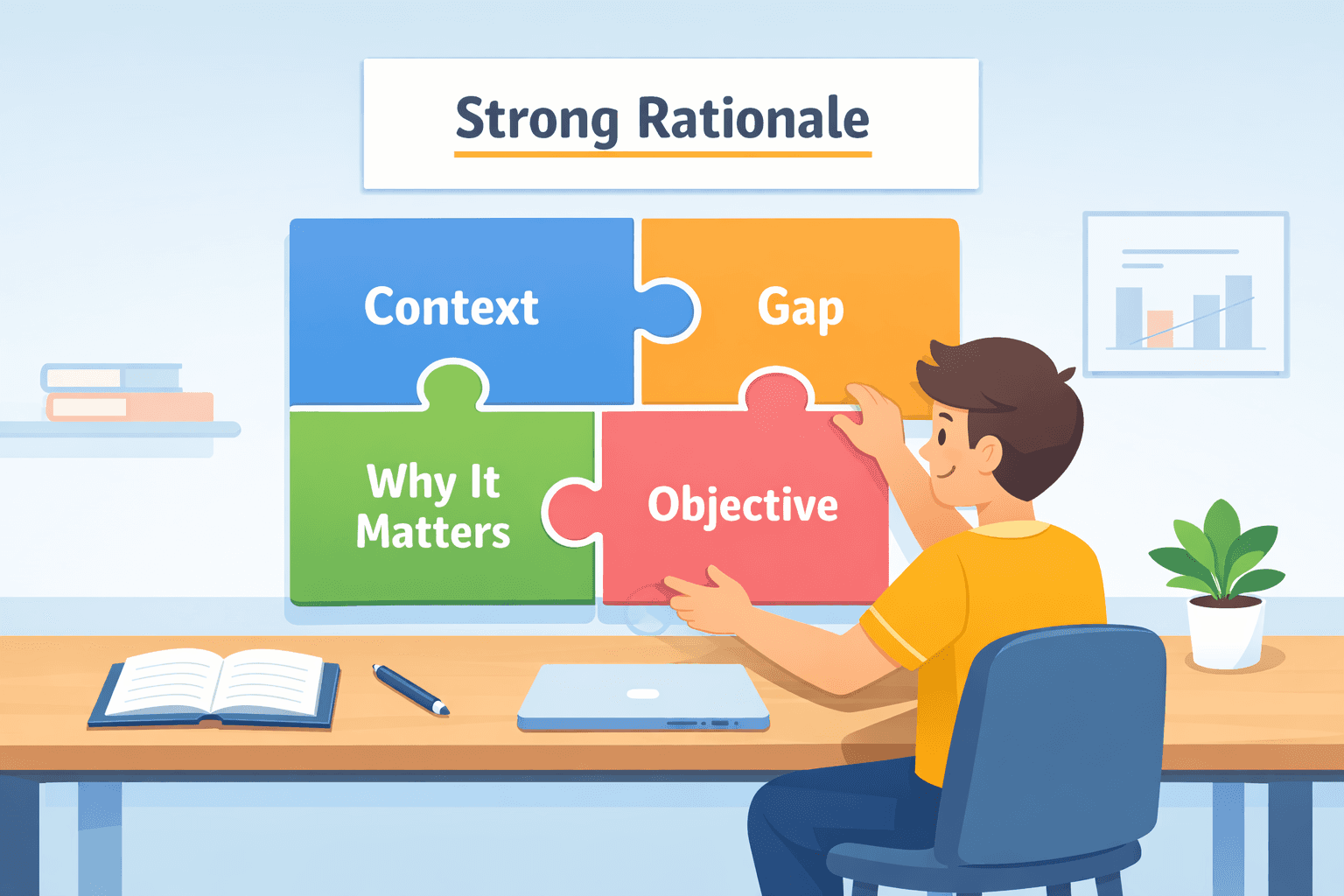
Writing a rationale can be confusing. You know your topic, but explaining why it matters is often the hardest part.
This guide will show you exactly how to do it, using clear examples and a simple structure. By the end, you'll know how to justify your topic, connect it to a real problem, and write confidently.
<CTA title="Build a Strong Rationale Faster" description="Turn your ideas into clear structured rationales with strong justification and academic clarity." buttonLabel="Try Jenni Free" link="https://app.jenni.ai/register" />
What a Strong Rationale Actually Looks Like
A strong rationale shows why your work is essential. It's not just background. It answers a direct question: why is this needed now? To better understand how this works in academic writing, this guide on research rationale structure and explanation breaks down how researchers justify their studies.
For example, look at a research rationale. Many studies examine online learning for university students. However, there's little known about its impact on younger children in primary school. This is a problem because early education shapes long-term academic results. Therefore, this study will investigate how online learning influences engagement for primary school pupils in urban areas.
See how it works? It states the current landscape, identifies a specific hole in it, explains why that hole matters, and then states what will be done to address it. That's a full rationale.
The Core Structure of a Rationale
A good rationale builds an argument step by step. Each piece supports the next.
1. Context: Set the Stage Begin by describing the current situation or what is already known. For instance, digital learning expanded rapidly following the shift to remote education. This stage often connects closely to defining a clear research problem and background context, which helps frame your study effectively. Keep this section short; you're providing background, not a full review.
2. Gap: What Is Missing? This is the crucial step. You must point out what hasn't been done or known. For example, research heavily favors higher education, with little attention paid to how primary school students engage. If there's no gap, there's no real need for your work.
3. Justification: Why It Matters Here, you answer the "so what?" Explain the consequences. You might point to a practical impact, an academic need, or relevance to a specific group. In our case, early engagement is critical, it directly influences a child's future academic path. If your study also depends on a particular worldview or method of understanding evidence, choosing the right research paradigms can help strengthen how your rationale is framed.
4. Objectives: What You Will Do Conclude with your specific aim. State clearly what you plan to do. Following the example, the objective would be: to measure and analyze engagement levels among primary school students using digital learning platforms.
Component | Purpose | Key Question It Answers | Example Sentence |
Context | Provides background and current state | What is already known? | Online learning has expanded rapidly in recent years. |
Gap | Identifies missing knowledge | What is not known or missing? | However, little research focuses on primary school students. |
Justification | Explains importance | Why does this matter? | Early engagement affects long-term academic success. |
Objective | States the aim | What will you do? | This study will analyze engagement in primary-level online learning. |
<ProTip title="💡 Pro Tip:" description="If your rationale does not clearly show a gap, your argument will feel weak no matter how well you write." />
Example-Led Breakdown: Different Types of Rationale

The approach changes depending on the context. Here are a few common types.
Research Rationale Example This is typical for academic papers and studies.
Example: Past research looks at student motivation in online settings. However, the influence of parents is rarely considered.
This oversight means we don't fully grasp how younger students succeed or struggle. Filling this gap could lead to better teaching methods and more effective guidance for families.
Focus: Identifying a hole in the existing literature and stating an academic contribution.
Project Rationale Example You'd use this for a grant application or a practical initiative.
Example: Our project will create a new waste management program for city schools.
The current approach doesn't engage students, so participation is poor. We plan to use interactive tools to boost both environmental awareness and actual involvement.
Focus: Solving a tangible problem with a direct, real-world application.
Thesis Rationale Example This is more formal, often for a dissertation or major paper.
Example: We know social media changes how people talk to each other. What we don't know is how it affects the formal writing skills of college students. This thesis will measure writing performance against different levels of social media use to find out.
Focus: Establishing a clear position within a field of study and defining a specific contribution.
<ProTip title="🧠 Reminder:" description="Adjust your rationale based on context. Research focuses on gaps, projects focus on solutions." />
Step-by-Step: How to Write a Rationale
Now let's turn examples into a repeatable method.
Step 1: Start with Focused Background Don't overload this section. Bad example: Many things have changed in education over time… Better: Online learning has become a key part of modern education.
Step 2: Start with Focused Background Don't overload this section. Bad example: Many things have changed in education over time… Better: Online learning has become a key part of modern education.
Step 2: Identify a Specific Gap Be precise. Avoid vague claims. Weak: There is not enough research. Strong: Few studies examine student engagement in primary-level online learning.
Step 3: Explain the Impact This is where you persuade the reader. You can frame impact in three ways:
Academic → fills a knowledge gap
Practical → solves a real problem
Social → improves outcomes
Step 4: State Your Direction Clearly End with purpose. Your objective should be precise and aligned with your overall argument. If you're unsure how to define this clearly, this explanation of research purpose and study objectives can help you refine what your study is aiming to achieve.
Example: This study investigates… This project aims to…
<ProTip title="⚡ Quick Tip:" description="Your rationale should move logically from what exists to what is missing to what you will do." />
Strong vs Weak Rationale
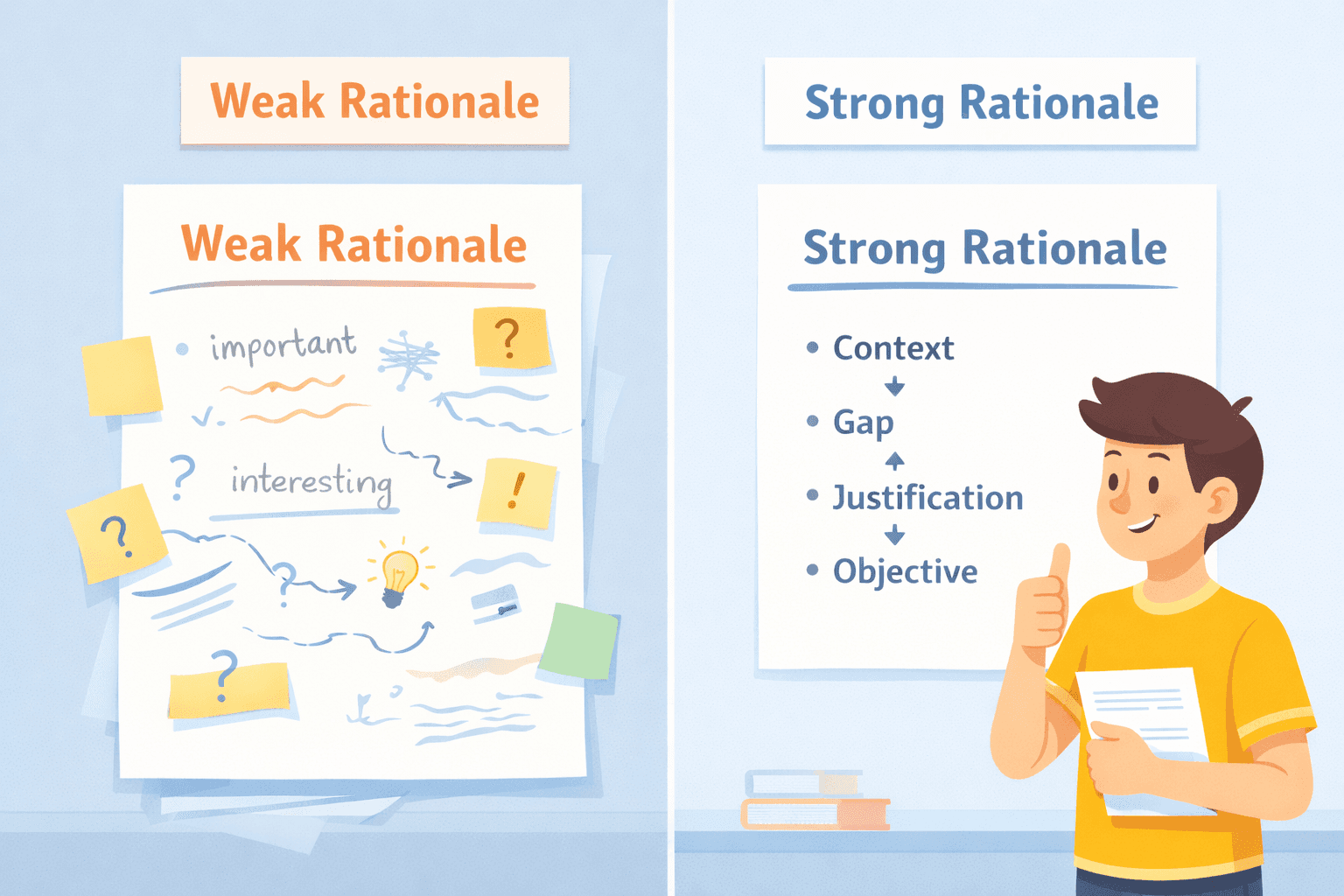
Comparing them directly shows you what to aim for.
Weak Rationale This topic is important and interesting. Many people study it, and it has many benefits. Why it fails:
It doesn't point out what's missing.
It offers no proof or reasoning.
It gives no indication of what will actually be done.
Strong Rationale
While social media is researched often, its specific impact on academic writing is not well understood. This is significant because writing ability affects grades and long-term success. This study will analyze how different levels of social media use correlate with student writing performance.
Why it works:
It identifies a precise, narrow gap in the research.
It provides a logical reason why that gap is a problem.
It states a clear, measurable objective.
Common Mistakes to Avoid
These errors are common, and they can completely undermine your argument. Spotting them in your own work is the first step to fixing it.
1. Being Too Vague General claims without support are easy to ignore. Saying a topic is "important" or "relevant" isn't an argument. You have to get specific. What exactly is the situation? What precise piece is missing? Vagueness leaves the reader wondering if you truly understand the subject yourself.
2. Writing Too Much Background It's tempting to prove you've done the reading by summarizing everything. Resist that. A rationale is not a literature review. If you need to synthesize sources before you define the gap, our AI Literature Review & RRL Generator can help you build that foundation. Its job is to set up a problem, not recount all prior solutions. If your background section runs longer than your gap and justification combined, you've likely lost the thread. Provide just enough context so the gap you identify makes immediate sense.
3. Skipping the Gap This isn't just a mistake; it's a fatal flaw. The gap is the engine of your rationale. Without it, you have no "why." You're just describing a field of study, not making a case for entering it. Always ask yourself: "What don't we know yet? What hasn't been tried? What specific question remains unanswered?" If you can't answer that, you need to refine your focus.
4. Using Opinion Instead of Evidence Your conviction isn't evidence. Phrases like "I feel this is crucial" or "It is obvious that..." introduce bias and weaken credibility. The justification must stand on external reasoning. Use established facts, point to contradictory data, or highlight a logical consequence. Show the reader why the gap matters based on something outside your own opinion. For example, instead of "I believe studying this will help," try "Understanding this could lead to improved policy, as shown by similar interventions in related fields."
If your study is trying to show a relationship between two variables, it can also help to understand correlational research, since many rationales are built around explaining why that relationship is worth investigating.
<ProTip title="📌 Note:" description="Aim for 60 percent justification and 40 percent background for a strong rationale balance." />
Quick Rationale Writing Checklist
Use this list before you finalize anything.
Structure
Context: Is the current situation or existing knowledge clearly and briefly explained?
Gap: Have you identified a specific, precise thing that is missing or unknown?
Justification: Does your explanation for why the gap matters make logical sense?
Objective: Is your final aim or direction stated plainly? If you're still narrowing your study focus, learning how to write a research question can help make your rationale more specific and academically grounded.
Content
Evidence: Do your claims have support from data, literature, or clear reasoning?
Clarity: Are there any vague, general, or unsupported statements?
Connection: Does each section lead naturally to the next, building a coherent argument?
Style
Tone: Is the language appropriately formal for your audience (e.g., academic, professional)?
Conciseness: Are sentences direct and free of unnecessary words?
Flow: Does the writing progress logically from one point to the next without jumping around?
What This Means in Practice
Writing a rationale is an exercise in persuasion, not storytelling. Your goal is to build a logical case.
Imagine you're pitching an idea to a skeptical audience. Your job is to guide them, step by step, to a single conclusion: that your work is necessary.
First, you establish the baseline. What's the accepted reality or current state of knowledge? This sets the boundaries.
Then, you reveal the flaw. Within that reality, what specific piece is missing, broken, or misunderstood? This is your opening.
Next, you argue the stakes. Why is that missing piece a genuine problem? What are the consequences of ignoring it? This creates urgency.
Finally, you offer the fix. Your study, project, or decision is the direct response to that specific problem.
When you see it as this kind of structured argument, the process gets clearer. You're not just describing a topic; you're solving a puzzle for the reader.
Bringing Your Rationale Together with Confidence
You can feel stuck when your ideas are there but the reasoning doesn’t come together, and it makes your work seem weaker than it is. It’s frustrating. A strong rationale isn’t just about describing your topic, it’s about showing why it matters and what needs to happen next.
<CTA title="Turn Ideas Into Clear Rationales" description="Organize your thoughts into structured rationales with stronger arguments and clearer academic flow." buttonLabel="Try Jenni Free" link="https://app.jenni.ai/register" />
That’s where Jenni can help, giving you a clear way to organize your thoughts so your argument stays focused and easy to follow. It’s a simple shift that takes the pressure off and helps you write with more clarity. When your rationale is clear, your whole work feels stronger.