By
Justin Wong
—
Random Sampling Explained: Methods, Steps, and Real Use

Justin Wong
Head of Growth
Graduated with a Bachelor's in Global Business & Digital Arts, Minor in Entrepreneurship
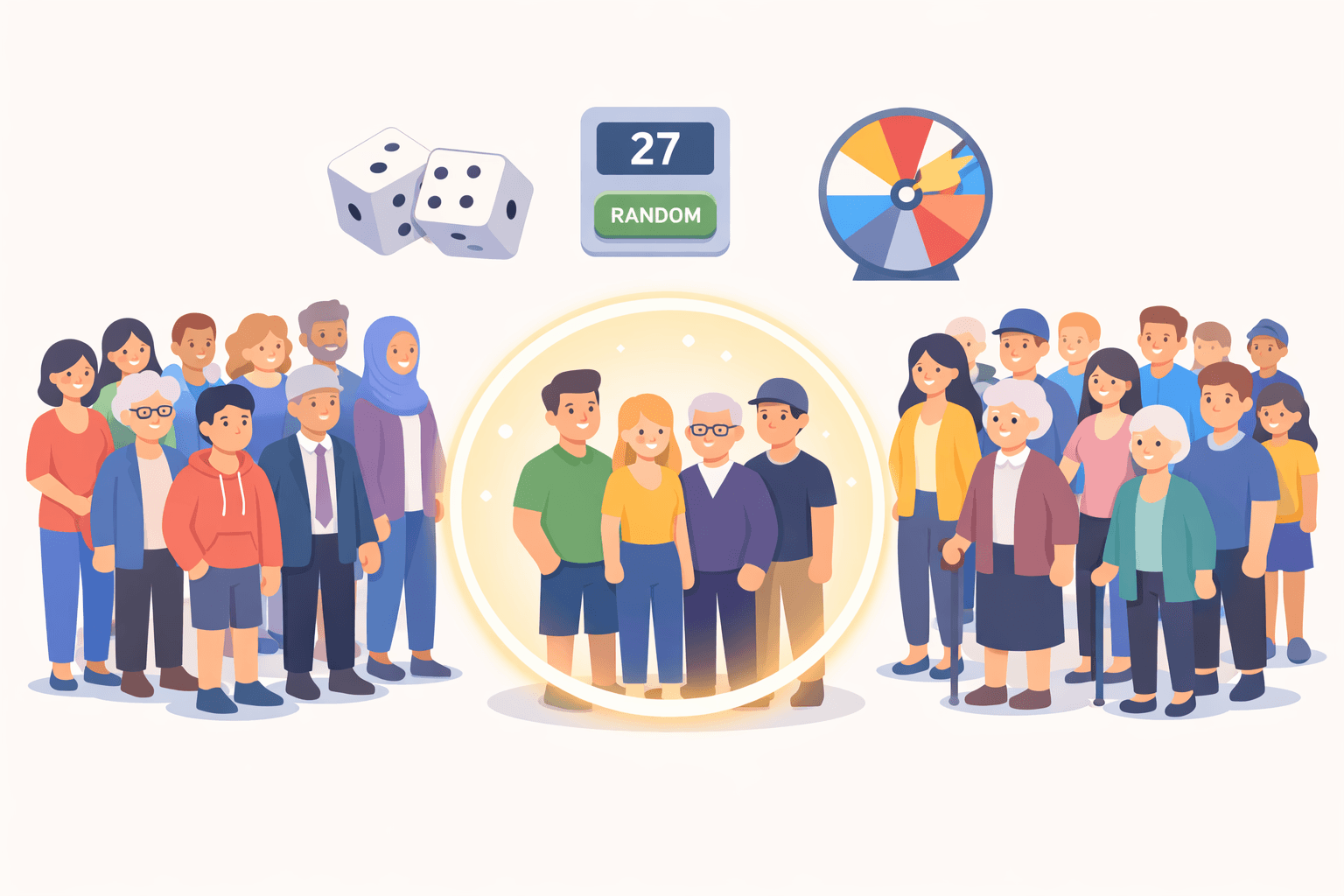
To study a large population, you randomly pick a small part of it. This method, called random sampling, gives everyone an equal chance to be selected. It's the foundation for trustworthy research in fields like medicine and polling.
This guide will show you how it works, the different techniques available, and how to apply them in a real project. Ready to learn how?
<CTA title="Build Better Research Samples" description="Create structured sampling plans faster and reduce bias in your research process" buttonLabel="Try Jenni Free" link="https://app.jenni.ai/register" />
What Random Sampling Really Means in Practice
In practice, random sampling means choosing subjects purely by chance, which is harder than it sounds.
The World Health Organization notes that this unbiased approach is key for accurate population estimates.
A good sample mirrors the full group's mix of ages, incomes, and other traits, making it crucial for tests like regression analysis. The theory is straightforward, but execution often fails.
Researchers frequently face problems like bad participant lists, forcing them to settle for "random-enough" methods that aren't truly random. This distinction is often the dividing line between different research paradigms in academia.
For a genuine random sample, you need three things:
A complete list of everyone in the population.
A known chance for each person to be picked.
A selection process based on randomness, not convenience.
Straying from these rules, even a little, introduces bias and skews your results.
<ProTip title="💡 Pro Tip:" description="Always verify your sampling frame before selecting participants to avoid hidden bias" />
Core Random Sampling Methods Explained
Different techniques apply randomness in a structured way. The best choice depends on your study's design, whether you are conducting qualitative vs quantitative research, and the size of the group you're looking at.
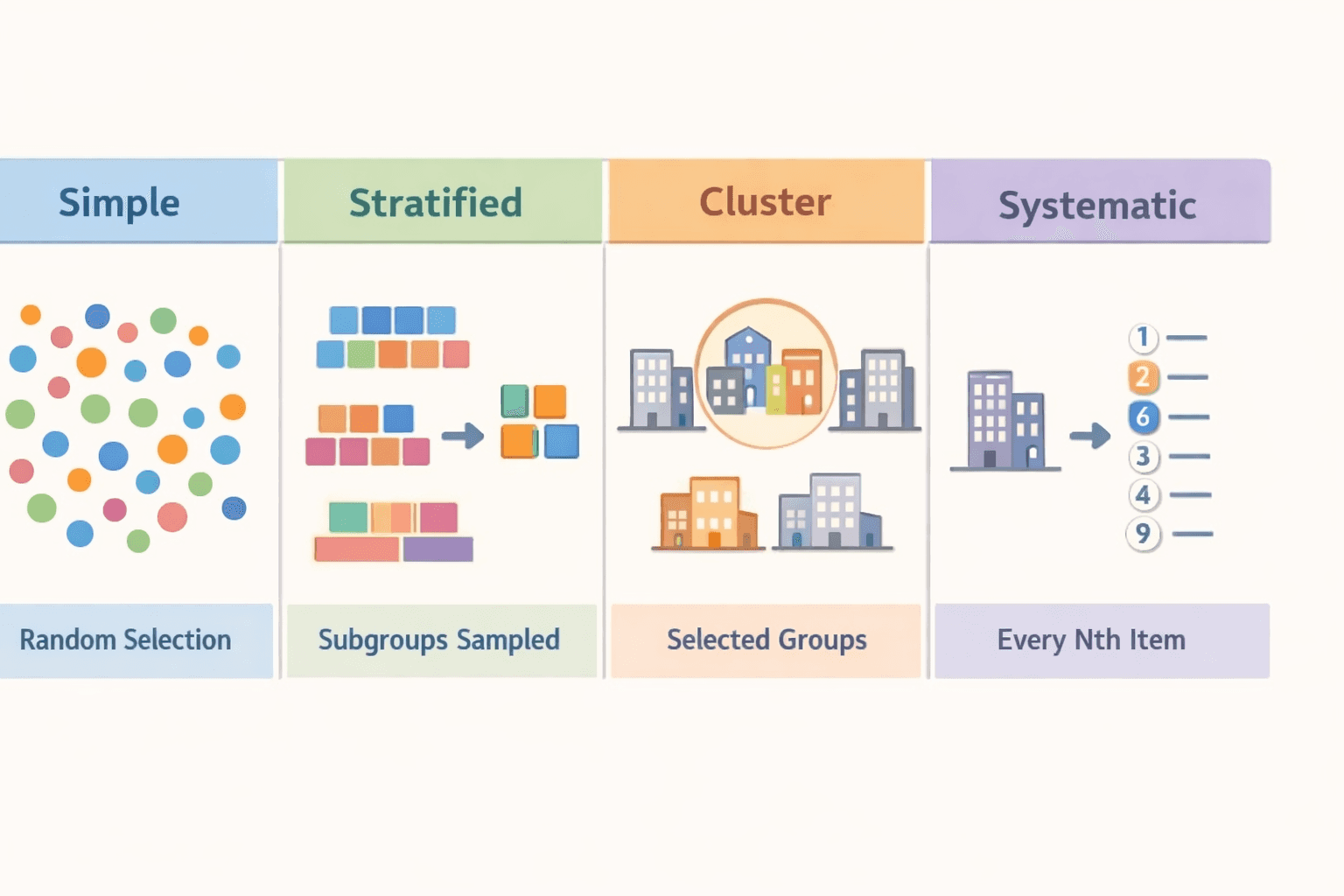
Simple random sampling (the pure form)
Here, every single person has the same shot at being chosen. Researchers typically use random number generators or lottery-style draws.
Think of a class with 500 students. You'd give each one a number, then use a generator to pick 50 of them. That's the textbook example.
The statistical power is high, but it hinges on having a perfect, complete list of the entire population. If your list is flawed, the results will be too.
Stratified random sampling (for balanced representation)
This method splits the population into distinct subgroups, like age brackets or income levels, before taking a random sample from each one. It ensures these key categories are properly represented.
A health survey, for instance, might stratify by decades of age (20-29, 30-39, etc.) to make sure all groups are included according to their share of the population.
The main benefits are reducing variability in the sample and getting a more accurate picture of each subgroup. It's widely used in fields like market research.
Cluster sampling (efficient for large groups)
Instead of picking individuals, you randomly select entire pre-existing groups, or "clusters," such as picking five schools at random and surveying all students within them.
This is one of the most common probability sampling methods for geographically scattered populations.
This approach cuts down on travel, time, and cost, which is a major advantage for large, spread-out populations. The trade-off is that it usually introduces more sampling error than methods like stratification.
Systematic sampling (structured randomness)
After picking a random starting point, you select every nth person from your list, like every 10th customer in a database queue.
It's straightforward to carry out, but it carries a hidden risk. If there's a recurring pattern in the list (for example, every 10th entry is always a manager), your sample will be biased.
How the methods compare
Method | Best use case | Main strength | Key limitation |
Simple Random | Smaller populations where a full list exists | High statistical accuracy | Requires a complete, accurate list |
Stratified | Populations with important, diverse subgroups | Ensures representation of key traits | More complex to plan and execute |
Cluster | Large, geographically scattered populations | Very practical and cost-effective | Generally has higher sampling error |
Systematic | Ordered datasets without hidden patterns | Simple and fast to implement | Vulnerable to cyclical bias in the list |
All these methods support the core idea of probability sampling, but each comes with practical trade-offs that shape your final data.
<ProTip title="📊 Pro Tip:" description="Use stratified sampling when population groups differ significantly in size or behavior" />
Step-by-Step Random Sampling Process
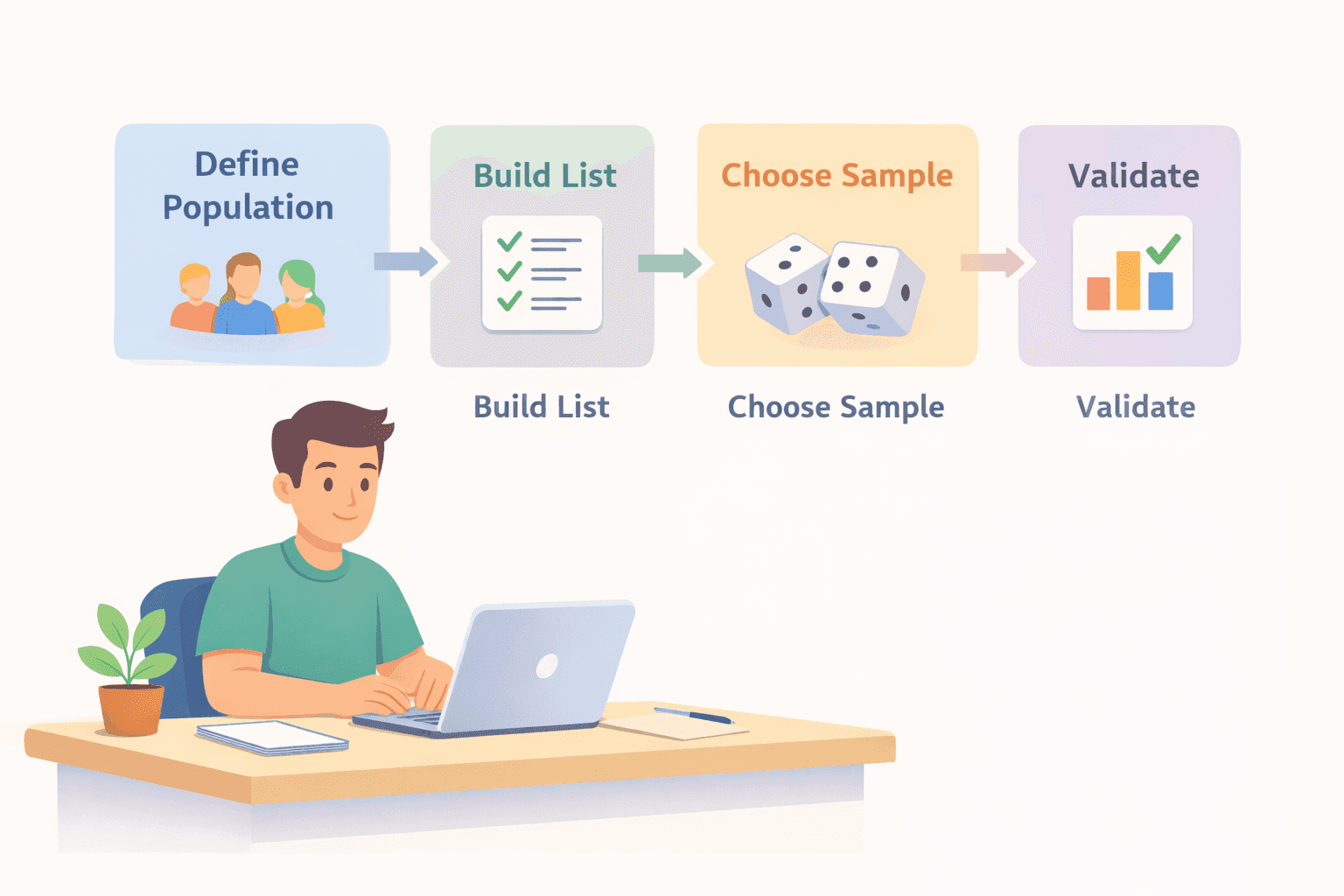
Getting random sampling right means following a clear sequence. If you skip a stage, your data can easily become skewed or useless.
Step 1: Define your population and scope
Start by deciding exactly who or what you're studying. Be specific, instead of "young adults," define it as "all university students in Surabaya enrolled in 2024." This initial decision shapes your entire research plan and tells you if the project is even possible.
Step 2: Build a sampling frame
This is your master list. It must include every single member of the population you just defined. If people are missing from this list, they have zero chance of being selected, which immediately ruins the randomness.
Pew Research Center has identified faulty sampling frames as a leading cause of bias in major surveys.
Step 3: Determine the sample size
How many units do you need to pick? The answer balances confidence and precision. A Harvard T.H. Chan School of Public Health analysis points out that a larger sample only boosts reliability if the selection is genuinely random.
Use a sample size calculator to balance your confidence level and margin of error. To calculate your size, you need to decide on three things:
Your confidence level (usually 95%)
An acceptable margin of error
The expected variability within your population
Step 4: Apply the random selection
This is where you use chance to pick your sample from the frame. Common tools include:
A digital random number generator
A printed table of random numbers
Specialized software for computer-generated selection The key is to remove any human choice from the process.
Step 5: Validate representativeness
Once you have your sample, don't assume it's good. Check it. Compare the sample's basic characteristics, like average age or gender split, to what you know about the full population.
If the sample looks noticeably different, something went wrong. You'll likely need to go back to an earlier step, often to fix the sampling frame or the selection method.
<ProTip title="🧪 Pro Tip:" description="Test your sampling method using small simulations before full data collection" />
Why People Distrust “Random Enough” Samples
That skepticism is well-founded. In the real world, many researchers have to settle for "random enough" methods, and online forums are full of people questioning if their approach is truly valid.
A common shortcut is the convenience sample, polling your classmates, posting a survey in a specific Facebook group, or using the first 100 website visitors.
These groups feel accessible and varied, but the selection isn't based on chance. It's based on who is easiest to reach, which is a classic form of bias.
A major misunderstanding is that gathering more people solves the problem. It doesn't. A biased sample of a thousand is fundamentally less trustworthy than a genuinely random sample of a hundred.
If you don't have a complete list to draw from, you can't claim it's a probability sample. This persistent gap is why many studies fail when researchers eventually try to choose a journal for research publication, as peer reviewers look for sampling rigor.
Random Sampling vs Non-Probability Sampling
Getting this difference right is fundamental. Your choice determines whether you can generalize your findings to a larger group.
How they differ in practice
Aspect | Random sampling | Non-probability sampling |
How selection works | Purely by chance (e.g., a lottery) | Based on the researcher's judgment or convenience |
Risk of bias | Theoretically low, if done correctly | Inherently high and often uncontrollable |
Statistical inference | Allows for valid estimates about the whole population | Does not support statistical generalization |
Random sampling is the basis for the math that lets you make predictions (inferential statistics). Non-probability sampling can't promise that your sample reflects the broader population.
When to use each approach
Choose random sampling when your conclusions need to be precise and defensible. This is critical for:
Clinical trials and public health research
Official government surveys, like a census
Formal academic studies where results are published
Opt for non-probability methods under specific, practical constraints:
Your project has very tight time or budget limits
You only need preliminary, exploratory insights, like early-stage market feedback
The full population is impossible to access or list (e.g., studying a hidden community)
In short, use random sampling to prove something; use non-probability sampling to learn about something.
<ProTip title="⚖️ Pro Tip:" description="Do not label convenience samples as random sampling in research reports" />
Real-World Applications of Random Sampling
This method isn't just a textbook idea. It's a practical tool used in different fields to make decisions more reliable and cut down on bias.
In healthcare, it's the backbone of trustworthy clinical trials and studies that track disease spread. For instance, the CDC uses probability sampling to estimate how many people in the U.S. have a particular illness, which guides public health policy.
For market research, companies depend on it. When a business wants to know what customers think about a new product or a brand's reputation, they use random sampling to get an unbiased snapshot of their target audience.
The field of data science and machine learning leans on it heavily. Analysts use random sampling to build balanced training datasets for algorithms.
Core techniques like bootstrap sampling (which resamples data to estimate uncertainty) and Monte Carlo simulations (which model probabilities) are built on repeated random draws.
You'll also find it at work in:
Social science, for national surveys on topics like voting or employment.
Government, for designing accurate census surveys and audits.
Business operations, for validating product quality from a manufacturing line.
Across these areas, the common thread is using random sampling to turn raw data into actionable analysis, moving from guesswork to informed decisions.
Common Mistakes and Best Practices
Even experienced teams can make errors that undermine their data's quality from the very start.
Frequent mistakes
A few common problems consistently weaken sample integrity:
Using an outdated or incomplete list of the total population.
Mistaking easily-gathered "convenience" data for a true random sample.
Skipping the necessary math to determine how large the sample needs to be.
Failing to ensure key subgroups within the population are adequately represented.
Practical steps for better accuracy
Improving your process relies on a few disciplined habits:
Define your population with precision before you begin.
Source your sampling frame from verified, comprehensive data.
Apply proper randomization tools or services, don't just pick names manually.
Validate your final sample by checking its demographics against known population metrics.
A carefully designed sampling method is what separates useful, credible data from a collection of misleading numbers.
Get Random Sampling Right from the Start
You can feel it when your sample doesn’t fully represent what you’re trying to study, and it makes your results harder to trust. It slows your progress and raises questions you didn’t expect. Even small missteps in how you choose participants can affect everything. That risk is real.
<CTA title="Design Smarter Research Workflows" description="Plan sampling methods and structure research faster with guided AI support" buttonLabel="Try Jenni Free" link="https://app.jenni.ai/register" />
Using Jenni helps you plan your sampling with more clarity so your research stays on track. It supports how you structure methods and explain your approach, making your work easier to defend and understand. It’s a simple way to keep your results solid.