By
Justin Wong
—
Literature Review Checklist for Stronger Research Writing

Justin Wong
Head of Growth
Graduated with a Bachelor's in Global Business & Digital Arts, Minor in Entrepreneurship

Most literature review checklists online are made of questions you cannot fail. Is it comprehensive? Is it critical? Does it flow? Nobody has ever read one of those and known what to change.
There are two real instruments for this, both validated, both free, and which one applies to you depends on the kind of review you are writing. This page gives you both, plus the process checks that sit underneath them and the failures supervisors flag most often.
<CTA title="Build a Review That Argues Instead of Lists" description="Jenni helps you outline, draft, and cite a literature review with every source traceable" buttonLabel="Try Jenni Free" link="https://app.jenni.ai/register" />
First, Which Kind of Review Are You Writing?
This is the question that determines everything else, and getting it wrong is why so many students apply a standard that was never meant for them.
Review type | What it does | Check it against |
Narrative or traditional | Surveys and interprets a body of work to build an argument. The kind in most thesis chapters | SANRA, six items |
Systematic | Answers a specific question using a pre-specified, reproducible search and appraisal protocol | PRISMA 2020, 27 items |
Scoping | Maps the extent and nature of a literature without appraising quality in the same way | PRISMA extension for scoping reviews |
The PRISMA statement is explicit about its scope: it has been designed primarily for systematic reviews of studies that evaluate the effects of health interventions. If you are writing the literature review chapter of a thesis, PRISMA is not your instrument, and applying it will produce a chapter full of headings you cannot fill.
The Checklist for a Narrative Review
SANRA, the Scale for the Assessment of Narrative Review Articles, is the one almost nobody mentions. It has six items, each scored zero, one, or two, for a total out of twelve. Score your own draft honestly and you will know exactly where the work is.
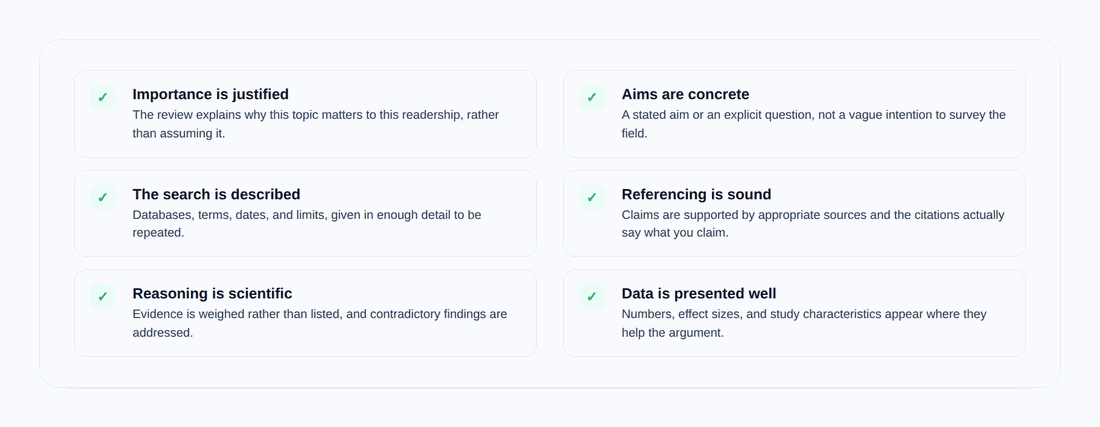
1. Justification of the article's importance for the readership. Does the review say why this topic matters to the people who will read it, or does it assume the importance is obvious? A one-sentence claim that the topic is under-researched is not a justification.
2. Statement of concrete aims or formulation of questions. An explicit aim or question, not a vague intention to survey a field. If your review has no stated question, no reader can tell whether it answered one.
3. Description of the literature search. Which databases, which terms, which date range, which limits. This is the item narrative reviews fail most often, and it is the cheapest one to fix, because you only need to record what you were doing anyway.
4. Referencing. Are the claims supported by appropriate sources, and do those sources actually say what you claim? This is where a review quietly loses credibility, because a reader who checks two citations and finds one misrepresented will not trust the other two hundred.
5. Scientific reasoning. Is evidence weighed, or merely listed? A review that reports what each study found, in sequence, without ever comparing or adjudicating between them, is an annotated bibliography wearing a chapter heading.
6. Appropriate presentation of data. Do numbers, effect sizes, and study characteristics appear where they would help the argument, rather than being flattened into "several studies have shown"?
One honest limitation, stated by SANRA's own authors: the scale cannot cover other elements of editorial decision making such as degree of originality, topicality, or conflicts of interest. It measures reporting quality, not whether your review was worth writing.
<ProTip title="⛳ Aim here:" description="Score your own draft against the six items before you send it to a supervisor. Any item you score zero on is a specific, fixable paragraph rather than a vague sense that the chapter is weak" />
<ProTip title="🏁 Before you start:" description="Decide narrative or systematic in week one and write it down. Switching halfway means either discarding a search protocol you built or bolting one onto a chapter that was never designed for it" />
The Extra Items a Systematic Review Needs
If you are running a systematic review, PRISMA 2020 replaces SANRA rather than supplementing it. The 27-item checklist runs across seven sections: title, abstract, introduction, methods, results, discussion, and other information.
The methods block is where the real work sits, and it is worth knowing what it asks for before you start rather than after: eligibility criteria, information sources, the full search strategy, the selection process, the data collection process, data items, risk of bias assessment, effect measures, synthesis methods, reporting bias assessment, and certainty assessment. Each is a decision you have to make and record while you work. Reconstructing any of them six months later is close to impossible.
Registration is the other item people discover too late. Systematic reviews are expected to be registered before you begin, and a review that was not registered will be asked to explain why.
The Process Checks, Stage by Stage
Both instruments assess a finished document. These are the checks that stop you producing a bad one in the first place.
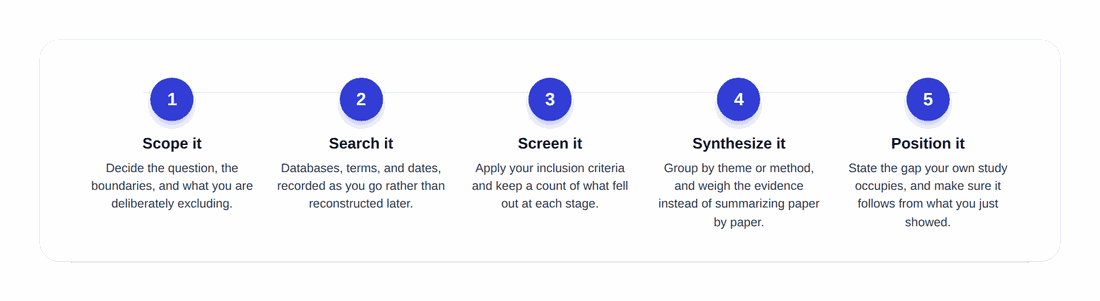
Scope it. Write down the question, the boundaries, and what you are deliberately excluding. The exclusions matter as much as the inclusions, and stating them is what separates a bounded review from an incomplete one.
Search it. Record databases, terms, dates, and filters as you go. A search log costs you five minutes a session and saves the single most painful reconstruction job in academic writing.
Screen it. Apply your criteria and keep a count of what fell out at each stage and why. Even in a narrative review, being able to say how many records you screened is a mark of seriousness.
Synthesize it. Group by theme, method, or finding rather than marching through papers one at a time. If your headings are author names, you have not synthesized anything.
Position it. State the gap your own study occupies and check that it actually follows from the evidence you just presented. A gap that appears in the final paragraph without having been demonstrated is the most common structural failure in a thesis chapter.
<ProTip title="📎 Keep a log:" description="Open a spreadsheet on day one with columns for database, search string, date run, and number of results. It takes minutes per session and it is the only way the search description item ever gets written honestly" />
The Failures Supervisors Flag Most

Five patterns account for most of the red ink, and all five are visible from the table of contents.
No stated search. The reader cannot tell whether you found the important work or the first twenty results.
Uncontested evidence. Every study agrees, which almost never happens in a real literature. Contradictory findings exist; a review that omits them looks either incomplete or selective.
A gap that arrives from nowhere. The final paragraph announces a gap the preceding thirty pages never demonstrated.
Sources that do not say what you claim. Often innocent, from citing a review rather than the primary study behind it, but it reads as carelessness. Checking that each source is credible and correctly represented is the last pass worth making.
How to Draft and Check a Review With Jenni
Step 1. Set up the document. Name the topic, the boundary, and the date range in the prompt. A review prompt without a boundary produces a draft that wanders.
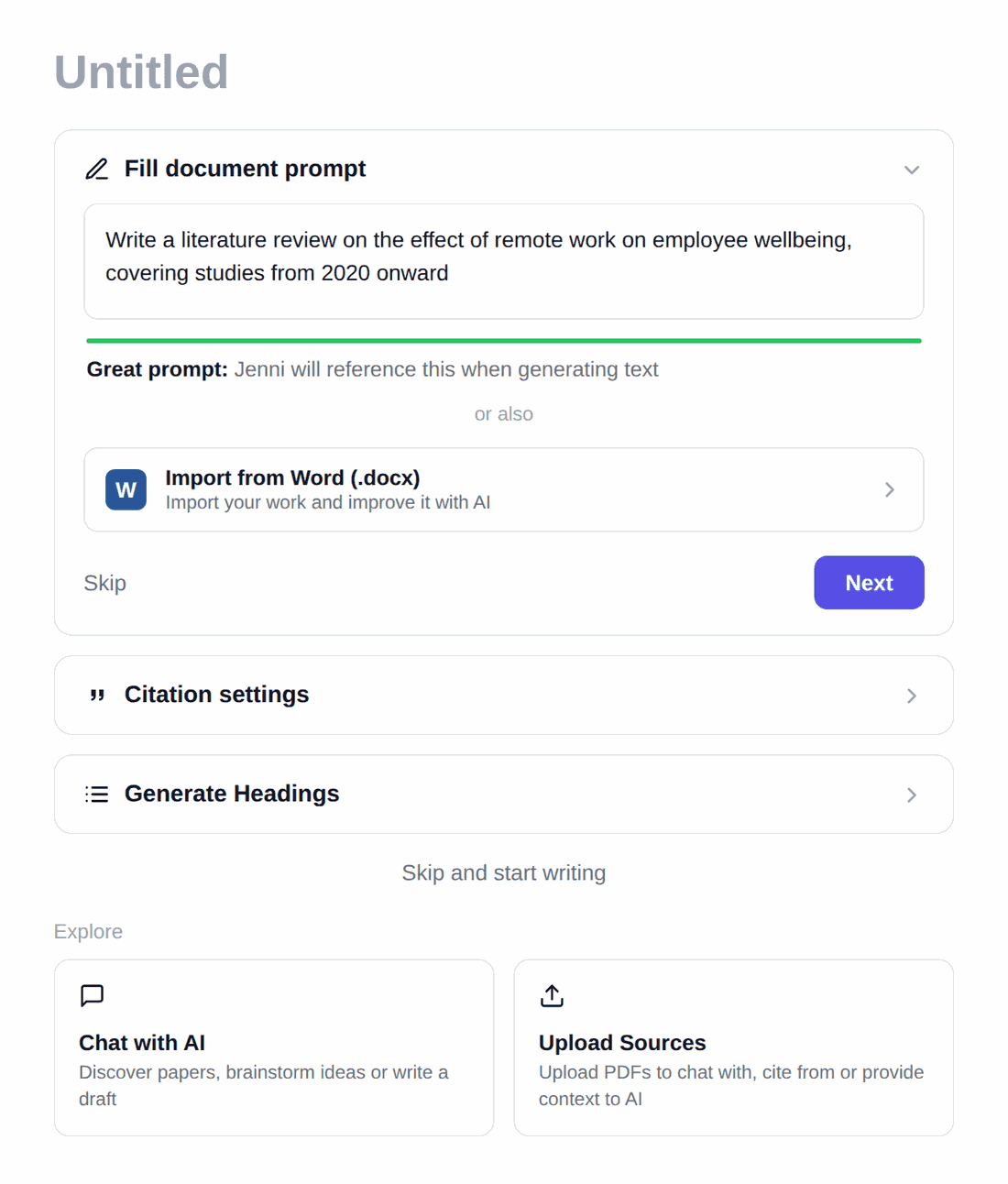
Step 2. Choose the citation style. Set the style your department expects and how many sources to draw on before drafting begins, so citations attach as you write rather than being retrofitted.
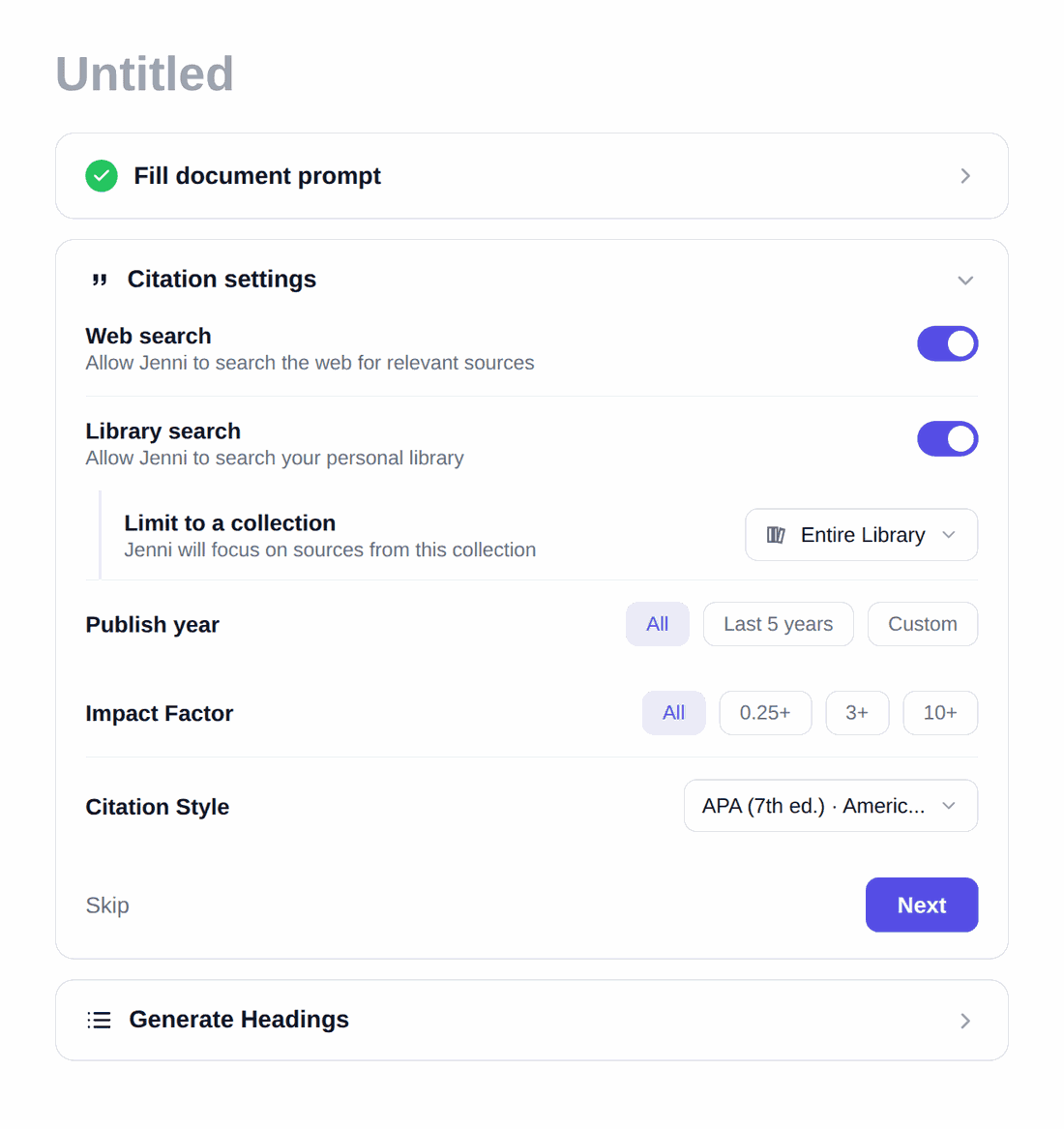
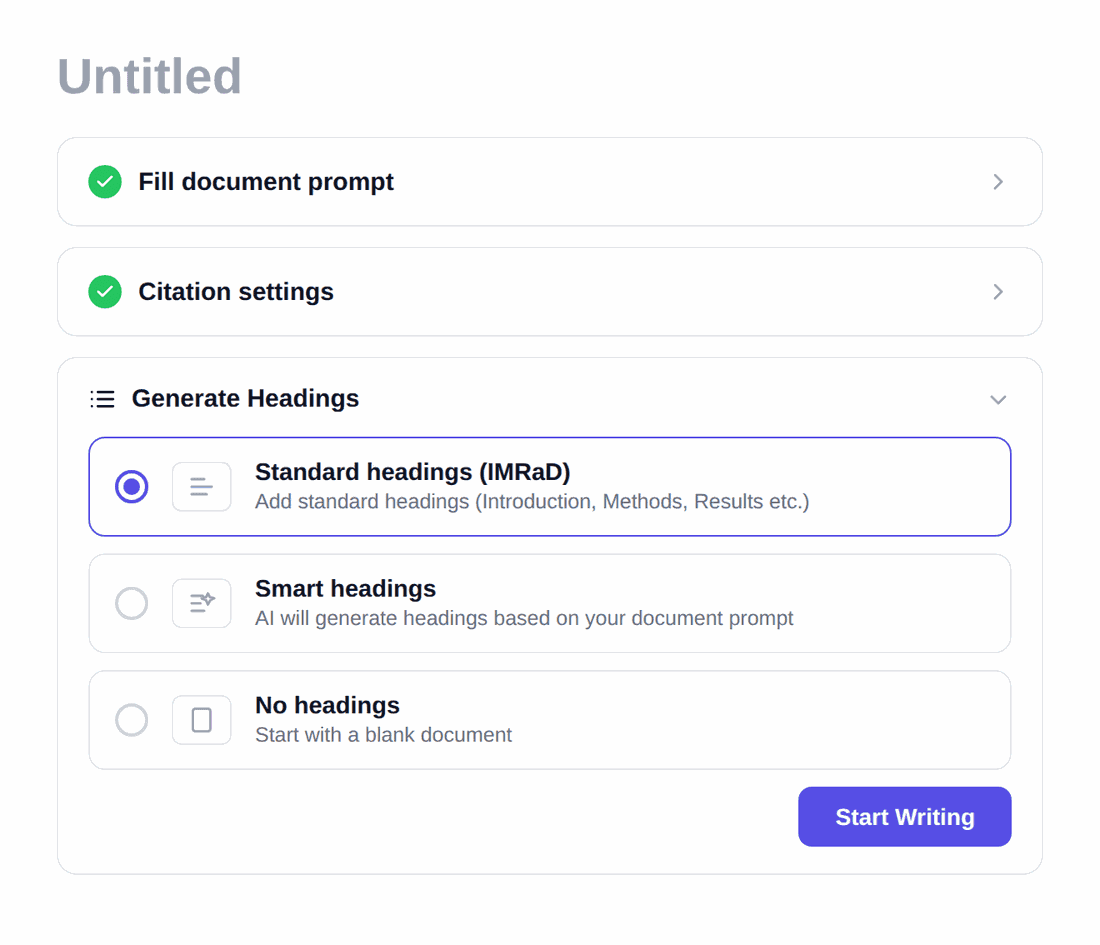
Step 3. Generate the headings. Build the outline first and make the headings thematic. This is the single decision that determines whether the chapter synthesizes or summarizes, and it is much cheaper to fix in an outline than in a draft.
Step 4. Bring your own sources in. Add papers by DOI, PMID, or ISBN, or import an existing library from Zotero, Mendeley, BibTeX, or RIS, so the reference details are right from the start.
Step 5. Run the review pass. Claim Confidence flags statements stronger than their support, which in a literature review is usually a sweeping claim attributed to a single small study. Source Quality flags citation risks such as retractions and preprints. Then check the six SANRA items yourself.
<ProTip title="🔦 Look for:" description="Search your draft for the phrase studies have shown. Every instance is a place where you have hidden the number of studies, their direction, and their quality behind three words" />
Use the Instrument That Matches Your Review
The reason generic checklists feel useless is that they are trying to serve two different documents at once. A narrative review and a systematic review have different obligations, and once you know which one you are writing, the standard tells you precisely what is missing rather than leaving you to guess.
<CTA title="Turn a Pile of Papers Into an Argument" description="Outline thematically, draft section by section, and keep every claim tied to its source" buttonLabel="Try Jenni Free" link="https://app.jenni.ai/register" />
Score your current draft out of twelve today. Then fix the lowest-scoring item before writing anything new, and keep the search log running. The same discipline carries into every other part of the document, from the methodology section to how the parts fit together.