By
Justin Wong
—
How to Tell Independent and Dependent Variables Apart

Justin Wong
Head of Growth
Graduated with a Bachelor's in Global Business & Digital Arts, Minor in Entrepreneurship
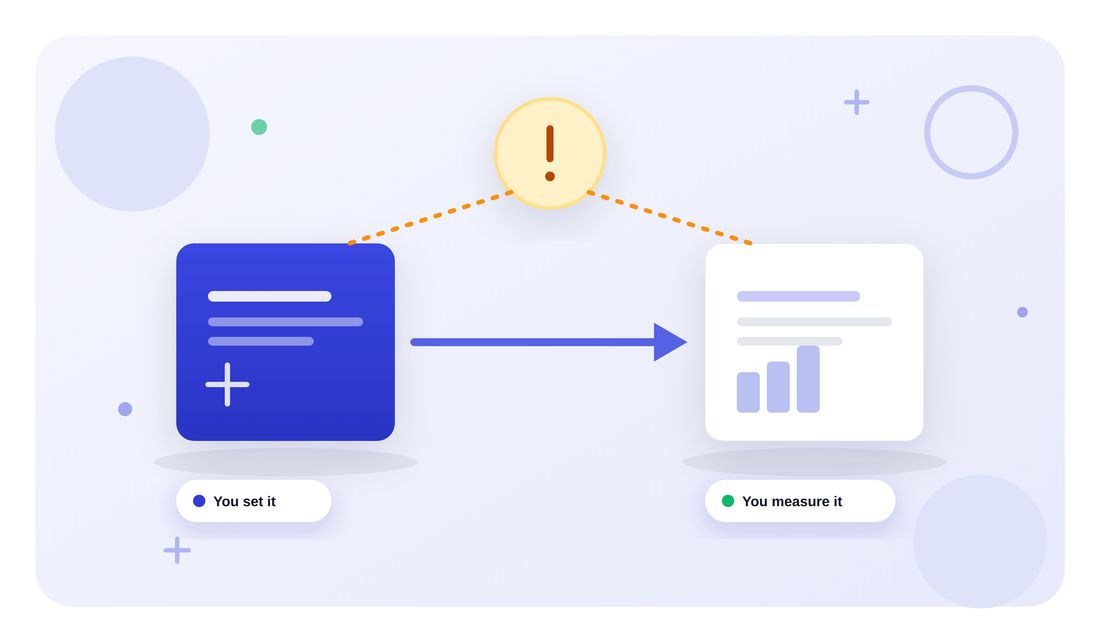
Almost every explanation of independent and dependent variables online is written for a school student. The pages that rank for this are a government site for children, a sixth-grade math review, and an encyclopedia entry. They all say the same thing: the independent variable is the one you change, and the dependent variable is the one you measure. That is correct, and it stops being enough the moment you sit down to write a methods chapter.
What follows is the version for someone who has to defend their choices: how to identify the two reliably, the four other variable types that belong in the same section, why confounders are the ones that will cost you marks, and how to write the whole thing into a paragraph an examiner will accept.
<CTA title="Write a Methods Section That Holds Up" description="Jenni helps you structure and draft each section with sources attached from the start" buttonLabel="Try Jenni Free" link="https://app.jenni.ai/register" />
What Are Independent and Dependent Variables?
The independent variable is the one you manipulate, assign, or select on. It is the presumed cause, the input, the thing that comes first. The dependent variable is the one you measure afterwards to see whether it responded. It is the presumed effect, and its value is thought to depend on the independent variable, which is where the name comes from.
National University's statistics resource puts it cleanly: the independent variable is manipulated by the researcher to determine if it will lead to change in the dependent variable, while the dependent variable is measured to see whether its value depends on that change.
Two conventions follow from this and are worth internalizing. In a graph, the independent variable goes on the horizontal axis and the dependent variable on the vertical one. In a regression equation, the dependent variable is the y on the left and the independent variables are the x terms on the right, which is why statisticians sometimes call them left-hand and right-hand side variables.
How to Tell Which Is Which
When a question is unfamiliar, work through this rather than guessing. It takes about a minute and it catches the cases where intuition fails.
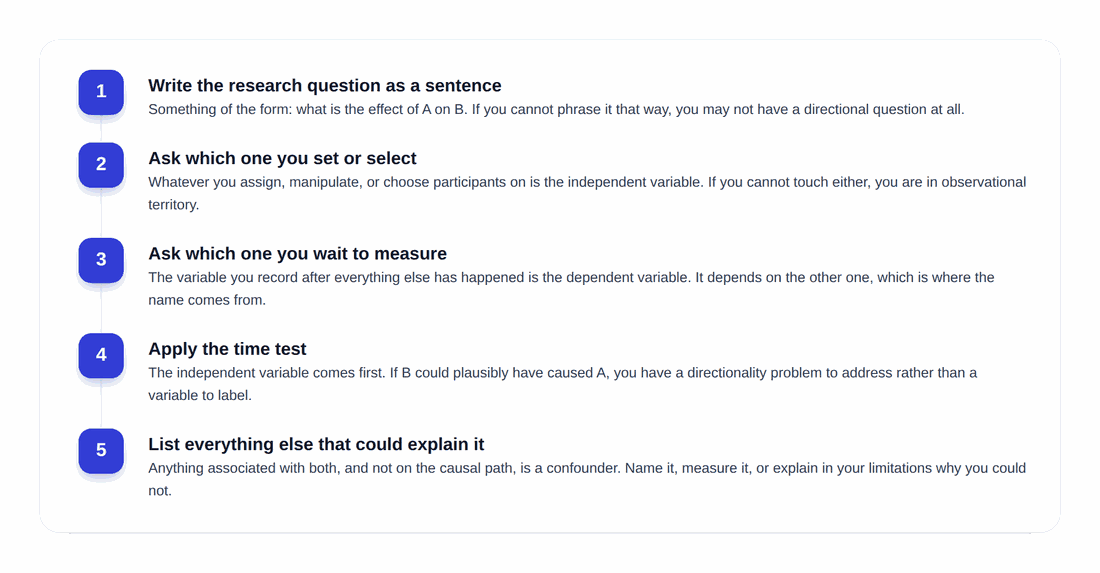
Write the research question as a sentence. Aim for the form what is the effect of A on B. If you cannot phrase it that way, you may not have a directional question, which is itself important to notice.
Ask which one you set or select. Whatever you assign, manipulate, or choose participants on the basis of is the independent variable. In an experiment you set it. In an observational study you select on it or simply record it as it occurs.
Ask which one you wait to measure. The variable you record after everything else has happened is the dependent variable.
Apply the time test. The independent variable comes first. If B could plausibly have caused A, you do not have a labeling problem, you have a directionality problem, and it belongs in your limitations.
List everything else that could explain the result. Anything associated with both variables that is not on the causal path between them is a confounder. Name it, measure it, or explain why you could not.
Applied to real questions, it looks like this.
Research question | Independent variable | Dependent variable |
Does sleep duration affect exam performance? | Hours slept the night before | Exam score |
Does a new teaching method improve retention? | Teaching method, new or standard | Retention test score at six weeks |
Does caffeine dose change reaction time? | Caffeine dose in milligrams | Reaction time in milliseconds |
Does household income predict life expectancy? | Household income, observed rather than set | Age at death |
Does feedback frequency affect job satisfaction? | Supervisor feedback sessions per month | Job satisfaction scale score |
Notice the fourth row. Nobody assigns anyone an income. That case is where the standard terminology starts to strain, and it is dealt with further down.
<ProTip title="🎚️ Set or measure:" description="If you can imagine assigning a participant to a level of the variable, it is your independent variable. If the only thing you can do is record what happened, it is your dependent variable" />
The Four Other Variables in Your Methods Section
A methods chapter that names only two variables is almost always incomplete. Reporting standards expect more, and reviewers look for them.

Control variables
A control variable is one you deliberately hold constant so it cannot vary and muddy the comparison. Testing everyone in the same room at the same time of day controls for environment and circadian effects. Control variables are not analyzed as effects; they are removed from play.
Confounding variables
A confounder is associated with both your independent and dependent variables and is not on the causal path between them. This is the one that invalidates conclusions, and it gets its own section below.
Moderating variables
A moderator changes the strength or direction of the relationship. In Baron and Kenny's canonical definition, a moderator is a variable that affects the direction and/or strength of the relation between an independent or predictor variable and a dependent or criterion variable. If your intervention works for experienced staff and not for new ones, experience is a moderator. Moderators answer for whom and when.
Mediating variables
A mediator sits on the causal path and explains the mechanism. Baron and Kenny again: a variable functions as a mediator to the extent that it accounts for the relation between the predictor and the criterion. If sleep affects exam scores because it affects concentration, concentration is the mediator. Mediators answer how.
The distinction that trips people up is moderator versus mediator. A moderator is a condition under which the effect changes. A mediator is a step in the chain by which the effect happens. Mislabeling one as the other changes your analysis and your claim.
Why Confounders Are the Ones That Matter

Confounding is the reason correlational findings get overturned, and it has a precise definition rather than a vague one. Columbia University's epidemiology teaching resource quotes Last's Dictionary of Epidemiology: confounding is the distortion of the estimated effect of an exposure on an outcome, caused by an extraneous factor associated with both the exposure and the outcome but not an intermediate step in the causal pathway between them.
That definition yields three tests, set out in Oregon State's open epidemiology textbook. To be a confounder, a variable must be statistically associated with the exposure, must cause the outcome, and must not lie on a causal pathway between the two. The third condition is the one people forget, and the textbook is blunt about the consequence: variables on the causal pathway are mediators, not confounders. Adjusting for a mediator does not clean up your estimate, it destroys the effect you were trying to measure.
The worked case: people who drink more coffee have higher rates of lung cancer. Coffee does not cause lung cancer. Smoking is associated with coffee drinking and causes lung cancer, and it is not a step in any causal path from coffee to cancer. Smoking is a confounder, and any analysis that ignores it produces a real, statistically significant, entirely spurious result.
<ProTip title="🕵️ Hunt confounders:" description="Before you collect anything, list five variables that could cause your outcome and are also linked to your predictor. Measure the ones you can. The ones you cannot are your limitations section, written in advance" />
The Same Variable Can Be Either One
There is nothing intrinsic about a variable that makes it independent or dependent. The role comes from the research question, not from the variable itself.
Sleep duration is the independent variable when you ask whether sleep affects exam performance. It becomes the dependent variable when you ask whether anxiety affects sleep. Job satisfaction is a dependent variable in a study of management practices and an independent variable in a study of staff turnover. The label describes a position in an argument.
This is also why the directionality problem is a genuine threat rather than a technicality. As the BCcampus research methods textbook illustrates, stress and poor planning are correlated, and being stressed may harm the ability to plan ahead just as easily as the reverse, while a third variable such as conscientiousness may drive both. Without an experiment or a strong temporal design, you cannot resolve that from the data alone, and pretending otherwise in a discussion section is the fastest way to lose a reader's trust.
<ProTip title="🔀 Direction check:" description="Write your causal claim backwards and see whether it still sounds plausible. If it does, your design has to justify the direction rather than assume it" />
When "Independent Variable" Is the Wrong Term
In a true experiment the terminology is comfortable, because you really do set the independent variable independently of everything else. In observational work you do not, and some methodologists consider the word actively misleading there.
The BCcampus textbook is direct about correlational designs: where neither variable is thought to cause the other and nothing is manipulated, the terms independent variable and dependent variable do not apply to this kind of research. National University makes the same point. Wikipedia notes that some authors prefer explanatory variable precisely because the quantities treated as independent may be neither statistically independent nor independently manipulable.
Be aware this is a live convention rather than a settled rule, and plenty of competent analysts use "independent variable" for observational data without apology. The practical guidance is to follow your field: epidemiology says exposure and outcome, clinical trials say endpoint, regression texts say predictor and response, and psychology says predictor and criterion in correlational work. Matching the convention signals that you know which tradition you are writing inside.
How to Write Variables Into a Methods Section

This is the step every ranking page skips, and it is the only step that actually appears in your thesis.
The best available specification comes from STROBE, the reporting standard for observational studies. Its item 7 asks you to clearly define all outcomes, exposures, predictors, potential confounders, and effect modifiers, and give diagnostic criteria where applicable. The elaboration adds three more expectations: the source of data and method of assessment for each variable, whether assessment methods were comparable across groups and over time, and the level of organization at which each variable was measured.
Read that as a checklist and the paragraph writes itself. For each variable: what it is, how it was measured, with what instrument, at what level, and why it is in the model. Here is what that looks like in practice.
The independent variable was sleep duration, measured in hours and self-reported on the morning of testing using a single-item question. The dependent variable was exam performance, operationalized as the percentage score on the standardized end-of-module assessment. Prior grade point average was measured from institutional records and included as a covariate, as it is associated with both sleep habits and academic performance and does not lie on the causal path between them.
Three sentences, and every one of them answers a question a reviewer would otherwise have to ask. Note that the third sentence justifies the covariate rather than merely listing it, which is the difference between a methods section that reports choices and one that defends them.
<ProTip title="📋 Report it:" description="Name your variables in the same words throughout the whole document. A variable called sleep duration in the methods and sleep quality in the results reads as two different constructs, and a careful examiner will ask which one you measured" />
How to Draft Your Variables Section With Jenni
Once you know what the variables are, the drafting is structural work.
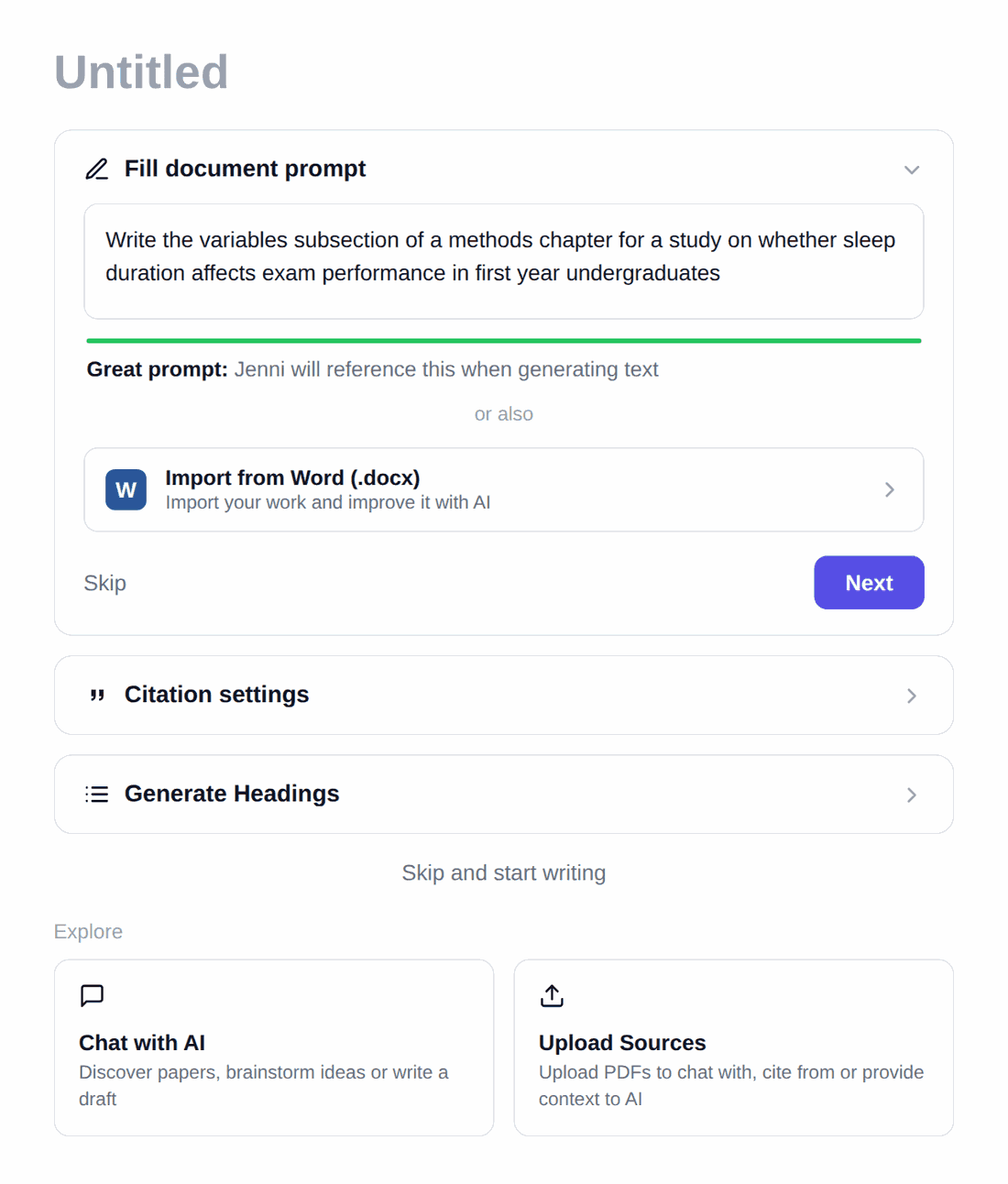
Step 1. Describe exactly what you need. Name the study, the population, and the variables in the prompt. A vague prompt returns a generic paragraph that will not survive supervision.
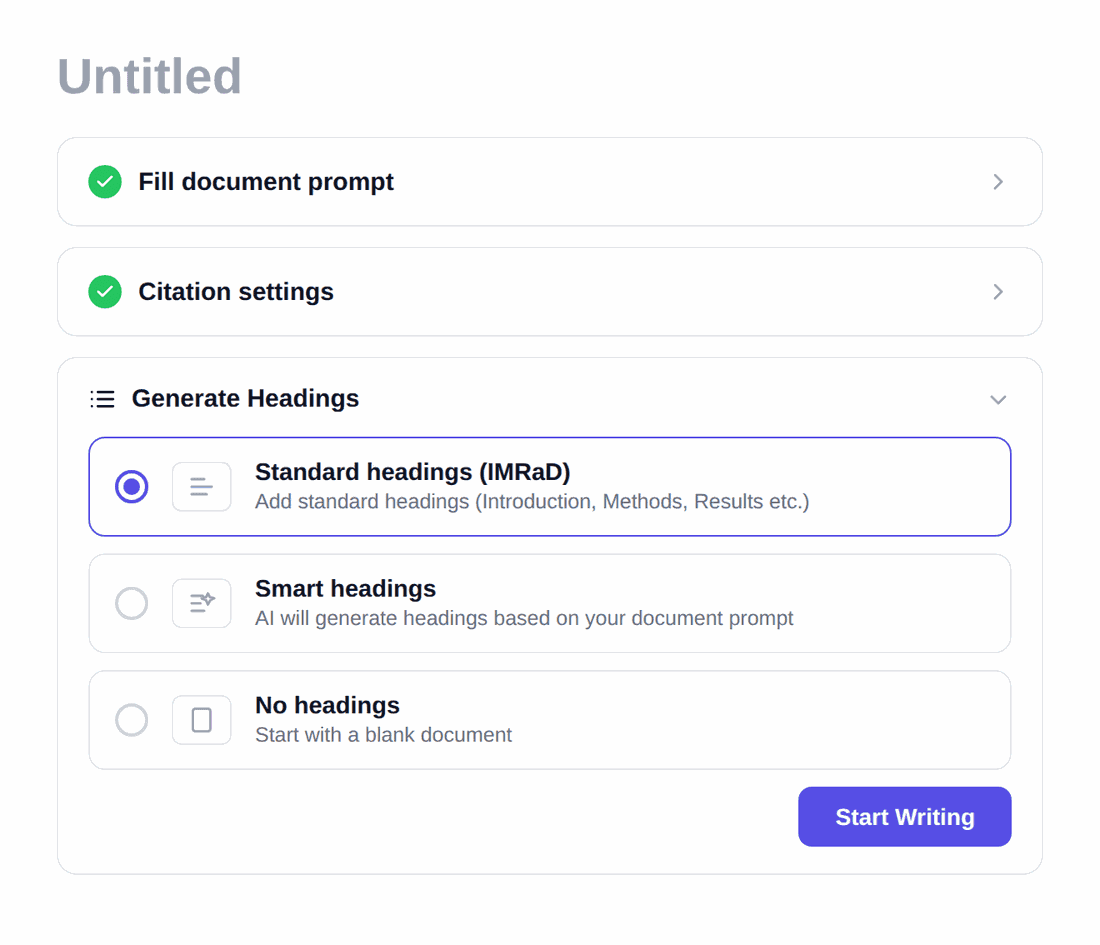
Step 2. Set your citation preferences. Choose the style your department expects. Methods sections carry a surprising number of citations, since every instrument and every established measure needs one.

Step 3. Generate the headings. Build the outline of the methods chapter before writing prose, so the variables subsection sits in the right place relative to design, participants, and analysis.
Step 4. Draft variable by variable. Work through the STROBE list for each one: definition, measure, instrument, level, and justification. Pull the citation for any published instrument into your library by its DOI so the reference is right the first time.
Step 5. Review before your supervisor does. Run Claim Confidence over the section to catch anywhere you have implied causation that your design cannot support, which in a variables section is usually a stray "affects" where "is associated with" belongs.
Get the Labels Right and the Argument Follows
Naming your independent and dependent variables correctly is the smallest part of this. The value is in what the exercise forces you to confront: whether your question is actually directional, whether you can defend the direction, what else could explain the result, and whether the words you are using match the design you ran.
<CTA title="Draft Your Methods Chapter With Confidence" description="Structure each section, cite every instrument, and check that your claims match your design" buttonLabel="Try Jenni Free" link="https://app.jenni.ai/register" />
Do the five-step check on your own question this week, then write the three-sentence version of the paragraph above. If you cannot fill in the measure or the instrument for any variable, that is the next thing to fix, well before you write another word of the methodology section. The same discipline runs through every part of a research paper, and it starts here.