By
Nathan Auyeung
—
Dependent Variable vs Outcome Variable Explained

Nathan Auyeung
Senior Accountant at EY
Graduated with a Bachelor's in Accounting, completed a Postgraduate Diploma of Accounting

In most contexts, a dependent variable and an outcome variable are the same thing wearing a different name. Both refer to the thing you measure, the thing whose value you expect to change, the thing on the left of the equation. If you have been worrying that you used the wrong one, you probably have not.
Where it does matter is signalling. The word you choose tells a reader which research tradition you are writing inside, and in one specific case it tells them something about your design. That case is worth understanding, because getting it wrong is one of the few terminology errors an examiner will actually stop on.
<CTA title="Write With the Vocabulary of Your Field" description="Jenni helps you keep terminology consistent across a long document" buttonLabel="Try Jenni Free" link="https://app.jenni.ai/register" />
The Short Answer
Dependent variable comes from the experimental tradition. It is called dependent because its value is expected to depend on the independent variable you manipulated.
Outcome variable is the broader, design-neutral term. It names the same position in the analysis without implying that anything was manipulated to produce it.
So every dependent variable is an outcome variable. Not every outcome variable is comfortably called a dependent variable, and the reason is the next section.
Why "Independent Variable" Is the Problem, Not "Dependent"
The awkwardness sits on the other side of the pair. In a true experiment you set the independent variable independently of everything else, which is what the name describes. In observational research you do not: you record income, or exposure, or prior grades, as they already are.
Some methodologists consider the experimental vocabulary actively wrong there. The BCcampus research methods textbook states of correlational designs that where neither variable is thought to cause the other and nothing is manipulated, the terms independent variable and dependent variable do not apply to this kind of research. National University's statistics resource makes the same point, noting that correlational research does not identify independent and dependent variables because the analysis does not depend on the direction of the relationship.
Because the two words travel as a pair, dropping "independent" tends to take "dependent" with it. That is how "outcome variable" ends up being the natural term in observational work, rather than through any property of the measured variable itself.
Be aware this is a live convention rather than a settled rule. Plenty of competent analysts use "independent variable" for observational data without apology, and no one will fail you for it. The practical guidance is to match your field.
<ProTip title="🧭 Pick by design:" description="If you assigned or manipulated something, dependent variable is exact. If you only observed what was already there, outcome variable is safer and says nothing you cannot defend" />
<ProTip title="🔤 Define it:" description="If you use the word covariate, say in one clause what you mean by it. Some readers will take it as a predictor of interest and others as a nuisance variable being adjusted for" />
The Same Thing in Six Vocabularies
This is the part worth bookmarking, because the synonym sets are field-specific and nobody teaches them.
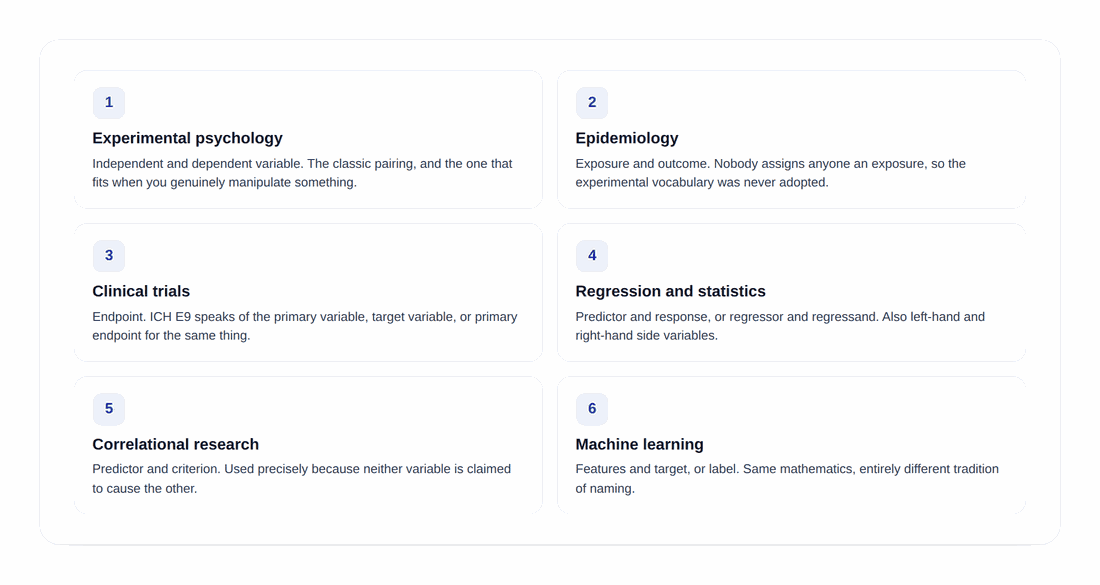
Experimental psychology uses independent and dependent variable, the classic pairing, appropriate when you genuinely manipulate something. Epidemiology uses exposure and outcome, because nobody assigns anyone an exposure and the experimental vocabulary was never adopted. Clinical trials speak of endpoints; ICH E9 refers to the primary variable, target variable, or primary endpoint for the same thing. Regression and statistics use predictor and response, or regressor and regressand, and informally the left-hand and right-hand side variables. Correlational research uses predictor and criterion, chosen precisely because neither variable is claimed to cause the other. Machine learning uses features and target, or label, which is the same mathematics under an entirely separate naming tradition.

What you measure | What predicts it | Where you will see it |
Dependent variable | Independent variable | Experimental psychology, education, most textbooks |
Outcome | Exposure | Epidemiology, public health, STROBE reporting |
Endpoint | Treatment or intervention | Clinical trials, ICH guidance, CONSORT reporting |
Response variable | Explanatory or predictor variable | Statistics and regression texts |
Criterion variable | Predictor variable | Psychometrics and correlational research |
Target or label | Features | Machine learning and data science |
One term is genuinely ambiguous and worth avoiding when precision matters: covariate. Some sources treat it as a synonym for an independent variable. In analysis of covariance it conventionally means a continuous nuisance variable being adjusted for rather than a variable of interest. If you use it, define it.
<ProTip title="🏷️ Name it once:" description="Pick one vocabulary at the start of the document and never mix. A methods section with dependent variable in one paragraph and outcome in the next reads as two people writing" />
Which Should You Actually Write?
Three questions settle it.
Did you manipulate or assign anything? If yes, dependent variable is precise and expected. If no, outcome variable is safer.
What does your field say? This outranks personal preference. Writing "dependent variable" in an epidemiology paper marks you as an outsider more surely than any grammatical error.
What does your reporting standard say? STROBE, the standard for observational studies, asks you to define outcomes, exposures, predictors, potential confounders, and effect modifiers. It never says dependent variable. If you are writing to a standard, use its words.
<ProTip title="🧾 Match the standard:" description="Check which reporting standard your target journal uses before you choose your terms. STROBE, CONSORT and PRISMA each carry their own vocabulary, and matching it removes an easy reviewer comment" />
Say the Same Thing the Same Way
The distinction is small and the discipline it demands is not. Choose the vocabulary your field uses, apply it consistently from the abstract to the discussion, and let the term you picked be honest about whether you manipulated anything.
<CTA title="Keep One Vocabulary Across a Whole Thesis" description="Draft each section with consistent terminology and every claim tied to its evidence" buttonLabel="Try Jenni Free" link="https://app.jenni.ai/register" />
If you are still working out which variable is which in the first place, the companion piece on telling independent and dependent variables apart covers the identification test and the four other variable types that belong in a methods section.