By
Nathan Auyeung
—
Deductive Reasoning Explained: Logic and Common Errors

Nathan Auyeung
Senior Accountant at EY
Graduated with a Bachelor's in Accounting, completed a Postgraduate Diploma of Accounting

Deductive reasoning is the only kind of reasoning that comes with a guarantee. If the premises are true and the structure is right, the conclusion cannot be false. That is a stronger promise than any other form of argument makes, and it is why deduction sits underneath mathematics, formal logic, and the way hypotheses get tested in science.
It is also where a specific and very common research error lives. Below: what deduction actually is, the difference between a valid argument and a true one, the five forms worth knowing, the two invalid forms that fool almost everyone, and how all of it shows up when you write a results section.
<CTA title="Build Arguments That Hold Up" description="Jenni helps you structure reasoning, check claims against sources, and write with precision" buttonLabel="Try Jenni Free" link="https://app.jenni.ai/register" />
What Is Deductive Reasoning?
Deductive reasoning moves from general statements to a specific conclusion that follows necessarily from them. It is often called top-down reasoning for that reason. You begin with something accepted as true, apply it to a particular case, and the conclusion is forced.
The textbook example is three lines long:
All mammals are vertebrates. All whales are mammals. Therefore all whales are vertebrates.
Nothing new enters at the conclusion. Everything it says was already contained in the premises, which is exactly why the guarantee holds and also why deduction can never, on its own, tell you something genuinely new about the world. Compare that with inductive reasoning, which moves from specific observations to a general claim and gains new content at the cost of certainty. Observing a thousand white swans supports the claim that all swans are white; it does not establish it.

Validity and Soundness Are Not the Same Thing
This distinction does more work than any other idea on this page, and most people who use the word "valid" casually are not using it correctly.
A deductive argument is valid when its structure guarantees the conclusion: as the Internet Encyclopedia of Philosophy puts it, a valid argument is one whose form is such that if the premises are true, the conclusion must be true. Validity says nothing whatsoever about whether the premises are actually true.
An argument is sound when it is valid and all its premises are in fact true. Soundness is the property you actually want.
Here is a perfectly valid argument that is completely unsound:
All birds can fly. Penguins are birds. Therefore penguins can fly.
The logic is flawless. The first premise is false, so the conclusion is worthless. This matters enormously in academic writing, because a literature review is a chain of arguments built on premises you did not verify yourself. Your reasoning can be impeccable and your conclusion still wrong, because one cited finding failed to replicate. Auditing your premises is a separate job from checking your logic, and knowing what makes a source credible is how you do it.
<ProTip title="🗝️ Key idea:" description="Validity is about structure and soundness is about truth. When somebody calls an argument valid, ask whether they mean the reasoning holds or the conclusion is correct, because those are different claims" />
Everyday Examples of Deductive Reasoning
Deduction is not confined to logic classes. Most people use it constantly without naming it, and seeing it in ordinary settings makes the formal versions easier to hold onto.
Medicine. Every patient with this infection tests positive on this assay. This patient tested negative. Therefore this patient does not have the infection.
Law. The statute applies to contracts signed after January 2024. This contract was signed in 2022. Therefore the statute does not apply.
Software. If the config file is missing, the service fails on startup. The service started. Therefore the config file is present.
Mathematics. Every proof is deductive by construction. The axioms are the premises and the theorem is the forced conclusion.
Aptitude tests. Deductive reasoning questions give you a set of rules and ask which conclusion necessarily follows, which is precisely the validity test applied under time pressure.
Notice how different these feel from the reasoning you use when you conclude that a restaurant is probably good because three friends liked it. That second one is induction, and it can be perfectly reasonable while still being wrong.
The Five Forms Worth Knowing
Deductive arguments come in recognized shapes. Learning the names is not pedantry: once you can see the form, you can check an argument in seconds instead of arguing about it for an hour.
Modus ponens
If P then Q. P is true. Therefore Q. If it rained, the pitch is wet. It rained. So the pitch is wet. This is the workhorse of hypothesis testing, and the form nearly every research prediction takes.
Modus tollens
If P then Q. Q is false. Therefore P is false. If the drug works, symptoms fall. Symptoms did not fall. So the drug does not work. This is the logical shape of falsification, and it is the form that gives negative results their force.
Hypothetical syllogism
If P then Q. If Q then R. Therefore if P then R. If funding rises, staffing rises. If staffing rises, waiting times fall. So if funding rises, waiting times fall. Chains of conditionals like this are how theoretical arguments get built across a literature review.
Disjunctive syllogism
Either P or Q. Not P. Therefore Q. Either the sample was contaminated or the reagent had expired. It was not contaminated. So the reagent had expired. Useful for eliminating explanations, and dangerous when the list of alternatives is incomplete.
Categorical syllogism
All M are P. All S are M. Therefore all S are P. The classical form, with three propositions and exactly three classes: a major term that is the predicate of the conclusion, a minor term that is its subject, and a middle term that appears in both premises but not the conclusion.
Two Invalid Forms That Look Valid
These two are worth more attention than all five valid forms combined, because they are persuasive, extremely common, and produce confident-sounding conclusions that do not follow.
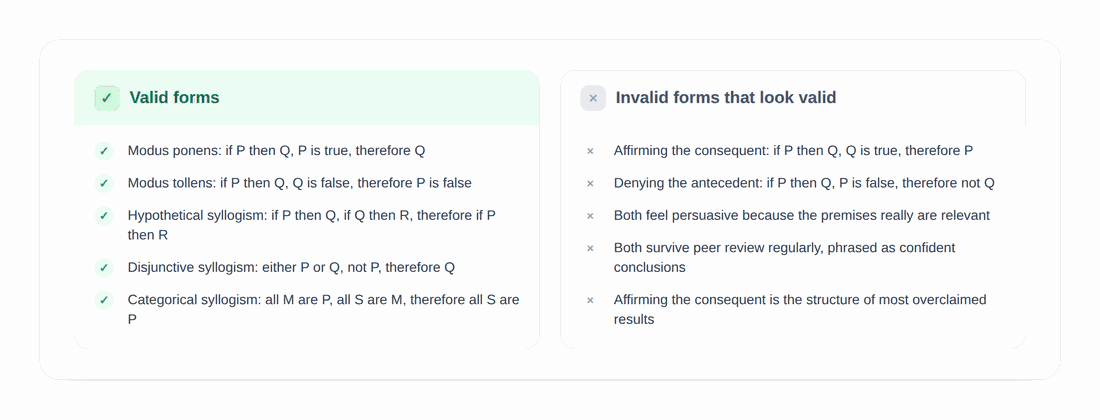
Affirming the consequent. If P then Q. Q is true. Therefore P. If the theory holds, scores rise. Scores rose. So the theory holds. Invalid, because something else could have raised the scores. This is the single most important fallacy in empirical research, for reasons the next section gets to.
Denying the antecedent. If P then Q. P is false. Therefore not Q. If the theory holds, scores rise. The theory does not hold. So scores will not rise. Invalid, because other causes exist.
Both feel compelling because the premises really are relevant to the conclusion. Relevance is not entailment, and the gap between them is where a great deal of overclaiming lives.
<ProTip title="🧩 Form check:" description="Strip an argument down to P and Q before you evaluate it. Once the content is gone, an invalid form is obvious in a way it never is while the sentences still sound authoritative" />
Deductive vs Inductive Reasoning
Most research uses both, in a cycle. The distinction is about direction and about what each one can promise you.
Deductive | Inductive | |
Direction | General to specific, top down | Specific to general, bottom up |
Promise | If premises are true, the conclusion must be true | The conclusion is probable, never guaranteed |
Judged by | Valid or invalid, sound or unsound | Strong or weak, cogent or not |
New content | None, the conclusion was already in the premises | Yes, which is why certainty is lost |
Research role | Theory testing, hypothesis testing | Theory building, pattern finding |
Typical design | Experiments, surveys testing a stated hypothesis | Grounded theory, exploratory qualitative work |
The pairing with theory is the part worth remembering. As Bhattacherjee puts it in his open methods textbook, inductive research is theory-building research and deductive research is theory-testing research, and both are needed for a field to advance.
How Deductive Reasoning Works in Research
The formal name for the research application is the hypothetico-deductive method: you deduce observable consequences from the hypothesis under test, then go and look. The Stanford Encyclopedia of Philosophy notes that it has no single founder, having been advanced by Whewell in the nineteenth century and given its standard modern formulation by Hempel in 1966.
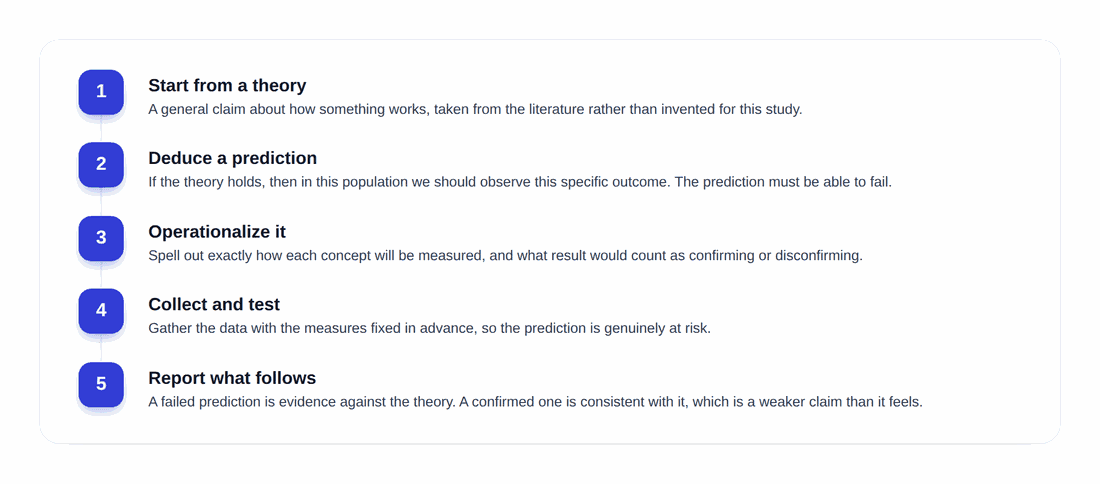
In practice the sequence runs like this. Start from a theory, taken from the literature rather than invented for the study. Deduce a prediction that follows from it: if the theory holds, then in this population we should observe this specific outcome. Operationalize it, which means spelling out precisely how each concept will be measured, including the variable, the measure, and how a result will be interpreted. Collect the data with the measures fixed in advance, so the prediction is genuinely capable of failing. Then report what actually follows, which is the step that goes wrong.
A prediction that must come true no matter what happens is not a deduction from a theory. It is a description of the theory. If you cannot state in advance what result would count against you, the study is not testing anything.
<ProTip title="📐 Structure:" description="Write your prediction as a single sentence in the form: if [theory] holds, then in [population] we should observe [measured outcome]. If you cannot fill all three slots, the hypothesis is not ready to test" />
The Reasoning Error Behind Most Overclaimed Results

Here is the connection almost nobody makes explicitly, and it is the most useful thing on this page.
Your prediction has the form if my theory is true, then I will observe this result. You run the study and observe the result. What follows? Formally: nothing. Concluding that the theory is therefore true is affirming the consequent, the invalid form from two sections ago. Some other mechanism could produce the same observation.
This is why the logic runs so much better in the negative direction. If you predicted the result and did not get it, that is modus tollens, and modus tollens is valid. Karl Popper built an entire philosophy of science on this asymmetry, arguing in The Logic of Scientific Discovery that it is logically impossible to verify a universal proposition by reference to experience, while a single genuine counter-instance falsifies the corresponding universal law.
The practical consequence is a sentence-level one. Confirmed predictions license consistent with, supports, and as predicted by. They do not license proves, demonstrates that the theory is correct, or confirms the theory. Examiners and reviewers notice the difference, and hedging correctly here reads as competence rather than weakness.
One honest complication. Real falsification is rarely clean either, because when a prediction fails you have also been testing your measures, your sample, and your manipulation. A negative result tells you that something in that bundle is wrong, not necessarily the theory. Saying so explicitly in a discussion section is a mark of a careful writer.
<ProTip title="🚫 Not so fast:" description="Search your results and discussion for the words prove, proves, and proven. In a deductive design a confirmed prediction never proves the theory, and that one word choice is what most often marks a draft as inexperienced" />
Deductive Reasoning in Qualitative Research
Deduction is usually filed under quantitative work, which is a mistake. It has a direct qualitative counterpart in deductive coding, where you build your codebook from an existing theory or framework before you touch the data, rather than letting codes emerge from it.
The rigorous version does not simply impose the framework. Writing in the International Journal of Qualitative Methods, Fife and Gossner describe deductive qualitative analysis as combining deductive and inductive work to examine supporting, contradicting, refining, and expanding evidence for the theory being examined, using sensitizing constructs from the guiding theory that must still earn their place in the results and stay grounded in the data.
Put plainly: the theory tells you where to look. It does not tell you what you found.
The Habit Worth Taking Away
Deduction is not an abstraction you learn once and file. It is a checking procedure. When an argument in a paper feels persuasive, reduce it to its form and see whether the conclusion is actually forced or merely suggested. When you write a conclusion of your own, ask whether it is entailed by what you showed or whether it is one plausible explanation among several.
<CTA title="Write Claims Your Examiner Cannot Puncture" description="Draft with sources attached and check every claim against what the evidence actually supports" buttonLabel="Try Jenni Free" link="https://app.jenni.ai/register" />
That habit shows up everywhere in academic writing: in how a research argument is built, in how methods are described, and above all in the gap between what a study observed and what its author claims it established. Most of the distance between a competent paper and a strong one is spent in that gap.