By
Nathan Auyeung
—
Data Triangulation vs Methodological Triangulation Explained

Nathan Auyeung
Senior Accountant at EY
Graduated with a Bachelor's in Accounting, completed a Postgraduate Diploma of Accounting
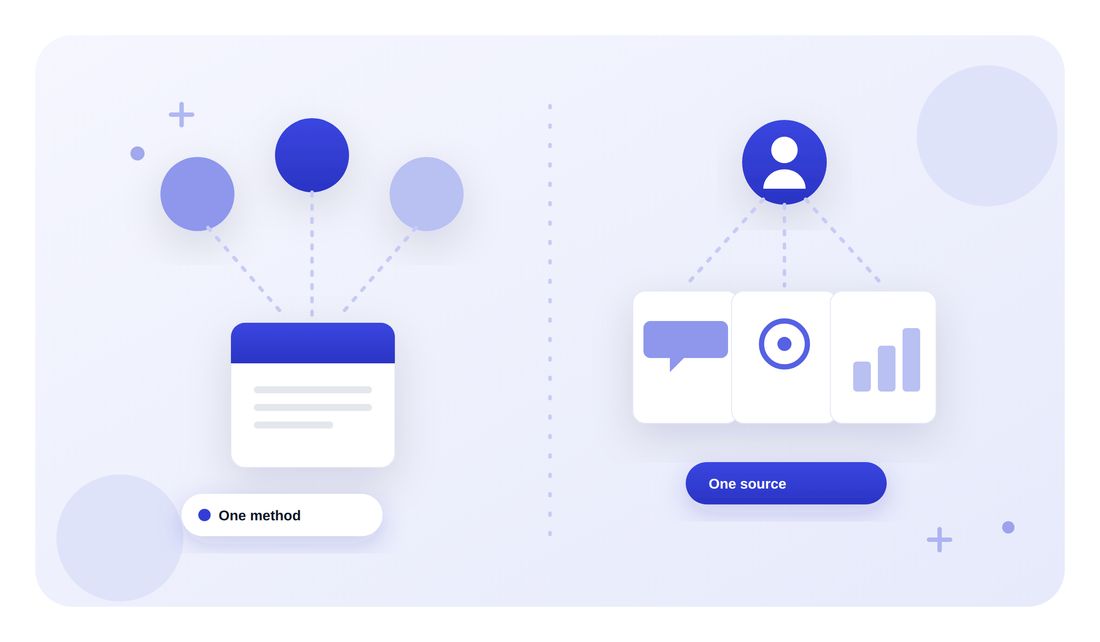
These two get used interchangeably, including by people who should know better, and the confusion is easy to clear up once you see what each one actually varies. Data triangulation changes who or when or where the data comes from. Methodological triangulation changes how you collect it. One varies the source. The other varies the instrument.
Both come from Norman Denzin's original typology, both have subtypes most guides never mention, and choosing between them is a design decision rather than a matter of taste. Here is how to make it.
<CTA title="Describe Your Design Precisely" description="Jenni helps you draft methods sections that say exactly what you did and why" buttonLabel="Try Jenni Free" link="https://app.jenni.ai/register" />
The Difference in One Line
Hold the method constant and change the source, and you are doing data triangulation. Hold the source constant and change the method, and you are doing methodological triangulation.
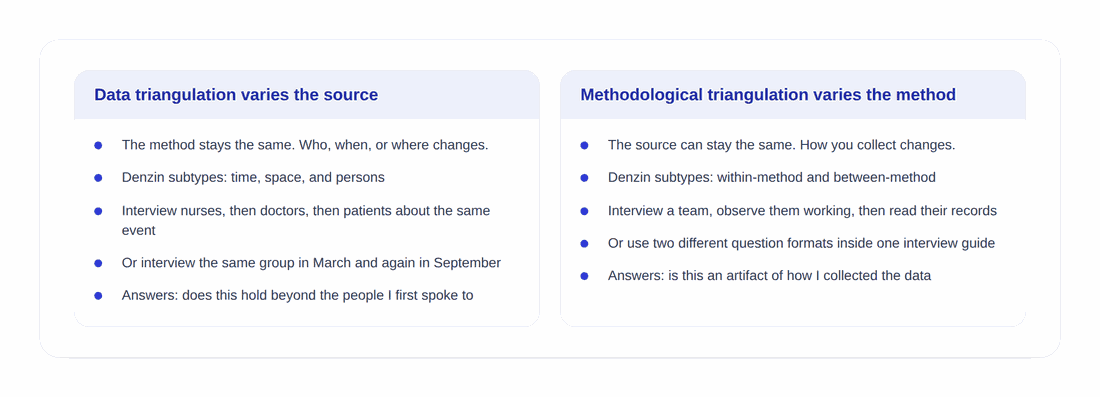
The reason this matters is that the two answer different questions. Data triangulation asks does this hold beyond the people I first spoke to. Methodological triangulation asks is this an artifact of how I collected the data. Those are separate threats, and picking the wrong one leaves the other one live.
Data Triangulation: Varying the Source
Denzin divided data triangulation into three subtypes, and naming the one you used is what turns a vague claim into a checkable one. A 2018 review in the Journal of Social Change records them plainly: data triangulation has three subtypes, time, space, and persons.
Time
Collect the same kind of data at different points. Interview a cohort at the start of a program and again six months later. This surfaces whether what you found was a stable feature or a snapshot of a particular moment, which matters enormously in studies conducted during a disruption.
Space
Collect the same kind of data at different sites or settings. Run the same interview protocol at three hospitals rather than one. If a finding appears at one site only, you have learned something about that site rather than about the phenomenon.
Persons
Collect from different types of people about the same thing. Denzin framed this as operating at the level of individuals, groups, or collectives. Speaking to nurses, then doctors, then patients about the same discharge process is the standard example, and the divergence between them is usually where the study earns its keep.
Methodological Triangulation: Varying the Method
This one has a split that almost no free guide covers, and it is Denzin's own rather than a later addition: methodological triangulation can be within method or between method.
Within-method
Use more than one technique inside a single approach. Two different question formats in the same interview guide, or a survey containing both closed items and open-ended free text. You stay within one broad method and vary how you elicit inside it. It is cheaper, faster, and weaker, because the shared method still imposes its own limits on everything you collect.
Between-method
Use genuinely different methods on the same phenomenon. Interviews plus observation plus document analysis. This is the stronger form precisely because the methods fail in unrelated ways: what people will say, what they do while watched, and what got written down are three different distortions rather than three versions of one.
Also worth noting, because it is a common misconception: methodological triangulation is not the same as mixed methods. Mixed methods research combines quantitative and qualitative components as a whole study design, with its own integration and sequencing decisions. Methodological triangulation is a narrower move that can happen entirely inside qualitative work.
<ProTip title="🧱 Within or between:" description="If both of your techniques would fail for the same reason, you are doing within-method triangulation. Say so rather than implying the stronger version, because a reader who knows the distinction will notice" />
<ProTip title="🪞 Which axis:" description="Ask what you held constant. If the protocol never changed and only the people did, that is data triangulation. If the people never changed and only the technique did, that is methodological" />
Which One Does Your Study Need?
Work from the threat you are most worried about rather than from what is easiest to arrange.
If your worry is | Use | Because |
My sample was too narrow to generalize from | Data, persons subtype | Adding a different group tests whether the finding travels |
This might have been true only during that period | Data, time subtype | A second wave separates stable patterns from moments |
This might be a quirk of this one organization | Data, space subtype | A second site distinguishes the setting from the phenomenon |
People may have told me what they thought I wanted | Methodological, between-method | Observation and documents do not depend on self-report |
My interview guide may have led participants | Methodological, within-method | A different elicitation format inside the same approach tests the instrument |
I may be reading my own framework into the data | Investigator or theory triangulation | Neither of the two here addresses analyst bias |
That last row is the honest limit of both. Varying the source or the method does nothing about the fact that one person coded everything through one theoretical lens. If that is your worry, you need a different type entirely.
Using Both, and What It Costs

Plenty of strong studies use both: interviews, observation, and documents, gathered across two sites. This is the most defensible configuration available to a qualitative project, and it is also expensive in a way research plans routinely underestimate.
The cost is not only fieldwork time. Every additional source or method multiplies the analysis, because integration is a separate task from collection. You have to decide at what stage the datasets meet, how you will compare them, and what you will do when they conflict. Doing that properly means sorting findings into agreement, partial agreement, silence, and dissonance, which is real analytical work rather than a paragraph you write at the end.
The failure mode is a study that collected three kinds of data, analyzed each one separately, and reported them in three sequential sections that never speak to each other. That is not triangulation. That is three small studies stapled together, and examiners recognize it immediately.
<ProTip title="⏱️ Plan the meeting point:" description="Decide before collection at which stage your datasets will be compared. Deciding afterwards almost always produces parallel reporting rather than genuine integration" />
How to Write Either One Into Your Methods Section
Four things belong in the paragraph, and most drafts contain only the first.
Name the type and the subtype. Not "the study used triangulation" but "data triangulation across persons, using three participant groups" or "between-method triangulation combining semi-structured interviews, non-participant observation, and document analysis".
Say what stayed constant. This is what proves you understand the distinction. In data triangulation, state that the protocol was identical across groups. In methodological triangulation, state that all three methods addressed the same phenomenon.
Say when the datasets met. During analysis, at interpretation, or both.
Say what you did with disagreement. One sentence is enough, and its absence is conspicuous.
Data triangulation was used at the level of persons. The same semi-structured protocol was administered to nursing staff, physicians, and discharged patients, and the three datasets were coded separately before being compared at the interpretation stage. Where accounts diverged, the divergence was retained and analyzed rather than resolved.
<ProTip title="💬 Say which:" description="Write the sentence naming your type before you collect anything. If you cannot write it cleanly, your design is not yet decided, and discovering that in month two is much cheaper than discovering it in your viva" />
Pick the Axis That Answers Your Doubt
The choice is not really between two techniques. It is between two questions about your own study: am I worried that I asked the wrong people, or that I asked in the wrong way. Answer that honestly and the design follows, along with a methods paragraph that reads as deliberate rather than defensive.
<CTA title="Turn Your Design Into a Clear Methods Chapter" description="Draft each section with the sources attached and the claims checked before submission" buttonLabel="Try Jenni Free" link="https://app.jenni.ai/register" />
If you want the wider picture first, the companion piece on why triangulation is used in qualitative research covers all four of Denzin's types and the argument about what triangulation can actually prove. Both feed into the same practical goal: a methodology section specific enough that another researcher could run your study, and claims that stay inside what your design supports.