By
Justin Wong
—
Appendix vs Supplementary Materials: Key Differences Explained

Justin Wong
Head of Growth
Graduated with a Bachelor's in Global Business & Digital Arts, Minor in Entrepreneurship
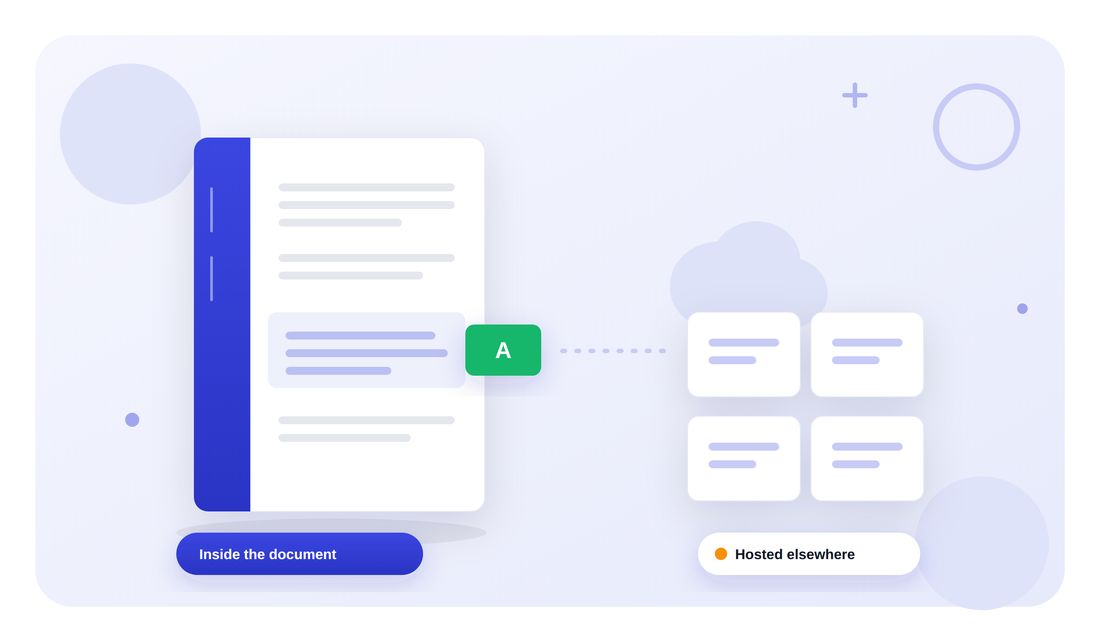
An appendix is bound inside your document. Supplementary material is hosted somewhere else and reached by a link. That is the whole distinction, and everything that follows from it, including who copy-edits the material, whether it gets peer reviewed, and whether it counts as part of the published record.
Those consequences are larger than most people expect, and publishers openly disagree about them. Nature says supplementary information is peer reviewed. IOP Publishing says its supplementary files are not reviewed by default and do not form part of the Version of Record. Both statements are on their own author pages. Below: what belongs where, what each major publisher actually says, and how to decide for a given item.
<CTA title="Keep Long Documents Organized" description="Jenni helps you structure a thesis or paper and keep every section consistent" buttonLabel="Try Jenni Free" link="https://app.jenni.ai/register" />
The Difference in One Line
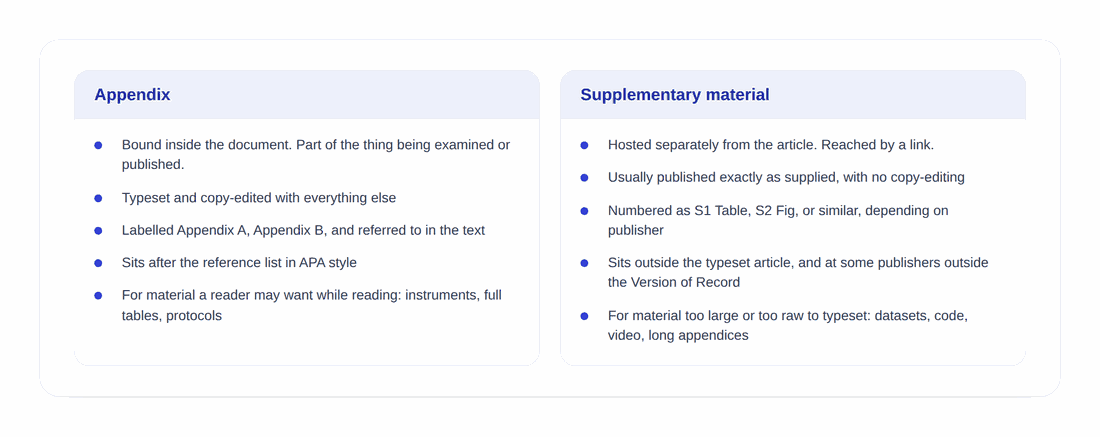
An appendix is part of the document. It is typeset with everything else, it appears in the table of contents, and a reader holding the thesis or the PDF already has it. A supplementary file lives outside the document and is retrieved separately, usually as the file you uploaded, unaltered.
A peer-reviewed editorial in Pediatric Radiology draws the practical line: appendices carry relatively concise material for reader reference placed outside the main part of the manuscript, while supplementary material holds voluminous, cumbersome, or large-format material and is not copy-edited in detail by journal staff.
The rule of thumb that follows: if a reader would want it while reading, it is an appendix. If they would only want it in order to check or reuse your work, it is supplementary.
What Goes in an Appendix

Instruments, full versions of abbreviated tables, interview schedules, coding frames, consent forms, mathematical derivations, and detailed protocols. Material a motivated reader might turn to mid-argument.
APA 7 sets the formatting conventions, and they are worth getting right because they are easy marks. If there is only one, it is titled Appendix. If there are several, they are Appendix A, Appendix B, and so on, ordered in the sequence in which they are mentioned in the text. Each appears after the reference list, with the label centered and the title on the next line. And every appendix must be referred to somewhere in the body, in the form "see Appendix B", because an appendix nothing points to reads as material you could not find a home for.
Two conventions people get wrong. Appendices come after the reference list, not before it. And ordering follows first mention in the text, not the order you happened to create them in.
<ProTip title="🖇️ Label it:" description="Write the in-text pointer at the same moment you create the appendix. Appendices added at the end almost always end up unreferenced, and an unreferenced appendix is the easiest thing in a thesis for an examiner to query" />
What Goes in Supplementary Material
Datasets, analysis code, video and audio, very large tables, extended methods, additional figures, and anything that would swamp the article if typeset. The defining features are size and rawness rather than importance.
Publishers impose real limits. Nature allows a maximum of ten files, with sound or video up to 30 MB each and a cumulative total of 150 MB. PLOS recommends keeping each file under 10 MB. IOP caps individual files at 50 MB and the total, including the article, at 150 MB.
Numbering conventions differ by publisher and are not optional. PLOS wants items cited in the text as S1 Table, S2 Fig, and so on, and accessed only via a hyperlink in the caption. Check your target journal's scheme before you build the files, because renaming a dozen supplementary items late is miserable work.
Publishers Do Not Agree, and It Matters
Here is the table that no other page on this topic seems to carry. All of it is quoted from the publishers' own author guidelines.
Publisher | Peer reviewed? | Edited? | Limits |
Yes. Describes SI as peer-reviewed material directly relevant to the conclusion of a paper | No. States that SI is not subedited | Max 10 files; sound and video up to 30 MB each; 150 MB total | |
Not stated on the guidelines page | No. States files are published exactly as provided and are not copyedited | Recommends under 10 MB per file; deposited to Figshare | |
No. States files will not be included in peer review by default | No. Not formatted or edited, and no proofs are provided | 50 MB per file, 150 MB total. Each file gets its own DOI |
IOP goes further than the others and states plainly that supplementary material does not form part of the Version of Record. That is a significant statement. It means the material is available but is not, formally, part of the published article.
Journals within a publisher differ too. The Journal of Monetary Economics tells authors that while it encourages supplementary materials, it does not review them with the same detail as the core paper.
<ProTip title="🚦 Decide:" description="Read your target journal supplementary policy before you decide what to move out of the article. If that journal does not peer review supplementary files, anything load-bearing for your conclusion belongs in the main text" />
Is Supplementary Material Peer Reviewed?

The honest answer is that it depends entirely on the publisher, and you cannot assume. That has a direct consequence for how you write.
If a claim in your results section depends on something a reviewer will never see, the claim is effectively unreviewed. In a venue that does not review supplementary files, a robustness check buried in a supplementary PDF has had no scrutiny at all, however rigorous it is. The safe practice is to keep anything your conclusion actually rests on inside the reviewed article, and use supplementary space for material that supports reuse and replication rather than material that carries the argument.
A related trap: reviewers who do have access often do not open the files. Writing "see Supplementary Table S4" in place of reporting a result is a common way to have a finding treated as though it were not there.
<ProTip title="🗃️ Archive it:" description="Never let a supplementary file be the only copy of anything. Publishers change platforms and links rot, so keep the same material in a repository with its own persistent identifier" />
Is It Citable and Indexed?
Also publisher dependent, and this is where the practical differences get sharp.
IOP mints a DOI for each supplementary file, stating that each will receive a unique identifier so that it is citable and discoverable. Nature and PLOS host supplementary files under the article's own DOI without separate identifiers, though PLOS additionally deposits to Figshare.
So: a supplementary file may be independently citable, or it may only be reachable through the article. An appendix, by contrast, is never independently citable, because it is part of the document, which is exactly what makes it dependable.
Data Availability Statements Are a Third Thing
Worth separating, because people conflate the two constantly. Supplementary material is content you upload alongside the article. A data availability statement is a declaration of where the underlying data can be found, which is usually a repository rather than the journal.
Nature's policy asks that statements describe the minimal dataset that would be necessary to interpret, replicate and build upon the methods or findings, include accession codes and links, and states that the preferred way to share large datasets is via public repositories. Datasets are then cited in the reference list rather than attached as files.
That preference is worth following on its own merits. A dataset in a subject repository gets a persistent identifier, a license, and a maintainer. The same dataset uploaded as a supplementary ZIP has none of those.
Deciding Where a Given Item Goes
Four questions, in this order.
Does my conclusion depend on it? If yes, it belongs in the main text, or in an appendix if you are writing a thesis. Never in unreviewed supplementary space.
Would a reader want it while reading? If yes, appendix. If they would only want it to verify or reuse, supplementary.
Is it data rather than exposition? If it is a dataset, put it in a repository and write a data availability statement, rather than attaching it as a file.
Can it be typeset? Video, code, and interactive material cannot. That decides it regardless of the other three.
For a thesis specifically, most of this collapses: theses have appendices, bound with the document, and supplementary material only becomes a live question when you turn a chapter into an article. At that point material that sat comfortably in an appendix has to be sorted into main text, supplementary files, or a repository, and it is worth doing that deliberately rather than by moving everything into supplementary by default.
<ProTip title="📦 Where it lives:" description="Before submitting, list every non-text item and write beside it whether it is reviewed, typeset, and citable at your target venue. Anything that is none of the three has to be something your argument can survive without" />
Put Load-Bearing Material Where It Will Be Read
The distinction sounds administrative and turns out to be about scrutiny. An appendix is inside the thing being examined. Supplementary material may or may not be reviewed, is almost never edited, and at some publishers sits formally outside the published record.
<CTA title="Organize a Long Document Without Losing the Thread" description="Structure your chapters, keep terminology consistent, and cite every source properly" buttonLabel="Try Jenni Free" link="https://app.jenni.ai/register" />
Decide by asking what the material is doing for your argument, then check the specific policy of the venue you are submitting to rather than assuming it matches the last one. The same care that goes into structuring the parts of a paper and describing your methods belongs here too, because a reader who cannot find your instrument cannot evaluate your study.