{{HeadCode}} How to Identify Research Gaps in Literature Effectively

通过

内森·奧勇

How to Identify Research Gaps in Literature Effectively

奥扬的个人资料图片

内森·奧勇

安永的高级会计师

获得会计学学士学位,完成会计研究生文凭

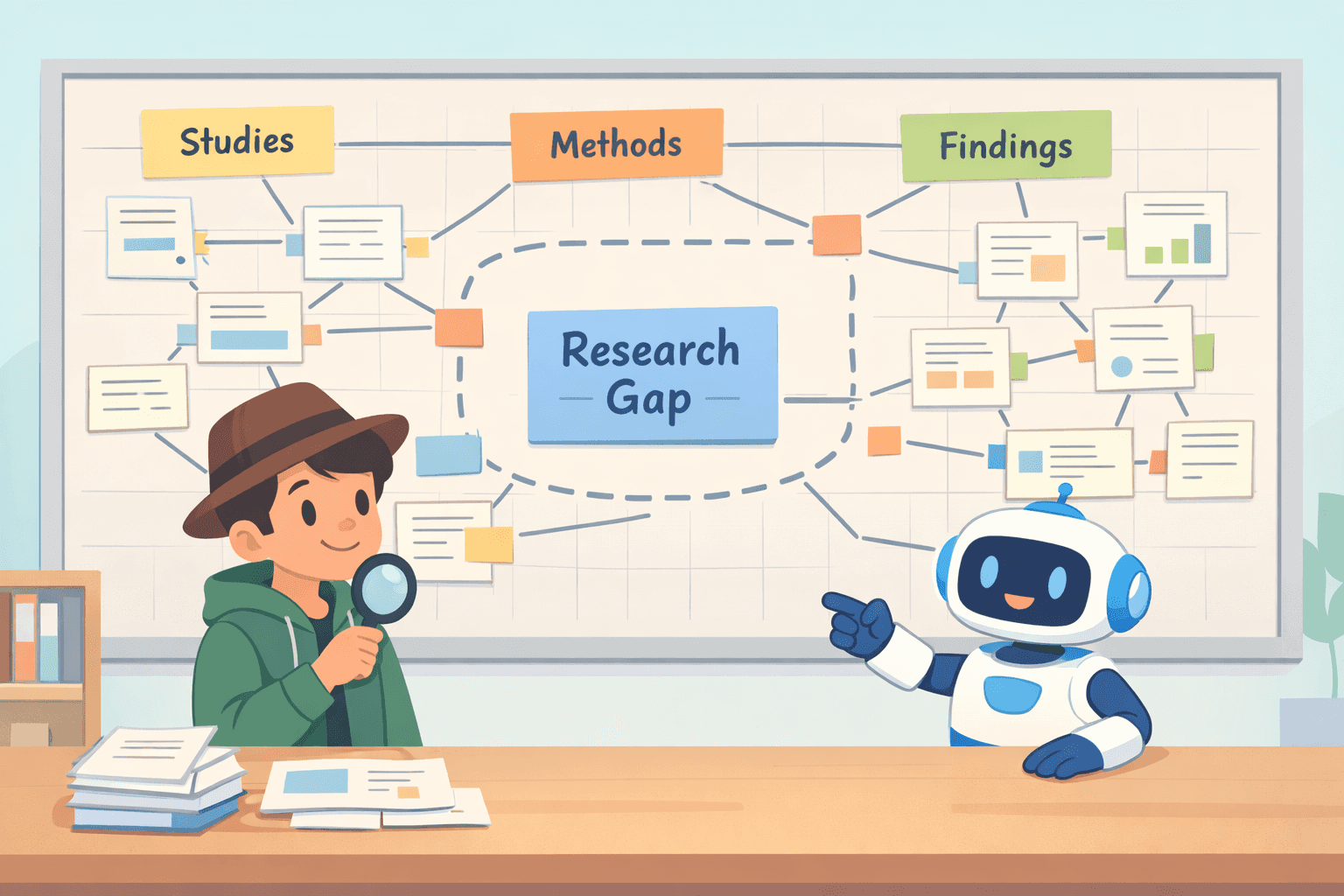
Finding a research gap isn't about discovering something no one has ever thought of. It's about spotting an unanswered question within what's already known. This guide will show you a practical method.

You'll learn to read papers with a detective's eye, organize the clues you find, and pinpoint where the current knowledge stops. By following these steps, you can move from feeling stuck to formulating a solid, researchable question. Keep reading to build your own reliable system for finding gaps that matter.

<CTA title="Find Your Research Gap Faster" description="Turn scattered papers into clear research opportunities using structured prompts and guided workflows." buttonLabel="Try Jenni Free"link="https://app.jenni.ai/register" />

What Counts as a Research Gap (And Why It Matters)

What even is a research gap? It's not just something nobody's written about. Think of it as a crack in the wall of what we already know, a specific, unanswered question that actually matters. Your job is to find that crack and explain why filling it is important.

If you want a formal academic explanation, this guide on what a research gap is and how to find one breaks it down clearly.

Research usually looks like a patchy map. Some areas are crowded with studies, others are sketchy or blank. A genuine gap shows up in a few common ways:

  • No one's looked at a specific thing yet.

  • The old studies are, well, old, or they only tell part of the story.

  • Different papers keep contradicting each other.

  • Everyone studies the same type of people or places, ignoring others.

  • The methods everyone uses are too similar and might be missing something.

Why bother finding one? Because it's the foundation. It's what makes your work new, gives your proposal a solid reason to exist, and honestly, it's what reviewers and editors are looking for. It boils down to a simple question: What's still confusing, and why should we figure it out?

Step 1: Understand What a Strong Contribution Looks Like

A common mistake is picking a broad, "interesting" topic and calling it a gap. They're different. A topic is a general area. A genuine research gap is a precise, justified opening for new knowledge.

Here's the difference.

  • A weak, vague idea: "Social media affects students."

  • A strong, researchable gap: "There's limited research on how short-form video apps impact the attention spans of university students in Southeast Asia."

See the difference? The strong version specifies the platform (short-form video), the outcome (attention span), and the context (university students in Southeast Asia).

That specificity is what makes your work defensible and actually doable. If you can't narrow it down to something that concrete, you're not looking at a gap yet.

If you need more examples, this practical guide on research gaps with examples can help clarify the difference.

<ProTip title="💡 Pro Tip:" description="If your topic feels too general, narrow it by adding population, method, or context." />

Step 2: Read Strategically Instead of Randomly

Reading every paper from start to finish is a sure way to get lost. Your goal isn't to memorize everything; it's to spot patterns and see where the conversation stops.

Start your search in three key places:

  • Review articles. These are your roadmap. They summarize years of research and often explicitly state what's still unknown. If you're working with broader thematic evidence rather than strict systematic synthesis, learning how to approach a narrative literature review can also help you trace how ideas evolve across studies.

  • Recent studies (last 5 years). This is where you find the current debate and see what questions are emerging right now.

  • Highly cited papers. These are the classics. Knowing the foundational arguments helps you understand what later studies are building on, or challenging.

If you're unsure how to approach this, this resource on how to write a literature review effectively explains how to analyze and synthesize research instead of just reading it. Seeing how that synthesis becomes the literature review section of a research paper can also make it easier to justify your gap clearly.

The gaps aren't hidden. They're often stated outright. When you're skimming a paper, go straight to these sections:

  • The Limitations section. This is where authors confess what their study couldn't do.

  • The Future Research section. Consider this a direct invitation.

  • The Discussion section. Look for points of contradiction or unresolved issues other studies mention.

Here's how it works in practice. Let's say you're looking at online education research. After scanning a batch of papers, you might see a pattern:

  • Almost all the data comes from universities in North America and Europe.

  • There's very little on rural communities or areas with poor internet.

  • The methods are nearly all surveys; hardly anyone tries an experimental approach.

You've just found several clear gaps without reading a single paper cover-to-cover.

<ProTip title="📌 Reminder:" description="You do not need 100 papers. Patterns often emerge after 10 to 15 strong studies." />

Step 3: Organize Your Literature to Reveal Patterns

Reading a lot of papers will only give you insight if you sort the information. Trying to keep it all in your head doesn't work. A simple tool like a concept matrix forces you to see the big picture. If you're not sure how to structure your notes, this guide on how to organize sources literature review can make the process much easier.

Study

Main Topic

Method Used

Population Studied

Key Finding

Study A

Online learning

Survey

University students (US)

Positive impact on grades

Study B

Online learning

Interviews

University students (UK)

Mixed results on engagement

Study C

Online learning

Survey

Urban college students

No significant effect

Look at what a basic table like this shows you immediately:

  • A population gap: Every study looks at urban or Western students. What about rural learners?

  • A methods gap: It's all surveys and interviews. Where are the experimental or longitudinal studies?

  • A contradiction: The findings aren't consistent. Why do some studies show positive effects and others show none?

If you just had these three papers in a folder, those gaps might stay hidden. Putting them side-by-side in a table makes the missing pieces obvious.

<ProTip title="🧠 Pro Tip:" description="If you cannot see patterns across studies, you cannot identify meaningful gaps." />

Step 4: Learn the Main Types of Research Gaps

Categorizing what's missing helps you spot it faster and argue for it better. Think of these as the main types of holes in the research fabric.

  • The Evidence Gap. This is the blank spot on the map. Literally no one has studied this specific thing. Example: There are no published studies on using generative AI for teaching in small, rural primary schools.

  • The Knowledge Gap. Some research exists, but a key question is still hanging. Example: We know blended learning improves test scores, but we don't understand its effect on students' long-term knowledge retention after the course ends.

  • The Methodological Gap. The way everyone is studying the topic is too narrow or repetitive. Example: The entire body of work on remote work productivity relies on self-reported surveys. There's a lack of experimental studies that track actual output.

  • The Population Gap. Research overlooks specific groups of people or contexts. Example: Hundreds of studies exist on social media use, but they overwhelmingly focus on adolescents and young adults, leaving out users over 65.

  • The Contradiction Gap. Different studies keep saying different things, and no one has resolved why. Example: Half the literature says a certain teaching method boosts engagement; the other half finds it has no significant effect.

Here's a quick way to test if you've found something: Ask these questions about your pile of articles.

  • What's missing entirely?

  • What's still unclear or confusing?

  • What feels outdated given new technology or theories?

  • What findings are inconsistent or contradictory?

If you can answer "yes" to any of those, you're likely looking at a legitimate gap.

Step 5: Apply Frameworks to Strengthen Your Analysis

Noticing a gap is one thing. Systematically proving it exists is another. Frameworks turn your hunches into structured, defensible points.

Try the SPIDER framework. It breaks a research area down into components, making it easy to see what's missing.

  • Sample – Who is being studied?

  • Phenomenon of Interest – What is being studied?

  • Intervention (or Design) – How is it being studied?

  • Evaluation – What is being measured?

  • Research type – Is it qualitative, quantitative, or mixed?

Let's apply it to "mental health apps."

  • Sample: Most studies focus on adults.

  • Missing: Teenagers.

  • Design: The research relies heavily on short-term surveys.

  • Missing: Longitudinal studies tracking users over a year or more.

Just by filling out this grid, you've clearly identified a population gap (no teens) and a methodological gap (no long-term data).

Do a timeline analysis. Plot the key studies in your area on a simple timeline. Look for two things:

  • Clusters and empty spaces. Is there a burst of activity in 2015-2018, then nothing? That's a stagnation gap, research hasn't kept up.

  • Shifts in focus. Did studies before 2020 look at effectiveness, but after 2020 they all shifted to user experience? That shift might leave the old question partially unanswered.

This visual approach often reveals gaps that a simple list of papers hides.

<ProTip title="⚡ Pro Tip:" description="Use more than one framework to confirm your gap is real and not accidental." />

Step 6: Validate Your Research Gap

Finding a hole in the literature is just the first step. You need to check if it's a pothole or a sinkhole, some gaps are too trivial, impractical, or secretly already filled.

A worthwhile research gap needs to pass three tests:

  • It's relevant. Does answering it actually move the field forward or solve a real problem?

  • It's feasible. Can you realistically study it with the time, resources, and data you have access to?

  • It's original. Has someone already published a study that does exactly what you're proposing?

Here's how to tell a weak gap from a strong one.

  • Weak: "There aren't many studies on mindfulness for students."

  • Strong: "There are no longitudinal studies measuring the impact of daily mindfulness apps on the academic resilience of first-generation college students during their initial semester."

The strong version is specific, researchable, and clearly adds something new.

How to validate your idea:

  • Do one last, thorough search for very recent publications (last 6-12 months). Someone might have just closed the gap.

  • Look for similar studies in adjacent fields. Could their findings make your question redundant?

  • Honestly ask: "What, exactly, is new here?" If your only answer is the population's country, you might need to dig deeper.

Skipping this step is risky. Validation is what turns an interesting observation into a project that has real value and a chance of getting approved.

Step 7: Turn Your Gap Into a Research Question

You've found a gap in the literature. Now you have to shape it into a question your research can address.

Take this example.

  • The Gap: Almost no studies exist on using AI in rural schools.

  • The Question: How does AI-based learning affect student engagement in rural secondary schools?

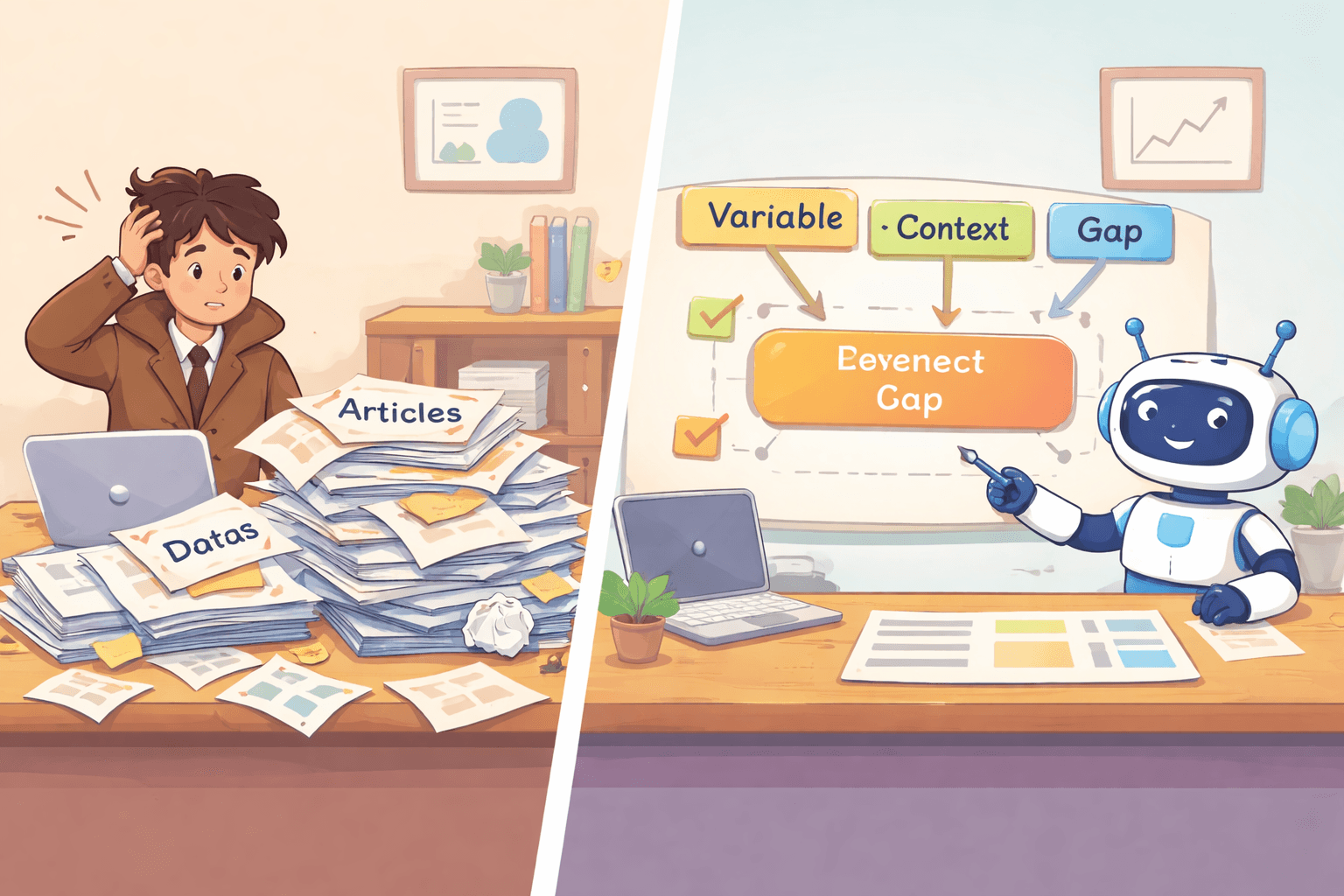
A useful method is to follow a basic formula: Gap + Context + Variable = Research Question.

This isn't just academic box-ticking. It forces you to move from a general observation ("nobody's studied this") to a concrete plan of action ("here's exactly what I will investigate").

At this stage, it also helps to map your argument using a clear structure, and this guide on how to write literature review outline can help you turn your gap into a more coherent review and proposal.

Real Example, From Start to Finish

Here’s how this process looks with a real topic.

Step 1: Pick a Topic You start with a broad area: the effectiveness of online learning.

Step 2: Dive Into the Research You read a dozen studies. A few things become clear:

  • Nearly all the research focuses on students in cities.

  • The main method used is surveys.

  • The results don’t agree with each other.

Step 3: Sort What You Find You organize the studies into a table, comparing what each one looked at.

Step 4: Spot the Trends Looking at your table, three patterns emerge:

  • There’s almost no data on rural students.

  • Very few studies use experimental methods.

  • The findings from different papers contradict one another.

Step 5: State the Gap Based on the patterns, you can define the specific gap: There is a shortage of experimental research testing how well online learning works in rural areas.

Step 6: Ask Your Question Finally, you shape that gap into a direct question: How does online learning compare to traditional classroom teaching in rural schools?

Following these steps turns a pile of confusing articles into a clear path for your own work.

Tools That Help You Find Gaps

Doing the reading yourself is essential, but these tools can help you work much faster.

Tools to Try

  • Google Scholar: The standard for finding papers and seeing who cites them.

  • ResearchRabbit: Creates maps of how studies are connected through citations.

  • Connected Papers: Builds a visual graph of related research from a single starting paper.

  • Scinapse: Helps you spot trends and get insights from large sets of papers.

If you manage your citations in Zotero or Mendeley, Jenni’s Zotero and Mendeley integration can help you bring sources into your workflow while you review and compare studies.

What They're Good For These tools make it easier to:

  • See groups or "clusters" of research on a topic.

  • Find areas that have very few studies.

  • Discover hidden links between different pieces of work.

  • Notice new trends as they start to appear.

Remember, a tool can't do your thinking for you. It just helps you see the patterns in the literature more quickly, so you can focus on the analysis.

<ProTip title="🔍 Pro Tip:" description="Use tools to explore patterns, but rely on your judgment to define the gap." />

Common Mistakes That Block Gap Identification

Even if you follow the steps, these errors can stop you from finding a real gap. For a tighter checklist of what to watch for, see how to avoid literature review mistakes in academic writing.

Starting Too Broad If your topic is huge, any gaps will be hidden. Narrow it down.

  • Too broad: Technology in education.

  • Better: AI-based tutoring in rural secondary schools.

Reading Without a Plan If you don't take organized notes, you'll forget what you read. Insights get lost.

Mixing Up Topic and Gap A topic is a general area. A gap is a specific, missing piece of knowledge that you can prove exists by pointing to the research.

Ignoring Contradictions When studies disagree, don't dismiss it. Those conflicts often point to a more interesting problem or a missing factor nobody has studied yet.

Skipping the Check You must verify your gap. If you don't double-check that it's truly unexplored, you risk building your whole project on a shaky foundation.

<ProTip title="🚫 Pro Tip:" description="Always confirm your gap with recent studies before finalizing your topic." />

Stop Feeling Lost in Research, Start Seeing the Gap

You’re staring at pages of papers, your eyes feel tired, and nothing seems to connect no matter how long you read. It’s frustrating. The more you scroll, the harder it gets to spot what actually matters or where your work fits.

<CTA title="Turn Research Gaps Into Clear Ideas" description="Organize literature, spot patterns, and build strong research questions without getting stuck." buttonLabel="Try Jenni Free" link="https://app.jenni.ai/register" />

That’s where Jenni helps you cut through the noise and move faster with real direction. It keeps your ideas organized and helps you shape a clear gap without second-guessing every step, so you can focus on building something that actually makes sense. If you want support turning your sources into a draft, the AI Literature Review & RRL Generator is designed for that literature-review workflow.

目录

今天就开启你的非凡写作之旅

从今天起,用 Jenni 写下你的 第一篇论文,开启全新篇章

免费开始

无需信用卡

随时取消

500万+

遍布全球的学者

5.2小时

每篇论文平均节省

超过1500万篇

在鉴研上完成的论文

今天就开启你的非凡写作之旅

从今天起,用 Jenni 写下你的 第一篇论文,开启全新篇章

免费开始

无需信用卡

随时取消

500万+

遍布全球的学者

5.2小时

每篇论文平均节省

超过1500万篇

在鉴研上完成的论文

今天就开启你的非凡写作之旅

从今天起,用 Jenni 写下你的 第一篇论文,开启全新篇章

免费开始

无需信用卡

随时取消

500万+

遍布全球的学者

5.2小时

每篇论文平均节省

超过1500万篇

在鉴研上完成的论文