{{HeadCode}} Literature Review Section of a Research Paper Explained

通过

内森·奧勇

2025年10月31日

通过

内森·奧勇

2025年10月31日

通过

内森·奧勇

2025年10月31日

Understanding and Writing the Literature Review Section of a Research Paper

奥扬的个人资料图片

内森·奧勇

安永的高级会计师

获得会计学学士学位,完成会计研究生文凭

奥扬的个人资料图片

内森·奧勇

安永的高级会计师

获得会计学学士学位,完成会计研究生文凭

奥扬的个人资料图片

内森·奧勇

安永的高级会计师

获得会计学学士学位,完成会计研究生文凭

The literature review is the part of a research paper that explains what scholars already know about your topic. It highlights key ideas, debates, theories, and gaps so readers can see where your study fits. Many students struggle with it because it’s more than a summary. It needs clear synthesis and a logical flow that moves from broad ideas to a focused research gap.

This guide breaks down what the literature review section is, why it matters, how it’s structured, and how to write it with confidence. You’ll also learn common patterns, best practices, and simple steps used by researchers in strong academic papers.

<CTA title="Write a Clear Literature Review" description="Create a structured, publication-ready literature review with a guided outline and smart suggestions." buttonLabel="Try Jenni Free" link="https://app.jenni.ai/register" />

What the Literature Review Section Does and Why It Matters

A literature review has one main job: to explain what the academic world already knows about your topic. 

This context is essential for readers because it helps them see how your study fits into a bigger picture. Without a literature review, readers cannot judge the strength of your research.

The section should move from broad ideas in your field to the exact research gap that your study addresses. This “funnel style” helps guide the reader smoothly from old knowledge to your new contribution.

A strong literature review helps you:

  • Show awareness of major studies

  • Understand trends in your field

  • Avoid repeating past work

  • Justify your research question

  • Build a foundation for your theory or framework

These goals make your research more credible and more useful for future scholars.

What a Literature Review Includes

A clear literature review includes the research landscape, major themes, methods used by previous scholars, gaps, and how the current study contributes. This section explains each part in a simple and approachable way.

Key Components at a Glance

You have to understand:

  • What scholars have studied

  • Themes, patterns, or debates

  • Agreements and disagreements

  • Research gaps

  • How your study fills or extends the current knowledge

The goal is not to show every source you read. It is to show the sources that matter most for your research question.

Core Purposes of a Literature Review

This section explains the reasons researchers always include literature reviews in papers, journals, and dissertations. Understanding these purposes will help you write with more clarity and intention.

1. Show What Has Already Been Studied

The first purpose is to give readers a clear picture of existing scholarship. Researchers want to know what the field already understands, what theories guide it, and what kinds of questions scholars have tried to answer.

You may find well-developed concepts, standard methods, established findings, gaps left open, or conflicting ideas. 

These patterns help you understand how scholars frame their work in ways similar to the structure shown in many literature review writing discussions.”

You may find:

  • Well-developed concepts

  • Standard methods

  • Established findings

  • Gaps left open

  • Conflicting ideas

When you highlight these areas, you help readers understand the “state of knowledge” in your field.

<ProTip title="💡 Pro Tip:" description="Use skim-reading to spot repeated terms and patterns across studies. Repeated ideas almost always become your themes." />

2. Identify Patterns, Trends, or Inconsistencies

Once you gather the major studies, the next step is to compare them. Are scholars saying similar things, or do they disagree? Are new methods becoming popular? Have ideas shifted over time?

Examples of patterns:

  • A rise in digital tools in education

  • A shift from quantitative to mixed methods

  • A new theory replacing an older model

Seeing these movements helps shape your argument and makes your review more than a simple list.

3. Reveal Gaps That Need More Research

A research gap is the missing piece in the existing literature. This is the part where your study enters the conversation. Gaps often appear in the “future research” section of journal articles, but they also emerge when findings are inconsistent or only based on narrow samples.

Common gap examples:

  • Under-studied groups

  • New variables

  • Outdated theories

  • Limited geographic areas

  • Untested methods

These gaps give your research purpose and direction.

4. Clarify the Theoretical or Conceptual Background

Some fields use theories or models to shape analysis. Your literature review should explain these ideas in simple terms. It should show how concepts relate to each other and how researchers define the major terms used in your field.

This helps readers understand your framework and the logic behind your study.

5. Support Your Research Question and Design

A good literature review also lays the foundation for your method. When you understand how other scholars study similar questions, you can justify your choices about sampling, data collection, and analysis.

How a Literature Review Is Structured

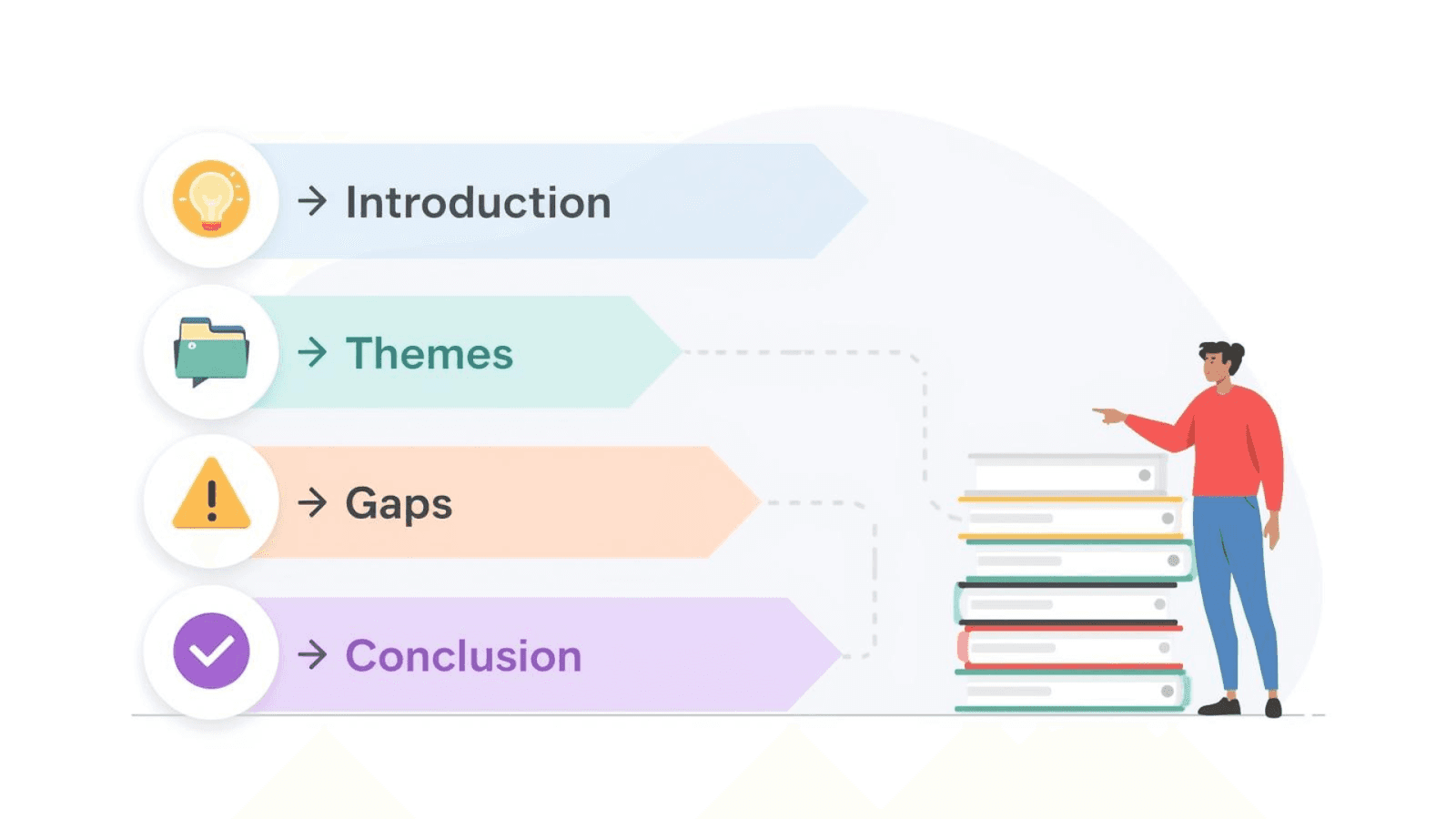
A strong opening includes a short overview of the topic, a clear scope statement, and a rationale for the type of organization you will use. 

This helps the reader see how your review flows logically. Especially when following approaches used by many to structure a review frameworks that move from broad to specific themes.

1. Introduction Section

The introduction sets up the scope and purpose of the review. It explains what you will cover and why these sources or themes matter.

A strong opening includes:

  • A short overview of the topic

  • A clear scope statement

  • A rationale for the type of organization (thematic, chronological, or methodological)

2. Main Body of the Literature Review

The body organizes sources in a way that highlights patterns and shows how ideas connect. The most common structures are:

Thematic Organization (Most Recommended)

This structure groups studies by shared topics or themes.

Example themes:

  • Digital learning tools

  • Teacher-student interaction

  • Motivation and performance

It is the most flexible and the most persuasive.

Chronological Structure

This structure follows the timeline of how research developed. It works when the field shows clear historical progress.

Methodological Structure

Here you group studies based on research designs such as:

  • Qualitative

  • Quantitative

  • Mixed methods

  • Case studies

  • Meta-analysis

This structure is helpful when your field debates methodology.

<ProTip title="🔎 Pro Tip:" description="Choose thematic structure when in doubt. It makes synthesis easier and improves logical flow." />

3. Conclusion of the Literature Review

The conclusion summarizes what is known, what is missing, and why your study matters. A strong ending includes:

  • A short recap of key patterns

  • A direct mention of gaps

  • A link to your research question or study

How to Write the Literature Review Section Step-by-Step

Writing a strong literature review involves a clear, step-by-step process:

1. Define the Research Question

You cannot search or review effectively without a clear research question. A strong question guides your keyword choices and helps you focus on relevant studies.

2. Search for Sources Using a Structured Strategy

A documented search strategy improves credibility and prevents missed literature. You can use database search, Boolean operators, keyword expansion, synonyms, and thesaurus terms to refine your process. 

Many studies also use focused keyword strategies similar to those seen in consumer research topics where precise terms determine the strength of results.

Useful tools include:

  • Database search

  • Boolean operators (AND, OR, NOT)

  • Keyword expansion

  • Synonyms

  • Thesaurus terms

Elements of a Good Search Strategy

Take notes of these aspects:

  • Primary keywords

  • Secondary terms

  • Alternate spellings

  • Subject headings (e.g., MeSH)

  • Inclusion criteria

  • Exclusion criteria

3. Screen and Select Relevant Studies

Screening keeps your review clean and credible. Remove studies that do not relate to your research question or use unreliable methods.

Screening steps:

  1. Review titles

  2. Review abstracts

  3. Review full texts

This prevents overload and keeps your review focused.

4. Extract the Most Important Data

Data extraction helps you compare sources. Common extraction items:

  • Author and year

  • Purpose

  • Method

  • Sample

  • Key findings

  • Limitations

<ProTip title="📝 Pro Tip:" description="Create a simple table to track findings so you can compare sources quickly." />

5. Analyze and Synthesize

Analysis is understanding. Synthesis is connecting.

You need both.

Examples of synthesis statements:

  • “Several studies confirm…”

  • “A strong disagreement exists across authors…”

  • “Recent findings shift toward…”

Synthesis shows that you understand the big picture

6. Group the Studies Into Themes

Themes help shape your structure. You can identify themes by looking for repeated:

  • Concepts

  • Variables

  • Methods

  • Problems

  • Models

7. Write the Section With Clear Transitions

Transitions help connect ideas. Examples include:

  • “In contrast…”

  • “Similarly…”

  • “Building on this…”

  • “However…”

Strong transitions make your review feel smooth and logical.

8. Show the Research Gaps Directly

A research gap is the missing piece that your study will address.

Examples:

  • A population not studied

  • A variable not tested

  • Mixed results that need clarification

Mention the gap clearly near the end of the section.

9. Connect the Gap to Your Study

This is where you explain how your research fills the space left by previous studies.
A clear link shows the contribution of your work.

Different Types of Literature Reviews You May Encounter

Not all literature reviews look the same. Here are the most common types and when they are used.

1. Narrative Review

A narrative review gives a broad, descriptive overview. It is common in humanities and early-stage research.

2. Systematic Review

A systematic review uses strict methods to locate and analyze studies. It follows fixed criteria and often uses quality assessment tools.

3. Scoping Review

A scoping review maps a field broadly. It works well for emerging topics or interdisciplinary fields.

4. Integrative Review

This type mixes theoretical and empirical studies. It allows a wide range of sources.

5. Historical Review

A historical review traces how theories or ideas developed over time.

Best Practices for a Strong Literature Review Section

A strong literature review is built on a set of practical best practices that improve clarity and credibility.

1. Be Selective With Sources

Do not include every study you find. Focus on those directly tied to your research problem.

2. Critically Evaluate the Sources

A strong review does not take studies at face value. You can evaluate:

  • Sample size

  • Bias

  • Data collection

  • Analysis methods

This boosts your credibility as a researcher.

3. Use Academic, Peer-Reviewed Sources

Prioritize:

  • Journal articles

  • Books from academic presses

  • Dissertations

  • Review articles

Avoid random blogs or opinion pieces.

<ProTip title="📘 Pro Tip:" description="Use review articles to understand the big picture quickly before diving into primary studies." />

4. Cite Accurately and Consistently

Citation shows respect to original authors and builds trust. Follow the style required by your field, such as APA, MLA, or Chicago.

5. Maintain Coherence and Flow

The review should read like a smooth argument, not a list. Transitions and synthesis help you maintain flow.

Examples of Themes in a Literature Review (Short Illustrations)

Short examples help you visualize how themes appear in real writing.

Example 1: Mobile Learning Research

Theme: Student Motivation
Studies show mobile apps increase motivation due to interactive features and instant feedback.

Theme: Learning Outcomes
Several researchers report improved test scores, but findings differ across age groups.

Theme: Teacher Perceptions
Teachers express mixed feelings because of classroom management challenges.

Example 2: Workplace Safety Research

Theme: Technology Adoption
Digital reporting tools reduce errors in high-risk industries.

Theme: Human Factors
Human fatigue remains a major cause of accidents.

Theme: Organizational Culture
Supportive leadership improves safety compliance.

Checklist Before Finalizing Your Literature Review

Use this quick list to ensure your section is complete:

  • Introduction defines scope

  • Clear themes in the body

  • Synthesis, not summary

  • Strong transitions

  • Identified research gaps

  • Connection to your study

  • Accurate citations

  • Smooth flow and coherence

<ProTip title="✔️ Pro Tip:" description="Read your review aloud. If the logic feels disconnected, reorganize your themes before re-writing." />

Strengthening the Literature Review Section of a Research Paper

A strong literature review section of a research paper does more than list sources. It shows what scholars agree on, where debates still stand, and which gaps need attention. By using clear themes and tight synthesis, you guide readers toward the logic behind your research question.

<CTA title="Write a Clear Literature Review" description="Use an outline-first approach to build a strong, focused review fast." buttonLabel="Try Jenni Free" link="https://app.jenni.ai/register" />

Using Jenni can help you build this section with a clean outline, sharper structure, and smoother flow. It keeps your review focused, readable, and ready for publication.

目录

今天就开启你的非凡写作之旅

从今天起,用 Jenni 写下你的 第一篇论文,开启全新篇章

免费开始

无需信用卡

随时取消

500万+

遍布全球的学者

5.2小时

每篇论文平均节省

超过1500万篇

在鉴研上完成的论文

今天就开启你的非凡写作之旅

从今天起,用 Jenni 写下你的 第一篇论文,开启全新篇章

免费开始

无需信用卡

随时取消

500万+

遍布全球的学者

5.2小时

每篇论文平均节省

超过1500万篇

在鉴研上完成的论文

今天就开启你的非凡写作之旅

从今天起,用 Jenni 写下你的 第一篇论文,开启全新篇章

免费开始

无需信用卡

随时取消

500万+

遍布全球的学者

5.2小时

每篇论文平均节省

超过1500万篇

在鉴研上完成的论文