The phrase “et al.” means “and others.” You use it in APA citations when a source has more than two authors. It helps you shorten the list. For example, you’d cite a book by Smith, Jones, and Brown as (Smith et al., 2020) in your text.
The rules change slightly between your first citation and later ones. Keep reading to see the examples and get it right in your next paper.
<CTA title="Write APA Citations With Less Confusion" description="Use Jenni to organize sources, format citations, and keep your academic writing clearer." buttonLabel="Try Jenni Free" link="https://app.jenni.ai/register" />
Understanding Et Al in APA Style
Et al. is Latin for "and others." In APA style, you use it to shorten citations that have multiple authors.
The American Psychological Association's 7th edition manual sets the rules for this. The main goal is to make things clearer.
If you want to explore the official APA 7th edition citation guidelines, you can refer to this APA citation guide.
Listing every single author's name over and over can clutter up a paper and make it hard to read. The et al. abbreviation cuts down on that repetition.
Think about a study written by five or six people. Citing them all each time you mention their work would take up a lot of space on the page.
APA's rule lets you list the first author followed by "et al." after the first full citation. This keeps the writing clean and lets the reader focus on your ideas, not a long list of names.
It's a standard practice now, so using it correctly helps your paper fit in with other academic work.
<ProTip title="💡 Pro Tip:" description="Always check APA 7th edition rules before using older citation formats. Et al. rules changed between editions." />
Et Al Example in APA for 3 or More Authors
The most common use of et al. happens when a source has three or more authors. APA 7th edition simplifies this by using the first author followed by et al. from the first citation.
If you're unsure about how to use et al. in APA citations, this et al. usage guide provides clear examples and explanations.
According to APA Style guidelines from the American Psychological Association, this rule applies consistently across in-text citations.
When writing citations in APA format:
Parenthetical citation: (Smith et al., 2023)
Narrative citation: Smith et al. (2023) argued that...
The format is straightforward. In a parenthetical citation, you put it in parentheses like this: (Smith et al., 2023). If you're mentioning the authors in the flow of your sentence, you write it as: Smith et al. (2023) argued that...
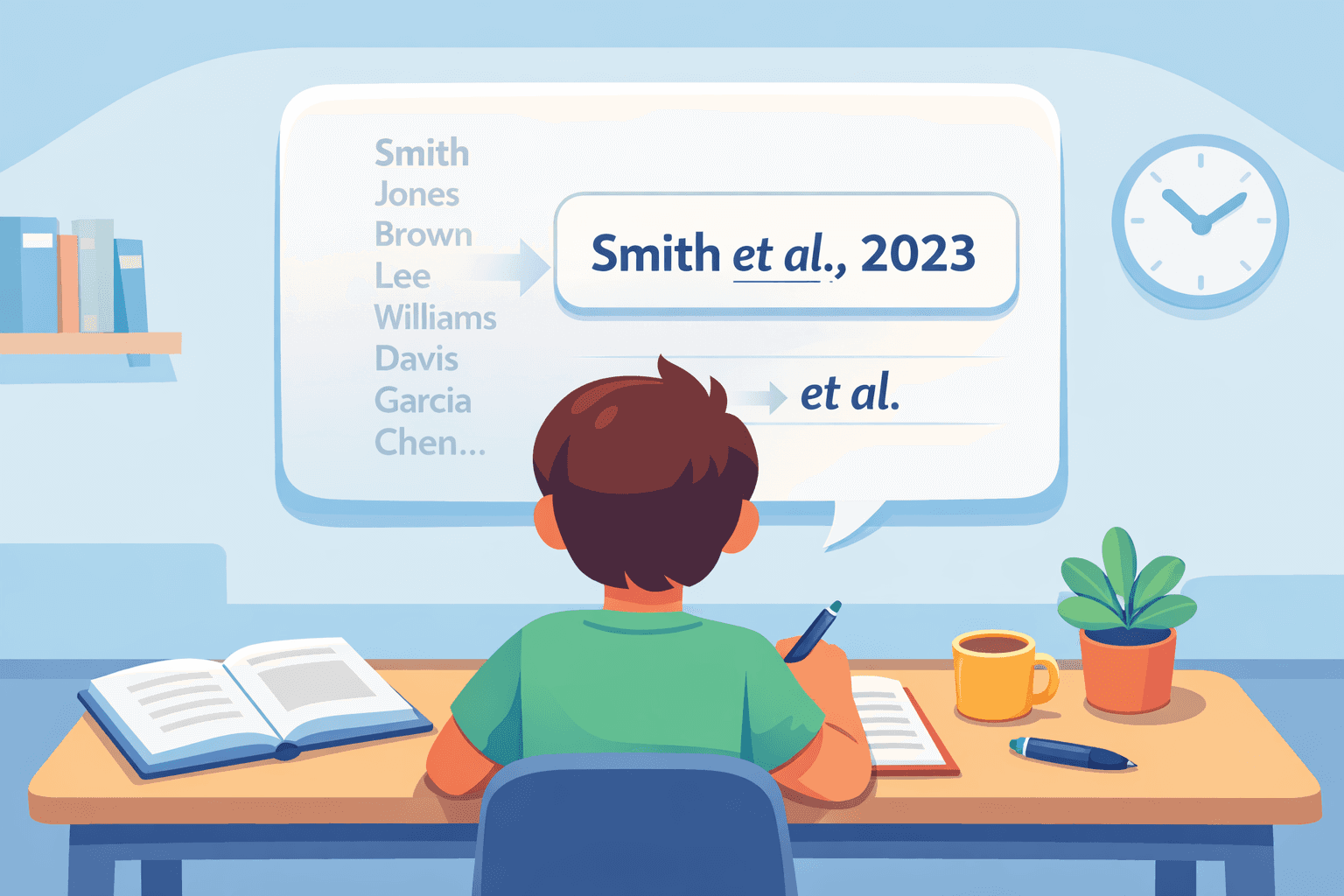
You only ever write the first author's last name. The "et al." part does the work of standing in for all the other contributors. Then you add the year.
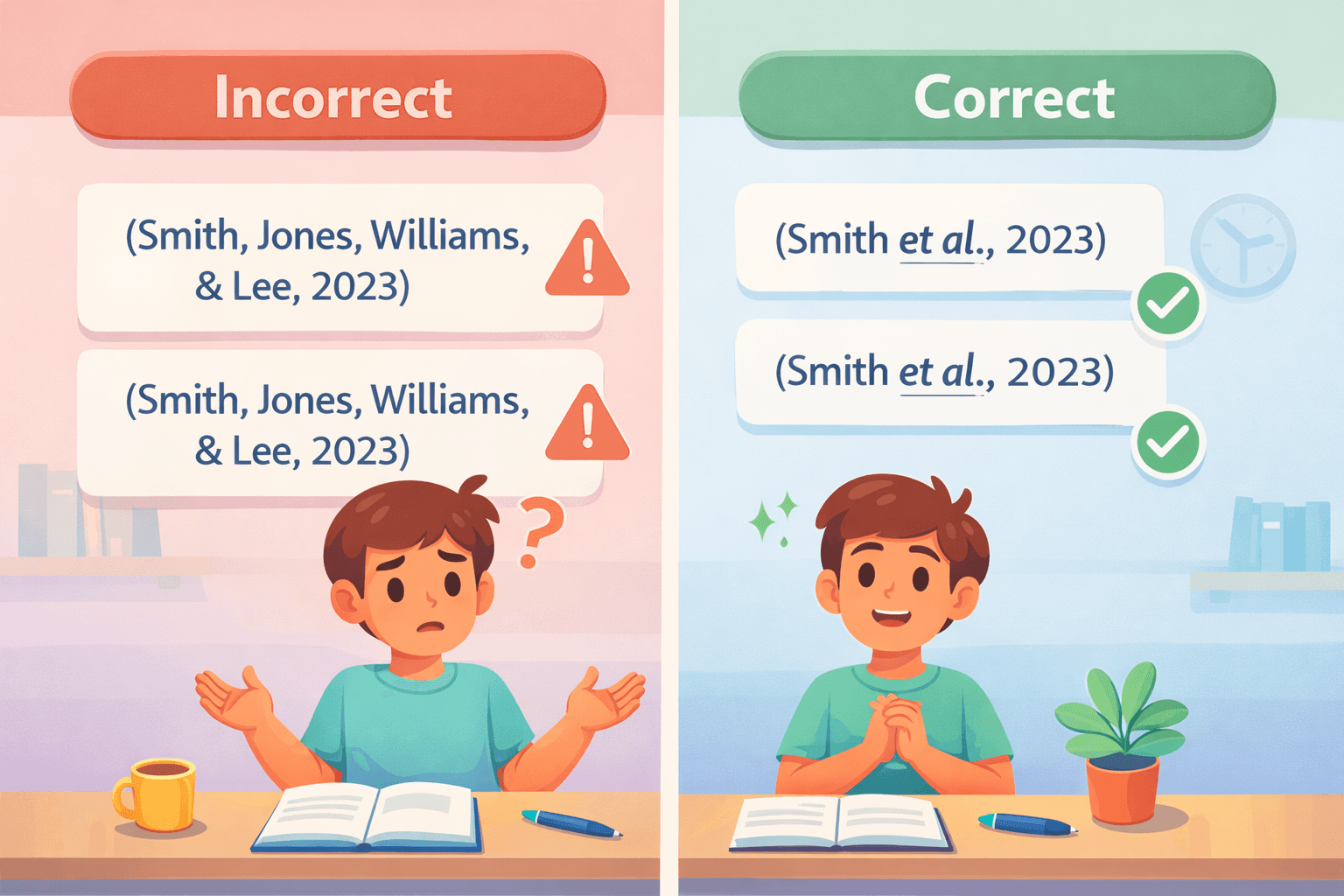
So, instead of writing a clunky sentence that says, "A recent study by Smith, Jones, Williams, and Lee (2023) demonstrated the effect," your text becomes smoother: "Smith et al. (2023) demonstrated the effect."
If you're working across different study frameworks, such as those explained in research paradigms, you'll often encounter multi-author papers where this rule becomes essential.
<ProTip title="💡 Pro Tip:" description="For sources with three or more authors, use et al. from the first in text citation in APA 7th edition." />
Et Al Examples Across Different Author Scenarios

The rules for using "et al." depend entirely on how many authors are on a source. Getting this right keeps your citations correct and avoids simple errors in your papers.
Resources like the Purdue Online Writing Lab (OWL) are good places to see these formats in action. You can also review detailed APA in-text citation rules for multiple authors in this APA citation resource.
Here’s a breakdown of how APA 7th edition handles different situations:
One author vs. multiple authors
One author: You just use that author's name. For example: (Johnson, 2022) or Johnson (2022) stated...
Two authors: You list both names every time, connected by an ampersand (&) in parentheses or "and" in the sentence. For example: (Johnson & Lee, 2022) or Johnson and Lee (2022) argued...
Three or more authors: This is where "et al." comes in. You use it from the very first citation. For example: (Johnson et al., 2022) or Johnson et al. (2022) found...
Comparison table of APA citation formats
Number of Authors | Parenthetical Citation | Narrative Citation |
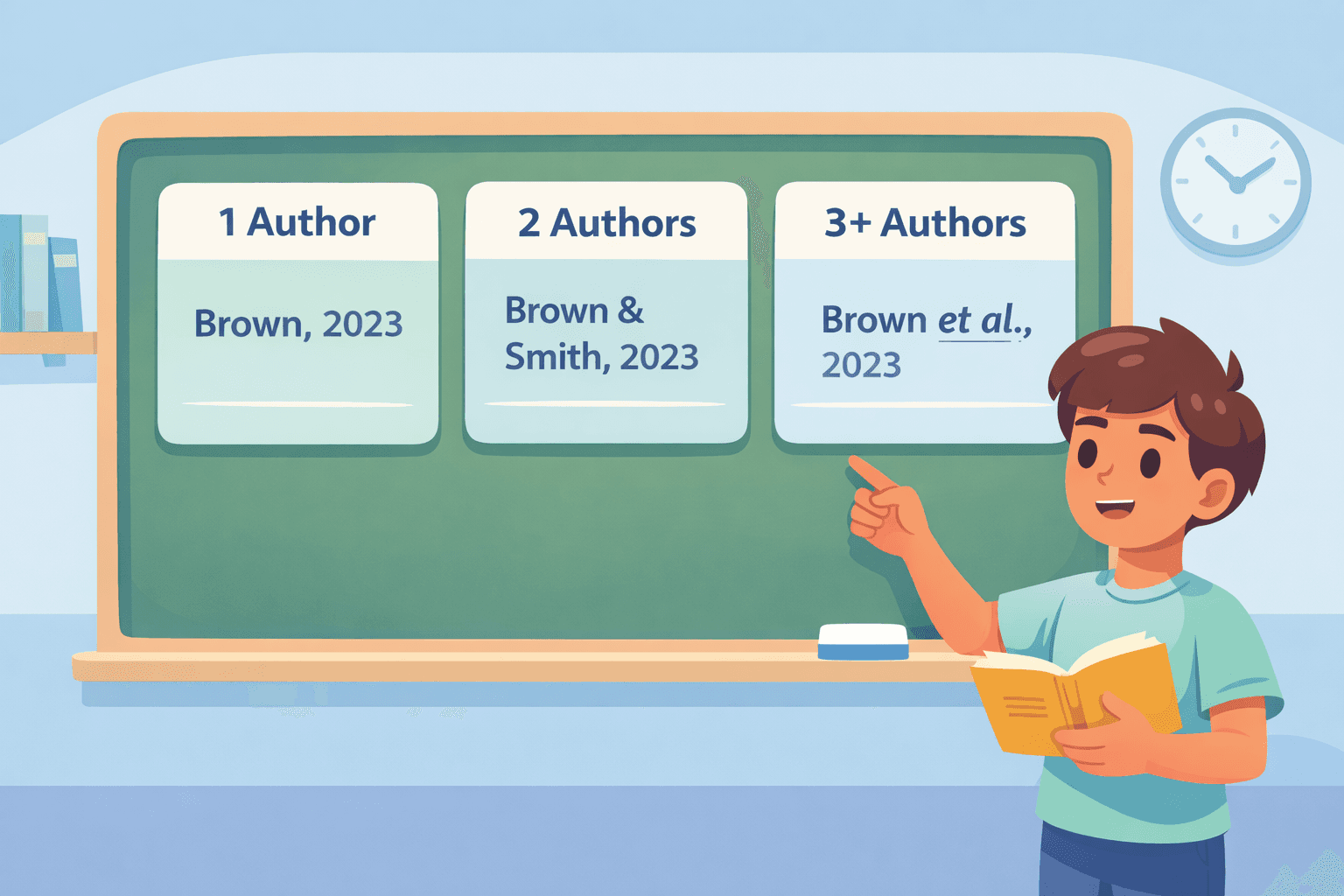
1 author | (Brown, 2023) | Brown (2023) |
2 authors | (Brown & Smith, 2023) | Brown and Smith (2023) |
3+ authors | (Brown et al., 2023) | Brown et al. (2023) |
The table shows the clear shift. Once you hit three authors, "et al." takes over, replacing what would otherwise be a long and repetitive list of names in your text.
<ProTip title="💡 Pro Tip:" description="Use an ampersand only in parenthetical citations. In narrative citations, write and between two author names." />
APA Reference List Rules for Multiple Authors
It's crucial to remember that "et al." is only for your in-text citations. You never use it in the reference list at the end of your paper. If you want a clearer explanation of how these two pieces fit together, see our citations vs references breakdown. The APA Publication Manual (7th edition) has specific rules for listing authors there.
If you're citing studies related to research quality, like those discussed in types of validity in research, you’ll often need to list multiple authors correctly in your references.
For the reference list, you must provide full details. If a source has up to 20 authors, you are required to list every single one of them. You write out all their names, separated by commas, with an ampersand (&) before the final author.
Example format:
Smith, J. A., Jones, B. C., Lee, M. K., & Davis, R. (2023). Title of the study. Publisher Name.
Only if a source has 21 or more authors does the rule change. In that case, you list the first 19 names, insert an ellipsis (...), and then write the very last author's name.
A common error is to carry the "et al." shortcut over to the references. This is wrong. In your text, you might cite something as (Smith et al., 2023), but on your reference page, you have to show the complete authorship.
Writing "Smith et al." in your references is incorrect and would likely lose you points on an assignment. The reference list is the place for the full, formal record.
<ProTip title="💡 Pro Tip:" description="Et al. belongs in in text citations only. Do not use it in your APA reference list." />
Step-by-Step: How to Use Et Al in APA Correctly

Here’s a straightforward way to apply the "et al." rule correctly in your writing.
Step 1: Check the author count. Look at your source. How many authors does it have?
1 author: Don’t use et al. Just use the single name.
2 authors: List both names every time.
3 or more authors: Use "et al." starting with your very first citation.
Step 2: Choose your citation style. You have two options for placing the citation in your sentence.
Parenthetical citation: You put the citation in parentheses at the end of a statement. Format: (Smith et al., 2023).
Narrative citation: You include the authors' names as part of your sentence. Format: Smith et al. (2023) explain...
Step 3: Pay attention to punctuation. The small details are what make it correct.
Write the first author's name, then a space, then "et al." with no comma in between.
There is always a period after "al" because it's an abbreviation.
The publication year comes immediately after, separated by a comma in parentheses.
Step 4: Fit it into your sentence. The goal is to make the citation part of your writing, not an interruption. For example:
Recent research supports this idea. Smith et al. (2023) explain that structured learning improves retention in academic settings, a finding relevant to this discussion.
This approach keeps your writing smooth and your citations professionally formatted.
<ProTip title="💡 Pro Tip:" description="Read your sentence aloud after adding a citation. This helps you check whether the citation flows naturally." />
Common Mistakes in Using Et Al APA Style
People often trip up on a few specific points when using "et al." in APA style. Knowing what usually goes wrong can help you avoid the same errors.
Common mistakes to watch for:
Using it for just two authors. This is incorrect. "Et al." is only for sources with three or more authors. For two authors, you must list both names every time.
Putting a comma in the wrong place. You should write "Smith et al., 2023", a comma goes after "et al." and before the year, but not between the author's name and "et al."
Putting "et al." in the reference list. Remember, the abbreviation is only for your in-text citations. The reference list requires the full list of authors (up to 20).
Being inconsistent. Sometimes writers use the full list of authors in one sentence and "et al." for the same source in the next. Stick with "et al." for every citation of a three-plus author source after you've established it.
A lot of these errors happen because the rules changed. The 7th edition of APA style made things simpler. Before, you had to list all authors the first time you cited a source.
Now, you use "et al." right from the start for any source with three or more authors. If you learned from an older guide or a professor using the 6th edition, you might be following outdated instructions.
<ProTip title="💡 Pro Tip:" description="Confirm whether your institution follows APA 6th or APA 7th edition before finalizing your citations." />
Et Al in Academic Writing and Research Papers
In academic writing, especially in research papers, your citations are a big part of establishing credibility. They show where your ideas come from. Using "et al." correctly helps you do this without cluttering up your sentences with long lists of names.
You'll see this abbreviation all the time in fields like psychology, education, medical journals, and social science reports.
When analyzing different types of data, like those discussed in qualitative vs quantitative research, research papers frequently involve multiple contributors, making "et al." a practical necessity.
Other style guides, like MLA, have similar abbreviation rules, but APA's approach is particularly geared toward clarity in scientific and technical writing. Researchers use it because it serves a practical purpose.
It saves a significant amount of space on the page. In a dense literature review, constantly repeating "Smith, Jones, Williams, Lee, and Chen (2023)" would make the text difficult to read. "Smith et al. (2023)" is cleaner and lets the reader focus on the study's findings, not its authorship.
It also creates a standard. Anyone familiar with APA style instantly understands what "et al." means, which helps communication across different institutions and countries.
But this tool only works if you follow the rules. Misusing it, like using it for two authors or putting it in your reference list, actually hurts clarity and can make your work look less careful. The point is to be precise, not just to shorten words.
<ProTip title="💡 Pro Tip:" description="Keep citations readable, but stay accurate. Et al. should shorten your citation without changing the source details." />
Quick Reference Checklist for APA Et Al Usage
Use this quick check before you submit your paper to avoid small citation mistakes:
Do your sources have three or more authors?
Have you used et al. only in your in-text citations (not in the reference list)?
Is the punctuation formatted correctly?
Did you include the full list of authors in your references?
Are you following APA 7th edition guidelines?
Running through these points can help you catch common errors and keep your citations clean and accurate.
Keep APA Citations Clear Without the Confusion
You’ve probably double checked your citations and still felt unsure if using et al is actually correct. It gets annoying fast. Small mistakes add up.
<CTA title="Keep APA Citations Clean and Consistent" description="Use Jenni to turn citation rules into clearer academic writing without constantly second guessing the format." buttonLabel="Try Jenni Free" link="https://app.jenni.ai/register" />
That’s where Jenni helps you stay consistent by turning citation rules into clean, ready to use writing, so you don’t keep fixing the same errors. If you manage your sources in a citation manager, the Zotero and Mendeley integration overview may also help you keep multi-author references organized. It’s an easy way to write with more confidence.