{{HeadCode}} Critical Review vs Literature Review: Key Differences Explained

通过

内森·奧勇

Critical Review vs Literature Review: Key Differences Explained

奥扬的个人资料图片

内森·奧勇

安永的高级会计师

获得会计学学士学位,完成会计研究生文凭

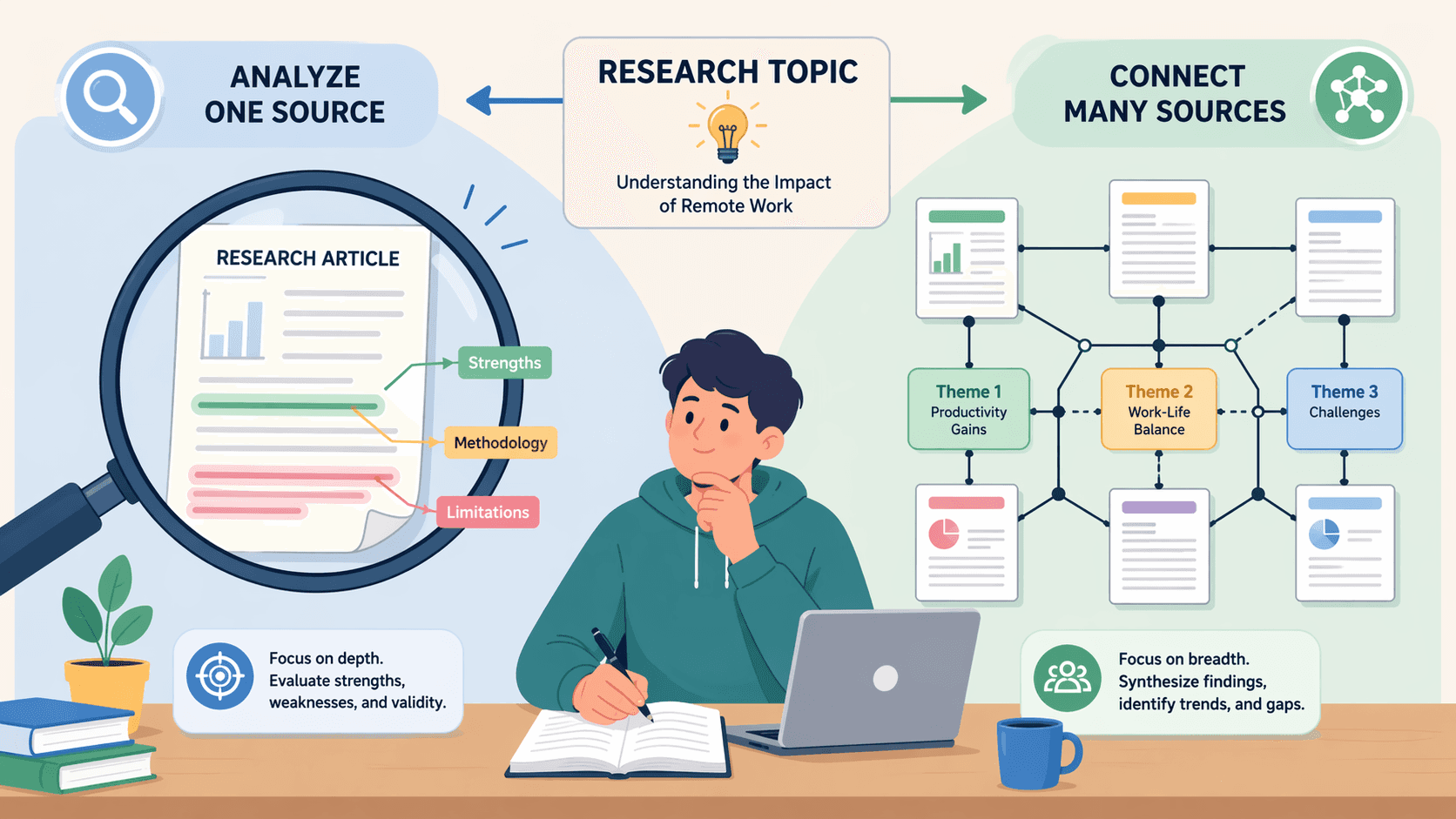
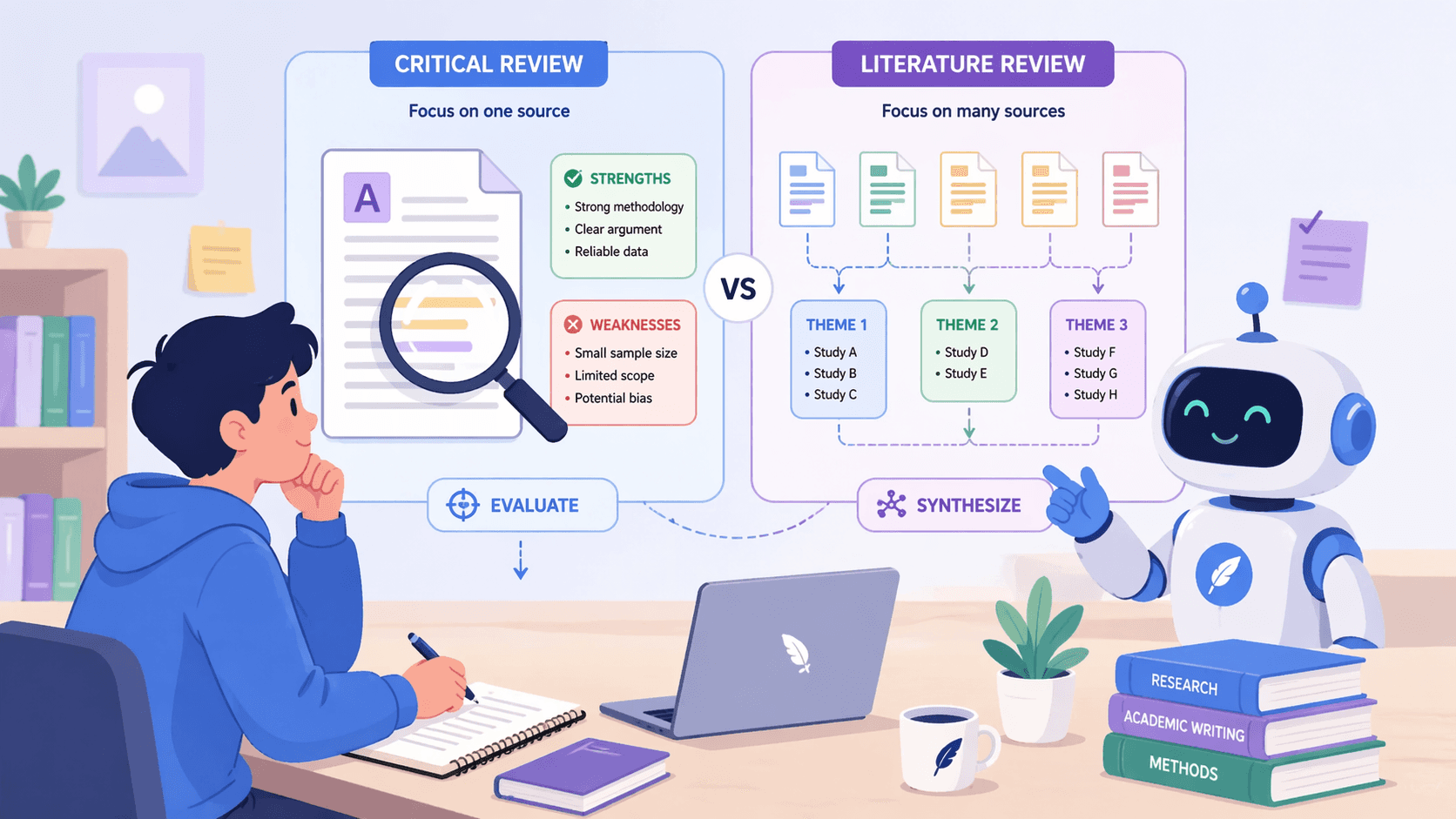
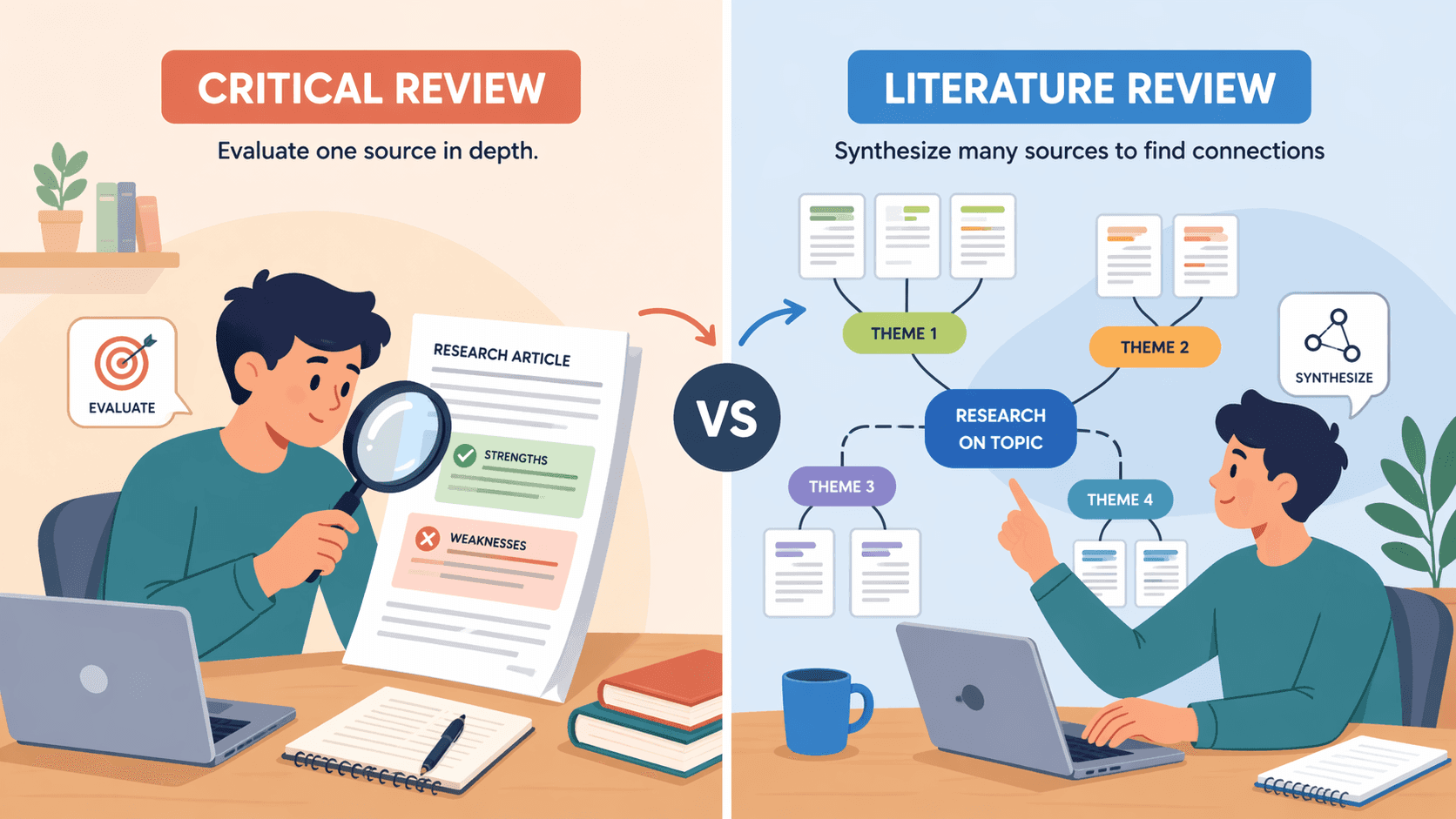
The difference between a critical review and a literature review is straightforward. A critical review judges a single source's strengths and weaknesses. A literature review connects many sources to show what's already known about a topic.

Purdue OWL notes that one is about judgment, the other about trends. Students often mix them up, especially with vague assignment prompts.

We'll clarify the differences with examples and a simple framework to pick the right one for your work. Keep reading for the breakdown.

<CTA title="Choose the Right Review Type Faster" description="Structure your academic writing with clear review frameworks and avoid confusion" buttonLabel="Try Jenni Free" link="https://app.jenni.ai/register" />

What Is the Difference Between a Critical Review and a Literature Review?

A critical review is an in-depth evaluation of a single book, article, or study. Its purpose is to judge the work's quality, logic, and value. In contrast, a literature review surveys a body of research on a topic.

It synthesizes findings from many sources to map out what is known and where the gaps are. The University of Toronto's writing advice on how to write a literature review puts it simply: one critiques an argument, the other builds context.

The confusion is common. On forums like Reddit, students in psychology and other fields often say they default to summarizing when an assignment actually asks for a critical analysis.

The table below shows how they diverge in practice.

Aspect

Critical Review

Literature Review

Scope

One source (e.g., a journal article)

Many sources on a topic

Purpose

To evaluate strengths, weaknesses, and validity

To synthesize knowledge and identify research gaps

Tone

Analytical, argumentative, and judgment-based

Objective, descriptive, and comparative

Structure

Driven by a thesis critiquing the source

Organized thematically or chronologically

Depth

Deep analysis of a single work's methods and claims

Broad overview of the field's landscape

Think of it as zooming in versus zooming out. One dissects a specific piece; the other connects the dots between many pieces.

<ProTip title="💡 Pro Tip:" description="If you analyze one source deeply it is a critical review if you compare many sources it is a literature review" />

When to Use Each Type of Review

Your choice depends entirely on what the assignment asks you to do. The goal defines the format.

Use a critical review for evaluation.

This format is for judging a single, specific work. Its job is to determine how good, valid, or useful that source is.

You’ll typically write one for a journal article critique, a formal book review, or an evaluation essay. For instance, if your prompt is to "critically assess the methodology of Smith's 2023 study," you’re writing a critical review.

You’ll dig deep into that one study, questioning its evidence, checking for bias, and analyzing its conclusions. If you’re unsure how to organize this, a guide on structuring a critical review effectively can help clarify the process.

Use a literature review for synthesis.

This type is for connecting the dots across many sources. Its purpose is to map the existing knowledge on a topic.

You write these for thesis chapters, research proposals, or as the foundation of a larger academic paper. If your task is to "review the literature on renewable energy subsidies," you need a literature review.

If you're building this into a larger project, this breakdown of the literature review section of a research paper shows how it supports the overall argument.

Your work becomes comparative, you’ll group studies by theme, trace how ideas have changed, and point out where more research is needed.

A helpful resource on building a clear literature review outline can make this much easier to manage.

In practice, the writing style shifts completely. A critical review builds an argument about one source. A literature review builds a narrative about a field.

Mixing them up is a common reason students lose marks; they summarize a dozen papers when they were supposed to dissect just one.

<ProTip title="🧠 Reminder:" description="Match your structure to the assignment goal before you start writing" />

Critical Review Structure vs Literature Review Structure

A critical review and a literature review are both organized pieces of writing, but they work differently on the inside.

Critical Review Structure: Built for Judgment

This format is for evaluating one specific source, like a book or a key study. It's less about summarizing and more about forming a verdict.

A typical structure looks like this:

For a step-by-step template, see our critical review structure guide.

  • Introduction: State your overall judgment of the work right up front.

  • Summary: Briefly outline the source's main points.

  • Critical Analysis: This is the core. You dissect the source's strengths and weaknesses. According to most academic guides, this section should be 50-70% of your entire review.

  • Conclusion: Restate your final evaluation.

The analysis needs to connect evaluation with reasoning. For instance: "While the study's dataset of 300 participants is robust, its sampling method introduces a bias that limits how widely we can apply the findings."

To strengthen your analytical writing, the Harvard guide to essay writing strategies offers useful techniques for developing strong arguments.

Literature Review Structure: Built for Synthesis

Here, you're not judging one thing. You're organizing and connecting many sources to map out a field of research.

If you’re working with broader storytelling-style synthesis, exploring a narrative literature reviews can be especially useful.

Common ways to structure it are:

  • Thematically: Grouping studies by common topics or arguments.

  • Chronologically: Tracing how ideas have developed over time.

  • Methodologically: Grouping studies based on the research methods they used.

The goal is synthesis. An example sentence would be: "Research on remote work consistently links it to higher productivity, but the size of the effect depends heavily on the industry and the methods used to measure it." You're comparing trends, not delivering a verdict.

Structure Comparison at a Glance

Section

Critical Review

Literature Review

Introduction

Presents a thesis that judges one source.

Establishes the research context and scope.

Body

Detailed analysis of one source's strengths/weaknesses.

Synthesizes multiple sources into themes or debates.

Use of Evidence

Deep, analytical dive into a single text.

Compares and contrasts across many texts.

Conclusion

Delivers a final judgment on the source.

Summarizes trends and identifies gaps in the research.

The core difference is simple: one is an analytical critique, the other is a thematic synthesis.

<ProTip title="⚡ Note:" description="If your writing compares studies you are doing a literature review not a critique" />

Student Confusion Traps and How to Avoid Them

Even the most capable students can trip up on the difference between these review types. Here are the most frequent traps.

Trap 1: The List, Not the Link

A common failure is writing a literature review that just catalogs studies. It reads like a sequence of summaries: "Smith (2020) found this. Jones (2021) argued that." This approach misses the point completely. For practical ways to fix this, see our guide to avoiding literature review mistakes.

The goal is synthesis, not a bibliography. You need to show how the studies talk to each other.

For a deeper understanding of this shift from summary to analysis, Purdue OWL’s academic writing guidelines explain how to build connections between ideas effectively. A better sentence would be:

"While Smith's 2020 work highlights clear productivity gains from remote work, Jones' 2021 study argues these gains are entirely dependent on management style." Now the ideas are in conversation.

Trap 2: The Fear of Judgment

In a critical review, many students hold back. They worry that being critical is impolite or unacademic, so they default to neutral summary.

That's a mistake. A critical review requires you to make a supported judgment. As the Harvard College Writing Center notes, a strong critique offers clear evaluations backed by evidence.

Saying "The study's conclusions are weakened by its lack of longitudinal data" isn't rude, it's rigorous analysis. Your job is to assess the work's merits and flaws.

Trap 3: Blurring the Lines

Some assignments, like a dissertation, might require both a literature review and a critical discussion. The confusion happens when students mix the two structures in the same section.

The key is to keep them separate. Use the literature review chapter for synthesis, mapping the existing research landscape.

Then, use your discussion chapter for evaluation, critically analyzing your own findings against that landscape. Knowing which structure to use, and when, makes your argument much clearer.

<ProTip title="🔥 Insight:" description="Write synthesis and critique in separate sections to avoid confusion" />

Practical Examples: Critical Review vs Literature Review

Sometimes, seeing it in action is clearer than any definition.

Example 1: A Critical Review Sentence

Take this line evaluating a single research article: "The article provides a strong statistical analysis based on its sample of 400 participants.

Its conclusions are limited, though, by a lack of demographic diversity, which reduces how applicable the findings are to wider populations."

What this does:

  • Identifies a strength (the analysis).

  • Identifies a weakness (the sample limitation).

  • Interprets the impact (on external validity).

This is a compact critical response. It's built on evaluation.

Example 2: A Literature Review Sentence

Now look at this line synthesizing a field: "Research on online learning effectiveness presents conflicting results.

Several studies link it to higher student engagement, but a consistent counter-finding points to lower information retention, often attributed to the lack of direct interaction."

What this does:

  • Compares multiple sources (studies showing different outcomes).

  • Identifies a trend or debate (the engagement vs. retention conflict).

This is synthesis. It's mapping what a group of studies collectively indicates.

The Simplest Way to Tell Them Apart

If you're stuck, ask one question:

  • A critical review asks: "Is this specific work any good?"

  • A literature review asks: "What's the bigger story all these works are telling?"

Frameworks That Help You Decide Quickly

Don't guess which structure to use. Work through these three simple questions instead.

The Three-Question Checklist

Before you start writing, ask yourself:

  • What am I working with? Am I focused on analyzing one primary source, or am I pulling together many different studies?

  • What's my main job? Is my core task to evaluate the quality of a work, or is it to summarize and connect the key trends from a body of research?

  • What's the end goal? Am I building an argument about a specific piece of work, or am I providing an overview of a research field?

Your answers point directly to the format you need.

The Quick-Reference Table

Your Question

If YES, use a Critical Review

If YES, use a Literature Review

Is there one main source I must analyze?

Am I synthesizing findings from multiple studies?

Is my primary task to evaluate strengths/weaknesses?

Do I need to establish the broader research context?

This method cuts through the confusion, making the choice between a focused critique and a broad survey much clearer.

<ProTip title="📌 Decision Tip:" description="Check assignment keywords like evaluate or review literature before choosing your structure" />

Pick the Review Style That Actually Fits Your Goal

You sit there staring at your notes, unsure if you should break down one paper or pull ideas from many, and it slows everything down. It’s frustrating. A critical review digs into one work and questions it, while a literature review connects multiple sources to show the bigger picture.

<CTA title="Build Strong Academic Reviews Faster" description="Organize critique and synthesis clearly with guided writing support" buttonLabel="Try Jenni Free" link="https://app.jenni.ai/register" />

If you want a faster way to stay clear, the AI literature review & RRL generator can help you organize sources and outline your draft, and Jenni can guide you as you write without taking over your thinking. It helps you stick to the right structure so your argument feels solid and easy to follow. That makes a real difference.

目录

今天就开启你的非凡写作之旅

从今天起,用 Jenni 写下你的 第一篇论文,开启全新篇章

免费开始

无需信用卡

随时取消

500万+

遍布全球的学者

5.2小时

每篇论文平均节省

超过1500万篇

在鉴研上完成的论文

今天就开启你的非凡写作之旅

从今天起,用 Jenni 写下你的 第一篇论文,开启全新篇章

免费开始

无需信用卡

随时取消

500万+

遍布全球的学者

5.2小时

每篇论文平均节省

超过1500万篇

在鉴研上完成的论文

今天就开启你的非凡写作之旅

从今天起,用 Jenni 写下你的 第一篇论文,开启全新篇章

免费开始

无需信用卡

随时取消

500万+

遍布全球的学者

5.2小时

每篇论文平均节省

超过1500万篇

在鉴研上完成的论文