{{HeadCode}} Critical Review Structure: Clear Framework for Academic Writing

通过

贾斯汀·王

Critical Review Structure: Clear Framework for Academic Writing

贾斯汀·王

增长负责人

获得全球商业与数字艺术学士学位,辅修创业

A critical review needs a clear structure to work. It should have four main sections: an introduction, a summary of the work, your critical analysis, and a conclusion. This framework helps you move beyond simply describing something to actually judging its merits and flaws.

Research from places like the Harvard Writing Center backs this up, showing that organized reviews are clearer and often get better grades.

Many students have good ideas but struggle to present them in a logical flow. This guide will show you the framework, provide examples, and walk you through applying it step-by-step. If you prefer starting from an outline, the AI essay outline generator can help you map the four sections before you write.

<CTA title="Write a Clear Critical Review" description="Turn complex papers into structured critical reviews with clarity and strong analysis" buttonLabel="Try Jenni Free" link="https://app.jenni.ai/register" />

What Is a Critical Review Structure?

What does a critical review structure actually do? It's the plan for how you'll break down and judge a text, step by step. Most academic formats use four core sections: an introduction, a summary, the analysis, and a conclusion. This isn't just busywork. It mirrors the way scholars are expected to think.

The University of New South Wales provides a helpful critical review guide explaining that a strong review balances objective summary with subjective evaluation, where the analysis should take up the majority of the paper.

You can think of it as building an argument. Your summary lays out the evidence. Your analysis is where you make your case about what that evidence proves.

The real reason structure is crucial

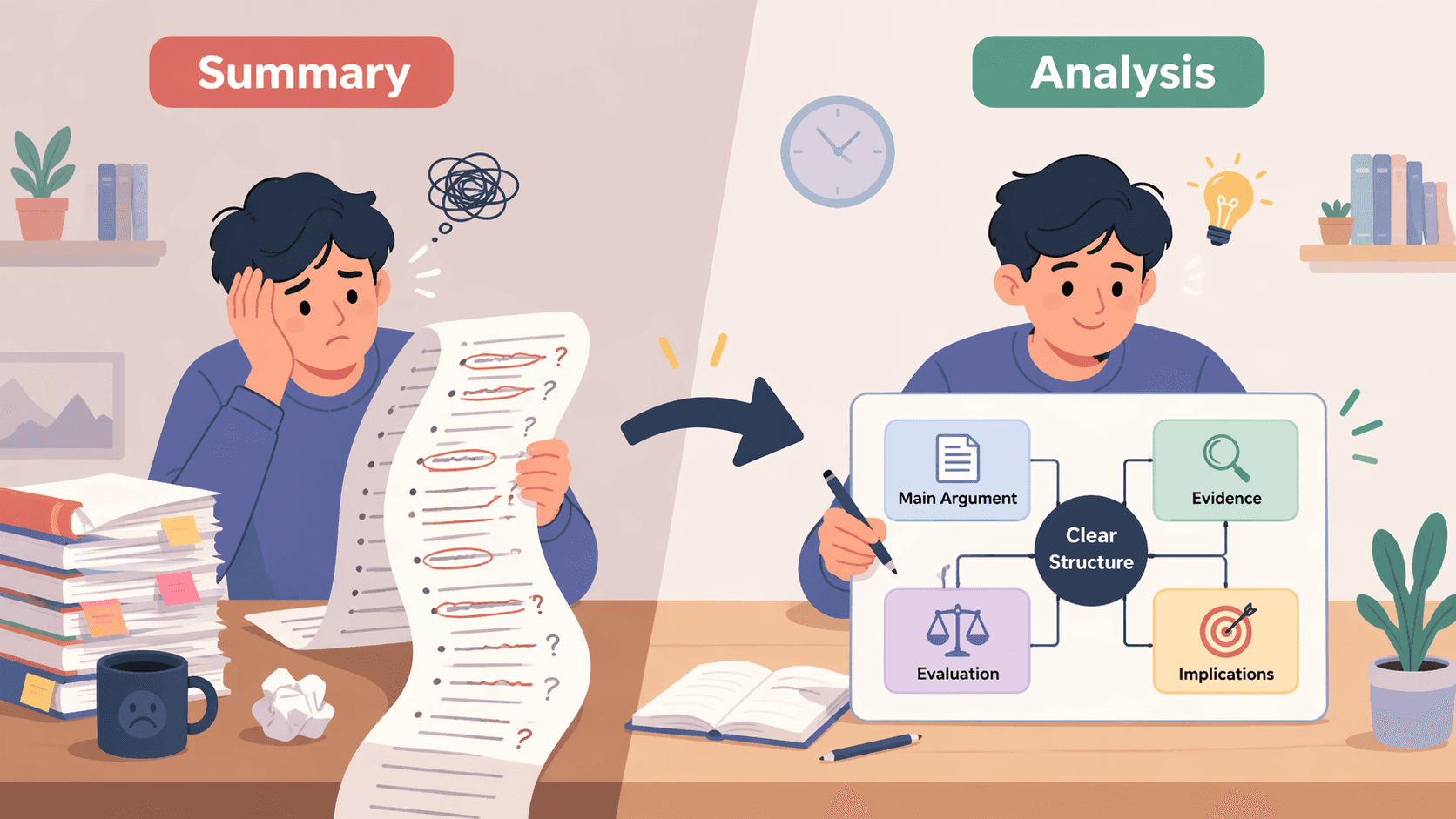
A review without a structure usually turns into a disorganized list. It's easy to get stuck just describing each point the author made, which is more of an annotated bibliography than a true critical review.

A defined framework stops that. It forces you to connect ideas instead of just listing them. It keeps your argument moving forward logically.

Most importantly, it pushes you to develop and showcase your own interpretation, which is exactly what instructors look for when they grade.

<ProTip title="💡 Pro Tip:" description="Write your analysis before polishing the summary to avoid over summarizing" />

Here's a breakdown of the standard four-part structure used for critical reviews in universities.

Section

Purpose

% of Word Count

Introduction

Context + thesis judgment

10–15%

Summary

Objective overview

20–30%

Critical Analysis

Evaluation of strengths and weaknesses

50–70%

Conclusion

Final judgment and implications

10–15%

This framework isn't arbitrary. It matches the format expected in most journal critiques and aligns directly with common academic grading rubrics.

Step-by-Step Critical Review Framework

Here is a practical, step-by-step framework for writing a critical review. The process is repeatable and follows standard academic expectations.

Step 1: Start with a focused introduction

Begin by clearly identifying the text and its author. Provide just enough context. Then, state your overall judgment or thesis immediately.

A strong introduction quickly answers three questions:

  • What is the text about?

  • What is its main argument?

  • What is your verdict?

For example: "In his 2022 study, Smith argues that remote work boosts productivity through flexible scheduling. While the survey data is compelling, the paper's narrow sample size undermines its broader conclusions."

This opening judgment guides your entire review.

<ProTip title="🧠 Reminder:" description="State your judgment early so readers understand your evaluation direction" />

Step 2: Summarize objectively

This section is purely descriptive. Your goal is to prove you understand the work before you judge it. Avoid adding any opinion or critique.

A good summary should cover:

  • The author's central argument.

  • The key evidence they present.

  • The methods or approach they used.

  • The overall structure of the text.

Example: "Smith's analysis is based on survey responses from 500 employees at technology companies, comparing their reported productivity before and after switching to remote work."

If you need a quick baseline to revise, an AI summarizer can generate a first-pass objective overview that you can verify against the original text.

If you’re struggling with organizing summaries in larger academic work, resources like how to write literature review outline can help you structure ideas more clearly before moving into critique. If you’re unsure how that differs from a critical review, see our critical review vs literature review comparison.

Step 3: Build your critical analysis

This is the main section of your review. Don't just list random good and bad points. Organize your evaluation around specific criteria, such as:

  • The quality and sufficiency of the evidence.

  • The validity of the methodology.

  • The relevance of the conclusions.

  • Potential biases or unstated assumptions.

A common mistake is to think critique means only pointing out flaws. A balanced analysis acknowledges both strengths and weaknesses, and most importantly, explains their significance. For more detailed, evidence-based models, see our critique paper examples.

For instance:

  • Strength: The use of 500 participants makes the survey data more reliable.

  • Weakness: Focusing solely on tech firms limits the study's applicability.

  • Interpretation: This narrow scope reduces the paper's value for understanding productivity in other industries, like manufacturing or healthcare.

If your writing feels too descriptive, you may also be falling into common source synthesis mistakes literature reviews, where ideas are listed rather than analyzed and connected.

<ProTip title="⚡ Note:" description="Always explain why a strength or weakness matters for the argument" />

Step 4: End with a concise conclusion

Your conclusion should not simply repeat your introduction. Instead, it should reinforce your final judgment by synthesizing the key points from your analysis.

It should:

  • Restate your overall evaluation.

  • Highlight the most important insights from your critique.

  • Suggest the implications or "so what" of your analysis.

Example: "While Smith's research provides useful data on productivity trends within tech, its limited demographic focus prevents it from making a definitive contribution to the wider academic debate on remote work."

Do not introduce new arguments here. This is your final synthesis.

Lived Struggles in Writing Critical Reviews

Students often know the theory behind a critical review but hit practical walls when they try to write one. These are the real execution problems people talk about online.

"I just end up summarizing everything"

This is the top complaint. It's easy to spend most of your paper just explaining what the author said.

A useful breakdown from Oxford Brookes University in their critical analysis in academic reviews guide reinforces that evaluation, not summary, should dominate your writing.

A straightforward fix: write your objective summary first. Then, go back and highlight only the specific claims, pieces of evidence, or methods that you want to engage with. Expand your discussion only on those highlighted points.

"My review reads like a disconnected list"

This happens when you present points without linking them. A review shouldn't be a bullet-point list of separate observations.

Instead of writing:

  • The study has a strong dataset.

  • The methodology has weaknesses.

  • The conclusion seems unclear.

Try to connect the ideas: "Although the study builds on a strong dataset, methodological flaws in its design make the final conclusions difficult to trust." This turns separate statements into a coherent argument.

"I'm not sure what 'critical' actually means" Being critical isn't about being negative. It's about being evaluative and asking specific questions.

Guidance like University College London’s writing a critical review effectively explains how to assess both strengths and weaknesses rather than simply criticizing.

Shift your mindset from "What did the author say?" to questions like:

  • How well does the provided evidence actually support the main claim?

  • Are there logical gaps in the argument?

  • What perspectives or counter-evidence might be missing?

Asking these questions moves your writing from simple description to genuine analysis.

<ProTip title="🔥 Insight:" description="Ask why after every point to turn summary into analysis" />

Viral Frameworks and Rubric Hacks That Work

Many students who write strong reviews don't just start typing. They use a specific model to guide their thinking, which makes the actual writing much simpler.

Approaches like a narrative literature review show how organizing ideas into a clear structure can make analysis more coherent and easier to follow.

The five-question evaluation model

This is a common and effective method for structuring your critique. You answer five straightforward questions, and each answer can form a section of your analysis.

  • What is the author's main claim? (Restate the core argument.)

  • What evidence do they use to support it? (List their primary sources, data, or examples.)

  • How strong or reliable is that evidence? (Evaluate its quality, source, and sufficiency.)

  • What's missing or overlooked? (Identify gaps, counterarguments, or alternative perspectives.)

  • Why does this analysis matter? (Discuss its implications, importance, or limitations.)

Answering these in order builds a logical, critical argument from the ground up.

Using criteria as your structure You can also organize your analysis section directly around the criteria you're evaluating. Instead of generic headings, use the specific elements you're judging.

For example, your subheadings could be:

  • Evaluation of the Evidence

  • Review of the Methodology

  • Assessment of Relevance and Contribution

This approach creates a clear, organized framework that directly addresses common marking rubric points.

Applying the logic: a mini-example

You can break down any point into a simple three-part logic that forms the core of a paragraph.

  • Evidence: The study uses strong survey data from multiple companies.

  • Method: However, it lacks any longitudinal tracking of participants.

  • Impact: This methodological choice limits the findings to short-term insights, leaving long-term effects unexamined.

This "evidence-method-impact" pattern is a compact way to build analytical paragraphs, and it closely mirrors the feedback format used in academic peer review.

Example of a Structured Critical Review

Here’s how the structure works in practice, using a short example.

Introduction In a 2021 study, Johnson evaluates the effectiveness of various climate policies across Europe. The comparative data is robust, but the paper’s dependence on sources from before 2015 undermines the strength of its conclusions.

Summary The research analyzes emissions data from ten European nations. Johnson uses a combination of policy review and statistical modeling to assess which approaches yielded the best results.

Critical Analysis The study’s breadth is a clear strength; comparing ten countries provides solid ground for comparative insight.

The major weakness lies in the data’s age. By relying primarily on pre-2015 figures, the analysis fails to account for significant shifts in emissions patterns documented in recent reports from the Intergovernmental Panel on Climate Change.

This dated information limits the paper's usefulness for informing current policy decisions.

Conclusion While Johnson’s work offers a valuable framework for cross-national comparison, its outdated empirical foundation reduces its relevance for contemporary academic and policy discussions.

Checklist for a Strong Critical Review

Before you submit, run through this checklist. It covers the core elements of a complete critical review.

  • Clear thesis in the introduction: Did you state your overall judgment upfront?

  • Objective summary: Does your summary stick to the facts, without any critique or opinion?

  • Evidence-based analysis: Is your evaluation built on specific evidence, with explanations of why points matter?

  • Balanced critique: Did you address both strengths and weaknesses?

  • Logical flow: Do your ideas connect to form a coherent argument, rather than just listing points?

  • Definitive conclusion: Does your ending provide a clear final synthesis and restate your judgment?

If any of these elements are missing, the structure of your review will be weaker.

<ProTip title="✅ Checklist Tip:" description="If your analysis is shorter than your summary you need more evaluation" />

Make Your Critical Review Flow Without Getting Stuck

You start writing, then second guess every section, wondering if it’s too descriptive or not sharp enough. It breaks your flow. A strong structure keeps your ideas moving, so each part builds on the last and your analysis feels clear instead of forced.

<CTA title="Structure Your Critical Review Faster" description="Organize your academic critique with clear outlines and focused evaluation" buttonLabel="Try Jenni Free" link="https://app.jenni.ai/register" />

If you want to stay focused without overthinking the format, Jenni can help you keep things on track as you write. It supports your structure while you stay in control of the argument, so your review reads clean and confident.

目录

今天就开启你的非凡写作之旅

从今天起,用 Jenni 写下你的 第一篇论文,开启全新篇章

免费开始

无需信用卡

随时取消

500万+

遍布全球的学者

5.2小时

每篇论文平均节省

超过1500万篇

在鉴研上完成的论文

今天就开启你的非凡写作之旅

从今天起,用 Jenni 写下你的 第一篇论文,开启全新篇章

免费开始

无需信用卡

随时取消

500万+

遍布全球的学者

5.2小时

每篇论文平均节省

超过1500万篇

在鉴研上完成的论文

今天就开启你的非凡写作之旅

从今天起,用 Jenni 写下你的 第一篇论文,开启全新篇章

免费开始

无需信用卡

随时取消

500万+

遍布全球的学者

5.2小时

每篇论文平均节省

超过1500万篇

在鉴研上完成的论文