By
Justin Wong
—
Jenni AI vs Claude: Which Cites Sources More Accurately?

Justin Wong
Head of Growth
Graduated with a Bachelor's in Global Business & Digital Arts, Minor in Entrepreneurship
Jenni puts the citation in the document. Claude tells you what is wrong with the argument and leaves the findings in a chat window. Which one you need depends on whether the paragraph is written yet.
The line that captures the difference came out of Claude's argument check. It flagged six claims, gave a real paper with a DOI for five of them, and said of the sixth: "I am not giving you a reference rather than inventing a plausible one."
The same 201-word paragraph went through both tools on 16 September 2026, on four jobs: fix a clunky sentence, cite a checkable claim, check the argument, get the file out. Jenni ran on Plus, Claude ran Opus 5 at High effort.
<CTA title="Keep the source and the sentence in one place" description="Search papers at the cursor, cite in one click, and let the reference list build itself while you write" buttonLabel="Try Jenni Free" link="https://app.jenni.ai/register" />
TLDR: Jenni or Claude?
Jenni for the paragraph that is still being written: the trial was on its citation list before a search term existed, and Accept on a review card files the source in the reference list. Claude for the paragraph that already exists: six claims weighed, six DOIs that resolve, and one reference it would not invent.
Jenni | Claude | |
Verdict | Where the writing happens. Papers at the cursor, citation and reference filed in one click, and an export that keeps Word citation fields live | Where the draft gets audited. It verified the trial, sourced five of six flagged claims with DOIs that resolve, and refused to invent the sixth. None of it lands in a document |
The clunky sentence | Improve fluency, one second, a diff, and Replace Selection puts the result in the paragraph | Ten seconds, a Before and After, five numbered reasons, and an unprompted flag on the next sentence. Copied back by hand |
The transthyretin claim | The NEJM trial was already in Discover with the search box empty. One click wrote the citation and the APA 7th reference with its DOI | Two searches, then the paper verified against itself, the citation placed before the full stop, plus the day 28 and 0.3 mg per kg detail |
The argument check | 29 seconds, three cards each carrying a real record with its citation count and impact factor. One accepted, two refused, one click each | Six claims weighed, six DOIs that all resolve, one author name wrong in the chat, and one claim left unsourced on purpose |
The file | Word with native citation fields or hyperlinks, or LaTeX, with four layout presets. No PDF | A clean .docx previewed beside the chat, seven references. The paragraph is changed in five places, four beyond the sentence it was asked to fix |
Free plan | Unlimited citations, 10 autocompletes a day, 3 AI edits, 5 chat messages, 3 reviews, body-only export | Chat, web search, memory, artifacts and file creation on Sonnet and Haiku. The test ran Opus 5 |
Paid billed yearly | Plus $144 a year, Pro $348 a year | Pro $200 up front. Max is monthly only, $100 or $200 a month |
Best for | Turning a paragraph into a paper with its sources attached | Taking a finished paragraph apart before a supervisor does |
Who should pick which?
Jenni while the writing is happening, Claude once it has stopped. The evidence for each pick is in the tasks below.
The PhD student with a chapter due and 40 papers in a folder
Jenni - three jobs eat a thesis year, and all three sit inside the document here:
Papers proposed at the cursor before a search term is typed.
A reference list that grows with every Cite click.
Claim confidence once a chapter, with each accepted source filed as it goes.
If the folder is a Zotero library, it imports. Send the chapter's weakest paragraph to Claude afterwards for the claim-by-claim read.
The postdoc with a submission deadline next week
Jenni for the manuscript, Claude for the audit - the Word export with native citation fields and the double-spaced preset are the submission jobs, and they exist on one side only.
Open every DOI the pre-review hands over, because one reference here carried the right DOI under the wrong first author.
The undergraduate with one essay to write this term
Jenni on the free plan - unlimited citations, ten autocompletes a day and three reviews will cover an essay, and the three AI edits are best saved for the sentences that decide the grade. Claude then reads the finished essay back for its logic, on whichever model the plan gives you.
How this was tested
One paragraph, written for the test, pasted into both tools cold:
What went in - 201 words, six sentences, on lipid nanoparticles as a CRISPR delivery vehicle.
The two faults planted in it - a sentence opening "There is a lot of things that still needs", and a hedge stacked three deep, "could perhaps maybe".
The claim that can be checked - a mean 87 percent drop in serum transthyretin at the higher dose, which is Gillmore et al., NEJM 2021.
What Claude was given - four typed prompts, each quoted in its own task below, so the run can be repeated.
Same conditions - nothing uploaded, the four jobs in the same order, Jenni on Plus and Claude on Opus 5 at High effort, both in Chrome on the day.
Where the test stops - at the export dialog on one side and the file card on the other. Nothing was downloaded.
Task by task
The sentence that needed fixing
Jenni - highlighting the sentence raises a menu at the selection: Find citations, AI Chat, AI Edit, Comment and Review, with the selection counted at 43 words. AI Edit opens a prompt box above a list of named commands, and Improve fluency sits at the top of the Strengthen writing group.
It ran on the click, with "Thought for 1 second" on the card:
"Many issues still need to be resolved, including how the particles behave outside the liver, whether repeat dosing triggers an immune response, and what the long-term editing outcomes are at off-target sites."
A See edits toggle shows the rewrite as strikethrough and insertion, with a two-line note on what changed underneath. Replace Selection dropped it into the paragraph and the word counter fell from 207 to 196. The triple hedge in the next sentence was left alone, which is the right scope for a one-sentence job.
Claude - the prompt was the paragraph plus one instruction: "Fix the clunky sentence that starts 'There is a lot of things', and only that sentence. Show me exactly what you changed." About ten seconds later it returned a Changed sentence block, the old version above the new one:
"Several questions remain unresolved, however: how the particles behave outside the liver, whether repeat dosing provokes an immune response, and what long term editing outcomes look like at off target sites."
Under it sat a What I fixed list with five numbered reasons: Agreement, Dead weight, Placement, List signal, Word choice. The second is the best line of writing advice either tool produced: "There is..." openers are like clearing your throat before a sentence.
Then a note nobody asked for, that the following sentence stacks three hedges, in case that one wanted trimming too.
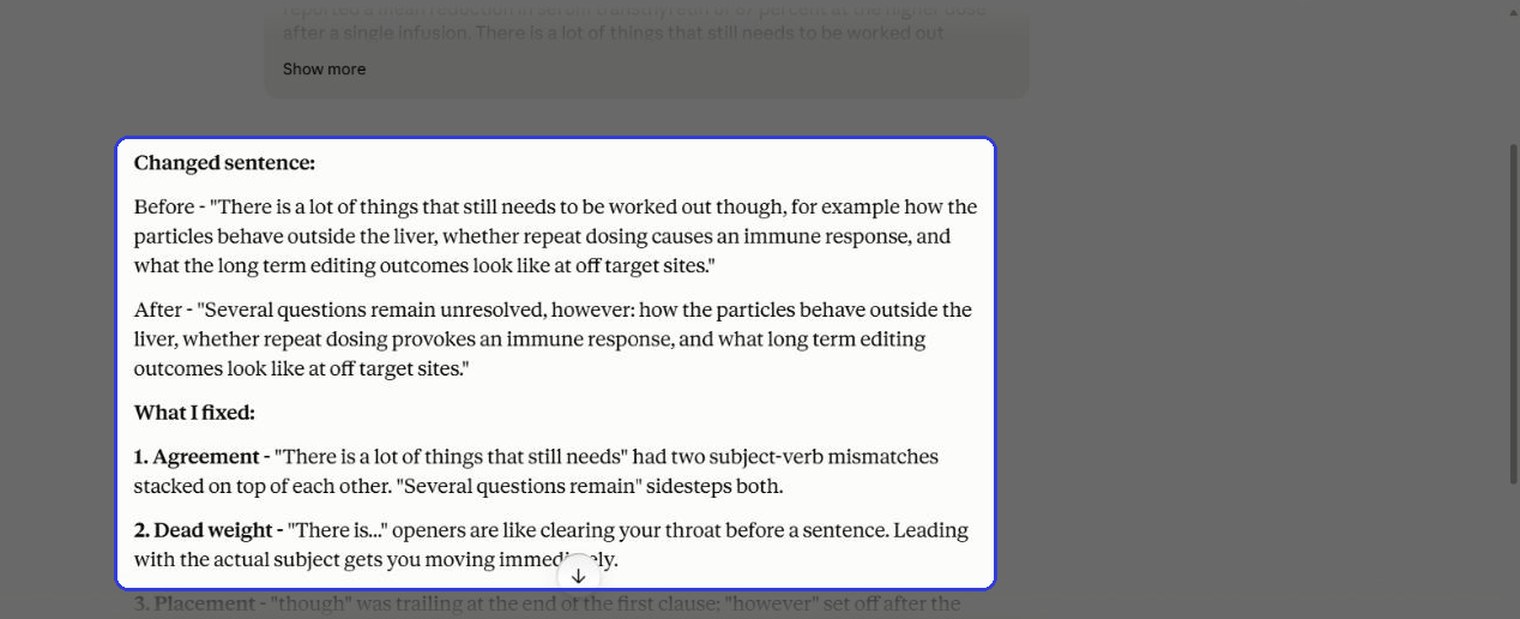
Claude on Opus 5: the Changed sentence block with Before and After, and the start of the numbered What I fixed list.
One detail worth catching: it wrote "long term" and "off target" open, where the other version hyphenates both.
Winner - Jenni, narrowly. Claude's five reasons teach more than any diff, and spotting the hedge unprompted was the smarter read. The sentence needed nothing further on either side, and only one of them put it in the document.
<ProTip title="💡 Pro Tip:" description="Read the note under a Claude answer, not only the answer itself. The flag on the next sentence stacking three hedges came unasked, and it was right" />
The claim that had to be sourced
Jenni - with the cursor after "infusion." the Cite button opens a search panel inside the text: an empty search box, tabs for All, Discover and Library, Sort and Filter, and an Add custom citation link at the foot.
The Discover tab was not empty. Cards had already been drawn from the sentence around the cursor, each with Cite, View and Save:
Finn et al., Cell Reports 2018 at the top: 810 citations, impact factor 6.44, Open Access.
Gillmore et al., New England Journal of Medicine 2021 second, the trial the sentence describes: 1.6K citations, impact factor 24.39, Open Access.
Second, not first, so the journal line is the thing to read before clicking anything.
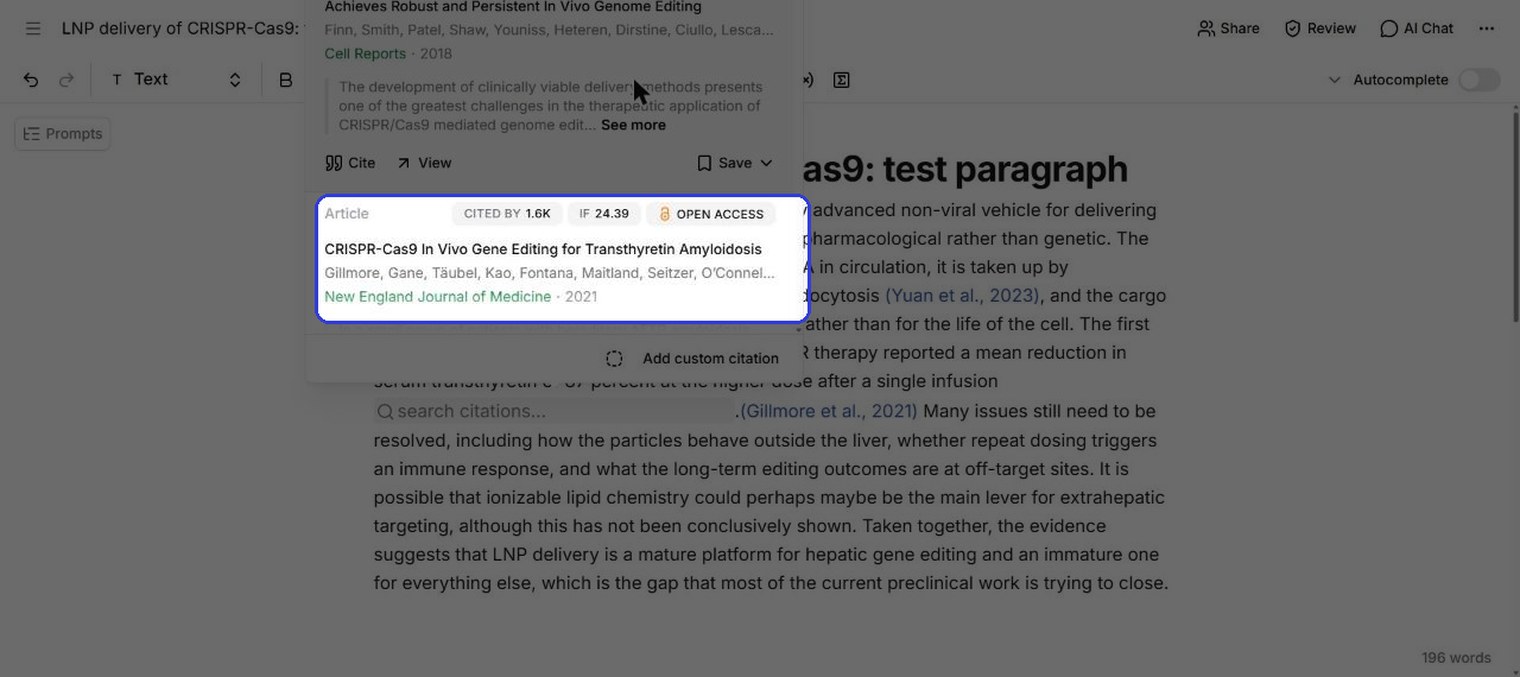
The Cite panel open at the cursor with the search box still empty. The NEJM trial is boxed, second on the Discover list: 1.6K citations, impact factor 24.39, Open Access.
Cite on that card did two jobs at once. The in-text citation went in at the cursor, and a References section appeared at the foot of the page with the APA 7th entry, its DOI, a style dropdown and a Sources counter reading 1.
Claude - the prompt asked for the same thing, "the in-text citation in APA 7th style and the full reference with a DOI." It said it would rather verify the details than write them from memory, and searched the web twice.
About twenty seconds in it reported: "Verified against the paper itself. The 87 percent figure, the journal details, and the DOI all check out." What came back with that:
The parenthetical citation placed before the full stop, and the narrative form offered as an alternative.
The correct DOI, plus a note that the paper has 26 authors, so APA 7th lists the first 19, an ellipsis and the last.
An accuracy point worth having: the 87 percent was measured at day 28 in the 0.3 mg per kg group, across three patients, in a range of 80 to 96 percent.
The catch is that all of it is text in a thread. The footer changed to "Please double-check cited sources", the umlaut in "Taubel" did not survive, and no reference list builds anywhere, because there is no document.
Winner - Jenni. Claude read the paper more closely than the card did, and the day 28 detail belongs in the sentence. The citation and the reference were built in the same click here, which is the part a thread cannot do.
<ProTip title="📌 Remember:" description="Ask for the narrative form as well as the parenthetical one. Claude gave both without being asked, and the narrative form is what you want when the study is the subject of the sentence" />
Which one reads the argument harder?
Jenni - Claim confidence sits in the Reviews panel with the other four reviews. Run review listed the database queries as they went out, and the card settled on "Thought for 29 seconds" with a summary of the run:
"Updated the citation for the transthyretin reduction percentage to a more precise source. Added supporting citations for the clinical status and hepatocyte uptake mechanism of lipid nanoparticles."
Under it, a breakdown: three suggestions, two Unsupported and one Weakly supported, with a green tick against Misrepresented and Contradicted.
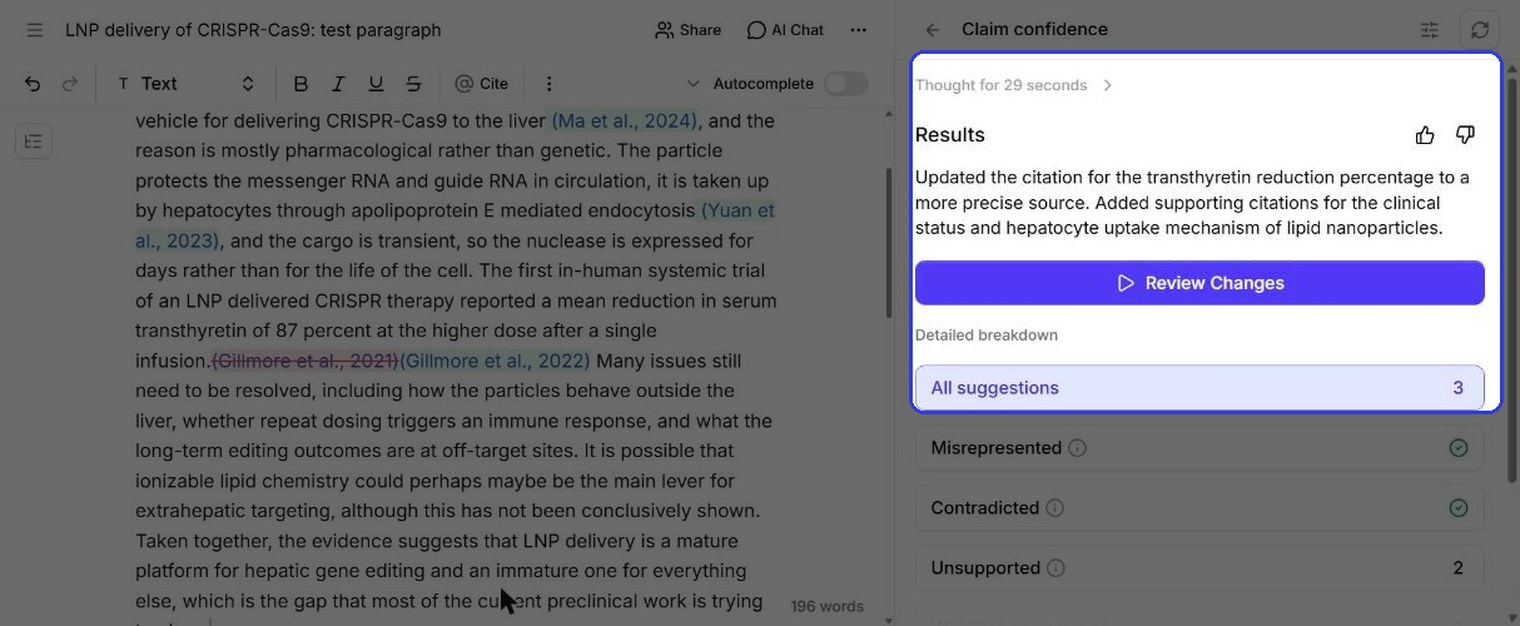
The finished Claim confidence run: 29 seconds of thinking, the summary of what it did, and the breakdown reading three suggestions. The proposed citations sit inline in the text on the left.
Review mode then steps through the cards one at a time. Each names the flagged sentence, gives a one-line reason, and shows the proposed source with its citation count, impact factor, journal, year and an excerpt, over a bar with Reject and Accept. How the three went:
The apolipoprotein E claim - Yuan et al., 2023, Biomaterials Research, 70 citations, its excerpt naming the LDL receptor on the hepatocyte surface. Accepted, and filed on the click.
The "most clinically advanced" superlative - a 2024 Small paper on mulberry-leaf lipid nanoparticles for colon disease. Wrong paper for that claim. Rejected.
The 87 percent figure - a swap of the NEJM citation for a 2022 reprint of the same study, 46 citations, impact factor 0.00. Same paper, worse record. Rejected.
"All suggestions resolved!" closed the run with the Sources counter at 2 and the accepted paper already formatted in the list. Three real records, judged and filed without leaving the page.
Claude - the prompt: "Check the argument in the paragraph. Which claims are unsupported, overstated or weakly supported, and for each one give me a real paper that would support it, with the DOI."
It ran several searches and answered after about a minute, opening with a summary of its own: "Six claims need attention. Two are fine but uncited, three are load-bearing and unsupported, and one is a superlative you probably can't defend as written." The six:
The superlative, handed Paunovska, Loughrey and Dahlman 2022 as the review to lean on.
"Mostly pharmacological rather than genetic", called framing rather than a finding, with no paper that would carry it.
The apolipoprotein E mechanism, sent to Akinc et al. 2010, Molecular Therapy.
"Expressed for days", sent to Pardi et al. 2015, a mouse study supporting transient rather than a human number.
Repeat dosing, sent to a 2024 Molecular Pharmaceutics paper on anti-PEG antibodies.
The ionizable lipid sentence, sent to Cheng et al. 2020 and Dilliard et al. 2021, with "lipid composition" as the better phrase.
Then two paragraphs no review card produced. It declined to source the long-term off-target claim at all, named the reason, and suggested citing the trial's own limitations section instead.
The second was structural: the paragraph's confidence "runs backwards", with the best-evidenced claim buried under three hedges while the interpretive claims are stated flat.
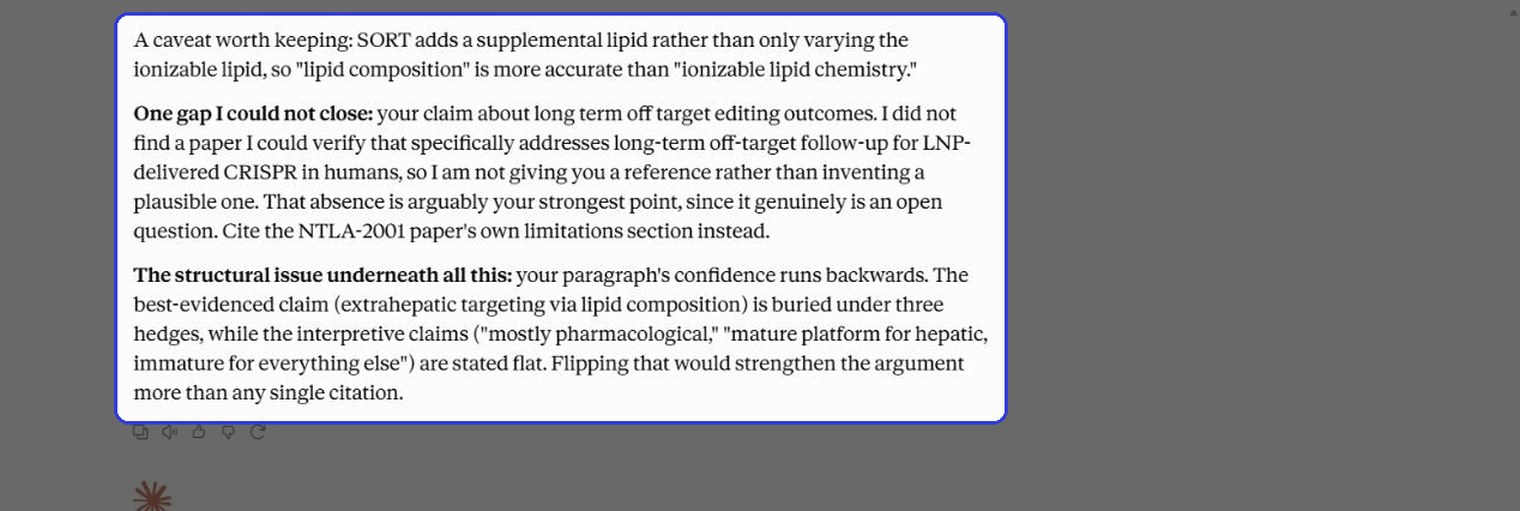
The closing section of the argument check: the claim Claude would not source, the suggestion to cite the trial limitations instead, and the note that the paragraph is built back to front.
Every DOI was then opened against Crossref and the publisher pages. All six resolve to the papers named, and so does the Gillmore one from the citation job, seven for seven. One slip: the anti-PEG paper is by Omata et al., and the chat credited it to Miyazaki.
Winner - depends on the job. For sourcing a paragraph, Jenni: three real records in 29 seconds, each judged in one click, and the good one filed into the list. For interrogating a paragraph, Claude went further than anything else in the test, and every finding then has to be typed in by hand.
<ProTip title="⚠️ Caution:" description="One reference in the chat answer carried the right DOI under the wrong first author. Open the DOI and copy the author list off the landing page, never off the chat" />
Getting the document out
Jenni - Export lives under the three-dot menu at the top right, beside Comments, Copy to clipboard, Version history and Document settings. It offers Word (.docx) and LaTeX (.tex), and nothing else.
The Word tab asks one useful question first: how the citations should travel. Native Word citation fields keep the in-text cites and the bibliography linked through the References tab; hyperlink citations are the Google Docs option, clickable but with no citation fields behind them.
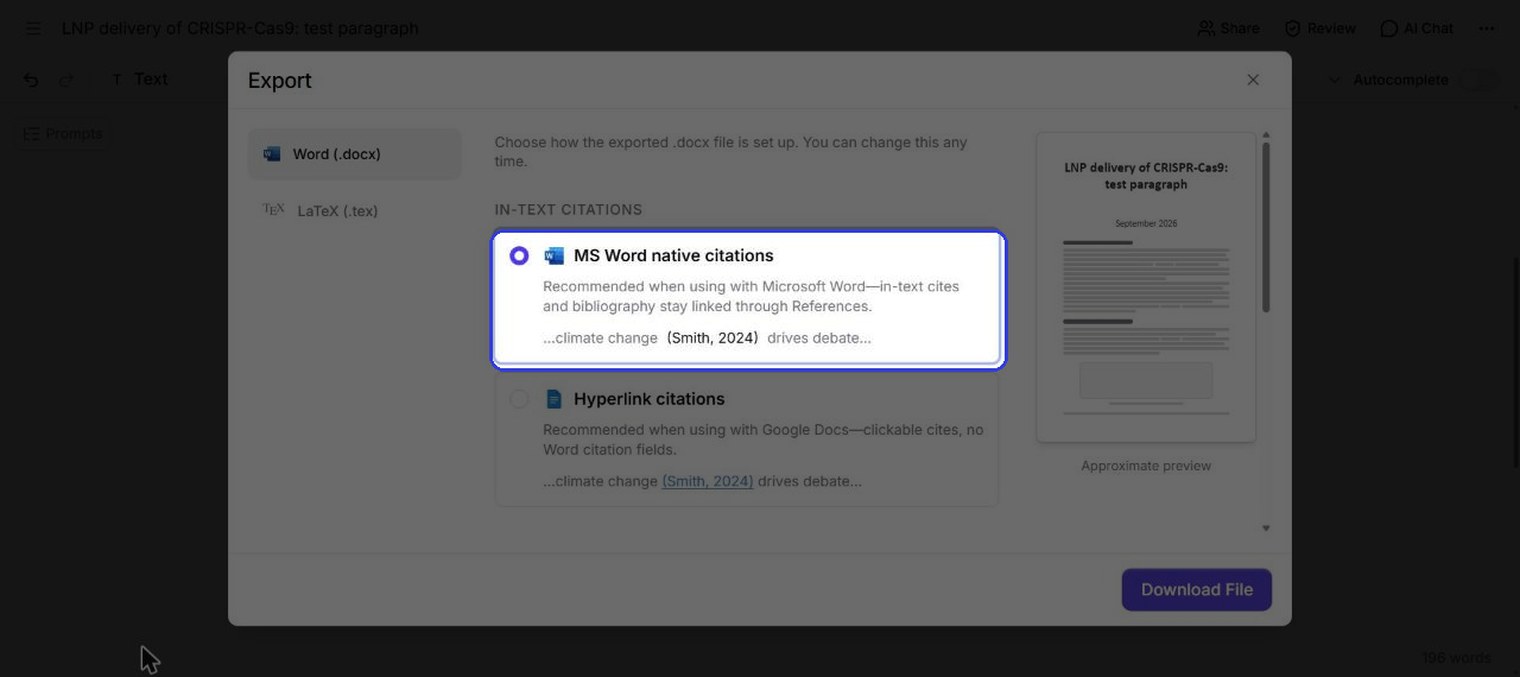
The Export dialog: Word or LaTeX on the left, and the boxed choice between native Word citations and hyperlink citations. There is no PDF option.
Below that sit four layout presets, Advanced options, and an approximate page preview with Download File under it. What is missing is PDF, and the docs note that the free plan leaves the bibliography out of the file.
Claude - the prompt: "Give me the corrected paragraph with the in-text citation and the reference list as a Word document I can download." It read a file, searched, ran two commands and produced a file card about seventy-five seconds later: Lnp paragraph revised, Document, DOCX.
A preview opened beside the chat: Times New Roman, double spaced, hanging indents, three pages. The reference page carried seven entries, and the anti-PEG paper was credited to Omata there, correctly, after the chat had got the name wrong.
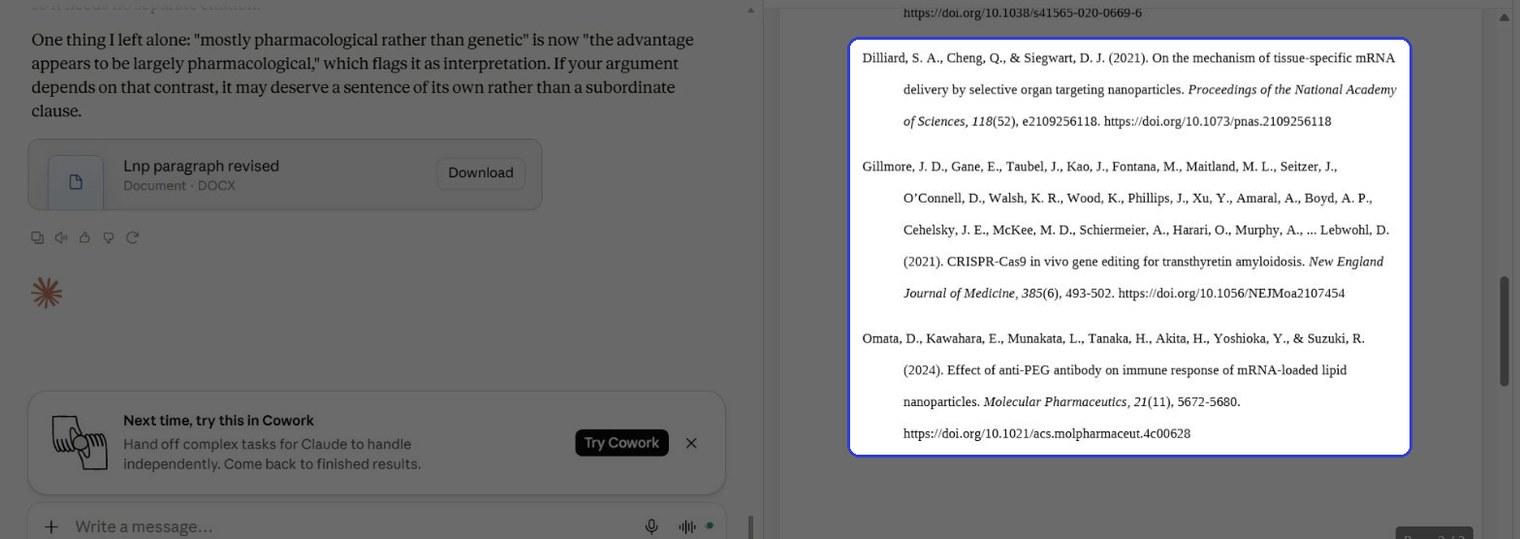
The document preview beside the chat, with the reference page boxed. The Omata et al. entry is the one the chat answer had credited to a different first author.
Its own list of what had changed ran to five items, and only the first was the sentence from the opening task:
The clunky sentence, rewritten and widened to absorb the repeat-dosing point.
The triple hedge gone, and extrahepatic targeting restated as established but not shown in humans.
The mechanism tightened, so the apolipoprotein E sentence now names ionizable formulations and the LDL receptor.
The trial result given its day 28 and 0.3 mg per kg detail.
The off-target claim reframed as something the trial was not built to assess.
Winner - Jenni. The export dialog sends out the document that was written, citations still live in Word or LaTeX. Claude's file is a well-made .docx of Claude's paragraph, carrying seven citations nobody placed, and it has to be read against the original before any of it is kept.
<ProTip title="🔗 Next step:" description="Claude previews the .docx beside the chat. Read the reference page in that preview before you download it, because in this test that is where the author name stopped matching the chat" />
Where Jenni is ahead

Four things the test showed here that the chat window did not match:
The list arrives before the question - cards drawn from the sentence at the cursor, the NEJM trial among them, search box still empty. Claude found the same paper after two searches, once asked.
One click files two things - the in-text citation and the formatted APA entry with its DOI, both inside the document.
Accept means filed - the source that survived the review went into the reference list with the counter moving to 2.
The exported file is your file - Word with live citation fields or LaTeX, in the layout you picked. The .docx from the other side is a rewrite with citations you did not choose.
Where Claude is ahead
Four things Claude did that the other side did not, checked on the day:
It reads the paper, not the record - day 28, the 0.3 mg per kg group, a spread of 80 to 96 percent across three patients, and the 26-author ellipsis rule.
It says when it cannot source something - one claim left deliberately unsourced, with the trial limitations section offered instead. Claim confidence proposed a paper for all three sentences it flagged, and two were refused.
Six DOIs, six real papers - every one resolved to the paper it named, with a single first author wrong in the chat and right in the document it built afterwards.
It explains itself - five numbered reasons for one sentence, an unprompted flag on the next, and a diagnosis of how the paragraph is built. The note on the other side is two lines.
What each tool costs
Both pricing pages were read on 16 September 2026. Claude lists Sonnet and Haiku on the free plan and Opus from Pro upwards, so the model this test ran is a paid one.
Plan | Jenni | Claude |
Free | $0. Unlimited citations, 10 autocompletes a day, 3 AI edits, 5 AI chat messages, 3 reviews, 10 PDF uploads, body-only export | $0. Chat, web search, memory, artifacts, file creation and extended thinking, on Sonnet and Haiku |
Second tier | Plus, $30 monthly or $12 a month billed yearly ($144): 5,000 autocompletes a month, unlimited PDF uploads, 500 AI edits, 500 chat messages, 10 reviews a month, full export | Pro, $20 monthly or $17 a month billed yearly ($200 up front): more usage, Opus, Claude Code, Cowork, projects, Research, Microsoft 365 |
Third tier | Pro, $73 monthly or $29 a month billed yearly ($348): unlimited autocomplete, uploads, edits, chat and reviews, priority support | Max 5x, $100 a month, monthly only: five times the Pro usage |
Fourth tier | None | Max 20x, $200 a month, monthly only: twenty times the Pro usage |
Yearly billing | Plus $144, Pro $348 | Pro only, at $200 up front. Max is monthly |
September 2026 pricing, read on 16 September from jenni.ai/pricing and claude.com/pricing.
The Max tiers are described on the Max plan help page, and the context window is the same on every plan. The money buys different things on each side: writing volume here, usage and reach there.
<ProTip title="⏳ Timing:" description="Ask Claude for the document last. The .docx it built carried the references from the argument check, with the author name the chat had got wrong now corrected, so running the jobs in another order changes what the file contains" />
Using both
These two do not compete for the same hour. The draft gets written in Jenni, with the sources attached on the way through, because that is the part a chat window cannot do at all.
The finished paragraph then goes to Claude for the read-through, and whatever comes back gets typed in by hand. Nothing from a chat goes near a reference list until its DOI has been opened.
<CTA title="Put the next source straight into the paper" description="Cite from the editor, run a review that files what you accept, then export to Word with the citations still linked" buttonLabel="Start Writing Free" link="https://app.jenni.ai/register" />
Claude gave the paragraph the hardest read of the day, and was honest about the one claim it could not stand behind. Every word of that reading stayed on its own side of the screen.
The other session was quieter. The trial was on the list before the search began, the citation and the reference went in together, the accepted source was filed with a click, and the export dialog was ready to send the document out with its citations live.
Write where the sources are. Send the finished thing to the chat window afterwards, and carry its notes back yourself.